CHICAGO (AP) — Caleb Williams has been the most important player for the Chicago Bears since he was selected with the No. 1 pick in the 2024 NFL draft.
Sunday was just another example of that.
Returning from a right hamstring injury, Williams led the Bears to a 31-23 win at Atlanta. The third-year quarterback was 30 of 36 for 305 yards and a touchdown.
“I think he just did a good job of taking what the defense gave,” offensive coordinator Press Taylor said Monday. “It didn’t feel like there were forces. ... You’ve watched him mature and grow in the system and he was seeing things well the other night and it just came together pretty well for him in terms of putting the ball in play and putting the ball where our guys were able to do something with it.”
It was Williams' first action since he left in the fourth quarter of a 9-3 loss to Minnesota on Sept. 20. Case Keenum led Chicago to a 27-7 victory over Philadelphia and Tyson Bagent helped the Bears to a 23-12 win against the New York Jets in the team's first two games after Williams got hurt.
But Bagent and Keenum both struggled in last weekend's 31-7 loss at Green Bay, setting the stage for Williams' return against the Falcons.
“I felt confident from the jump,” Williams said. “Let it rip ... let these guys go make plays for us. Get first downs, touchdowns, all that.”
He sure looked confident.
Williams completed his first 12 passes. According to Next Gen Stats, he was 24 of 24 for 248 yards from a clean pocket. He has completed 72.5% of his passes in three games this season after that number was 58.1% last year.
“To come back and to be on point, to be on rhythm, to be as accurate as he was in his first outing in a while, credit to him,” Taylor said, “credit to the skill guys to be able to get open, be available, be on time, and really be where they’re supposed to be when they are supposed to be there for him.”
Williams' return seemed to help Colston Loveland, who had six receptions for 65 yards and a TD in his best game of the season. The tight end had 13 catches for 110 yards over the first five games.
Special teams made two huge plays in Sunday's win. Josh Blackwell recovered a muffed punt by Zachariah Branch at the Atlanta 10 late in the first half, resulting in D’Andre Swift's 2-yard TD run. Nick McCloud recovered Branch's fumble on a kickoff in the third quarter, leading to Cairo Santos' 50-yard field goal.
Penalties were an issue once again. The Bears were flagged 12 times for a season-high 133 yards, compared to four for 31 yards by the Falcons.
“We had way too many penalties,” Taylor said. “That’s not something we want to live with.”
The Bears were penalized 20 times for 115 yards in their first two games, but they had been better of late. They were flagged three times for 20 yards in the loss at Green Bay.
Kyler Gordon had three sacks and two forced fumbles in his season debut. His late strip-sack on Michael Penix Jr. helped Chicago close out the win.
Gordon opened this season on the physically unable to perform list because of a calf injury. He became the first defensive back to record three sacks in a game for the Bears since Todd Bell on Oct. 2, 1983, against Denver.
“It was exciting to see because I think he did some things that we’ve always felt like that he could do for us,” defensive coordinator Dennis Allen said. “And so, I’ve always thought that there was a way that we could utilize him that he could really help us win games, and he was big in the game this week.”
Rome Odunze had another quiet performance, finishing with three receptions for 39 yards. The third-year wide receiver had just one catch in the second half.
The 24-year-old Odunze has 20 receptions for 312 yards in six games this season. He is looking for his first touchdown after catching six TD passes in 12 games last year.
The Bears didn't provide any substantive injury updates on Monday. Right guard Jonah Jackson left Sunday's win with a hip injury, and his status is particularly noteworthy in the short week before Thursday's game against New England.
13 — The Bears have 13 rushing touchdowns, including three against the Falcons. That is their highest total over the first six games of a season since they also had 13 in 1989.
The Bears play consecutive primetime games against last season's Super Bowl participants, beginning with the matchup with the Patriots at Soldier Field. They visit Seattle on Nov. 2.
See AP’s full NFL coverage here

Chicago Bears quarterback Caleb Williams, right, hugs Atlanta Falcons cornerback Billy Bowman Jr. (33) after the Bears beat the Falcons in an NFL football game in Atlanta, Sunday, Oct. 18, 2026. (AP Photo/Mike Stewart)

Chicago Bears quarterback Caleb Williams (18) scrambles as he is pressured by Atlanta Falcons defensive ends Cameron Thomas (99) and Zach Harrison (96) during the first half of an NFL football game in Atlanta, Sunday, Oct. 18, 2026. (AP Photo/Brynn Anderson)

Chicago Bears quarterback Caleb Williams passes against the Atlanta Falcons during the first half of an NFL football game in Atlanta, Sunday, Oct. 18, 2026. (AP Photo/Brynn Anderson)
A Japanese spacecraft rocketed toward Mars on Tuesday on an unprecedented quest to explore its mysterious moons and bring back samples.
Five of the world’s space agencies joined forces for the five-year mission that will attempt to land a robotic prospector plus a rover on Phobos, the larger and closer of Mars’ two pint-sized moons.
The Japan Aerospace Exploration Agency, which is leading the bold sampling effort, launched the spacecraft before dawn from the country's main spaceport on Tanegashima Island. Officials declared success an hour later when the spacecraft separated as planned from the rocket's upper stage. Flight controllers burst into applause and jumped to their feet, shaking hands and embracing.
While NASA has successfully landed nine spacecraft on Mars over the past 50 years and China scored a 2021 touchdown, no one has ever ventured onto Phobos or its sidekick Deimos. And no one has managed to fetch samples from Mars, let alone its moons.
If successful, bits of dust, soil and rocks from Phobos will arrive on Earth in 2031.
“There’s a lot of adrenaline and a lot of excitement and a lot of wow,” said NASA astrophysicist Tom Statler, who’s involved with the project.
Japan has an edge going in, with two asteroid sample returns already under its cosmic belt.
Phobos is a lumpy, potato-shaped rock just 14 miles (22 kilometers) or so across. Examining pieces of it can explain how Mars’ moons — and possibly moons elsewhere — came to be.
Dubbed MMX for Martian Moons Exploration, the $578 million mission features a hefty 5-ton spacecraft that should reach Mars by late next summer. It will sync up with Phobos’ tight orbit around the red planet, before ejecting the French-German rover that’s named Idefix after the white terrier in the Asterix comics.
No bigger than a microwave oven, Idefix will plop onto Phobos by itself, bouncing for several minutes before coming to a halt in the moon's extraordinarily low gravity.
The four-wheeled rover is designed to right itself if it lands upside down. All bets are off, though, if it sinks into soft soil or gets wedged between rocks, said the French Space Agency’s Julien Baroukh. Once the rover’s solar panels are deployed, the vehicle can no longer right itself, he added, which is why it will move at a glacial 1 millimeter per second (0.04 inches per second).
Idefix will serve as a “scout for safety,” according to Baroukh, as it prowls around Phobos for 100 days. Japanese flight controllers want to avoid powdery soil and rough terrain when the mothership — a four-legged stationary lander — descends to the surface to gather samples in late 2028 or 2029.
The lander will spend just two hours on Phobos, drilling and vacuuming up at least one-third of an ounce (10 grams) of material, before launching back into space. It will study Deimos during a series of flybys before leaving the Martian neighborhood in 2030 and hustling back to Earth for a 2031 sample delivery in the Australian desert.
It’s a treacherous undertaking, with wreckage littering the path.
The moons’ names aren’t exactly comforting: Phobos is Greek for fear and Deimos means dread. They’re the twin sons of the god of war Ares — Mars in Roman mythology.
Russia stumbled in all three of its Phobos attempts as well as many other Mars endeavors. In its only other Mars mission, Japan failed to get a spacecraft into orbit around the red planet. Even NASA has had its share of flops in a bid to answer the burning question: Did life ever exist on Mars?
By studying Mars’ moons, scientists hope to learn whether Phobos and Deimos formed in the aftermath of an ancient collision between Mars and a battering space rock. It’s also possible that the moons might be stray asteroids that became ensnared in Mars’ gravity.
Either way, scientists anticipate finding traces of Mars on Phobos, making the samples an irresistible two-for-one that should help demystify planetary and moon formation, and perhaps even the recipe for life. The findings will help shape future Mars missions, including those by astronauts, said NASA’s acting planetary science director Lindsay Hays.
“It is a once-in-a-lifetime chance. We are part of the first sample return mission from the Martian system,” said the Germany Space Agency's rover chief Markus Grebenstein.
Japan isn’t the only one looking to claim the scientific riches packed into the Martian system’s rocks and dirt. China plans to launch a sample return mission to Mars in 2028, while NASA is still debating how to retrieve the more than 30 sample tubes collected by the Perseverance Mars rover, the new champion for off-Earth driving.
Japan and China could be neck-and-neck in getting samples back from the Martian system. Both are targeting 2031.
Japan is investing $350 million in this mission. NASA is contributing $87 million, the French Space Agency about $68 million, the German Space Agency about $56 million and the European Space Agency some $17 million.
The Associated Press’ health and science coverage receives financial support from the AP Fund for Journalism and private foundations. AP is solely responsible for all content. Find AP’s standards for working with philanthropies, a list of supporters and funded coverage areas at AP.org
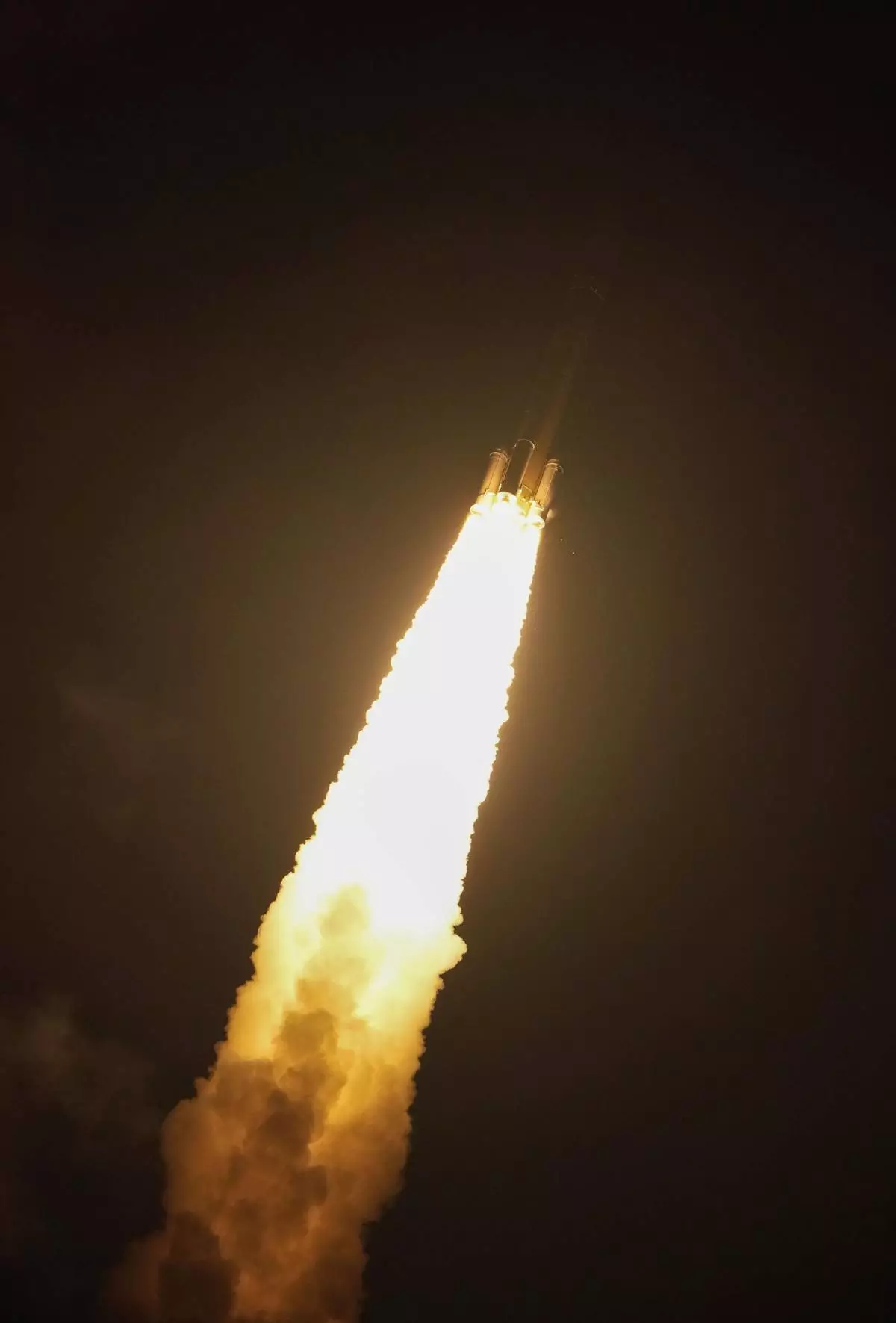
An H3 rocket lifts off from the Tanegashima Space Center in Kagoshima prefecture, southern Japan, Tuesday Oct. 20, 2026. (Naoki Hiraoka/Kyodo News via AP)
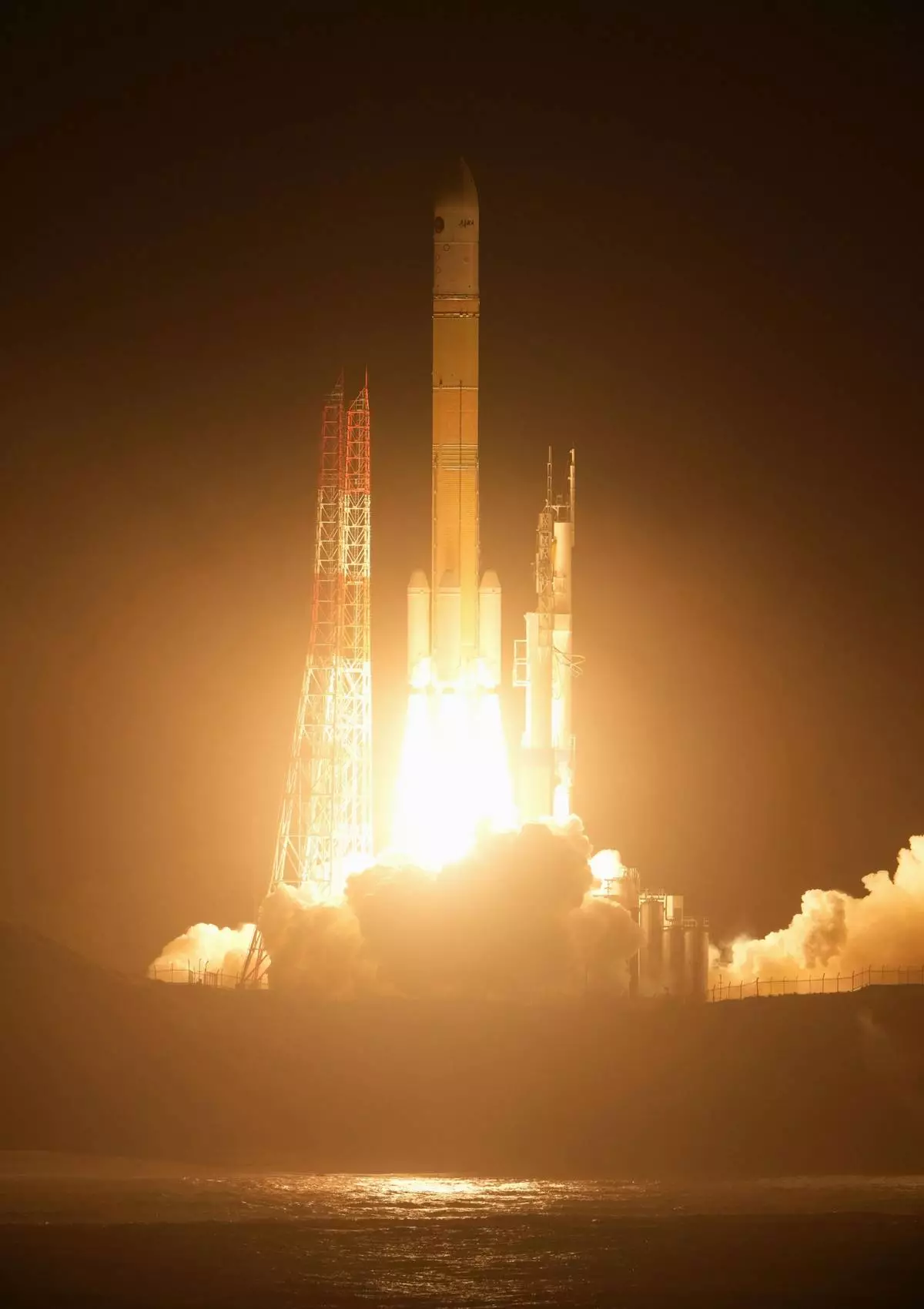
An H3 rocket lifts off from the Tanegashima Space Center in Kagoshima prefecture, southern Japan, Tuesday Oct. 20, 2026. (Naoki Hiraoka/Kyodo News via AP)
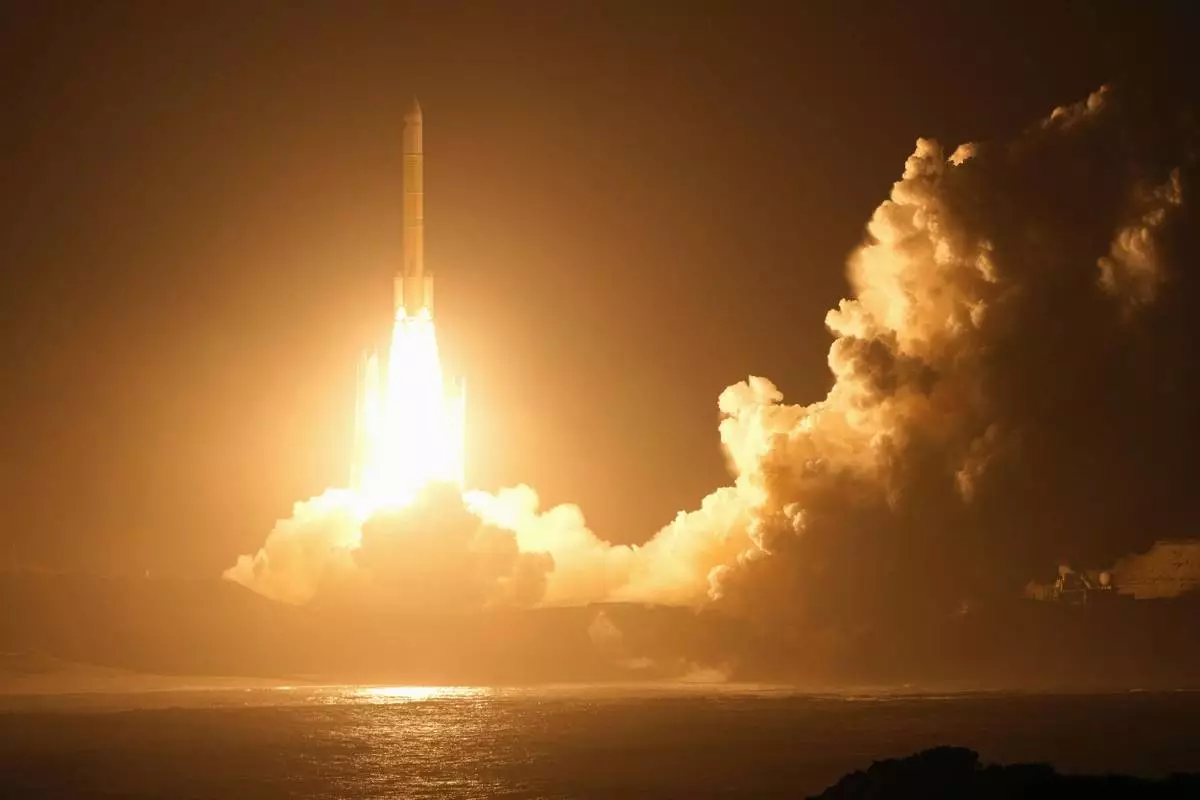
An H3 rocket lifts off from the Tanegashima Space Center in Kagoshima prefecture, southern Japan, Tuesday Oct. 20, 2026. (Naoki Hiraoka/Kyodo News via AP)
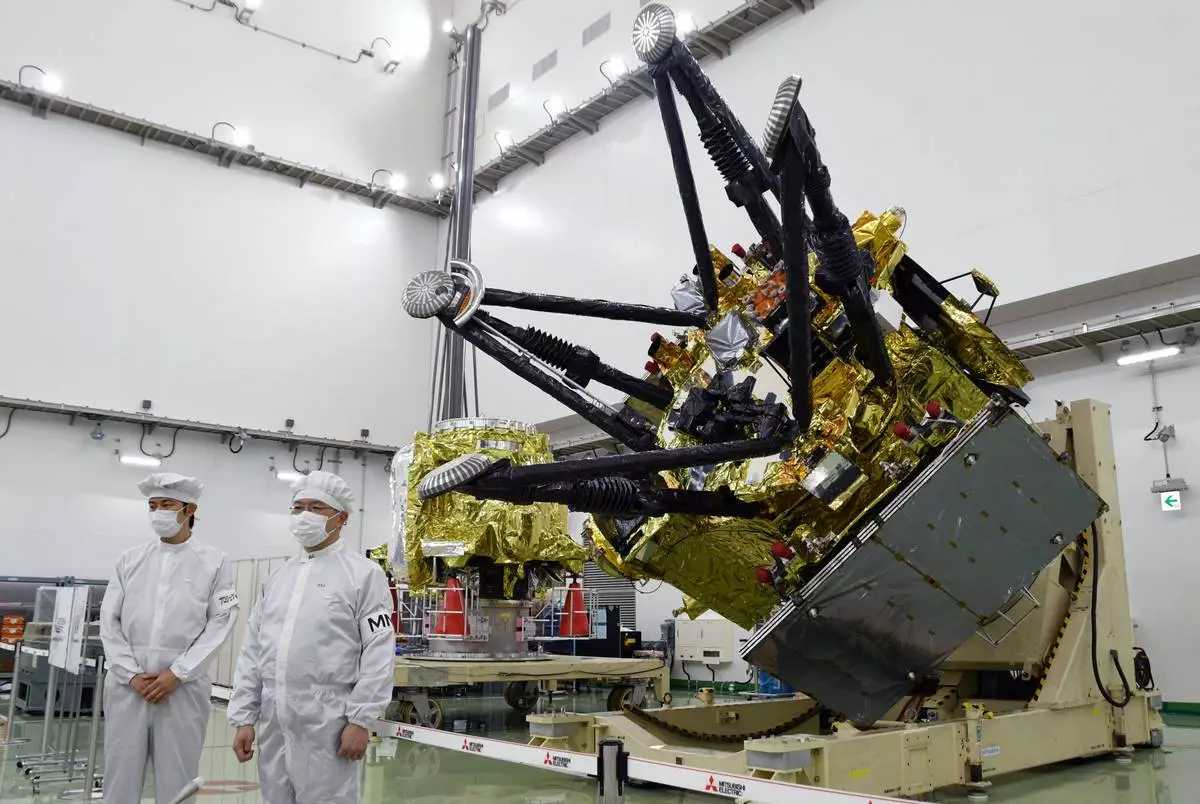
The Japan Aerospace Exploration Agency unveils a spacecraft for its Martian Moons eXploration mission at the Tanegashima Space Center in Minamitane, southwestern Japan, Aug. 13, 2026. (Yuika Kawazoe/Kyodo News via AP)
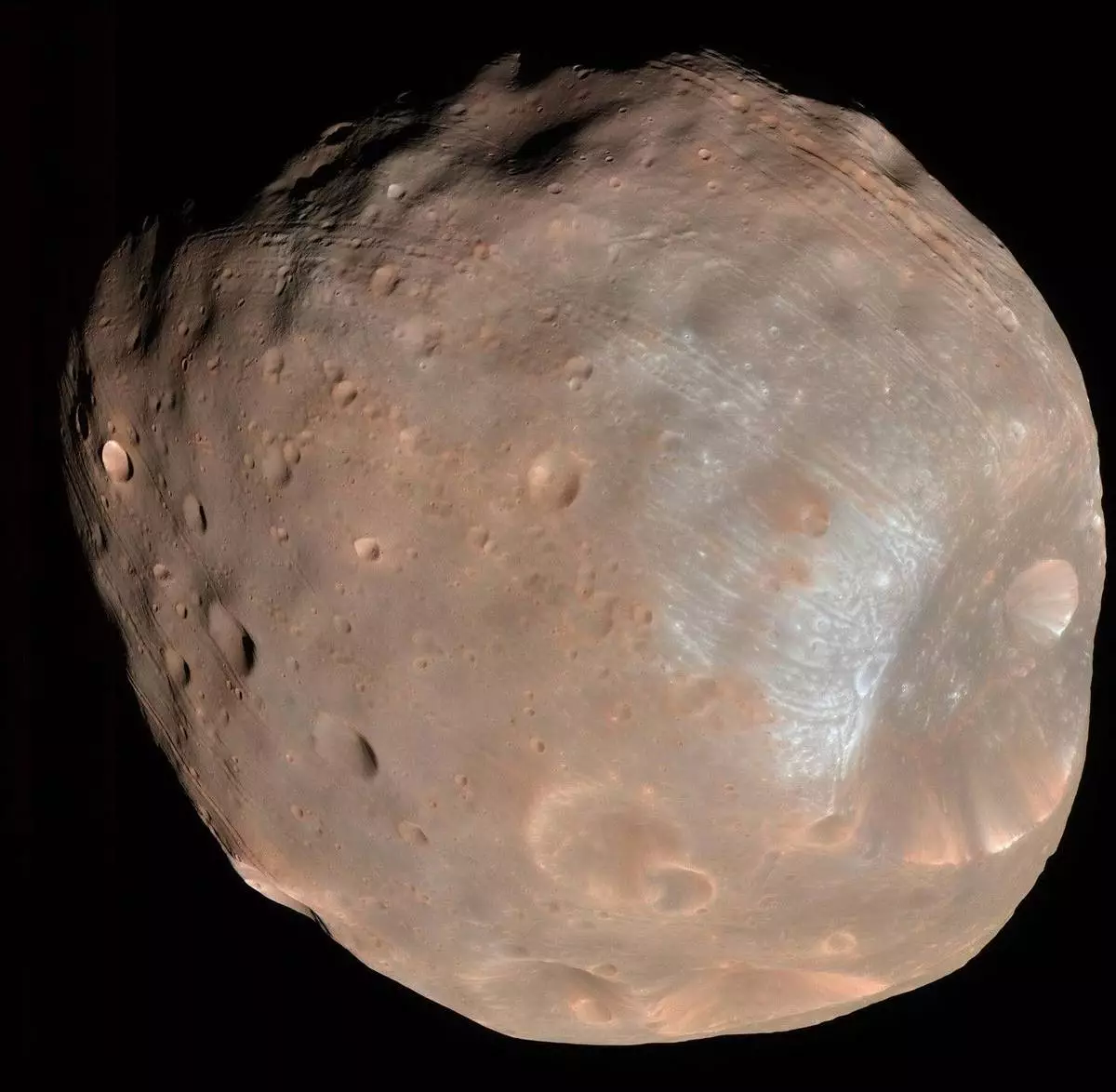
This photo provided by NASA/JPL-Caltech/University of Arizona, taken with NASA's Mars Reconnaissance Orbiter, shows Phobos, one of Mars' moons, on March 23, 2008. (NASA/JPL-Caltech/University of Arizona via AP)