CHARLOTTE, N.C. (AP) — Of the Carolina Panthers' eight wins last season, six were the result of second-half comebacks orchestrated by quarterback Bryce Young.
On Sunday, the Panthers didn't need one.
Click to Gallery
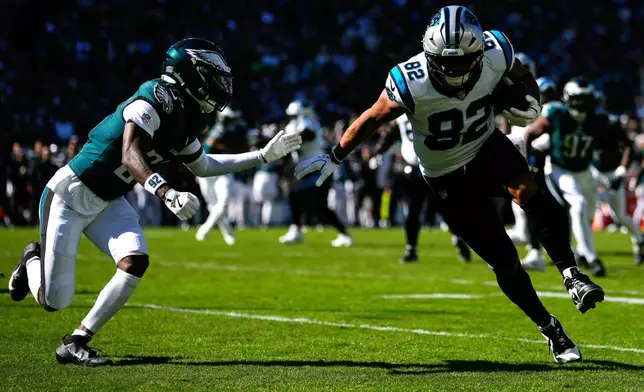
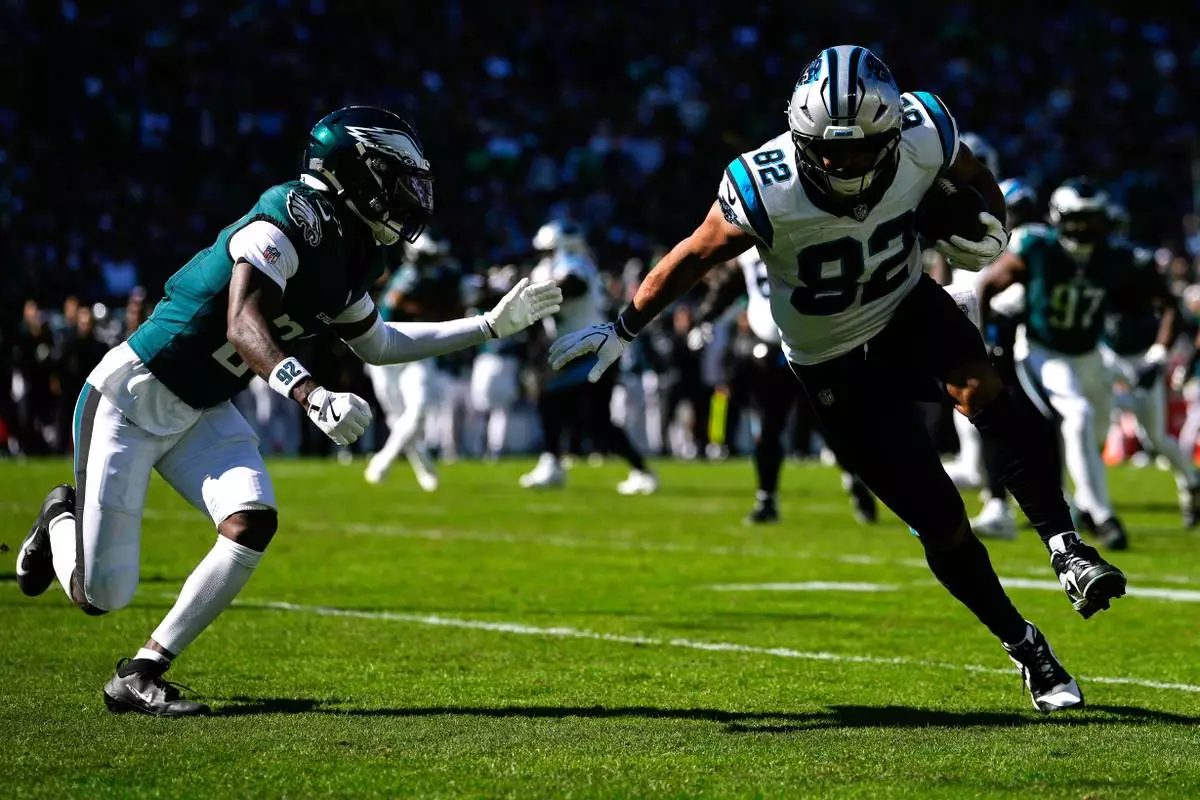
Carolina Panthers tight end Tommy Tremble (82) scores a touchdown as he gets by Philadelphia Eagles cornerback Quinyon Mitchell during the first half of an NFL football game in Philadelphia, Sunday, Oct. 18, 2026. (AP Photo/Matt Slocum)
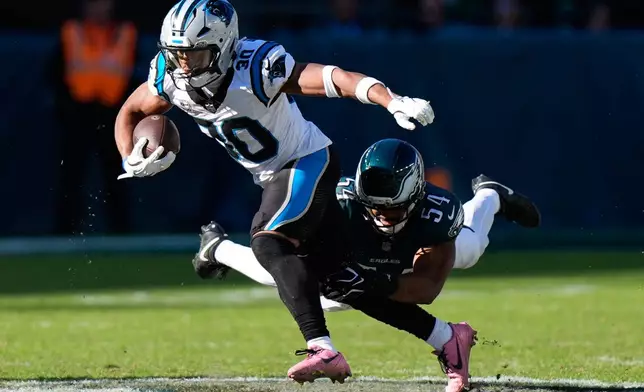
Carolina Panthers running back Chuba Hubbard, left, is tackled by Philadelphia Eagles linebacker Jeremiah Trotter Jr. during the second half of an NFL football game in Philadelphia, Sunday, Oct. 18, 2026. (AP Photo/Chris Szagola)
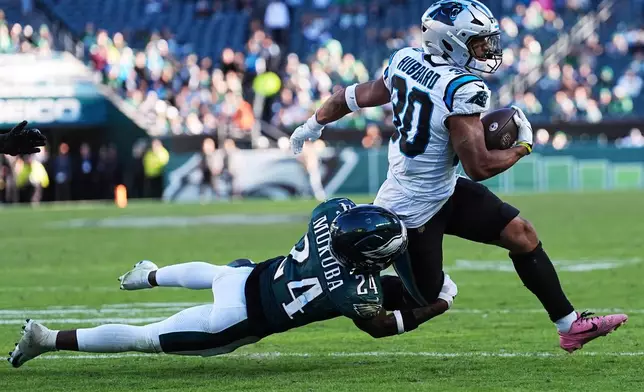
Carolina Panthers running back Chuba Hubbard is brought down by Philadelphia Eagles safety Andrew Mukuba, left, during the second half of an NFL football game in Philadelphia, Sunday, Oct. 18, 2026. (AP Photo/Matt Rourke)
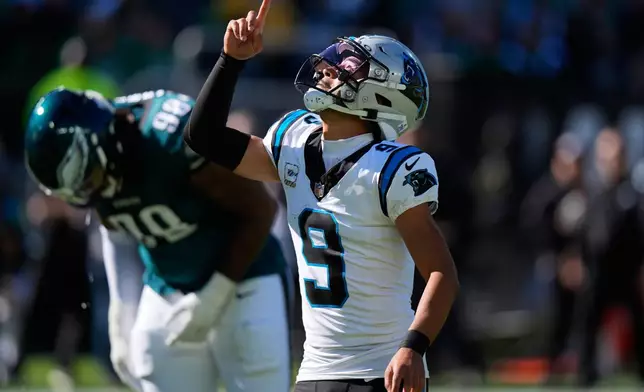
Carolina Panthers quarterback Bryce Young reacts to his touchdown pass to Panthers tight end Tommy Tremble during the first half of an NFL football game against the Philadelphia Eagles in Philadelphia, Sunday, Oct. 18, 2026. (AP Photo/Chris Szagola)
Leading by six late in the third quarter, Carolina put together a 14-play, 92-yard touchdown drive that took nearly eight minutes off the clock and gave them some cushion they needed on the road against the Philadelphia Eagles. The teams would trade touchdowns from there, but the Panthers (3-2) never appeared in danger of losing to an injury-riddled Eagles team and walked away with a 25-14 wire-to-wire victory to remain atop the NFC South.
Outside of falling behind 3-0 early to Detroit, Carolina has maintained control of the lead in all three of its wins this season.
That means they're learning to play with leads, keep them and put opponents away when they need to do so.
And that's the next needed step in progression for a steadily maturing team, which now finds itself with a 1 1/2-game lead in the NFC South as it looks to defend its division title.
While Young's comebacks have been notable and important in the team's growth, the idea of stepping on the gas pedal and burying a team is "absolutely” what coach Dave Canales said the team needs to take things to a different level.
That's why Canales loved the long scoring drive that culminated with a 1-yard scoring run by Chuba Hubbard.
“That's territory that we have to be comfortable with, and to be able to execute those type of drives,” Canales said. “It was the physical nature of the way we finished. That's really just a dream of mine to be able to run with that type of physicality.”
Five weeks into the season, the Panthers are showing no signs of moving to a split backfield.
Despite the return of Trevor Etienne from injured reserve on Sunday, Hubbard continued to gobble up almost all of carries, logging 28 rushes for 120 yards and a touchdown against the Eagles. Etienne got just one carry.
Hubbard struggled through injuries early last season before battling back to regain his starting spot from Rico Dowdle.
This year, it was expected he would split time in the backfield with Jonathon Brooks, the team's 2024 second-round pick from Texas. But the injury-riddled Brooks landed on IR again this season and it's been all Hubbard since.
Hubbard has 426 yards rushing and six total touchdowns — four rushing and two receiving — through five games while averaging 4.8 yards per carry.
“He’s running the ball really well right now,” Canales said of Hubbard. "That should complement the rest of the offense.”
Despite the win, the Panthers have plenty to clean up.
They were penalized 13 times for a franchise-record 149 yards on Sunday. Carolina is averaging nearly 10 penalties for 84 yards per game, putting them in the top 10 in the league in both categories.
Tight end Tommy Tremble reeemerged as a sneaky weapon in the red zone Sunday, catching four passes for 46 yards and two touchdowns against the Eagles.
He punctuated his first TD catch with a viral celebration of him imitating fictional Philadelphia icon Rocky Balboa, pretending to deliver a knockout punch to teammate Jalen Coker in the end zone.
Tremble's role as a pass receiver was expected to take a hit with the arrival of veteran tight end Darren Waller, but he has fought hard to carve out his own niche.
He has 15 catches for 128 yards through five games.
“His toughness first and foremost, his versatility, how much he cares about doing his job, all of those things are exactly what we’re trying to point out offense and our guys toward," Canales said. “He creates that veteran leadership from that standpoint.”
Cornerback Will Lee had some rookie growing pains against the Eagles. The fourth-round draft pick from Texas A&M, who was making his second career start while helping fill the void of starters Jaycee Horn and Mike Jackson who are on injured reserve, was flagged for two defensive pass interference calls resulting in two Eagles first downs and 45 penalty yards. He also surrendered a 19-yard touchdown pass to DeVonta Smith in one-on-one coverage.
Still, Canales remains high on Lee and loves his competitiveness.
The Panthers emerged from Sunday's game fairly healthy with the exception of outside linebacker Thomas Incoom, who left in the second quarter with a calf injury and did not return.
3.6 — The Panthers limited Tanner McKee and the Eagles to 3.6 yards per play. Minus Saquon Barkley, Philadelphia managed just 35 yards and one touchdown on 13 carries. That's a vast improvement from the season opener when the Panthers allowed Chicago to run for 291 yards and six touchdowns.
McKee, starting in place of Jalen Hurts, was limited to 215 yards passing and sacked three times.
The Panthers return home Sunday for a divisional contest against Tampa Bay (1-5). Carolina holds a 26-25 edge in the series, but the Bucs have won five of the last six with former Panthers QB Baker Mayfield — currently sidelined with a thumb injury — at the helm.
See AP’s full NFL coverage here
Carolina Panthers tight end Tommy Tremble (82) scores a touchdown as he gets by Philadelphia Eagles cornerback Quinyon Mitchell during the first half of an NFL football game in Philadelphia, Sunday, Oct. 18, 2026. (AP Photo/Matt Slocum)
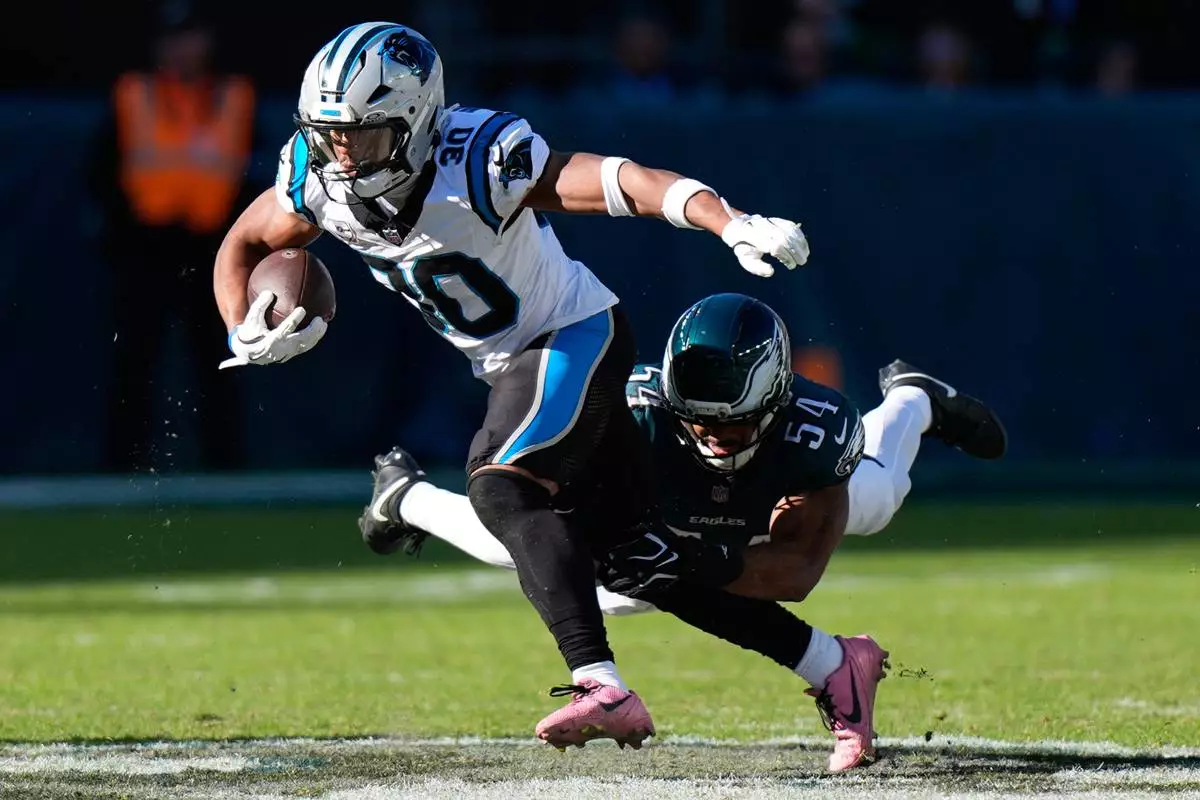
Carolina Panthers running back Chuba Hubbard, left, is tackled by Philadelphia Eagles linebacker Jeremiah Trotter Jr. during the second half of an NFL football game in Philadelphia, Sunday, Oct. 18, 2026. (AP Photo/Chris Szagola)
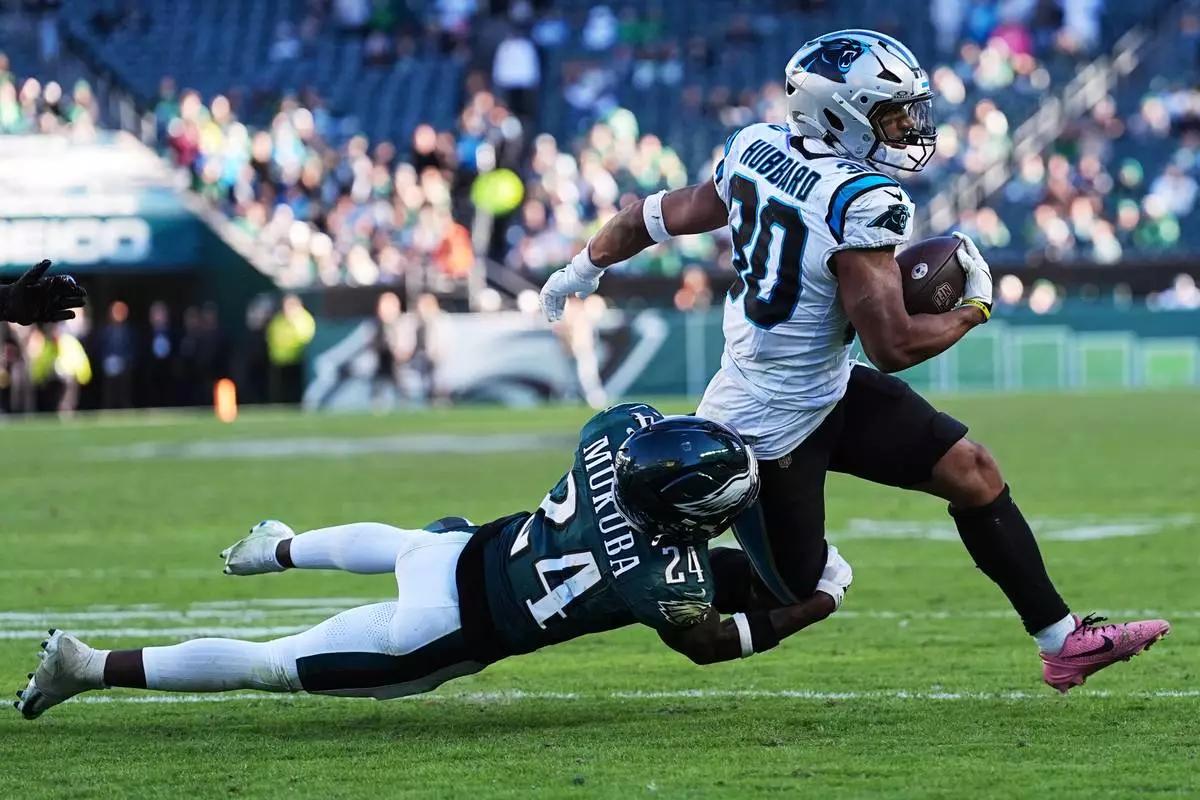
Carolina Panthers running back Chuba Hubbard is brought down by Philadelphia Eagles safety Andrew Mukuba, left, during the second half of an NFL football game in Philadelphia, Sunday, Oct. 18, 2026. (AP Photo/Matt Rourke)
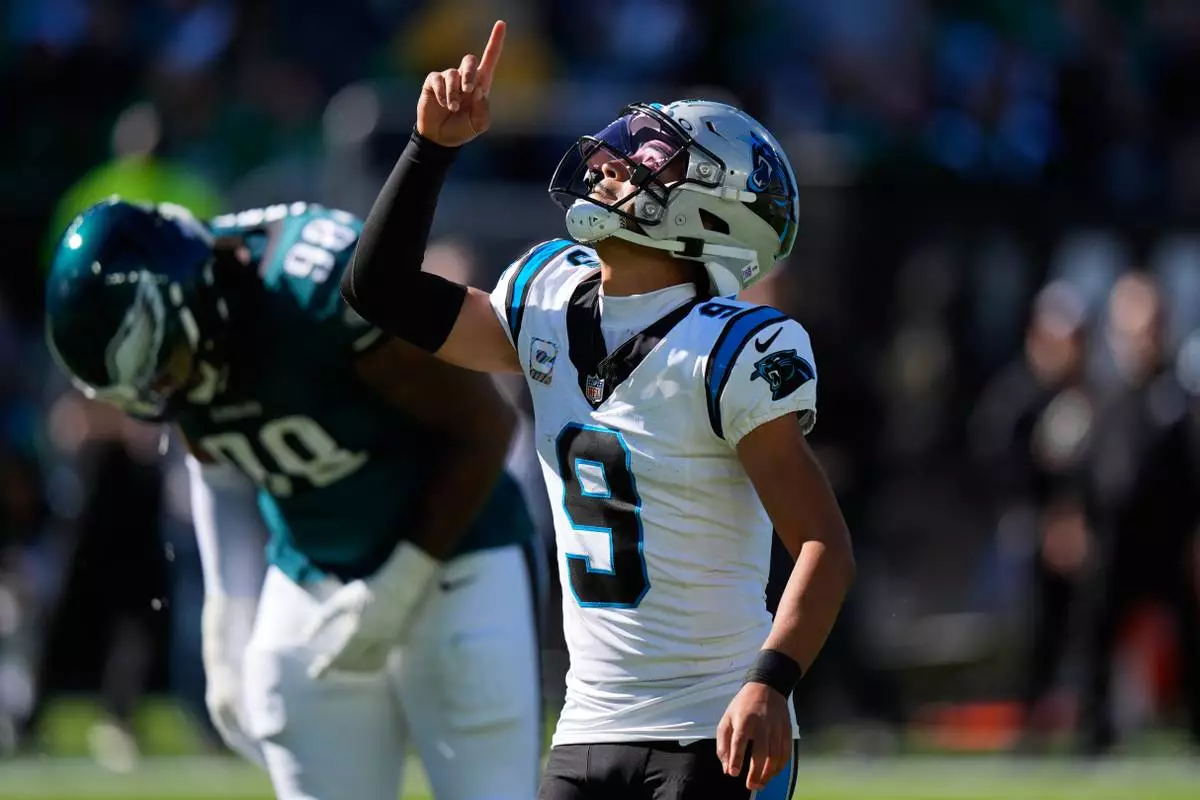
Carolina Panthers quarterback Bryce Young reacts to his touchdown pass to Panthers tight end Tommy Tremble during the first half of an NFL football game against the Philadelphia Eagles in Philadelphia, Sunday, Oct. 18, 2026. (AP Photo/Chris Szagola)