Skip to Content Facebook Feature Image

Cemex Supplies Concrete for Major Los Angeles Metro Expansion

Business

Cemex Supplies Concrete for Major Los Angeles Metro Expansion
Business

Business

Cemex Supplies Concrete for Major Los Angeles Metro Expansion

2026-10-20 05:30 Last Updated At:05:41

MONTERREY, Mexico--(BUSINESS WIRE)--Oct 19, 2026--

Cemex supplied concrete for section 1 of the Los Angeles Metro D Line Extension, a major underground infrastructure project designed to expand transit capacity beneath one of the city’s busiest corridors.

This press release features multimedia. View the full release here: https://www.businesswire.com/news/home/20261019658403/en/

The project extends the existing D Line west from Wilshire/Western to Wilshire/La Cienega, adding three underground stations: Wilshire/La Brea, Wilshire/Fairfax, and Wilshire/La Cienega. Construction is being executed by the Skanska–Traylor–Shea Joint Venture, with Skanska serving as lead contractor. Cemex supplied more than 300,000 cubic yards of concrete for the project and is expected to supply more than 400,000 additional cubic yards across the remaining two phases of the extension.

Building new transit infrastructure beneath a dense urban corridor required precise coordination of tunneling, waterproofing, structural concrete placement, while protecting existing utility infrastructure. Complex ground conditions, including tar sand, high groundwater levels, gassy soils, and nearby earthquake fault zones, required specialized excavation methods and continuous geotechnical monitoring.

“Resilient infrastructure is fundamental to building more connected and livable cities,” said Jesus González, Cemex US President. “Cemex is proud to support the D Line Extension with the essential materials, technical expertise and execution needed for one of Los Angeles’ most complex underground construction projects.”

Cemex concrete supported key structural elements of the underground stations, including vaulted concrete roofs and reinforced concrete side walls up to four feet thick. These elements help create open, column-free passenger platforms while supporting the structural demands of construction beneath the city.

The D Line Extension will add approximately nine miles of new subway service connecting Downtown Los Angeles to the Westside. Section 1 has been completed. According to LA Metro, Sections 2 and 3 are expected to continue development through 2026 and 2027.

Projects such as the D Line Extension show the role of resilient infrastructure in helping large cities move more efficiently. Cemex supports complex urban construction projects through concrete supply, technical coordination, and the logistics expertise to enable construction in dense, high-traffic zones while helping to reduce disruption to communities.

About Cemex

Cemex is a multinational construction materials company focused on building a better future for communities worldwide. The company produces and markets cement, ready-mix concrete, aggregates, and related construction materials such as admixtures and mortars, enabling construction projects across its markets. Through customer-centric solutions, operational excellence, and continuous innovation, Cemex delivers high-performance materials that meet the industry's evolving needs. With a workforce of around 40,000 people worldwide, Cemex provides reliable and high-quality products and services, partnering with its customers to deliver solutions that create long-term value. For more information, visit cemex.com and connect with us on LinkedIn.

Except as the context otherwise may require, references in this press release to “Cemex,” ”we,” ”us,” ”our,” refer to Cemex, S.A.B. de C.V. (“Cemex”) (NYSE: CX; BMV: CEMEX.CPO) and its consolidated subsidiaries. This press release contains forward-looking statements within the meaning of securities laws. We intend these forward-looking statements to be covered by the “safe harbor” provisions for forward-looking statements in securities laws. These forward-looking statements reflect our current expectations and projections about future events based on our knowledge of present facts and circumstances and assumptions about future events, as well as our current plans based on such facts and circumstances, unless otherwise indicated. These statements necessarily involve risks, uncertainties, and assumptions that could cause actual results to differ materially from our expectations, including, among others, risks, uncertainties, assumptions and other important factors discussed in our most recent annual report and detailed from time to time in our other filings with the U.S. Securities and Exchange Commission (“SEC”), the Mexican National Banking and Securities Commission (Comisión Nacional Bancaria y de Valores, the “CNBV”) and the Mexican Stock Exchange (Bolsa Mexicana de Valores, the “BMV”), which factors are incorporated herein by reference, which if materialized could ultimately lead to our expectations and/or expected results not producing the expected benefits and/or results. Forward-looking statements should not be considered guarantees of future performance, and past results or developments are not indicative of results or developments in subsequent periods. These factors may be revised or supplemented, and the information contained in this press release is subject to change without notice, but we are not under, and expressly disclaim, any obligation to update or correct this press release or revise any forward-looking statement contained herein, whether as a result of new information, future events or otherwise, or to reflect the occurrence of anticipated or unanticipated events or circumstances. Any or all of our forward-looking statements may turn out to be inaccurate. Accordingly, undue reliance on forward-looking statements should not be placed, as such forward-looking statements speak only as of the dates on which they are made. The content of this press release is for informational purposes only, and you should not construe any such information or other material as legal, tax, investment, financial, or other advice. We are not responsible for, and expressly disclaim responsibility for, the content of any third-party information included in this press release or in any third-party sources referenced in or accessible through this press release.

Photo courtesy Cemex

Photo courtesy Cemex


Photo courtesy Cemex

Photo courtesy Cemex

A Japanese spacecraft rocketed toward Mars on Tuesday on an unprecedented quest to explore its mysterious moons and bring back samples.

Five of the world’s space agencies joined forces for the five-year mission that will attempt to land a robotic prospector plus a rover on Phobos, the larger and closer of Mars’ two pint-sized moons.

The Japan Aerospace Exploration Agency, which is leading the bold sampling effort, launched the spacecraft before dawn from the country's main spaceport on Tanegashima Island. Officials declared success an hour later when the spacecraft separated as planned from the rocket's upper stage. Flight controllers burst into applause and jumped to their feet, shaking hands and embracing.

While NASA has successfully landed nine spacecraft on Mars over the past 50 years and China scored a 2021 touchdown, no one has ever ventured onto Phobos or its sidekick Deimos. And no one has managed to fetch samples from Mars, let alone its moons.

If successful, bits of dust, soil and rocks from Phobos will arrive on Earth in 2031.

“There’s a lot of adrenaline and a lot of excitement and a lot of wow,” said NASA astrophysicist Tom Statler, who’s involved with the project.

Japan has an edge going in, with two asteroid sample returns already under its cosmic belt.

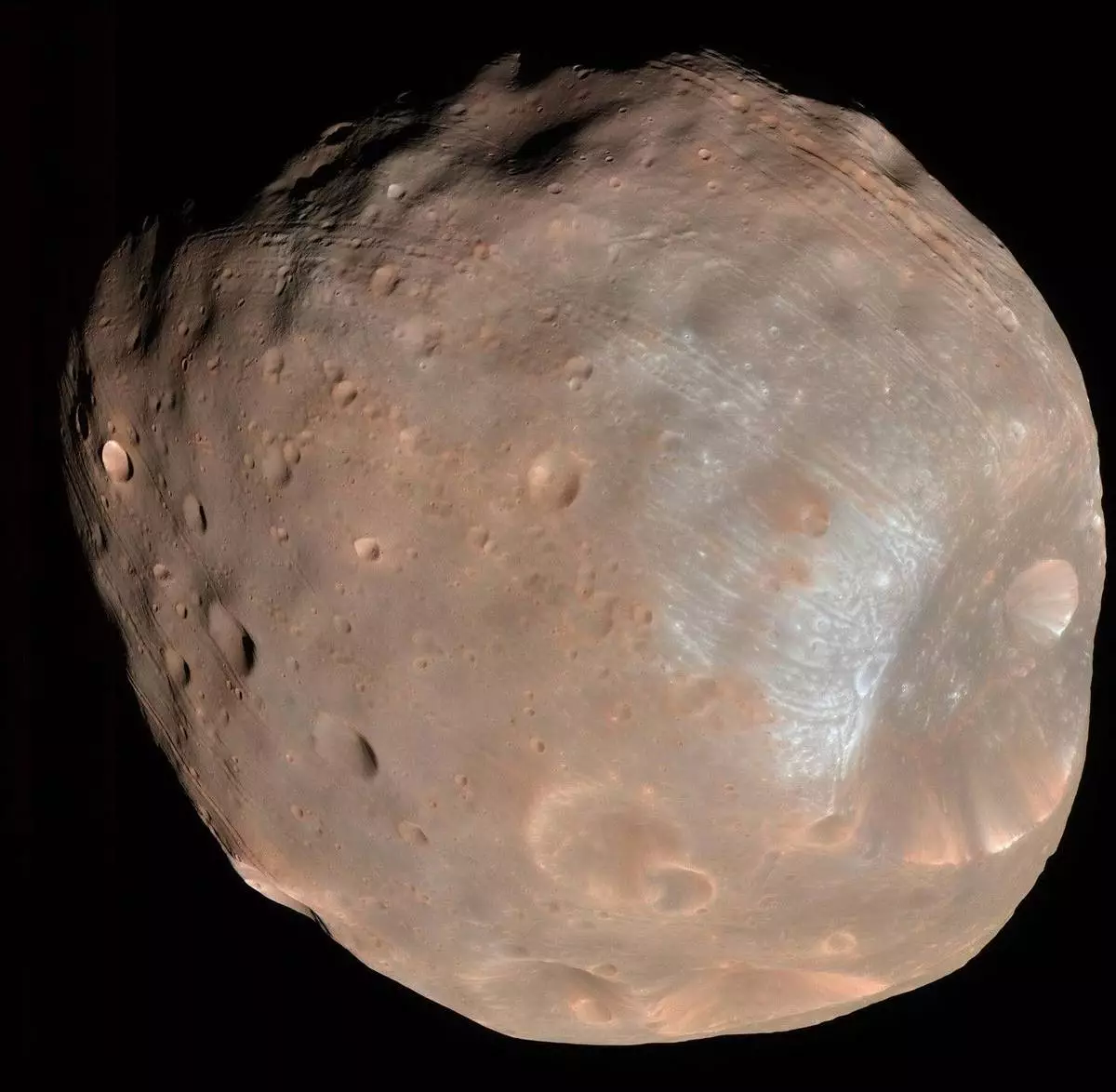
Phobos is a lumpy, potato-shaped rock just 14 miles (22 kilometers) or so across. Examining pieces of it can explain how Mars’ moons — and possibly moons elsewhere — came to be.

Dubbed MMX for Martian Moons Exploration, the $578 million mission features a hefty 5-ton spacecraft that should reach Mars by late next summer. It will sync up with Phobos’ tight orbit around the red planet, before ejecting the French-German rover that’s named Idefix after the white terrier in the Asterix comics.

No bigger than a microwave oven, Idefix will plop onto Phobos by itself, bouncing for several minutes before coming to a halt in the moon's extraordinarily low gravity.

The four-wheeled rover is designed to right itself if it lands upside down. All bets are off, though, if it sinks into soft soil or gets wedged between rocks, said the French Space Agency’s Julien Baroukh. Once the rover’s solar panels are deployed, the vehicle can no longer right itself, he added, which is why it will move at a glacial 1 millimeter per second (0.04 inches per second).

Idefix will serve as a “scout for safety,” according to Baroukh, as it prowls around Phobos for 100 days. Japanese flight controllers want to avoid powdery soil and rough terrain when the mothership — a four-legged stationary lander — descends to the surface to gather samples in late 2028 or 2029.

The lander will spend just two hours on Phobos, drilling and vacuuming up at least one-third of an ounce (10 grams) of material, before launching back into space. It will study Deimos during a series of flybys before leaving the Martian neighborhood in 2030 and hustling back to Earth for a 2031 sample delivery in the Australian desert.

It’s a treacherous undertaking, with wreckage littering the path.

The moons’ names aren’t exactly comforting: Phobos is Greek for fear and Deimos means dread. They’re the twin sons of the god of war Ares — Mars in Roman mythology.

Russia stumbled in all three of its Phobos attempts as well as many other Mars endeavors. In its only other Mars mission, Japan failed to get a spacecraft into orbit around the red planet. Even NASA has had its share of flops in a bid to answer the burning question: Did life ever exist on Mars?

By studying Mars’ moons, scientists hope to learn whether Phobos and Deimos formed in the aftermath of an ancient collision between Mars and a battering space rock. It’s also possible that the moons might be stray asteroids that became ensnared in Mars’ gravity.

Either way, scientists anticipate finding traces of Mars on Phobos, making the samples an irresistible two-for-one that should help demystify planetary and moon formation, and perhaps even the recipe for life. The findings will help shape future Mars missions, including those by astronauts, said NASA’s acting planetary science director Lindsay Hays.

“It is a once-in-a-lifetime chance. We are part of the first sample return mission from the Martian system,” said the Germany Space Agency's rover chief Markus Grebenstein.

Japan isn’t the only one looking to claim the scientific riches packed into the Martian system’s rocks and dirt. China plans to launch a sample return mission to Mars in 2028, while NASA is still debating how to retrieve the more than 30 sample tubes collected by the Perseverance Mars rover, the new champion for off-Earth driving.

Japan and China could be neck-and-neck in getting samples back from the Martian system. Both are targeting 2031.

Japan is investing $350 million in this mission. NASA is contributing $87 million, the French Space Agency about $68 million, the German Space Agency about $56 million and the European Space Agency some $17 million.

The Associated Press’ health and science coverage receives financial support from the AP Fund for Journalism and private foundations. AP is solely responsible for all content. Find AP’s standards for working with philanthropies, a list of supporters and funded coverage areas at AP.org

An H3 rocket lifts off from the Tanegashima Space Center in Kagoshima prefecture, southern Japan, Tuesday Oct. 20, 2026. (Naoki Hiraoka/Kyodo News via AP)

An H3 rocket lifts off from the Tanegashima Space Center in Kagoshima prefecture, southern Japan, Tuesday Oct. 20, 2026. (Naoki Hiraoka/Kyodo News via AP)

An H3 rocket lifts off from the Tanegashima Space Center in Kagoshima prefecture, southern Japan, Tuesday Oct. 20, 2026. (Naoki Hiraoka/Kyodo News via AP)

An H3 rocket lifts off from the Tanegashima Space Center in Kagoshima prefecture, southern Japan, Tuesday Oct. 20, 2026. (Naoki Hiraoka/Kyodo News via AP)

An H3 rocket lifts off from the Tanegashima Space Center in Kagoshima prefecture, southern Japan, Tuesday Oct. 20, 2026. (Naoki Hiraoka/Kyodo News via AP)

An H3 rocket lifts off from the Tanegashima Space Center in Kagoshima prefecture, southern Japan, Tuesday Oct. 20, 2026. (Naoki Hiraoka/Kyodo News via AP)

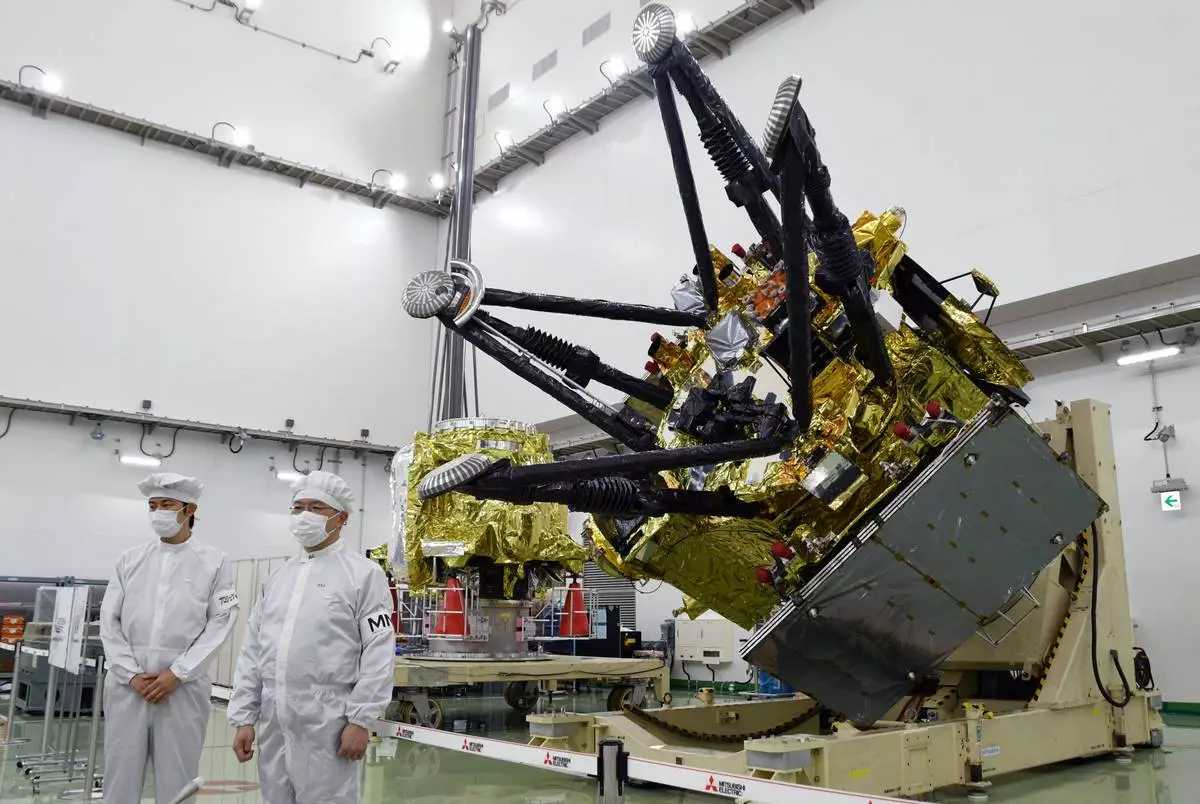
The Japan Aerospace Exploration Agency unveils a spacecraft for its Martian Moons eXploration mission at the Tanegashima Space Center in Minamitane, southwestern Japan, Aug. 13, 2026. (Yuika Kawazoe/Kyodo News via AP)

The Japan Aerospace Exploration Agency unveils a spacecraft for its Martian Moons eXploration mission at the Tanegashima Space Center in Minamitane, southwestern Japan, Aug. 13, 2026. (Yuika Kawazoe/Kyodo News via AP)

This photo provided by NASA/JPL-Caltech/University of Arizona, taken with NASA's Mars Reconnaissance Orbiter, shows Phobos, one of Mars' moons, on March 23, 2008. (NASA/JPL-Caltech/University of Arizona via AP)

This photo provided by NASA/JPL-Caltech/University of Arizona, taken with NASA's Mars Reconnaissance Orbiter, shows Phobos, one of Mars' moons, on March 23, 2008. (NASA/JPL-Caltech/University of Arizona via AP)

Recommended Articles