The 140th China Import and Export Fair, also known as the Canton Fair, has put cutting-edge technology firmly in the spotlight, showcasing how China's manufacturing sector is shifting from mass production to smart, high-value innovation.
The first phase of the Canton Fair concluded its in-person exhibition on Monday, with overseas buyer attendance reaching a record high.
About 189,000 overseas buyers from 214 countries and regions had attended the fair, up 13.3 percent from the same period of the previous session.
For Russian buyer Dmitry Ikonnikov, who first visited the fair in 2006, this year marks exactly two decades of attendance.
"The first time I came was in 2006, so exactly this year is the 20th year. So basically in China now there are a lot of interesting products and they are being generated more and more. So that is why the whole world is coming here to look for something special," he said.
The products on display may look familiar — hammers, power tools and kitchen appliances — but look closer and they are becoming cordless, connected, automated and increasingly intelligent. China's manufacturing story is no longer simply about making more. It is increasingly about making better and becoming smarter.
Johann Anton Klimmer, managing director of the Rothenberger Group based in Germany, highlighted how robotics is transforming traditional trades.
"So you don't need to drill by hand anymore. You don't need to go up the ladder. You take the robot and go up," he said.
Joy Shen, manager of Jiangsu Dongcheng Power Tools Company, demonstrated how artificial intelligence (AI) is being embedded into everyday tools.
"They have been equipped with AI technology, and this one has smart vision that helps position automatically. And it controls exactly where and how deep the drill needs to go," he said.
The numbers tell a compelling story. China's trade in advanced manufacturing and technology products - including industrial robots, electronic components, computer parts and electrical equipment - totaled more than 10 trillion yuan, or about 1.5 trillion U.S. dollars, in the first three quarters of this year, up 58.9 percent year on year.
Look around the fair and it becomes clear that buyers are not simply arriving with shopping lists. They are coming to meet suppliers, to touch the products, and to figure out what they can do with China — not just what they can buy from it.
Brazilian buyer Angely Michelli explained her approach.
"[We are] seeing the product, knowing the supplier, talking with them and going to the factory directly," she said.
Michelli said she had already visited many cities of Guangdong including Dongguan, Shenzhen and Foshan.
Klimmer said his company is producing and developing products together with its factories in China.
"We are constantly producing and developing products together with our factories in China and with our research and development team in Shanghai and with our research and development team in Europe," she said.
This is where China's "Trade Opportunity 2.0" comes in. The first chapter was about becoming the world's factory — building supply chains, making products and sending them around the globe. The next chapter is more two-way: a world market. And the Canton Fair is where the two meet.

Tech innovations take spotlight at Canton Fair

Tech innovations take spotlight at Canton Fair
Ninety years after the Red Army completed the Long March in Yan'an City, northwest China's Shaanxi Province and survived on barren loess through self-reliance, the enduring spirit is thriving in Nangou Village, where two generations of farmers work side by side with elders transforming wasteland into orchards while the young selling apples via livestreaming.
Modern farming has turned remote gullies into flourishing apple gardens, a modern rebirth of the Long March spirit -- resilience, self-reliance and legacy -- captured in every red apple from the Loess Plateau.
"The government paved brick roads, and the Fruit Industry Technical Service Center supplies the saplings. The whole farm was designed for mechanized and smart farming. The trees began to bear fruit in the second year after planting and reach full production in the third. The survival rate is 99 percent. Out of the 1,000 sapling we planted, only four died. The trees we planted last year have already started bearing fruit this year. After this demonstration orchard was established, it has encouraged villagers across the community to follow suit," said Zhao Shengsheng, a fruit farmer from Nangou Village, Ansai District, Yan'an.
Yan'an began systematically experimenting with imported apple varieties as early as 1940. Yet traditional growing methods meant trees took five years to bear fruit and seven years to reach full production, a wait many villagers found too long to bear.
"In terms of cultivation, we use a high-density dwarf planting system. It makes mechanized operations easier, reduces labor and costs, and improves profitability. For soil, fertilizer and water management, we use organic fertilizer and drip irrigation. Ground cover retains moisture and reduces evaporation. We also use drones and apply biopesticide formulations, which help improve operational efficiency. This farm serves as a demonstration base. After proving successful here, the model was promoted county-wide," said Guo Liping, Deputy Director at Fruit Industry Technical Service Center, Ansai District, Yan'an.
Ninety years ago, the Red Army overcame seemingly impossible odds and forged a path through adversity. Today in Nangou Village, modern agriculture is overcoming the limitations of mountainous terrain, turning barren hills into productive orchards and using science and technology to create new opportunities.
Zhao Shengsheng returned home in May 2023 after his startup failed and took over the family orchard.
His father, he explained, knows the techniques but is getting older and no longer has the strength to do the work himself.
Watching short videos of other sellers thriving on online platforms, Zhao wondered why he couldn't do the same, and gradually began embracing online sales.
In a single night he can bring in more than 100 orders; each box of 24 apples sells for 120 yuan (about 18 U.S. dollars) including delivery, earning him a profit of half.
The older generation laid the foundation by planting apple trees, while the younger is opening new markets through livestreaming. This is how the Long March spirit lives on today: through practical efforts to support local communities and a legacy of perseverance passed down from one generation to the next.
"Without the hard struggle and perseverance of the Long March, we wouldn't have the good life we enjoy today," said Zhao.
When the Long March ended in Yan'an, it left a legacy of resilience and renewal. Nine decades later, that spirit is flourishing in the orchards of Nangou Village. The once-barren hills now yield abundant harvests of bright red apples, carrying local people's hard work to markets across China and around the world.
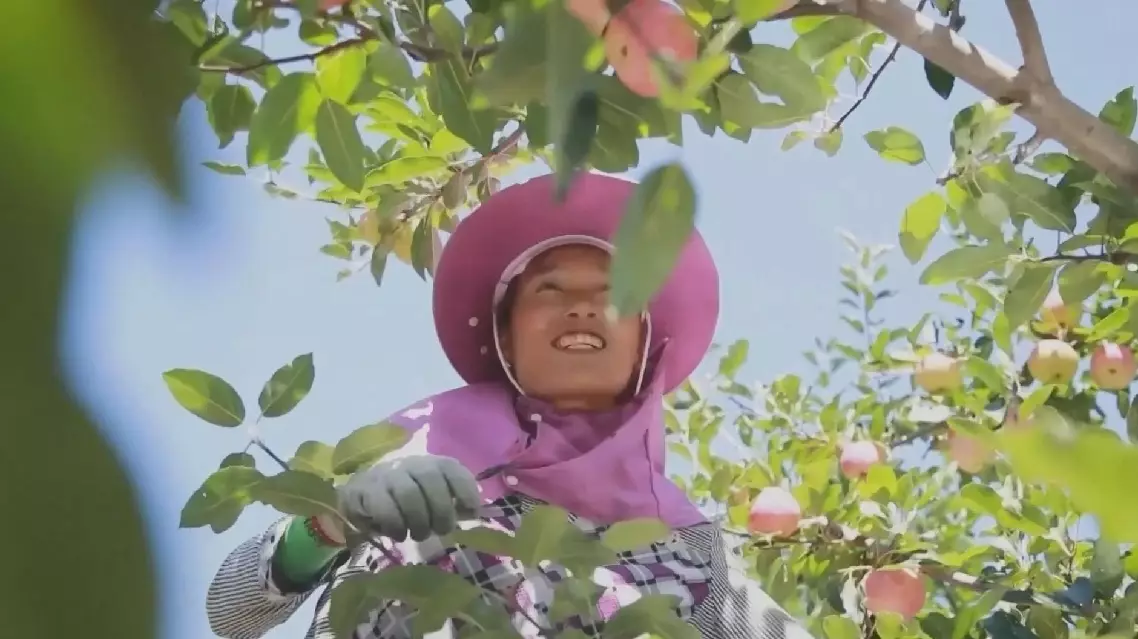
Yan'an's Long March spirit drives modern apple farming, livestream sales