A car crash destroyed Katherine Screws’ small intestine, leaving her unable to eat, dependent on IV nutrition and often too sick to get out of bed. But the Phoenix woman clung to her hospital’s prediction that she could get an intestine transplant in about six months.
That was way off. She wouldn’t get one until three years after the crash.
It could have been longer if not for an unusual meeting with an organ procurement organization, or OPO, that taught the frustrated Screws how hospitals vary in which organs they accept or refuse — and she flew across the country for a better chance.
“I wish that there was more clarity with patients about when is an organ coming up that could be a match for you and why is it not a match,” said Screws, who received a transplant at her new hospital in just weeks. She wishes she had asked sooner, “What is the thing that’s holding this up?”
Screws’ journey shows how the transplant system often struggles to inform patients about options that can be incredibly difficult to navigate on their own. Among them are where to seek care, whether to get on multiple hospitals’ transplant lists, and how to discuss if you’d accept a less-than-perfect organ rather than continue waiting. And in the background, viable organs can be wasted. About 1 in 5 donated organs go unused, usually because a recipient wasn’t found in time.
For kidney transplants, the most common type, a large study found "there’s about a 16-fold variation in how quickly a patient will get transplanted at one center versus another,” said Dr. Syed Ali Husain of NYU Langone Health, who researches such differences.
One reason is that some surgeons have more experience than others using kidneys with complex anatomy like extra arteries, or those from older, sicker donors that still may be better than dialysis for the right patient, he said.
There’s far less information about rare types of transplants like the intestine, which is biologically more difficult to handle than some other organs.
“We offer them but they’re declined so often that it’s demoralizing,” said Lisa Stocks of California’s OneLegacy, one of the nation’s largest OPOs, who showed the data to Screws.
Screws was one of just 88 people in the U.S. to receive a new intestine last year, compared with more than 27,000 kidney transplants.
Whatever the organ, most patients don’t know what to ask, said Dr. Allyson Hart of Minnesota’s Hennepin Healthcare Research Institute. She helped design tools for a new patient-friendly online database that can help people compare waiting times and other characteristics of different transplant hospitals.
Too many patients think “they just needed to wait for five years and they would get transplanted,” Hart said, when often “that’s actually not what happens.”
With just over 49,000 transplants performed in the U.S. last year, more people than ever are getting new organs. That’s mostly thanks to over a decade of increases in donations from the deceased, recovered by OPOs that act as a bridge to transplant hospitals.
But about 100,000 people are awaiting a transplant, the vast majority of whom need a kidney. There’s growing pressure to retrieve and use more donated organs, even as donor registrations recently dipped and an aging population means organs increasingly come from older, sicker donors. And the government is in the midst of a yearslong overhaul of the transplant system.
One pending move threatens to close some of the nation's 55 OPOs under a controversial grading system that holds them accountable for the number of organs they procure and how many are transplanted — the latter, they argue, being out of their control because surgeons decide when an organ is right for their patient. Some, including OneLegacy, are part of lawsuits seeking to block such closures.
Regulators also grade hospitals, and Husain said some of the reluctance to use less-than-perfect organs has long stemmed from concern about getting a lower score if even a few of them fail.
Medicare is running a pilot project to see if financial incentives or penalties will push hospitals to perform more kidney transplants, so fewer of those donated organs go to waste.
In late 2024, OPOs around the country began receiving emotional letters from Screws and some of her family members. They detailed how a May 2022 car crash, a month after her wedding, required the removal of Screws' small intestine, the organ that breaks down food and absorbs nutrients. The self-described “passionate foodie” who loves to cook now got all her nutrition from an overnight IV drip that left her severely nauseous and unable to return to her engineering job or pursue plans with her husband to start a family.
“This accident completely derailed my life and the wait for a new organ has been excruciating,” wrote Screws, adding that her original transplant doctors “feel that it is possible there is a lack of awareness of small bowel transplant among organ procurement organizations.” She asked that the OPOs “confirm your organization’s matching programs are properly searching for and prioritizing small intestine donations.”
To OPOs required to recover as many organs as possible, it was a shocking question. They work closely with grieving relatives of deceased donors but seldom get questions from would-be recipients. Stocks, the OneLegacy nurse, realized OPOs have data that could help patients advocate for themselves, and started combing records.
Every transplant center has its own organ-specific waiting list linked to a nationwide automated matching system. The OPO in charge of each deceased donor enters information about organs deemed suitable for use, which generates lists of possible matches at multiple hospitals in order of priority. A patient who matches baseline biological characteristics still might not show up as a candidate if the surgeon added some additional requirements, such as wanting a donor to be younger than 40.
Transplant teams must quickly decide on an offer, based on lab tests, scans and other medical records. If they decline, the organ then is offered to the hospital with the next-in-line possible match.
“It’s the right donor at the right time. You can never predict these things,” said Dr. Cal Matsumoto at MedStar Georgetown University Hospital in Washington, the second transplant center where Screws registered, and where she wound up getting a new intestine.
Matching begins before surgery to recover the organs, and distance also plays a role, as some organs last longer than others outside the body. Oftentimes, surgeons travel to personally remove certain tricky-to-handle organs rather than relying on a local surgeon to retrieve and ship them.
“Generally if it’s a very good donor, so to speak, there’s going to be a heart team, a lung team, a pancreas team and a liver team, so there’s a lot of coordination” even to schedule recovery, said Matsumoto. For intestines, he said, that also involves surgeons negotiating how they’ll divide critical blood vessels shared by nearby abdominal organs.
But the process is far from perfect: In a study published last year, a group of kidney patients who died on the waiting list had a median of 25 organ offers their transplant team had declined — organs that were eventually used in someone else.
It turned out that Screws' local OPO, OneLegacy, had made nine offers for her during 2024 that were all rejected. Stocks said she had “candid conversations” with the transplant team about why they were declined, such as technical preferences about the retrieval, so she'd know better how to evaluate potential new donors.
Meanwhile, Stocks also showed Screws how to use a database run by the Scientific Registry of Transplant Recipients to decide whether to also seek care at a hospital that does more intestine transplants.
In June 2025, just a few weeks after “double listing,” Screws received a new intestine at Georgetown. It came, she learned, from a donor in Chicago. It was longer than is usually transplanted, but Matsumoto said it wound up fitting fine.
Screws’ original hospital, UCLA Health, cited patient privacy rules in declining to comment except to say that it follows federal transplant guidelines and that its transplant teams “continuously strive to enhance processes in service to our patients.” While its intestine program is small, UCLA is a major provider of kidney and other transplants.
Screws is careful to say her frustration wasn’t with her doctors, but with the lack of centralized, easy-to-understand information about what to expect. She had never heard of OPOs until her transplant coordinator mentioned them or realized there had to be a bridge between donors and transplant surgeons.
“My main takeaway was that there is more subjectivity to selecting an organ than I would have previously thought,” Screws said. Hers was “larger than average and maybe another surgeon wouldn’t have accepted that.”
The Associated Press’ health and science coverage receives financial support from the AP Fund for Journalism and private foundations. AP is solely responsible for all content. Find AP’s standards for working with philanthropies, a list of supporters and funded coverage areas at AP.org.
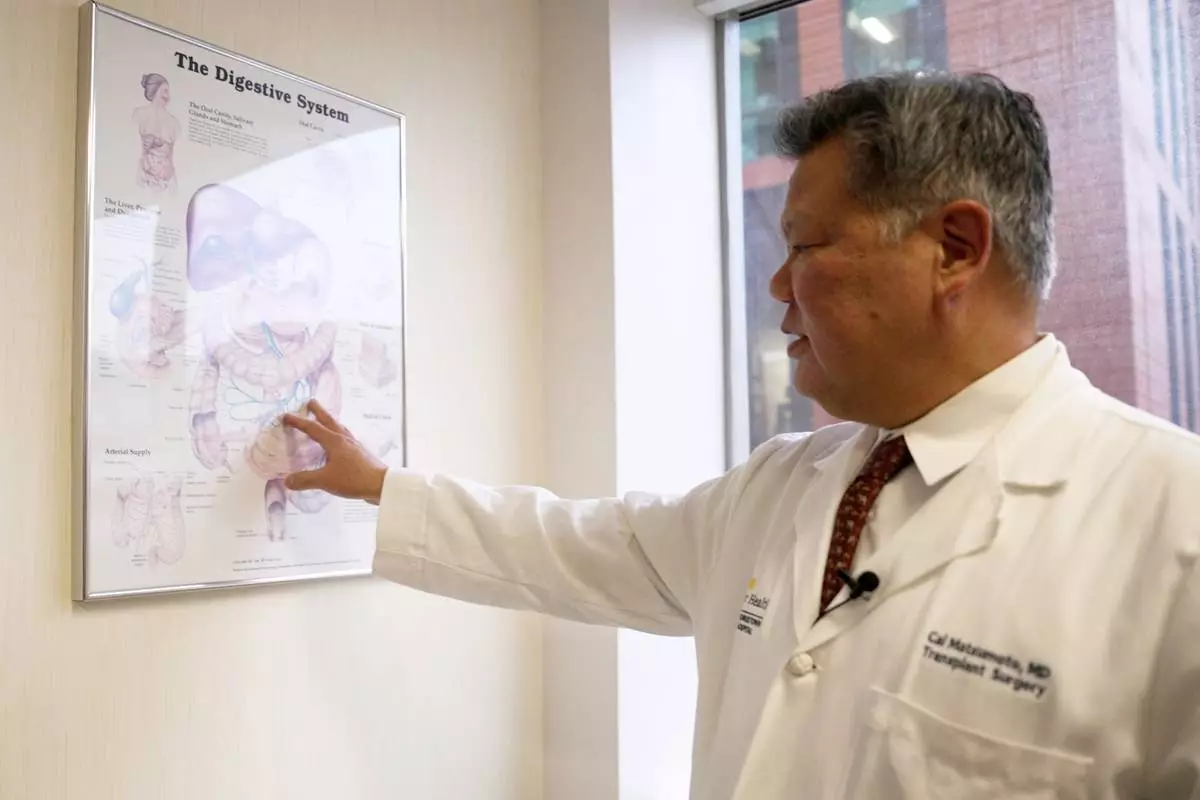
Dr. Cal Matsumoto, a MedStar Georgetown University Hospital transplant surgeon, gestures to a chart on the digestive system on March 4, 2026, in Washington. (AP Photo/Shelby Lum)
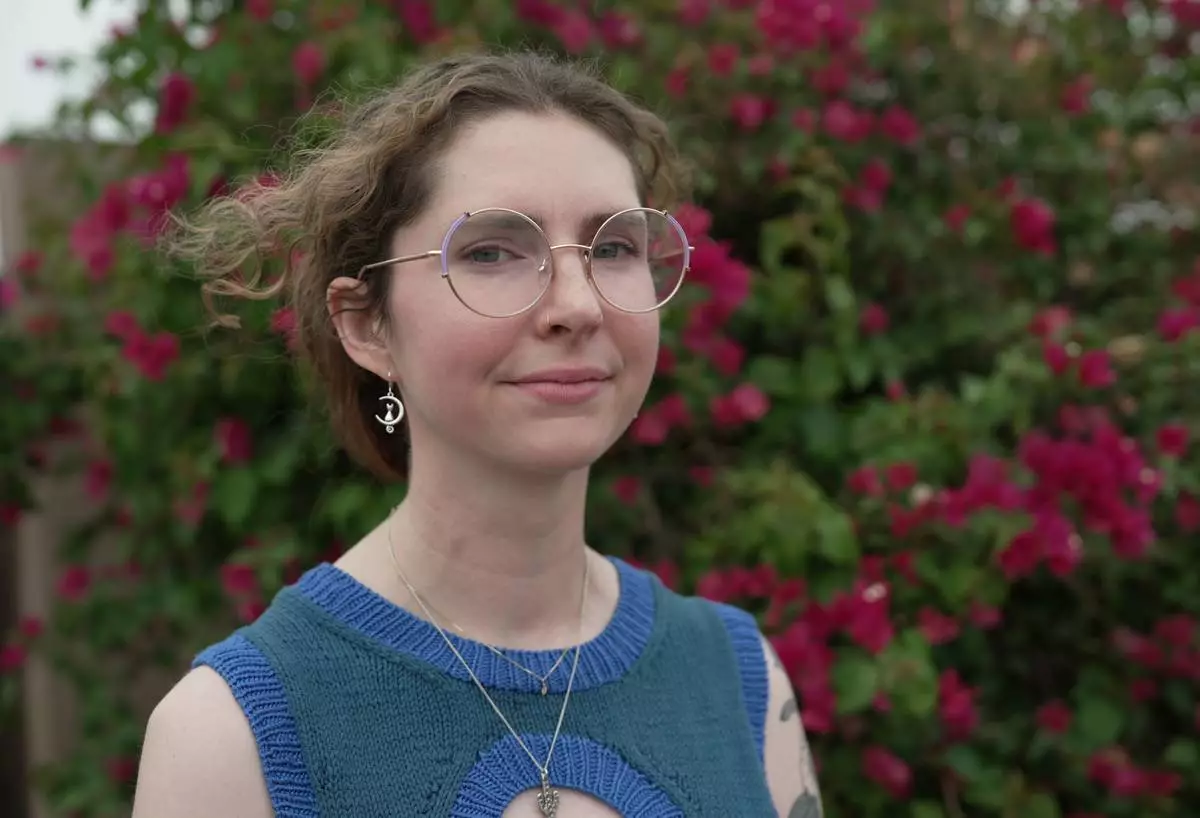
Katherine Screws, an intestine transplant recipient, poses for a photo in Phoenix, Ariz., on April 12, 2026. (AP Photo/Shelby Lum)