Joint study shows emerging markets will generate 60% of new online spending over the next decade — most of it from consumers without a credit card
SINGAPORE – Media OutReach Newswire – 21 October 2026 – Asia is projected to add 702 million middle-class adults between 2026 and 2036, three-quarters of all middle-class growth in emerging markets, according to a new study from World Data Lab (WDL) and EBANX, a global technology company specializing in payment services for emerging markets.
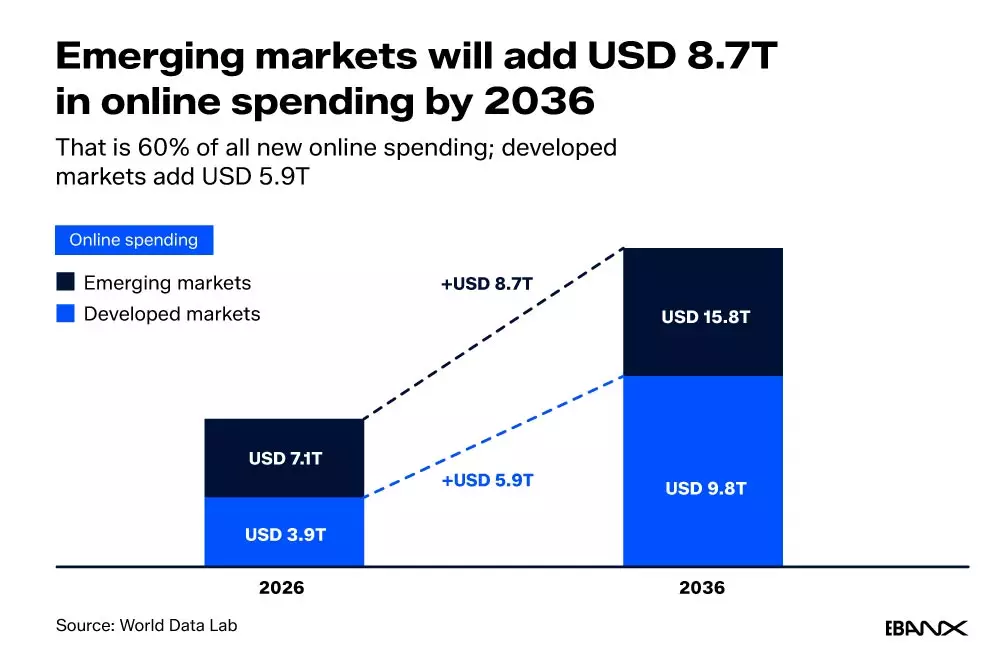
Emerging markets will add USD 8.7T in online spending by 2036
But this new consumer class will not shop the same way developed-market consumers do: by 2036, only 20% of adults in emerging markets will hold a credit card, against 66% in developed markets.
Global online spending is projected to grow from USD 11 trillion in 2026 to USD 25.6 trillion in 2036. Emerging markets add USD 8.7 trillion of that increase (60% of all new online spending), with China (USD +4.7 trillion) and India (USD +1.3 trillion) leading this growth. Indonesia (USD +243 billion), Brazil (USD +249 billion) and Mexico (USD +191 billion) form the next tier.
The categories matter as much as the markets. Online gaming spending in emerging markets grows 14% a year over the decade, the fastest of any category, and SaaS nearly 10%. Emerging markets will generate 76% of global growth in social media spending and 64% in SaaS.
The demographic picture challenges a common assumption. Consumers aged 45 and over account for 51% of emerging markets' online spending growth through 2036, and spending by those aged 65 and over grows 12% a year, faster than any other age group.
The outlook was discussed during "Navigating Payments: How innovation and fragmentation are changing the game for e-commerce," a webinar co-hosted by World Data Lab (WDL) and EBANX.
"Over the next ten years, people aged 45 and over will add USD 4.4 trillion in online spending in emerging markets, half of all the growth. Some of them already shop on their phones and will keep doing so as they get older. Others will buy online for the first time in their fifties or sixties. Merchants who build their checkout only for a 25-year-old will miss both groups," explained Wolfgang Fengler, CEO of WDL.
The study models consumer spending, demographics, and financial access across 184 countries to 2036, drawing on the World Bank's Global Findex and WDL's consumer models, combined with EBANX's experience processing payments for global merchants in emerging markets since 2012.
"If your checkout only takes credit cards, you are competing for one in five adults in emerging markets and conceding the other four", said Marie-Elise Droga, Chief Revenue Officer of EBANX. "The merchants growing fastest with us didn't wait for cards to arrive: they added the payment rails their customers already use, and they're taking new buyers, bigger baskets and recurring revenue that card-only competitors can't even see."
834 million new online buyers, 281 million new credit cards
Between 2026 and 2036, the global economy will add 834 million online buyers but only 281 million credit card holders—a ratio of nearly three to one. In emerging markets, two in three new online buyers (67%) will arrive without a credit card. Adults without it already account for 55% of online spending in emerging markets, a share that rises to 90% in India and 93% in Sub-Saharan Africa. Credit cardless adults also represent 52% to 59% of spending in every digital category, from gaming and SaaS to streaming and travel.
Digital payment use is also running ahead of online shopping. Of the 2.6 billion emerging-market adults spending between USD 6 and USD 25 a day, 70% already pay merchants digitally while only 33% buy online, leaving at least 957 million digitally active consumers who are not yet online buyers. Many hold a bank account or mobile wallet but no card that works at an international checkout.
"This is closely tied to the innovation that came out of the financial industry in emerging markets, which developed solutions for an increasingly mobile economy and for the habits of local consumers. Today, we call them local payment methods, or LPMs, and they allowed e-commerce growth to decouple from the credit card, which still has very low penetration in these countries," said Estelita Hass, head of Market Intelligence at EBANX.
Subscriptions are the next frontier — and India shows why
Recurring categories such as streaming, SaaS and online education will reach USD 2.1 trillion a year in emerging markets by 2036, with USD 1.1 trillion coming from adults without a credit card. In India, 82% of recurring online spending will be cardless. Account-based recurring rails are beginning to close that gap: a global SaaS company saw a 20% uplift in new subscribers after adding UPI at checkout in India, and cybersecurity company Nord Security now generates 28% of its revenue in Brazil through Pix Automático, Brazil's recurring instant payment, six months after launching it with EBANX.
The webinar presentation is available at [LINK].
Hashtag: #EBANX #WorldDataLab #Fintech #Payments #EmergingMarkets #Consumers
The issuer is solely responsible for the content of this announcement.
ABOUT EBANX
EBANX is the leading technology platform connecting global businesses to the world's fastest-growing digital markets. Founded in 2012 in Brazil, EBANX was built with a mission to expand access to international digital commerce. Leveraging proprietary technology, deep market expertise, and robust infrastructure, the platform enables global businesses to offer hundreds of local payment methods and streamline cross-border payments across Latin America, Africa, and Asia. With a global footprint, it established a technology and regulatory headquarters in Singapore in 2026. More than just payments, EBANX drives growth, enhances sales, and delivers seamless purchase experiences for businesses and end users alike.
For further information, please visit:
Website: https://ebanx.com/en/
LinkedIn: https://www.linkedin.com/company/ebanx/
** This press release is distributed by Media OutReach Newswire through automated distribution system, for which the client assumes full responsibility. **
MindFlex Education’s 7-year study of more than 100,000 home tuition arrangements shows what families actually pay, who they hire, and when they look for help
SINGAPORE – Media OutReach Newswire – 21 October 2026 - A single home tutor costs Singapore families a median of S$390 a month. That is according to The Singapore Home Tuition Report 2026–2027, published today by MindFlex Education. The tuition rates climb as children move through school: a home tutor costs S$325 a month at Primary level and S$553 at Junior College, roughly 70% more.
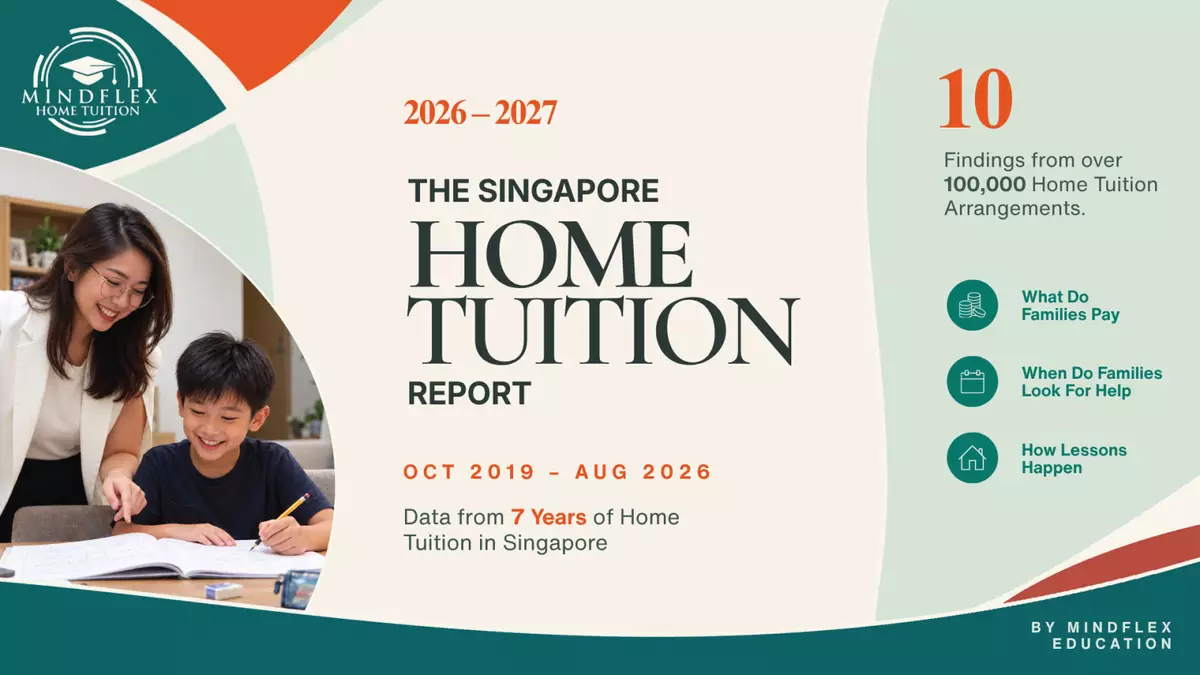
MindFlex Study: 7 Years of Data Reveal How Home Tuition Cost Varies in Singapore
The report draws on more than 100,000 home tuition arrangements made through MindFlex Education between October 2019 and August 2026, and the enquiries behind them. Unlike published rate guides, it is based on confirmed arrangements.
"Home tuition plays an important role in how many Singaporean families support their children aged 4 to 18 through their school years. Yet there has been little hard data on what families actually pay for it. We wanted to put real numbers on the table: the rates families actually agreed with their home tutors, not advertised prices. We hope it helps parents weigh their options with clear figures, whether they're comparing tutors, planning a budget, or deciding when to start," said Benjamin B, Director, MindFlex Education.
A Home Tutor Costs S$390 a Month, and 70% More at Junior College Than at Primary
The median monthly cost of a home tutor:
- Primary: S$325
- Secondary: S$390
- Junior College: S$553
These figures are for one tutor. Families with more than one tutor, or more than one child in tuition, will spend more. At Preschool level, where tuition is less common, a tutor costs a median of S$260 a month.
Higher Rates and Longer Lessons Push the Cost Up
Two forces drive the increase in home tuition fees across the school years.
Hourly rates rise. The median rate goes from S$45 an hour at Lower Primary to S$60 at Upper Secondary, then jumps to S$80 at Junior College.
Lessons get longer. A 1.5-hour lesson is the most common format at every stage, but the share of arrangements with 2-hour lessons rises from 12% at Lower Primary to 19–25% at Secondary and 33% at Junior College.
Families in the Core Central Region Spend 36% More
Where families live is closely tied to what they spend. A home tutor costs a median of:
- S$488 a month in the Core Central Region (CCR)
- S$390 in the Rest of Central Region (RCR)
- S$358 in the Outside Central Region (OCR)
That puts spending in the CCR 36% above the OCR.
The type of tutor families hire also differs:
- At Primary level, 34% of arrangements in the CCR are with an NIE-Trained Teacher. That compares with 24% in the RCR and 19% in the OCR.
- Part-Time Tutors account for 21% of Primary arrangements in the CCR, and 33% in the OCR.
For the same type of tutor, rates are much closer across the island. A Part-Time Tutor for a Primary pupil costs a median of S$35 an hour in all 3 regions, and rates for the same type of tutor differ by S$5 or less.
NIE-Trained Teachers Charge 2 to 2.5 Times the Part-Time Tutor Rate
The report compares 3 categories of home tutors:
- Part-Time Tutors are mostly students, the large majority of them university undergraduates.
- Full-Time Tutors are mostly graduates who tutor as their main career, and usually have at least 5 years of teaching experience.
- NIE-Trained Teachers are current and former school teachers, trained by Singapore's National Institute of Education.
The tutor's background makes a large difference to price, even at the same school level. At Upper Primary, a Part-Time Tutor charges a median of S$35 an hour, while a Full-Time Tutor charges S$50 and an NIE-Trained Teacher S$80. By Junior College, the same 3 categories charge S$50, S$80 and S$120 an hour.
Across Primary to Junior College, that makes an NIE-Trained Teacher typically 2 to 2.5 times the Part-Time Tutor rate, and about 1.5 times the Full-Time Tutor rate.
Surprisingly, Tuition Has Become Cheaper in Real Terms
Despite the common view that tuition costs keep climbing, rates have risen more slowly than everyday prices.
Between 2020 and 2025, the average hourly tuition rate rose 13.1%, from S$51.66 to S$58.45. Over the same period, Singapore's Consumer Price Index rose 17.6%. After inflation, the average hourly rate in 2025 was about 4% lower than in 2020.
The lower end of the market has barely moved: in every year from 2019 to 2026, at least 25% of hourly rates were S$40 or less.
The Search for Help Starts Early
Some families start before Primary 1. For the smaller group who arrange tuition at Preschool level, the focus is on the basics: 56% of Preschool enquiries ask for English or Phonics, and 40% for a Mother Tongue language.
The PSLE search starts a year ahead. Enquiries for incoming Primary 6 pupils peak in November, before the school year has even begun, at twice the level of a typical month. By September of the exam year, they fall to about a fifth of a typical month.
Every Stage of School Has Its Own Tuition Season
Parents at different stages look for help at different times of year:
- Preschool: most active in January, with steadier demand through the year.
- Lower Primary: most active in July.
- Secondary 4: most active in January, as the national-exam year begins, at about 50% above a typical month.
- Junior College: most active in July, about 65% above a typical month.
Students Often End Up with More Than 1 Subject, Even When They Start with Just 1
85% of tuition requests name a single subject. But when the same children are followed from 2022 to 2026, 47% end up with requests in 2 or more subjects. A family might start with Maths in Primary 4 and return for Science in Primary 5.
Online Tuition Was a Lockdown Necessity, Not a Lasting Preference
Before the Circuit Breaker, 1% or fewer of enquiries were open to online tuition. When in-person home tuition was suspended from 7 April to 18 June 2020, that rose to at least 86% in May. By July, after home tuition resumed, it had fallen to around 14%. The pattern repeated when in-person tuition was suspended again in May and June 2021.
Since 2023, around 5% of families have been open to online lessons. Openness rises sharply with age: about 2% at Primary, 6% at Secondary, 13% at Junior College and 22% among Polytechnic and University students.
As Children Grow, Tuition Moves to Evenings and Weekends
Primary pupils most often start lessons at 3pm on a weekday. For Secondary and Junior College students, the most popular weekday start is 7pm.
On weekdays, about 30% of Primary first lessons start at 6pm or later, rising to about 45% at Secondary and 55% at Junior College.
Weekends take a growing share too: 25% of Primary arrangements begin on a Saturday or Sunday, rising to 37% at Secondary and 48% at Junior College.
The Full Report
The Singapore Home Tuition Report 2026–2027 sets out all 10 findings, with 17 charts covering monthly costs, regional spending, tutor rates, inflation, Preschool demand, PSLE timing, seasonal patterns, subject needs, online tuition and lesson timing.
The full report is available at https://singaporetuitionteachers.com/mindflex-tuition-report/.
Hashtag: #MindFlexEducation #singaporehometuition #hometuitionagency
The issuer is solely responsible for the content of this announcement.
About MindFlex Education
Founded in 2017, MindFlex Education is Singapore’s largest home tuition agency, with more than 100,000 successful tutor matches and a network of more than 60,000 tutors. It connects families with home tutors across all levels and subjects, from Preschool, Primary, Secondary and Junior College to International Curriculum, Polytechnic and University. Its tutors include Part-Time Tutors, Full-Time Tutors and NIE-Trained Teachers.
Website: https://singaporetuitionteachers.com/
** This press release is distributed by Media OutReach Newswire through automated distribution system, for which the client assumes full responsibility. **