Skip to Content Facebook Feature Image

LTK and Northwestern University Release Fourth Annual Creator Marketing Study: Creator Marketing Enters Its Infrastructure Era

Business

LTK and Northwestern University Release Fourth Annual Creator Marketing Study: Creator Marketing Enters Its Infrastructure Era
Business

Business

LTK and Northwestern University Release Fourth Annual Creator Marketing Study: Creator Marketing Enters Its Infrastructure Era

2026-10-21 22:02 Last Updated At:22:10

DALLAS--(BUSINESS WIRE)--Oct 21, 2026--

LTK, the pioneer of Creator Commerce™, today released findings from the fourth annual Creator Marketing Study in partnership with Northwestern University. The study reveals creator marketing has moved beyond one-off campaigns to become always-on marketing infrastructure, reshaping how brands organize, measure and scale creator programs. As creator marketing expands across the customer journey and the organization, the challenge now is operating it more intelligently at scale.

This press release features multimedia. View the full release here: https://www.businesswire.com/news/home/20261021692036/en/

Always-On Creator Marketing Is the New Baseline

Creator marketing has outgrown the one-off campaign model. Today, 91% of brands operate programs with an always-on component, while the average number of creators brands work with has increased 275% year over year.

Creator programs are also reaching more teams across the organization, spanning marketing (74%), social (65%), media (61%) and brand (60%). Affiliate and PR are also increasing their involvement - PR increased 15 points to 30% while affiliate rose to 36%, up 7 points year over year. As programs grow larger and more cross-functional, brands are rethinking the organizational structures, budgets and measurement models originally built for one-off campaigns.

The types of creators that brands value are also broadening. Lifestyle creators still lead in importance at 55%, but category-niche specialists (50%) and certified experts such as chefs, dietitians and trainers (49%), are close behind. Certified experts posted the largest gain in the study, up 18 percentage points from last year and category-niche specialists rose 6 points.

“Brands have stopped asking whether creator marketing works and started asking how to run it well,” said Frank Dudley, a Professor at Northwestern University and Associate Director of its Retail Analytics Council. “Creators build the confidence that moves people to buy, and commerce media puts that trust where the purchase happens. Seven in ten brands now use or plan to use creator content on marketplaces, and two-thirds on retail media networks.”

Creators are the Commerce Engine

Creator influence now extends beyond awareness, spanning the entire customer journey. Marketers report creators’ strongest influence at conversion and loyalty, with 55% rating their impact as high at each stage, followed by consideration (52%), discovery (50%) and repeat purchase (48%). Trusted creator recommendations are helping consumers decide what to buy while also strengthening relationships with brands after the sale.

As creator influence grows, brands are shifting how they measure success, focusing more on the actions creator content drives. The three most important creator-campaign reporting metrics are now awareness and campaign sales, tied at 51%, followed closely by conversion rates at 50%. Compared with last year’s study, campaign sales rose from 37% to 51% (+14 points) and conversion rates from 39% to 50% (+11 points), while awareness eased from 58%.

Human Trust Makes the Entire System Valuable

Technology can help brands scale creator marketing, but trust is what makes it work. For the second year in a row, marketers rank creators as the most trusted source of product recommendations, with 44% selecting creators, ahead of social media ads (34%) and celebrities (22%). That trust advantage is increasing, with creators widening the gap over social ads and celebrities year over year.

That trust matters throughout the customer journey. Marketers report that creators help consumers feel confident in their decisions (65%), demonstrate how products work in real life (61%) and simplify complex choices (57%). Clear, useful product information (62%), transparency about paid relationships (60%), genuine category expertise (54%), and honest comparisons (51%) are the leading factors that make creator recommendations feel trusted.

The Creator Post Is Just the Start

Creator content is becoming a core asset across the marketing ecosystem, extending beyond social into paid media, owned channels, commerce and, now, AI-driven search.

While 92% of brands use creator content in social advertising, brands are also expanding their use of creators across other marketing channels, including content and email (52%), display (50%), affiliate marketing (39%), and connected TV (36%).

For the first time in the study, 41% of marketers say they use creator content for AI-driven search visibility, a new use case that did not appear in previous studies. Brands are using creator content to influence how their products show up in AI-powered search experiences, extending its value beyond traditional channels.

Turning Creator Intelligence into Action

As creator marketing continues to scale, brands are looking to AI not just as a feature, but as a way to simplify the work, improve decisions and provide better business outcomes.

AI is now an expected part of how brands run creator marketing, with 95% of marketers rating it as a must-have or important when evaluating creator marketing platforms. Marketers are looking to AI for better personalization, performance forecasting, strategic planning and content reuse across channels. Yet operational complexity remains high: 90% of brands want a less complex creator marketing technology stack, while 45% still rely on manual processes such as spreadsheets and email.

“Creator marketing is no longer campaign marketing. It has become core marketing infrastructure,” said Amber Venz Box, Co-Founder and President of LTK. “But the industry has scaled faster than the systems built to support it. Brands are managing more creators, more content and more complexity than ever before, and the work surrounding the work has never been greater. The next chapter is about simplification. AI alone isn't the advantage. It's the intelligence behind it that will enable brands to make better decisions, remove friction and turn trusted creator relationships into measurable business growth.”

As creator marketing expands, LTK is building the infrastructure brands need to operate it at scale. More than 4,000 brands use the LTK Brand Platform, which connects creator discovery, activation, management and measurement in one experience. The platform is powered by LTK’s proprietary Commerce Intelligence Graph, built on more than 100 billion data points across 15 years of creator, consumer, product and transaction behavior. In the past 12 months, brands have invested $450 million in LTK Creators.

Building on that foundation, LTK introduced the next evolution of its Brand Platform: a new agentic experience. The experience is designed to help marketers turn business objectives into launch-ready creator campaigns through conversation, recommending campaign structure, creators and next-best actions while proactively surfacing trends and optimization opportunities and keeping marketers in control of every decision.

The reported data summarizes key findings from research conducted by LTK in collaboration with Northwestern University in June 2026. The study surveyed 209 C-suite marketers and senior decision-makers at brands that invest in creator marketing, the majority at organizations with more than $100 million in revenue. Because the 2026 survey updated its sample and questionnaire, comparisons with prior years should be considered directional.

To learn more about the LTK and Northwestern University Creator Marketing Study, visit https://company.shopltk.com/en/brands/northwestern-university-study .

About LTK

LTK is the global creator commerce platform that turned creator influence into a worldwide economy. Founded in 2011 by Amber Venz Box and Baxter Box, LTK is a three-sided marketplace with dedicated platforms for creators, brands, and consumers.

LTK empowers creators to retain, nurture and grow direct relationships with their audiences through their LTK profiles, creating lasting businesses. For brands, LTK is a full-funnel, performance channel that scales globally, and turns creators into a retailer’s tech-enabled power partner. Today, LTK powers over $6B in annual retail sales, supports 60,000+ creator-brand collaborations each year, and enables more than 8,000 retailers to scale through creator-led marketing. LTK’s mission to empower creator success has led to over 464 women becoming self-made millionaires. Nearly 40% of Gen Z and Millennial women in the U.S. use LTK to discover and follow trusted creators, fueling the platform’s 44M+ monthly users.

Headquartered in Dallas, TX, LTK operates across five continents. Download the LTK app in the App Store or Google Play. For updates, follow @ltk.hq on Instagram and @shopltk on X and LTK on LinkedIn.
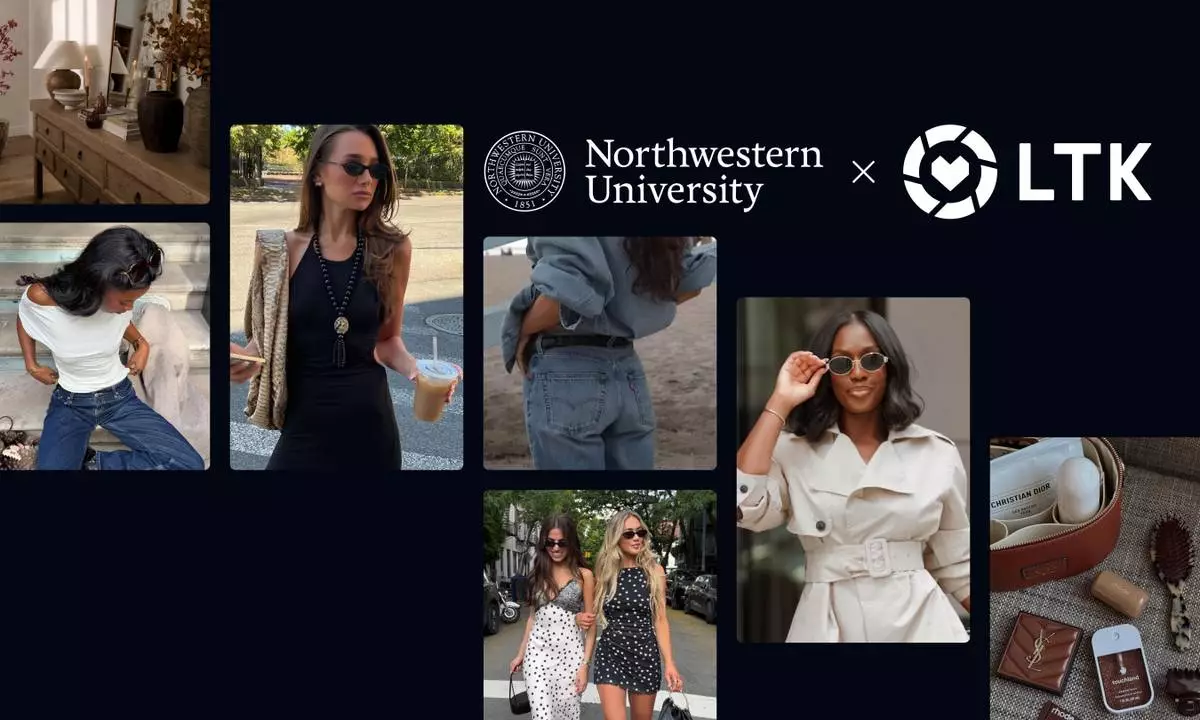
The fourth-annual study reveals creator marketing has moved beyond one-off campaigns to become always-on marketing infrastructure, reshaping how brands organize, measure and scale creator programs.

The fourth-annual study reveals creator marketing has moved beyond one-off campaigns to become always-on marketing infrastructure, reshaping how brands organize, measure and scale creator programs.
Russian President Vladimir Putin agreed Wednesday to resume three-way negotiations next month with Washington and Kyiv aimed at ending the war in Ukraine, a Kremlin official said, potentially setting up the first such talks since February.

The Russian leader agreed “in principle” to resume the talks after Nov. 10, Putin foreign affairs adviser Yuri Ushakov told reporters following a meeting in St. Petersburg between Putin and U.S. envoy Steve Witkoff.

The talks will focus on “building a security system for Russia and Ukraine after the conflict ends,” Ushakov said.

Witkoff's talks with Putin about Moscow’s full-scale invasion of Ukraine took place as U.S. President Donald Trump pushed Kyiv to make a deal that stops the fighting.

Ukrainian President Volodymyr Zelenskyy has insisted that only a summit of leaders can break the impasse. The two armies remain locked on the battlefield, and the countries pummel each other with daily long-range strikes.

Representatives of the three countries held three rounds of negotiations early this year, meeting twice in Abu Dhabi in January and February, followed by further talks in Geneva in February.

However, little progress was reported beyond exchanges of prisoners of war as Moscow and Kyiv stuck to their longstanding basic demands.

The discussion in St. Petersburg lasted about three hours, the Kremlin said, and came a day after Witkoff met with Zelenskyy and some European leaders in Norway's capital, Oslo.

The proposals from the Oslo meeting “contained little of real value in the context of resolving the Ukrainian crisis,” Ushakov said.

However, he later told Russian state TV that while Moscow isn’t “fully satisfied” with the Oslo proposals, they are a step in the right direction.

Witkoff’s meetings suggested leaders are keen to bring new momentum to U.S.-led peace efforts, more than 4½ years after the war began. Efforts by the Trump administration since early last year to end the war have made no significant progress.

Zelenskyy said freezing the conflict in Ukraine was the “minimum” required from Russia to bring about an end to the war.

“Right now, we have to freeze, and I think this is (the) real way to end this war,” Zelenskyy said in an interview broadcast Wednesday on Fox News.

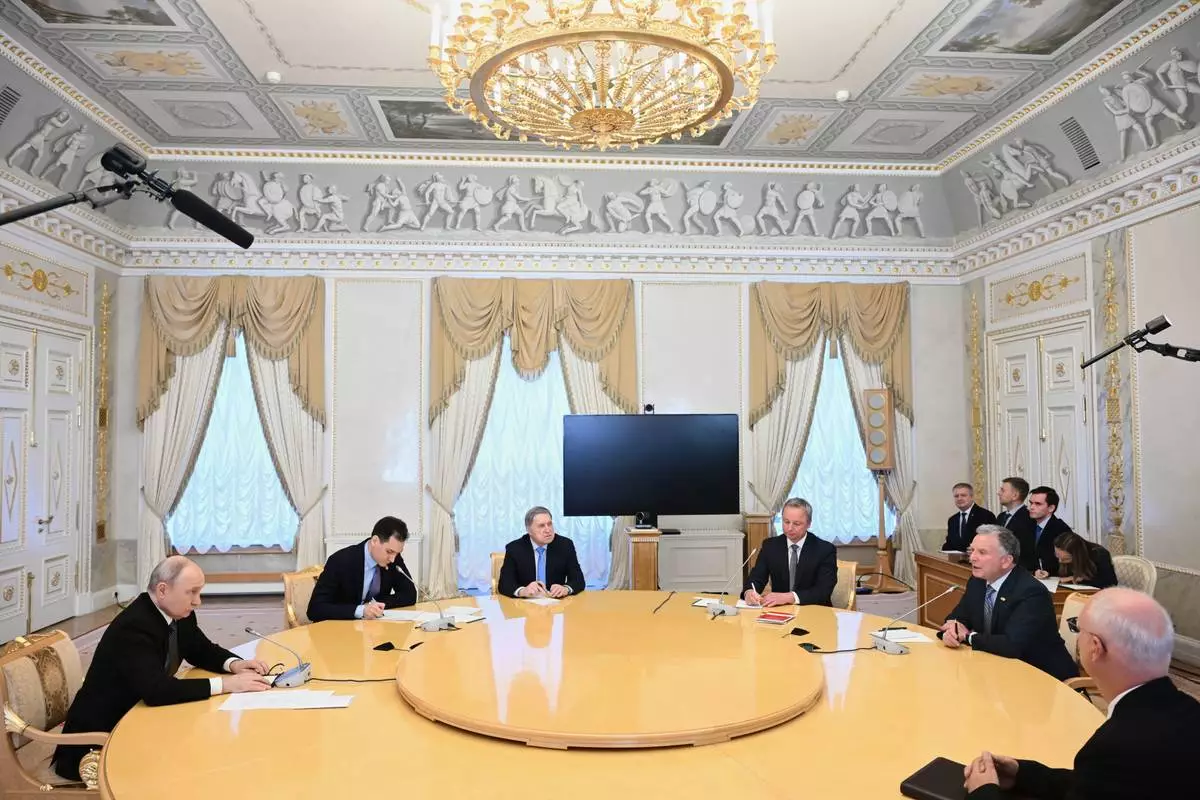
Witkoff and Putin met at St. Petersburg’s Constantine Palace, with Ushakov and Russian presidential envoy Kirill Dmitriev also at the table. Trump’s son-in-law, Jared Kushner, joined the discussion via a video link, Ushakov said.

Before the meeting, Witkoff said that there was "some degree of momentum” in talks.

During the meeting, Witkoff and Kushner proposed a three-way meeting with the U.S., Russia and Ukraine at the technical level and shared progress on their talks with Zelenskyy a day earlier, according to a U.S. official familiar with the talks who spoke on condition of anonymity to discuss the private meeting.

Witkoff and Kushner also discussed a postwar economic plan, European security and plans for the upcoming meeting, the official said.

Witkoff thanked Putin for agreeing to send diesel to the U.S., after Trump lifted a ban despite anger from some U.S. lawmakers, adding that the fuel would help reduce prices for American farmers and truckers.

Putin said he was ready to consider prospects for the restoration of U.S.-Russia economic ties and that he was prepared to discuss the U.S.-led conflict with Iran. Moscow stands ready to use its relationship with Tehran to help bring peace, he said.

Ushakov said that “large-scale joint economic projects that offer significant prospects for cooperation” between Russia and the U.S. were discussed in detail with Witkoff.

“Some of these are, in fact, nearing the implementation stage,” he said.

In other developments, Russia on Wednesday released a retired American teacher who had been imprisoned on charges of fighting as a mercenary in Ukraine. Witkoff said it appeared to be a goodwill gesture by the Kremlin after Trump asked Putin to free Stephen Hubbard.

Putin also met Wednesday with Chinese Premier Li Qiang, who was in St. Petersburg for talks with other Russian officials, the Kremlin said.

Russia has cultivated its ties with China, and the two countries last month vetoed a U.S. proposal for U.N. experts to keep monitoring sanctions on Iran.

Putin and Witkoff also discussed a possible meeting next month between the Russian, Chinese and U.S. leaders at an economic summit in China, Ushakov said, adding that Beijing is already preparing for it.

Witkoff planned to return to Oslo for more consultations after his trip to Russia, Norwegian Prime Minister Jonas Gahr Støre said.

“I think we may have entered a phase now where the Russians are also looking for opportunities for diplomacy,” Støre told Norwegian broadcaster NRK on Wednesday.

Zelenskyy was still in Oslo early Wednesday, where he visited Norway's parliament and met with lawmakers.

Zelenskyy said the talks in Oslo and St. Petersburg included discussion of future security guarantees for Ukraine, the fate of occupied territories, postwar reconstruction and the possibility of a ceasefire.

At the White House on Tuesday, Trump increased the pressure on Zelenskyy to come to an agreement with Russia as relations between the two leaders have soured again.

“We want Zelenskyy to make a deal,” Trump told reporters in the Oval Office. “We’ve given a lot to Ukraine. We’ve gotten absolutely nothing back except grief, death, tremendous monetary loss.”

If that doesn’t happen, “I think it’s going to be a very bad thing,” Trump said.

Amid fears that Washington was turning its back on Ukraine, Zelenskyy said Kyiv is once again receiving early warnings from its partners about incoming Russian missiles, after recent strikes that he said occurred without enough notice from allies.

Overnight Russian attacks in Kyiv left three people dead and 12 wounded, while 10 residential buildings were damaged, the city’s military administration said.

Energy facilities were targeted in Kyiv and three other cities in Russian attacks early Wednesday, Ukrainian Prime Minister Serhii Koretskyi said. Outside the eastern city of Kharkiv, two people died and 11 others were wounded when drones exploded in a residential area, he said.

The Russian Defense Ministry said that overnight its forces struck a warehouse, an electrical substation and a bulk carrier at sea that was headed to the Ukrainian port of Odesa.

The Russian Defense Ministry reported Wednesday that its air defenses intercepted 373 Ukrainian drones over multiple Russian regions overnight, as well as the illegally annexed Crimean Peninsula and the Black Sea.

Follow the AP’s coverage of the war in Ukraine at https://apnews.com/hub/russia-ukraine

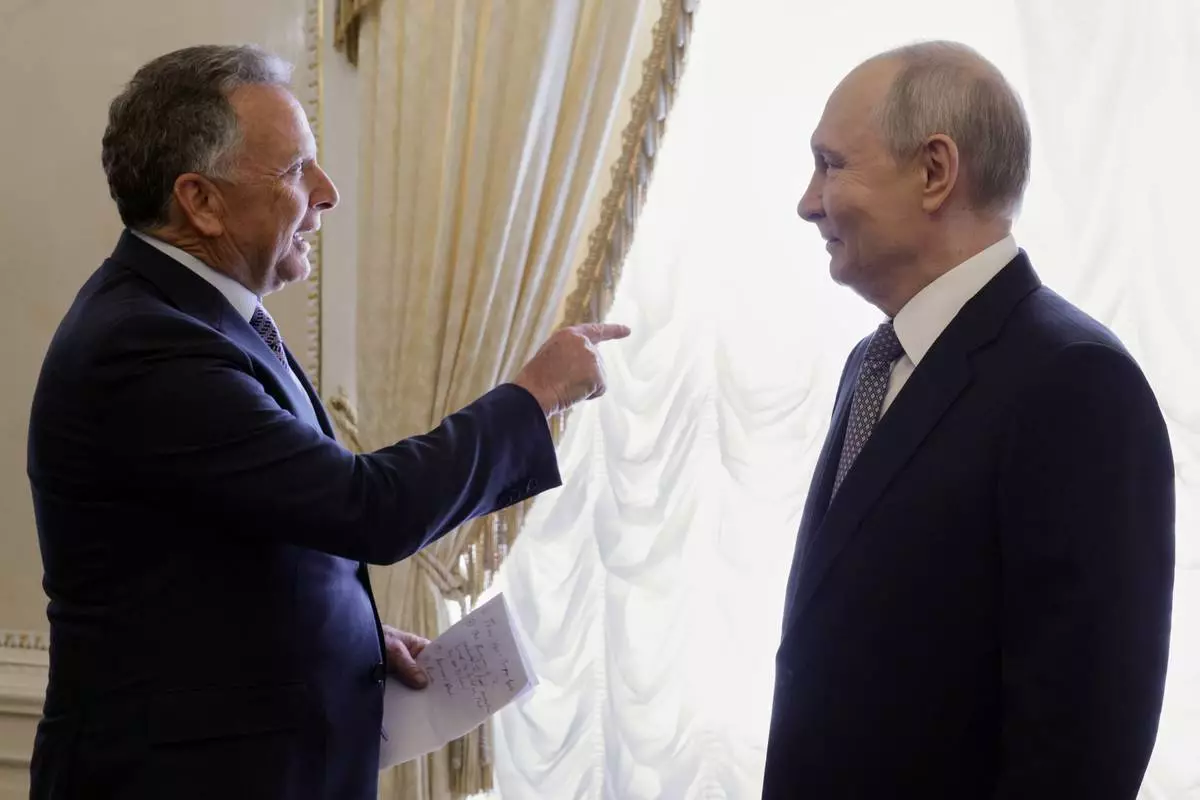
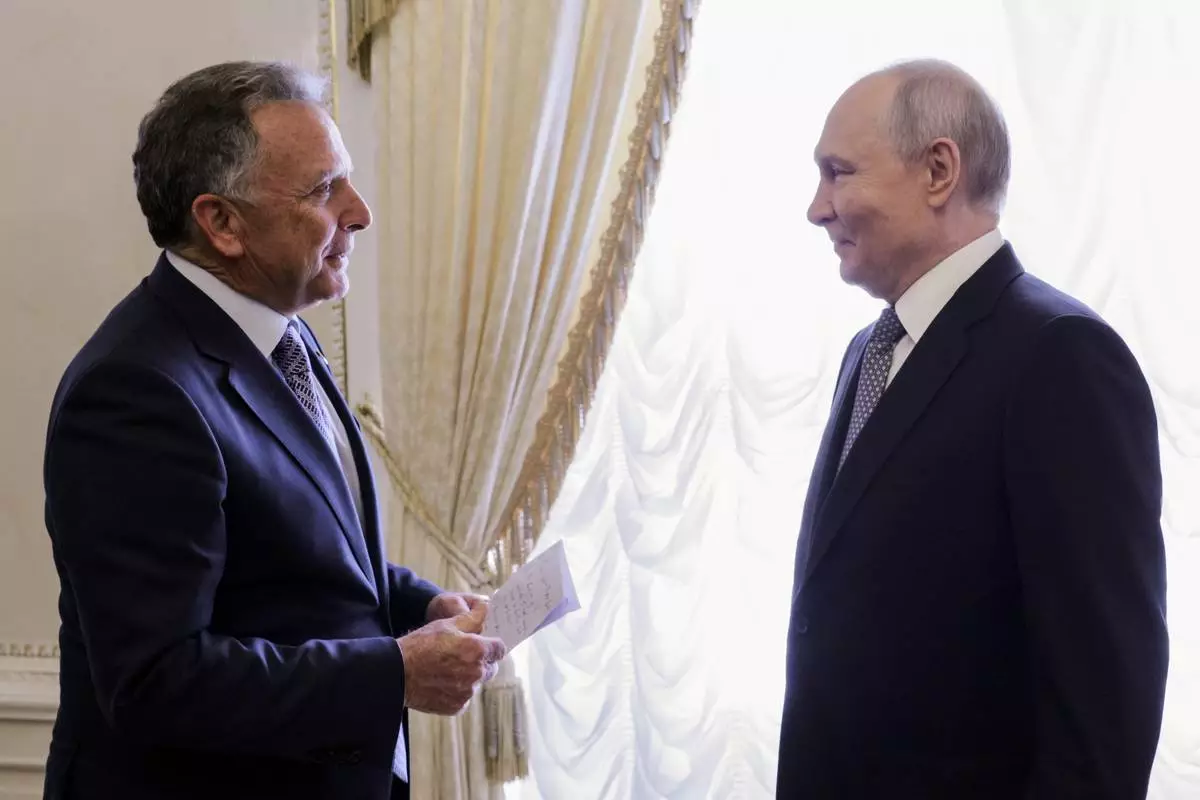
U.S. President Donald Trump's special envoy Steve Witkoff, left, holds a paper while speaking to Russian President Vladimir Putin at the Konstantin Palace in Strelnya, outside St. Petersburg, Russia, on Wednesday, Oct. 21, 2026. (Gavriil Grigorov, Sputnik, Kremlin Pool Photo via AP)

U.S. President Donald Trump's special envoy Steve Witkoff, left, holds a paper while speaking to Russian President Vladimir Putin at the Konstantin Palace in Strelnya, outside St. Petersburg, Russia, on Wednesday, Oct. 21, 2026. (Gavriil Grigorov, Sputnik, Kremlin Pool Photo via AP)

Russian President Vladimir Putin, left, and U.S. President Donald Trump's special envoy Steve Witkoff, second right, attend the talks, as Russian Presidential Envoy Kirill Dmitriev, right back to a camera, and Kremlin foreign policy adviser Yuri Ushakov, third left, sit near at the Konstantin Palace in Strelnya, outside St. Petersburg, Russia, on Wednesday, Oct. 21, 2026. (Kristina Solovyova, Sputnik, Kremlin Pool Photo via AP)

Russian President Vladimir Putin, left, and U.S. President Donald Trump's special envoy Steve Witkoff, second right, attend the talks, as Russian Presidential Envoy Kirill Dmitriev, right back to a camera, and Kremlin foreign policy adviser Yuri Ushakov, third left, sit near at the Konstantin Palace in Strelnya, outside St. Petersburg, Russia, on Wednesday, Oct. 21, 2026. (Kristina Solovyova, Sputnik, Kremlin Pool Photo via AP)

U.S. President Donald Trump's special envoy Steve Witkoff, left, gestures during his meeting with Russian President Vladimir Putin at the Konstantin Palace in Strelnya, outside St. Petersburg, Russia, on Wednesday, Oct. 21, 2026. (Gavriil Grigorov, Sputnik, Kremlin Pool Photo via AP)

U.S. President Donald Trump's special envoy Steve Witkoff, left, gestures during his meeting with Russian President Vladimir Putin at the Konstantin Palace in Strelnya, outside St. Petersburg, Russia, on Wednesday, Oct. 21, 2026. (Gavriil Grigorov, Sputnik, Kremlin Pool Photo via AP)

A rescue worker clears the rubble from a multi-story residential building damaged in a Russian drone strike in Kyiv, Ukraine, Wednesday, Oct. 21, 2026. (AP Photo/Evgeniy Maloletka)

A rescue worker clears the rubble from a multi-story residential building damaged in a Russian drone strike in Kyiv, Ukraine, Wednesday, Oct. 21, 2026. (AP Photo/Evgeniy Maloletka)

Policemen walk in front of destroyed cars in the yard of a multi-storey residential building damaged by a Russian drone strike on Kyiv, Ukraine, Wednesday, Oct. 21, 2026. (AP Photo/Evgeniy Maloletka)

Policemen walk in front of destroyed cars in the yard of a multi-storey residential building damaged by a Russian drone strike on Kyiv, Ukraine, Wednesday, Oct. 21, 2026. (AP Photo/Evgeniy Maloletka)

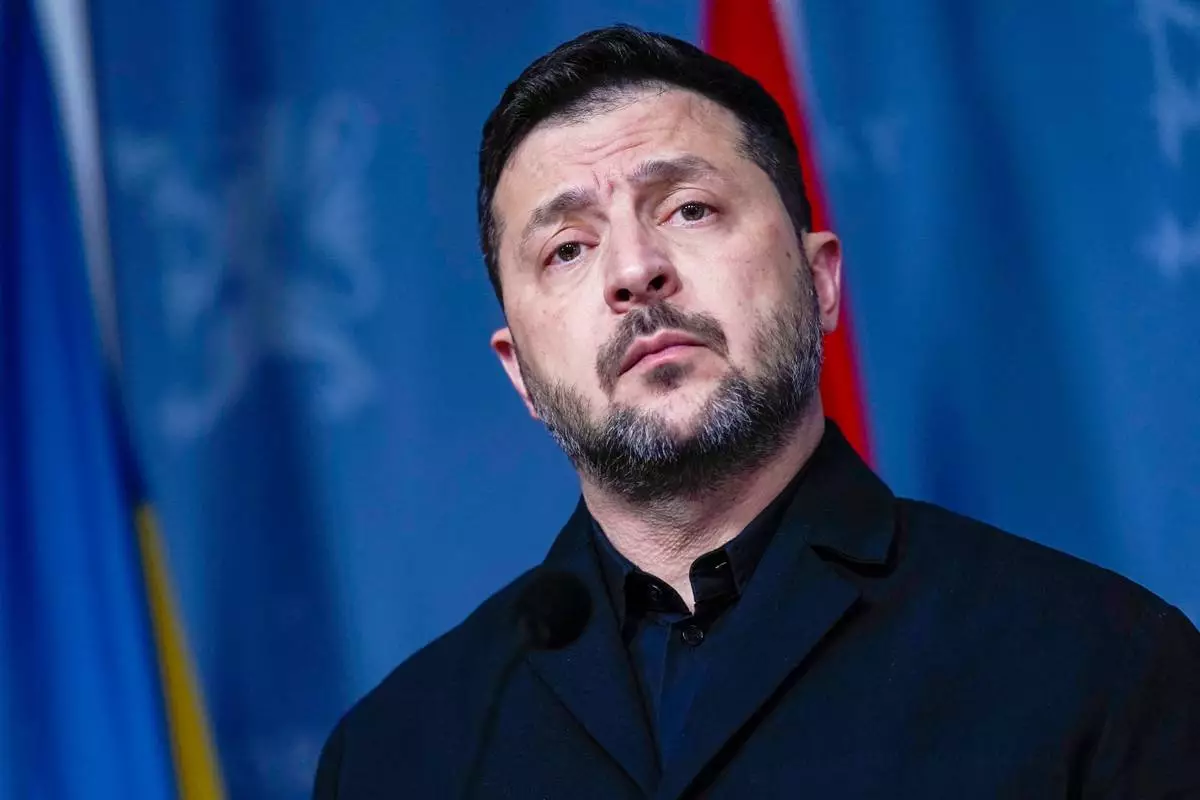
Ukrainian President Volodymyr Zelensky speaks during a press conference on Tuesday, Oct. 20, 2026 in Oslo, Norway. (Lise Åserud/NTB Scanpix via AP)

Ukrainian President Volodymyr Zelensky speaks during a press conference on Tuesday, Oct. 20, 2026 in Oslo, Norway. (Lise Åserud/NTB Scanpix via AP)

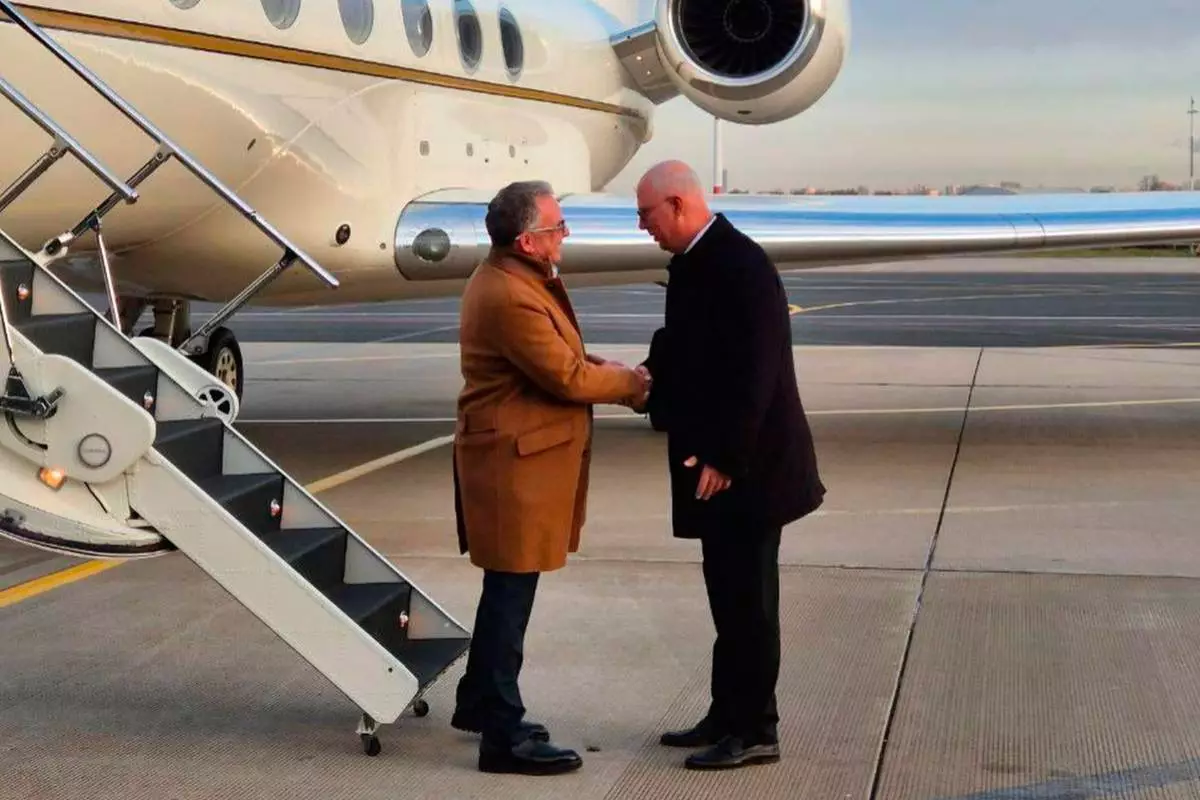
Russian presidential envoy Kirill Dmitriev, right, greets U.S. special envoy Steve Witkoff at the international airport outside St. Petersburg, Russia, Wednesday, Oct. 21, 2026. (TASS Photo via AP)

Russian presidential envoy Kirill Dmitriev, right, greets U.S. special envoy Steve Witkoff at the international airport outside St. Petersburg, Russia, Wednesday, Oct. 21, 2026. (TASS Photo via AP)

Recommended Articles