WASHINGTON (AP) — The Trump administration asked the Supreme Court on Wednesday to let it resume building a border wall project through the Big Bend region of Texas.
The government filed an emergency appeal asking the justices to lift a lower court decision halting construction. That ruling marked a setback to one of President Donald Trump's signature projects.
The administration has been racing forward with construction on a border wall and other infrastructure from the Pacific Ocean to the Gulf of Mexico.
But in the Big Bend region, the administration has run into opposition from ranchers, residents, business owners and environmentalists who argue the projects are a waste of money in an area of historically low illegal immigration and that construction could harm the region's scenic landscapes.
Opponents have filed numerous lawsuits seeking to stop the project, which in the Big Bend consists of a mixture of walls, vehicle barriers and surveillance technology.
Ruling in one of those cases, Judge Kathleen Cardone on Oct. 2 ordered the government to stop construction across the roughly 500-mile project area while the case plays out in the courts. It was a major victory for the bipartisan opposition.
The case hinges on sweeping waivers signed by the secretary of Homeland Security that allow U.S. Customs and Border Protection to bypass environmental and other regulations that would otherwise slow down construction of such a major project.
The government argued that the Big Bend sector is an area of high illegal entry, and said legislation dating back to 1996 explicitly gives the secretary these far-reaching powers as necessary to build physical barriers or roads near the border to stop people from crossing illegally.
Opponents disagreed, arguing that Congress gave that power to waive regulations specifically in areas of “high illegal entry.” They said Big Bend, a remote and rugged region, doesn’t fit that description.
Cardone sided with the opponents.
“The Court finds that Plaintiffs are likely to succeed on the merits of their major questions doctrine claim that the Big Bend Waivers were issued in excess of the Secretary’s authority,” she wrote.
Trump has long vowed to build a border wall along the roughly 2,000-mile length of the southwest border. Last summer, Republicans in Congress allocated Homeland Security $46 billion to finish the project, which will be a mixture of 30-foot-tall steel bollard walls, vehicle barriers and surveillance technology.
The opposition in Texas’s Big Bend region had been brewing for months, but it escalated in August when bulldozers were spotted clearing land in Big Bend National Park.
The preliminary injunction filed by Cardone stops construction there as well as land up and downriver from the park that is owned by private landowners or the state.
The government has argued that if this region is one of the only areas left without a wall or other border infrastructure, illegal immigration could end up funneling to the Big Bend. But opponents have argued that other forms of infrastructure such as drones or surveillance towers are just as effective and a lot less expensive than the wall plans.

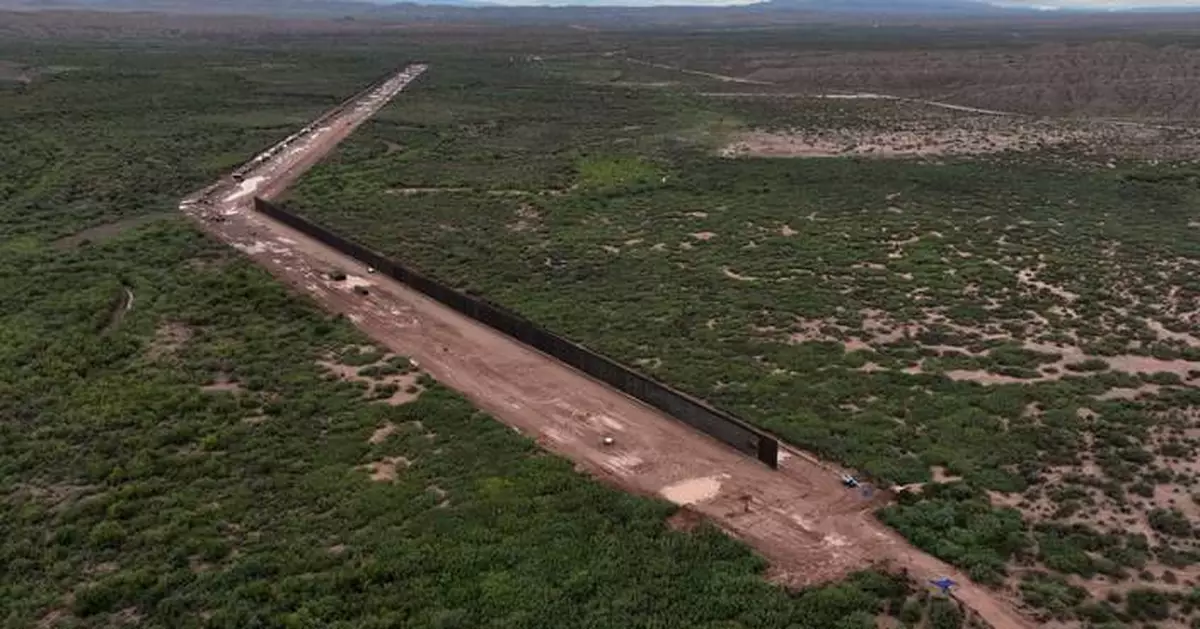
A portion of border wall is under construction in the Big Bend region, Wednesday, Sept. 23, 2026, near Sierra Blanca, Texas. (AP Photo/John Locher)
Russia agreed Wednesday to resume three-way negotiations next month with Washington and Kyiv aimed at ending the war in Ukraine, a Kremlin official said, potentially setting up the first such talks since February.
Russian President Vladimir Putin agreed “in principle” to restart the talks after Nov. 10, Putin's foreign affairs adviser, Yuri Ushakov, told reporters following a meeting in St. Petersburg between the Russian leader and U.S. envoy Steve Witkoff.
The talks will focus on “building a security system for Russia and Ukraine after the conflict ends,” Ushakov said.
Witkoff's talks with Putin about Moscow’s full-scale invasion of Ukraine took place as U.S. President Donald Trump pressed Kyiv to make a deal that stops the fighting.
Ukrainian President Volodymyr Zelenskyy said he supported the push from Washington to restart talks swiftly.
"The agenda is clear: to end the war, bring peace closer, and, as I understand it, prepare everything for a meeting at the leaders’ level,” Zelenskyy said in an audio message issued late Wednesday.
Russia, he added, "has said many times already that it is ready to meet in one format or another. Then something changed. Things were canceled. We’ll see what happens this time.”
Shortly after his message, a missile alert sounded over Kyiv, and loud explosions were heard in the capital.
Representatives of the three countries held three rounds of negotiations early this year, meeting twice in Abu Dhabi in January and February, followed by further talks in Geneva in February.
However, little progress was reported beyond exchanges of prisoners of war as Moscow and Kyiv stuck to their longstanding basic demands.
The discussion in St. Petersburg lasted about three hours, the Kremlin said, and came a day after Witkoff met with Zelenskyy and some European leaders in Norway's capital, Oslo.
The proposals that emerged from the Oslo meeting “contained little of real value in the context of resolving the Ukrainian crisis,” Ushakov said.
However, he later told Russian state TV that while Moscow isn’t “fully satisfied” with the Oslo proposals, they are a step in the right direction.
Witkoff’s meetings suggested leaders are keen to bring new momentum to U.S.-led peace efforts, more than 4½ years after the war began. Efforts by the Trump administration since early last year to end the war have made no significant progress.
Witkoff and Putin met at St. Petersburg’s Constantine Palace, with Ushakov and Russian presidential envoy Kirill Dmitriev also at the table. Trump’s son-in-law, Jared Kushner, joined the discussion by video, Ushakov said.
During the meeting, Witkoff and Kushner proposed a three-way meeting with the U.S., Russia and Ukraine at the technical level and shared progress on their talks with Zelenskyy a day earlier, according to a U.S. official familiar with the talks who spoke on condition of anonymity to discuss the private meeting.
Witkoff and Kushner also discussed a postwar economic plan, European security and plans for the upcoming meeting, the official said.
In televised opening remarks, Putin said he was ready to consider prospects for the restoration of U.S.-Russia economic ties and that he was prepared to discuss the U.S.-led conflict with Iran. Moscow stands ready to use its relationship with Tehran to help bring peace, he said.
Ushakov said “large-scale joint economic projects that offer significant prospects for cooperation” between Russia and the U.S. were discussed in detail with Witkoff.
“Some of these are, in fact, nearing the implementation stage,” he said.
In other developments on Wednesday, Russia released a retired American teacher who had been imprisoned on charges of fighting as a mercenary in Ukraine. Witkoff said it appeared to be a goodwill gesture by the Kremlin after Trump asked Putin to free Stephen Hubbard.
Putin also met with Chinese Premier Li Qiang, who was in St. Petersburg for talks with other Russian officials, the Kremlin said.
Russia has cultivated its ties with China, and the two countries last month vetoed a U.S. proposal for U.N. experts to keep monitoring sanctions on Iran.
Putin and Witkoff also discussed a possible meeting next month between the Russian, Chinese and U.S. leaders at an economic summit in China, Ushakov said, adding that Beijing is already preparing for it.
After his trip to Russia, Witkoff returned for more consultations in Oslo, where he met with Norwegian Prime Minister Jonas Gahr Støre at the airport before flying back to the U.S. The meeting lasted just over an hour, Norwegian broadcaster NRK reported.
“I think we may have entered a phase now where the Russians are also looking for opportunities for diplomacy,” Støre told the broadcaster. He said the new talks were likely to happen in mid-November.
Asked whether Zelenskyy could accept a border running along the current front line, Støre said: “I don’t think Ukraine will ever formally accept it and say that this is the new border. But whether they can live with it is another matter.”
At the White House on Tuesday, Trump increased the pressure on Zelenskyy to come to an agreement with Russia as relations between the two leaders have soured again.
“We want Zelenskyy to make a deal,” Trump told reporters in the Oval Office. “We’ve given a lot to Ukraine. We’ve gotten absolutely nothing back except grief, death, tremendous monetary loss.”
If that doesn’t happen, “I think it’s going to be a very bad thing,” Trump said.
Amid fears that Washington was turning its back on Ukraine, Zelenskyy said Kyiv is once again receiving early warnings from its partners about incoming Russian missiles, after recent strikes that he said occurred without enough notice from allies.
Overnight Russian attacks in Kyiv left three people dead and 12 wounded, while 10 residential buildings were damaged, the city’s military administration said.
Energy facilities were targeted in Kyiv and three other cities in Russian attacks early Wednesday, Ukrainian Prime Minister Serhii Koretskyi said. Outside the eastern city of Kharkiv, two people died and 11 others were wounded when drones exploded in a residential area, he said.
The Russian Defense Ministry said its forces struck a warehouse, an electrical substation and a bulk carrier at sea that was headed to the Ukrainian port of Odesa.
The Russian Defense Ministry reported Wednesday that its air defenses intercepted 373 Ukrainian drones over multiple Russian regions overnight, as well as the illegally annexed Crimean Peninsula and the Black Sea.
Follow the AP’s coverage of the war in Ukraine at https://apnews.com/hub/russia-ukraine
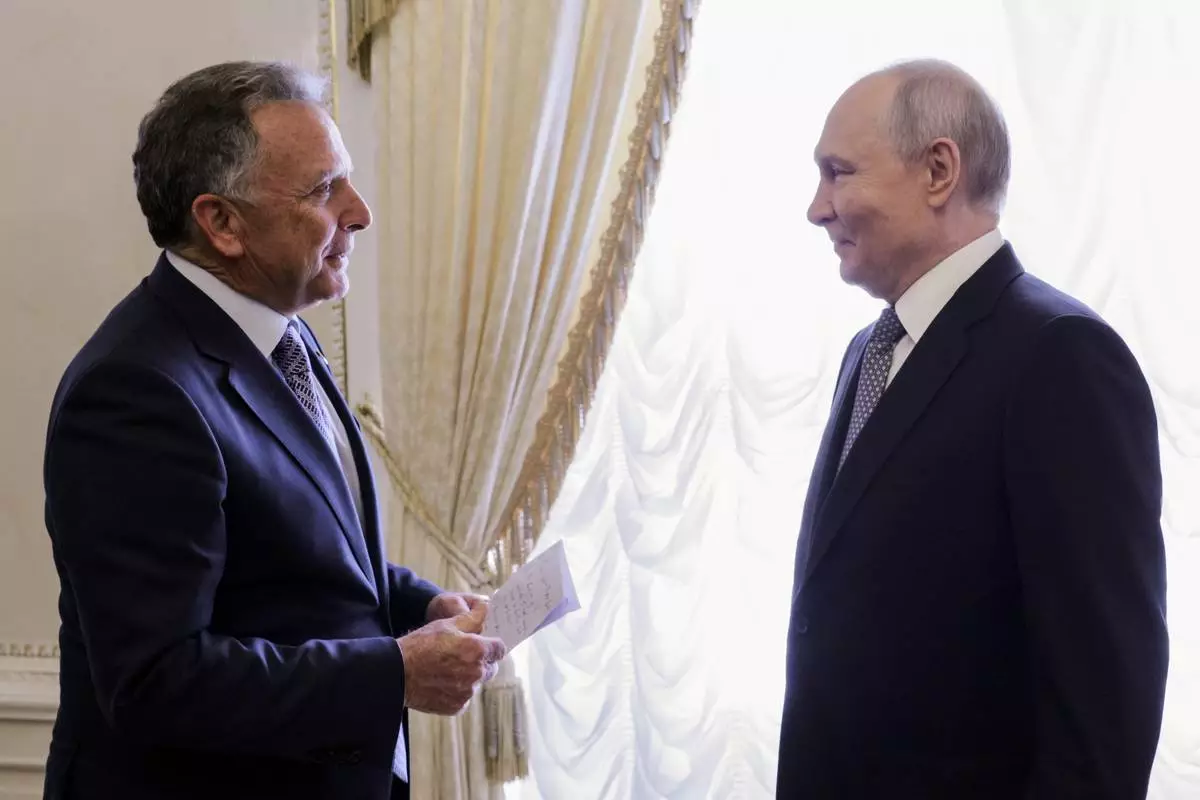
U.S. President Donald Trump's special envoy Steve Witkoff, left, holds a paper while speaking to Russian President Vladimir Putin at the Konstantin Palace in Strelnya, outside St. Petersburg, Russia, on Wednesday, Oct. 21, 2026. (Gavriil Grigorov, Sputnik, Kremlin Pool Photo via AP)
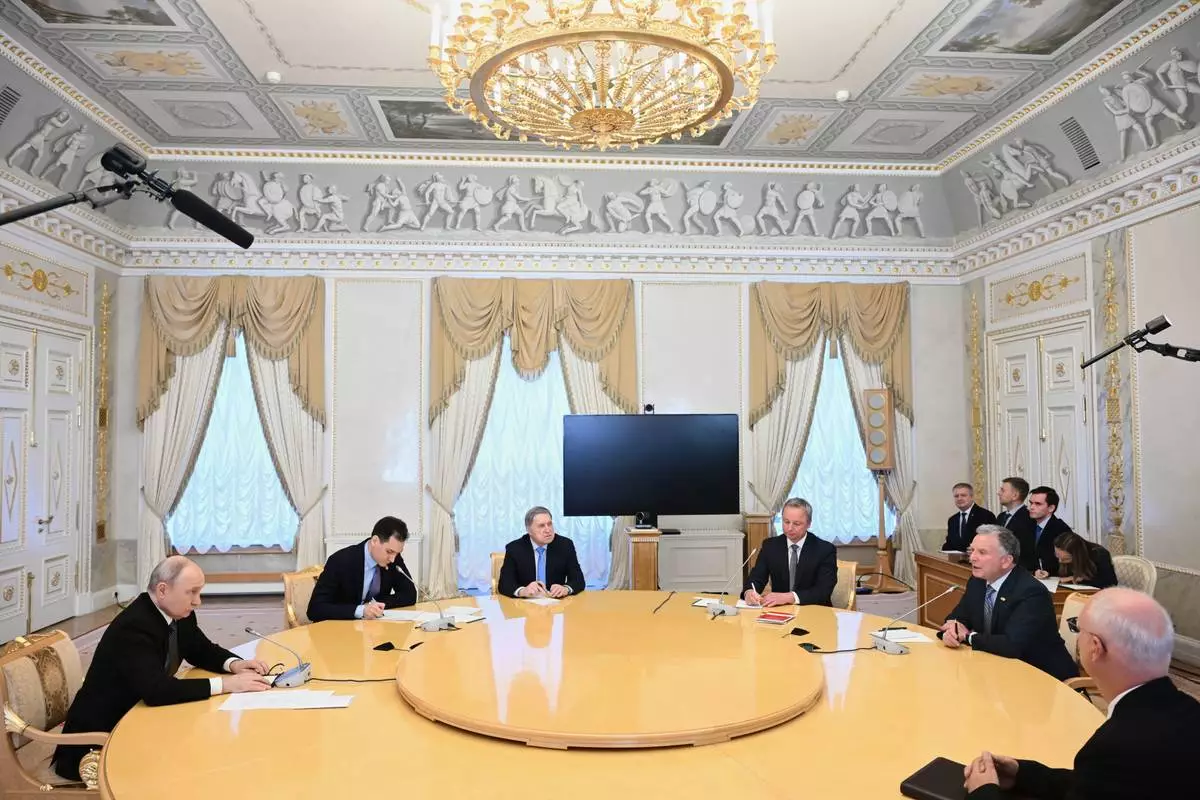
Russian President Vladimir Putin, left, and U.S. President Donald Trump's special envoy Steve Witkoff, second right, attend the talks, as Russian Presidential Envoy Kirill Dmitriev, right back to a camera, and Kremlin foreign policy adviser Yuri Ushakov, third left, sit near at the Konstantin Palace in Strelnya, outside St. Petersburg, Russia, on Wednesday, Oct. 21, 2026. (Kristina Solovyova, Sputnik, Kremlin Pool Photo via AP)
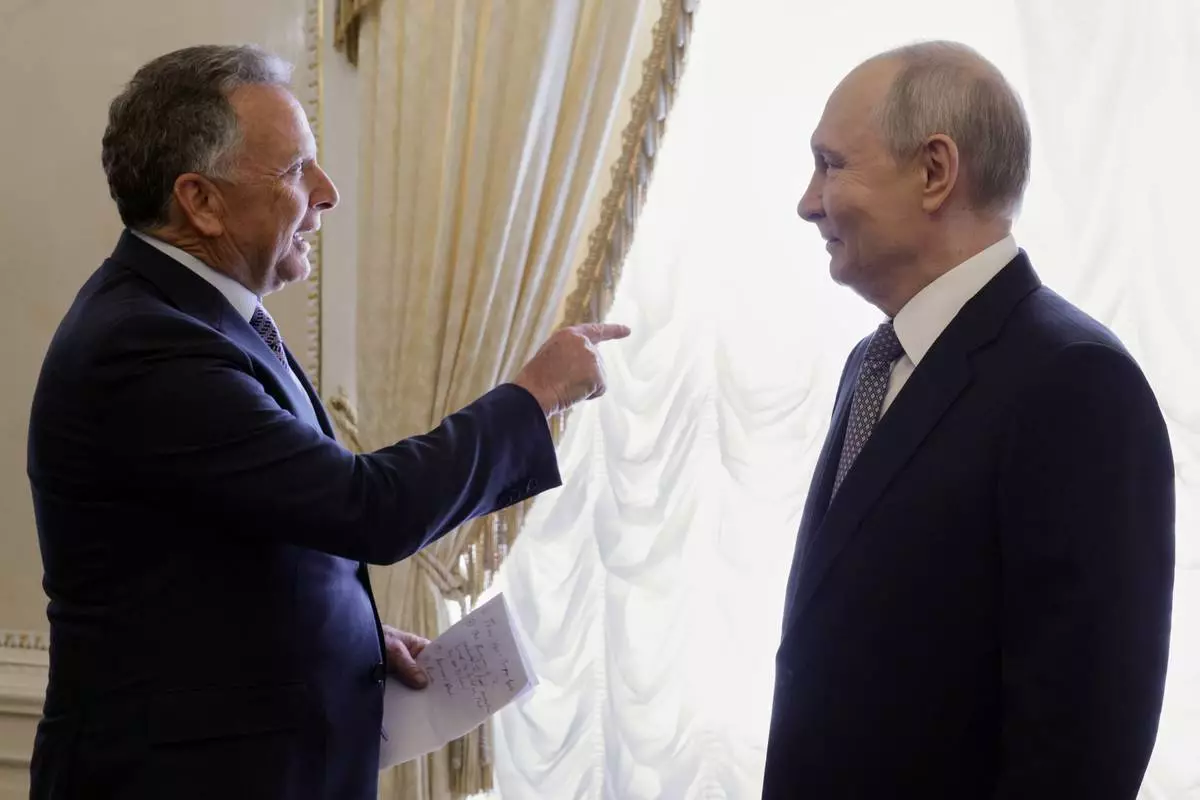
U.S. President Donald Trump's special envoy Steve Witkoff, left, gestures during his meeting with Russian President Vladimir Putin at the Konstantin Palace in Strelnya, outside St. Petersburg, Russia, on Wednesday, Oct. 21, 2026. (Gavriil Grigorov, Sputnik, Kremlin Pool Photo via AP)
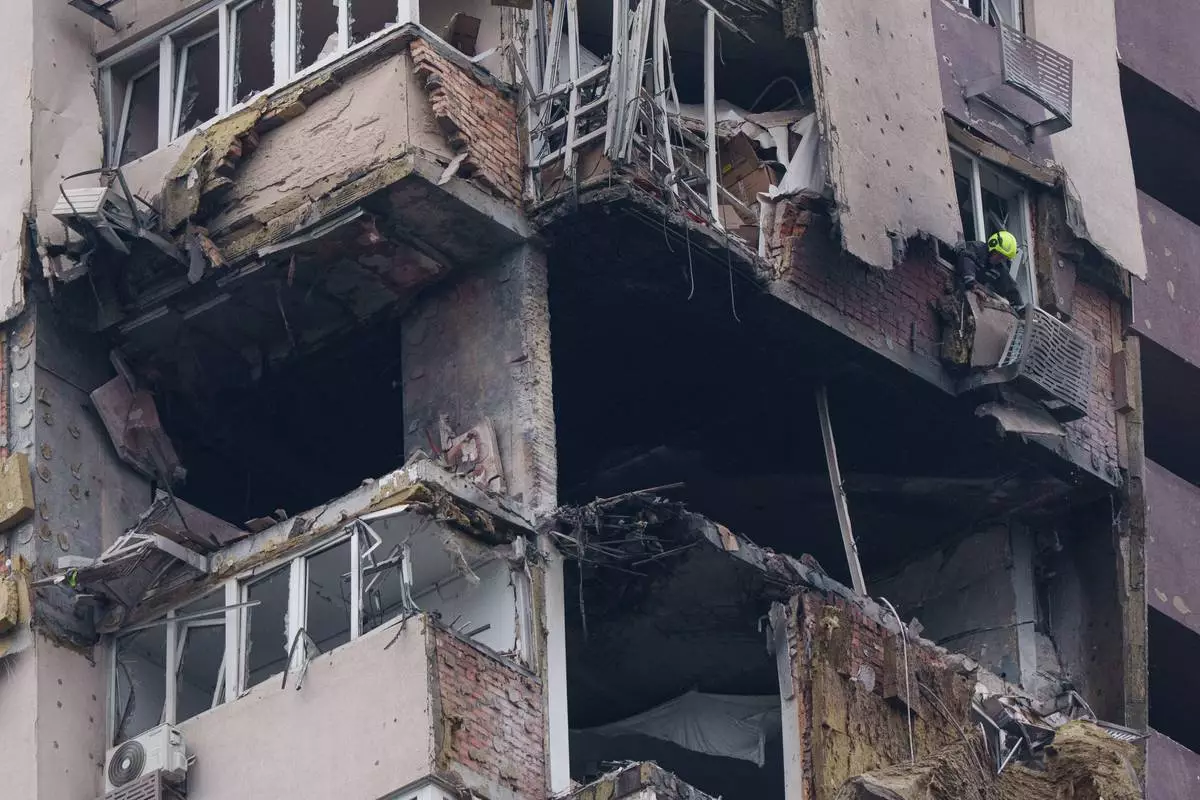
A rescue worker clears the rubble from a multi-story residential building damaged in a Russian drone strike in Kyiv, Ukraine, Wednesday, Oct. 21, 2026. (AP Photo/Evgeniy Maloletka)

Policemen walk in front of destroyed cars in the yard of a multi-storey residential building damaged by a Russian drone strike on Kyiv, Ukraine, Wednesday, Oct. 21, 2026. (AP Photo/Evgeniy Maloletka)
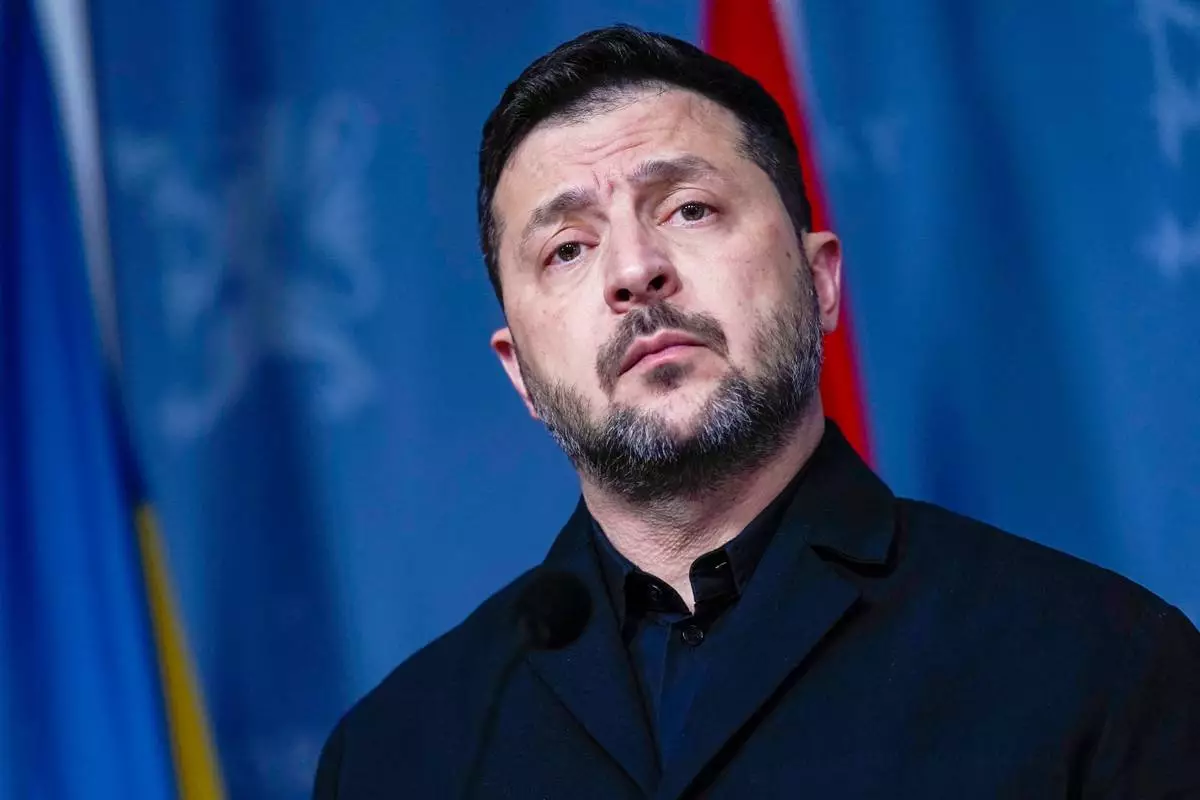
Ukrainian President Volodymyr Zelensky speaks during a press conference on Tuesday, Oct. 20, 2026 in Oslo, Norway. (Lise Åserud/NTB Scanpix via AP)
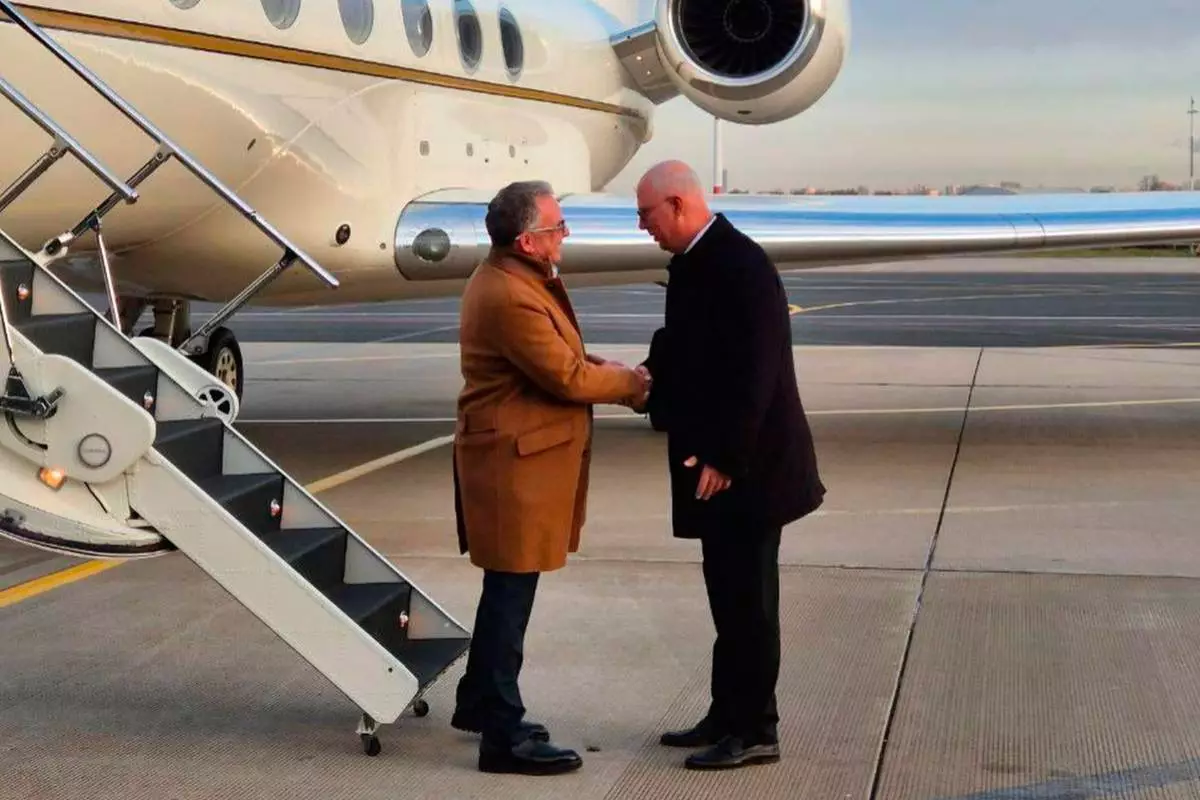
Russian presidential envoy Kirill Dmitriev, right, greets U.S. special envoy Steve Witkoff at the international airport outside St. Petersburg, Russia, Wednesday, Oct. 21, 2026. (TASS Photo via AP)