Yan'an, the city in northwest China's Shaanxi Province that is synonymous with the country's revolutionary past, is writing a new chapter in its storied history, as China marks the 90th anniversary of the Long March victory this year.
The Long March was an epic 12,500-kilometer strategic shift undertaken by the Communist Party of China (CPC)-led Red Army between 1934 and 1936 to break through a siege by Kuomintang forces. The historical journey helped pave the way for the founding of the People's Republic of China. October 22 marks the anniversary of the March's victory.
Nine decades ago, banks set up inside caves in Yan'an became a financial lifeline for the Red Army's military campaign. Today, the city is carrying forward that red legacy through green finance, achieving a three-way win for ecological conservation, clean energy and increased household income.
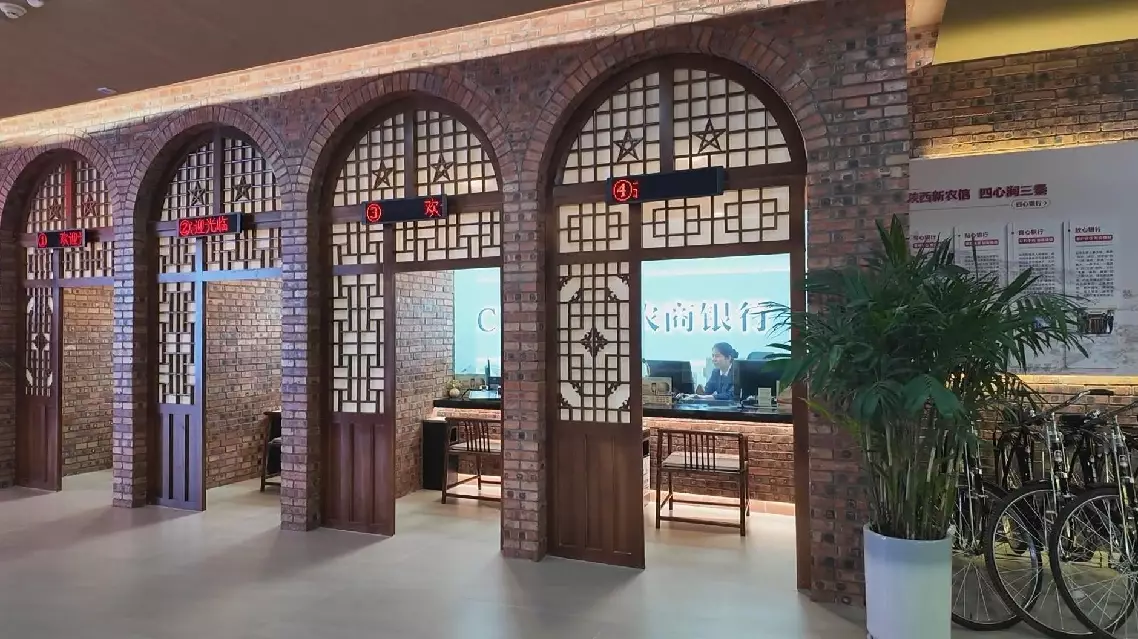
The Yan'an Rural Commercial Bank was established during the revolutionary period, and its design today brings that history to the fore, ensuring its legacy is not forgotten. At the Shuangyong Avenue Sub-branch, the service area references the region's architectural heritage.
"This is our service counter. We adopted northern Shaanxi elements and built one-meter barriers styled after cave dwellings to fully protect customers' privacy. The overall counter design features local cave-dwelling architecture and regional cultural touches. This area is our modern office zone. Since the venue opened, we have received nearly 7,300 visitors," Wang Wei, manager of the sub-branch, told the China Global Television Network (CGTN) during a recent tour.
The bank's on-site museum honors the revolutionary history of the region, but the cave dwellings common in this part of China are by no means relegated to the past. In this high-altitude region with intense sunlight and heat, cave dwellings remain a sensible housing choice. Now, many have been revitalized with the assistance of green finance.
As a result, Yan'an is now becoming well known for something besides its revolutionary past: renewable energy. Solar panels have been installed on top of cave houses, and locals have benefited greatly from the adoption of the new energy source.
"These 10 cave dwellings are covered with photovoltaic panels. Under this solar project, each panel earns villagers 40 yuan (about 6 U.S. dollars) per year. With over 300 panels on the roof, the yearly income tops 10,000 yuan (nearly 1,500 U.S. dollars). Money comes in as long as there is sunshine. More than 37 hectares of land on our mountains is fitted with solar panels. Vegetables and Chinese medicinal herbs grow underneath, adding another source of income for local farmers," Jing Ping, Party branch secretary of Xinyao Village in the city's Baota District, told CGTN.
Yan'an's green finance system has been steadily maturing in recent years. Local banks continue to expand green credit lending, and that funding has helped transform once barren hills and promoted a grain-for-green program that encourages farmers to convert pastures into woodland forests.
"Since May 2025, the Shaanxi Rural Credit Cooperatives Union taps local solar resources and low-carbon plans. To date, roughly 63 million yuan (over 9.4 million U.S. dollars) of solar loans has been granted to 17 village collectives. Sixty-five solar-plus projects are under development across the city, with an estimated capacity of 90 MW. An extra 288 million yuan in loans is projected for disbursement by year-end," said Li Yuan, deputy director of the Yan'an Audit Center at the Shaanxi Rural Credit Cooperatives Union.
Looking ahead, the Yan'an Rural Commercial Bank plans to build on its revolutionary legacy.
"Next, we will deeply integrate red finance culture with Yan'an's cultural tourism and rural industries. The museum will be developed into a red finance study-tour site. We will learn from the border region's historical practice of farm loans for farmers, increase credit support for rural industries and implement financial assistance for agriculture," said Zhang Wei, vice chairman of the Labor Union at the bank.
From cave-dwelling banks to solar-powered villages, financial institutions of Yan'an are proving that the spirit of the Long March can light the way to a sustainable future.
Yan'an banks forge green future from revolutionary past