Manufacturers gain additional deployment flexibility for industrial AI orchestration through support for NVIDIA Nemotron models
MILWAUKEE, Oct. 22, 2026 /PRNewswire/ -- Rockwell Automation, Inc. (NYSE: ROK), the world's largest company dedicated to industrial automation and digital transformation, today announced support for NVIDIA Nemotron open models within FactoryTalk® Conductor™, its AI-native orchestration platform for industrial automation.
Building on the recent introduction of FactoryTalk Conductor, support for NVIDIA Nemotron models expands deployment flexibility for manufacturers adopting industrial AI. The open-source approach enables organizations to keep engineering and production data within their own environments while leveraging Rockwell Automation-verified agents and skills to automate complex workflows with greater control over infrastructure, governance and cost.
"Manufacturers want to adopt AI in ways that align with their business, technology and governance requirements," said Matheus Bulho, SVP, software & control, Rockwell Automation. "Support for NVIDIA Nemotron models gives customers another option for deploying FactoryTalk Conductor using open-source AI technology while maintaining control of their data and infrastructure. Combined with Rockwell Automation-verified agents and skills, organizations can apply trusted industrial expertise across engineering workflows and scale AI with confidence."
FactoryTalk Conductor enables users to initiate engineering tasks through natural language interactions and intelligently coordinates the software, AI capabilities and workflows needed to complete them. By combining AI orchestration with Rockwell Automation-verified agents and skills, the platform helps manufacturers accelerate engineering activities while maintaining the standards, governance and reliability required in industrial environments.
Key benefits of NVIDIA Nemotron support include:
- Expanded AI deployment flexibility to align with enterprise AI strategies
- Additional options for customers seeking greater control over AI infrastructure and model management
- Support for scalable AI-powered workflows across industrial automation software and engineering processes
- Continued access to Rockwell-verified agents and skills alongside customer-developed capabilities.
Looking ahead, Rockwell Automation envisions FactoryTalk Conductor helping manufacturers move toward agent-driven engineering workflows, where AI agents can execute increasingly complex activities across software environments while engineers remain responsible for oversight, validation and critical decisions. Combined with support for NVIDIA Nemotron models and Rockwell Automation-verified agents and skills, the platform is designed to help manufacturers scale AI in a manner aligned with industrial requirements for governance, security and reliability.
Additional information about FactoryTalk Conductor can be found at www.rockwellautomation.com.
About Rockwell Automation
Rockwell Automation, Inc. (NYSE: ROK), is a global leader in industrial automation and digital transformation. We connect the imaginations of people with the potential of technology to expand what is humanly possible, making the world more productive and more sustainable. Headquartered in Milwaukee, Wisconsin, Rockwell Automation employs approximately 26,000 problem solvers dedicated to our customers in more than 100 countries as of fiscal year end 2026. To learn more about how we are bringing the Connected Enterprise® to life across industrial enterprises, visit www.rockwellautomation.com.
** This press release is distributed by PR Newswire through automated distribution system, for which the client assumes full responsibility. **
Rockwell Automation Expands FactoryTalk Conductor with NVIDIA Nemotron Support
Dr. Umar and colleagues outline how individualized assessment may reveal additional graft options while identifying areas to avoid
MANHATTAN BEACH, Calif., Oct. 22, 2026 /PRNewswire/ -- Dr. U Hair and Skin Clinic in the Los Angeles area reports that a new clinical review led by Sanusi Umar, MD, challenges reliance on fixed maps to define hair transplant donor areas. The open-access paper, "Redefining the Safe Donor Area in Follicular Unit Excision: Toward Dynamic, Patient-Specific Zones," was published Oct. 16 in the Journal of Cosmetic Dermatology.
Read Dr. Umar's illustrated companion article for clinical photographs and a plain-language explanation of how the shave test helps guide individualized donor assessment.
Traditional donor maps identify hair at the back and sides of the scalp that is relatively resistant to pattern hair loss. These maps remain useful starting points, but may exclude usable hair in some patients or include thinning regions in others.
"A donor map should be a starting point, followed by examination of the individual patient," said Dr. Umar, a board-certified dermatologist and lead author. "That assessment may reveal additional graft options, including finer hair for a softer hairline, or show why harvesting boundaries need to be smaller."
Evidence reviewed and key findings
The narrative review, authored by Dr. Umar, Aditya K. Gupta, Vasiliki Economopoulos and Mesbah Talukder, examines donor variability and tools for refining boundaries. It revisits Dr. Umar's 2015 observational series of 128 men treated with nape and periauricular hair for hairlines and temples.
Key points included:
- The shave test examines changes in hair thickness and density after close clipping. A gradual transition toward the nape and around the ears may support selective harvesting of additional peripheral hair.
- An abrupt decline in thickness or density can reveal unsuitable hair and indicate that donor boundaries should be narrowed. Magnified scalp examination, age, family history and hair-loss progression help guide selection.
- Donor grading and ratio-based methods provide additional tools for refining boundaries. When peripheral scalp hair is unsuitable, clinicians may consider conventional scalp donor hair or separately assess beard and body hair as alternative sources where clinically appropriate.
- Thirty-three patients from the earlier series completed longer-term questionnaires at an average of 4.6 years. The review separately presents one patient's 14-year follow-up showing retained transplanted hairline coverage despite further native frontal hair recession.
Why the findings matter
Follicular unit excision, or FUE, enables individual hair units to be harvested across broad scalp areas. As larger sessions place greater demands on donor resources, individualized assessment can help identify additional usable hair while protecting unsuitable zones.
The framework starts with a conservative core donor area, then refines its borders using scalp findings. Selected peripheral regions may offer additional grafts, while donor thinning can require a smaller harvestable area. Decisions also consider remaining donor coverage and future hair loss.
The authors call for larger prospective studies with standardized long-term follow-up. A favorable shave test does not guarantee lifelong graft permanence or establish a universal additional graft allowance. Read the full open-access review at https://doi.org/10.1111/jocd.71250.
About Dr Sanusi Umar
Sanusi Umar, MD, is a board-certified dermatologist, founder of Dr. U Hair and Skin Clinic, and a UCLA and Harbor-UCLA clinical instructor specializing in complex hair loss, baldness and scarring alopecias.
Media Contact
Xuran Huang
PR Coordinator
Dr. U Hair and Skin Clinic
Phone: +1-310-318-1500
Email: contentdept2@dru.com
** This press release is distributed by PR Newswire through automated distribution system, for which the client assumes full responsibility. **
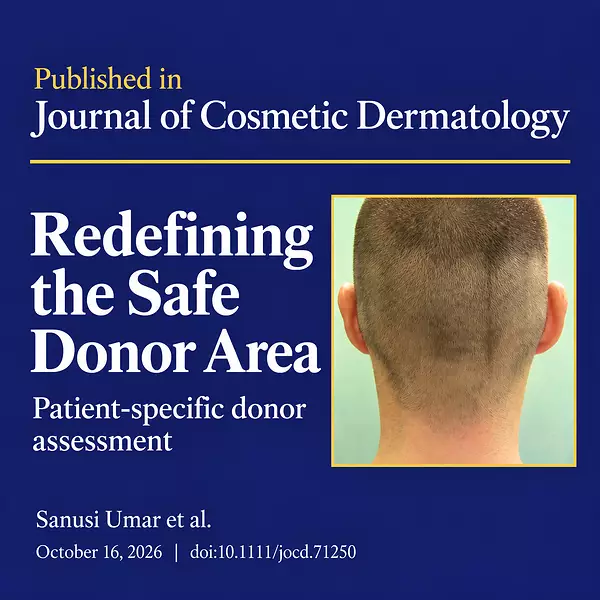
New hair transplant review challenges fixed donor limits