MEERUT, India (AP) — Police in India’s most populous state have shot hundreds of Muslim men accused of cow smuggling in the legs in encounters that critics describe as extrajudicial justice designed to pander to India’s Hindu majority, an Associated Press investigation found.
Police in Uttar Pradesh say they shoot in self-defense and that the state’s “zero tolerance” policy on crime has helped restore law and order.
Now the tactic of shooting people just below the knee — known locally as “Operation Lame” — is spreading to other states in India, even as human rights lawyers, local judges and activists raise alarms about rule of law and religious bias in the world’s largest democracy.
Here are key takeaways from the investigation:
The Center for the Study of Organized Hate, a Washington-based think tank, compiled records of nearly 650 cases in which Uttar Pradesh police shot and injured suspects accused of cow smuggling since 2020. They were shared exclusively with AP, which independently reviewed a sample of more than 200.
In case after case, suspects were shot in the leg, most often below the knee. Police accounts described suspects fleeing, opening fire and being wounded when officers shot back.
Dr. Mohd Kaleem Khan, a forensic medicine professor in Uttar Pradesh, said a bullet passing horizontally through a fleeing person’s calf without striking bone would be highly unlikely, particularly from a distance. He said such wounds suggest deliberate shots at close range.
Over 90% of suspects injured in cow-smuggling-related shootings were Muslim, according to the center’s analysis of 627 cases with identifying information available.
“State institutions, particularly the law enforcement, are increasingly being used as the vehicles for the persecution of Muslim minority,” said Raqib Naik, executive director of the Center for the Study of Organized Hate.
The findings almost certainly represent an undercount because the analysis is based only on incidents police themselves publicized.
Amitabh Yash, a senior Uttar Pradesh police official, told the AP that police are instructed to respond only in self-defense, and said police in his state have killed and injured far fewer suspects, per capita, than police in the United States.
Yash said there is no order to shoot suspects in the leg and added that he would investigate the consistent pattern of injuries if an appropriate complaint were lodged. He said the high proportion of Muslims among injured suspects accused of cattle smuggling reflected their prominence in the cattle trade.
“The police must be questioned for every action they take. Every action is open to scrutiny, whether it is a death or an injury,” he said. “In the last year, there has been no reason to punish any police officer for inappropriate use of force.”
Under Prime Minister Narendra Modi’s leadership, India has moved away from its founding as a secular democracy and toward a Hindu-first state. In Uttar Pradesh, the chief minister, Yogi Adityanath, has positioned himself at the hard edge of this surging religious nationalism. Critics say his tough-on-crime approach amounts to a veiled attack on Muslims that panders to the hard-line Hindu vote.
From the time Adityanath took office as chief minister in March 2017 through Oct. 13 of this year, 316 suspects were killed in police encounters and 110 of them — around one in three — were Muslim, according to state police data obtained by the AP. That’s a higher proportion than the state’s overall population, which is around one in five Muslim.
Over the same period, 12,890 suspects were injured, while 18 police were killed and 1,953 injured in the line of duty. Data on the religion of suspects injured by police was not available.
Yash, the senior police official, disputed allegations of religious bias.
“The police itself has all castes and religions,” he said. “You cannot try to target one group.”
The AP spoke with relatives of six Muslim men who had been shot in the leg by police. All spoke anonymously, fearing repercussions. The men remained in jail or in hiding.
Two mothers said their sons traded buffalo, which are outside cow protection laws. They said their sons could no longer work, leaving their families dependent on handouts and small loans.
“He’s been left lame,” one of the mothers told AP. “If someone gives us something, we accept it. That’s how we’re getting by. That poor man can’t go out and work anymore. Whatever people give us, we eat.”
Kinetz reported from Rome. Anika Seth and Rishabh Jain contributed to this report.
Associated Press religion coverage receives support through the AP’s collaboration with The Conversation US, with funding from Lilly Endowment Inc. The AP is solely responsible for this content.
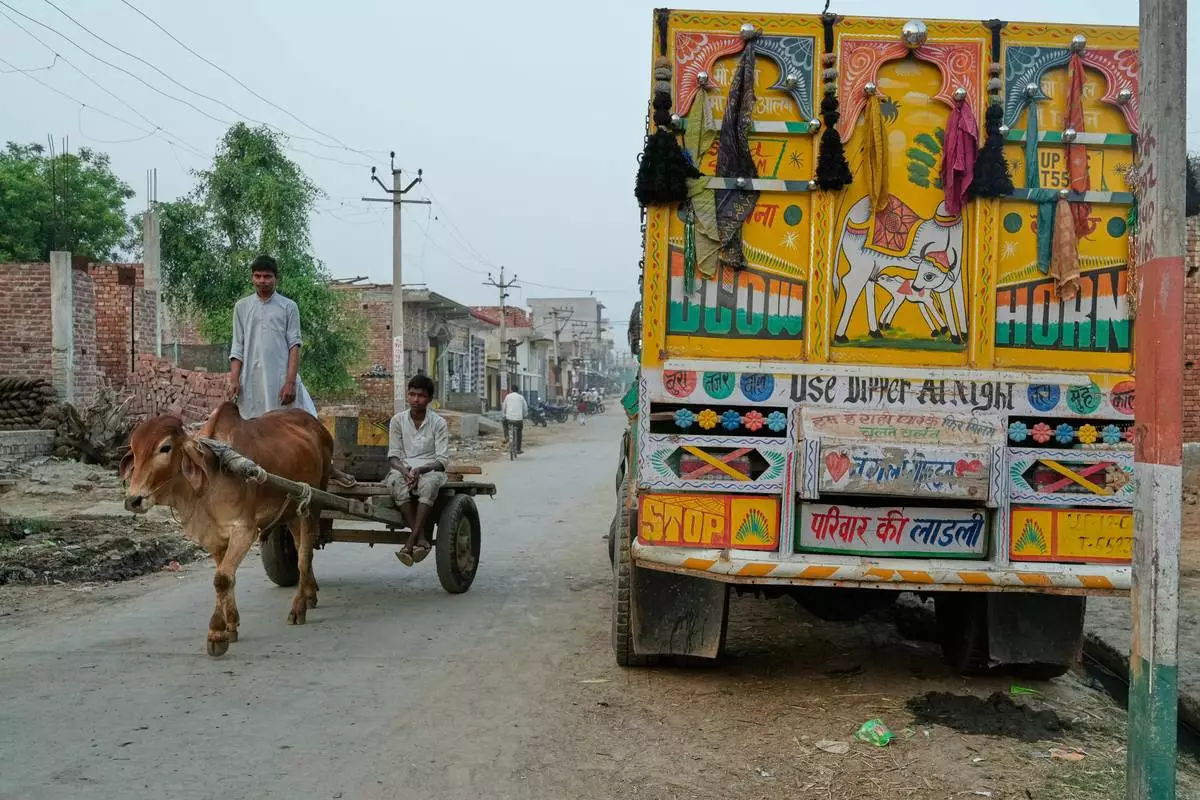
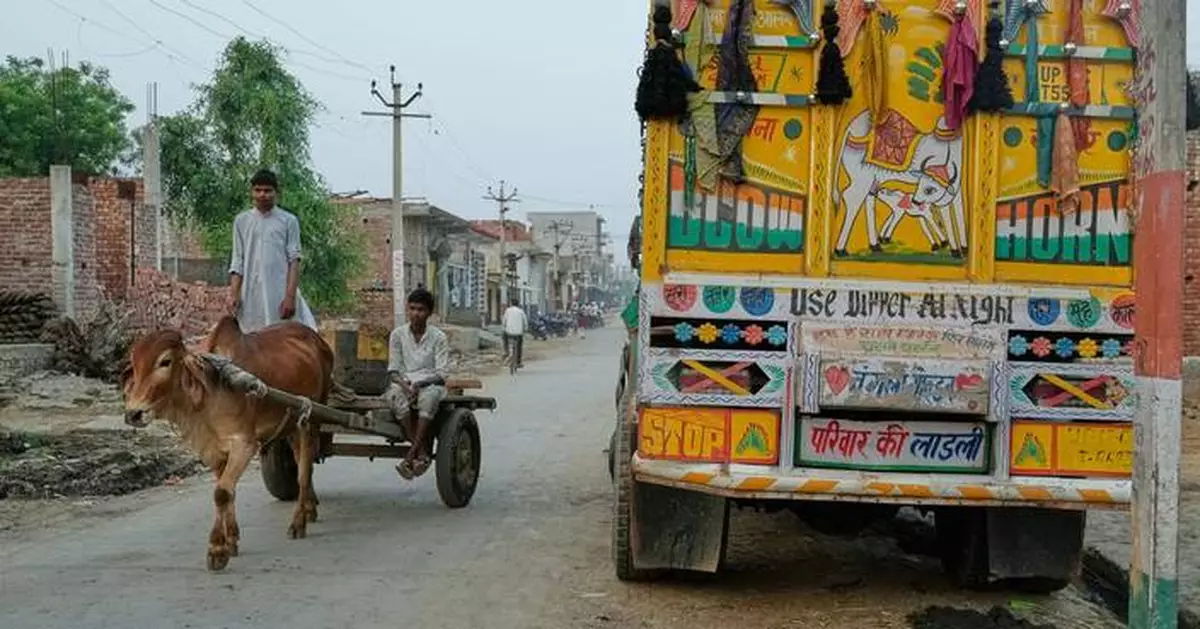
A villager rides a bullock cart past a truck bearing a painting of a cow and her calf in a village near Muzaffarnagar in India's Uttar Pradesh state, Tuesday, April 15, 2025. (AP Photo/Manish Swarup)