SOFIA, Bulgaria (AP) — Bulgarians will vote for a new president on Sunday following an election campaign that was focused mainly on Russia’s war in Ukraine and the widening hostilities in the Black Sea, on Bulgaria's doorstep, including deadly drone attacks on commercial vessels.
Candidates are also addressing public fears about the steep rise in energy prices and surging inflation, with many Bulgarians in rural areas struggling to make ends meet.
Click to Gallery
Posters featuring independent presidential candidate Andrey Gyurov and his vice-presidential running mate, Georgi Kandev are displayed on screens during their campaign's closing event in Plovdiv, Bulgaria, on Oct. 21, 2026. (AP Photo/Valentina Petrova)
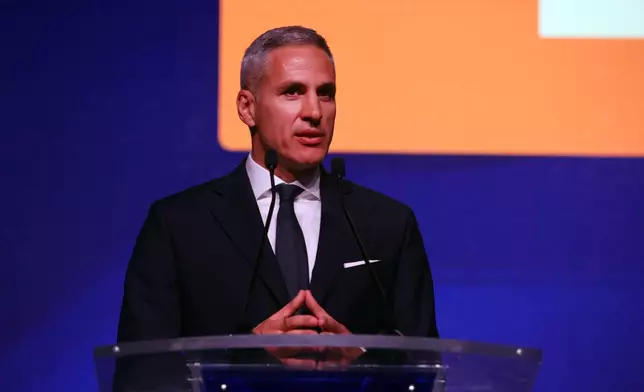
Independent presidential candidate Andrey Gyurov speaks during campaign's closing event in Plovdiv, Bulgaria, on Oct. 21, 2026. (AP Photo/Valentina Petrova)
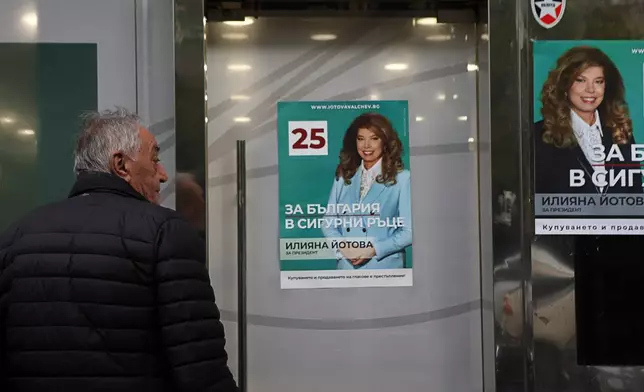
Poster of incumbent President and presidential candidate Iliana Yotova is seen in Sofia, Bulgaria, Thursday, Oct. 22, 2026, before presidential elections on Sunday, Oct. 25. (AP Photo/Valentina Petrova)
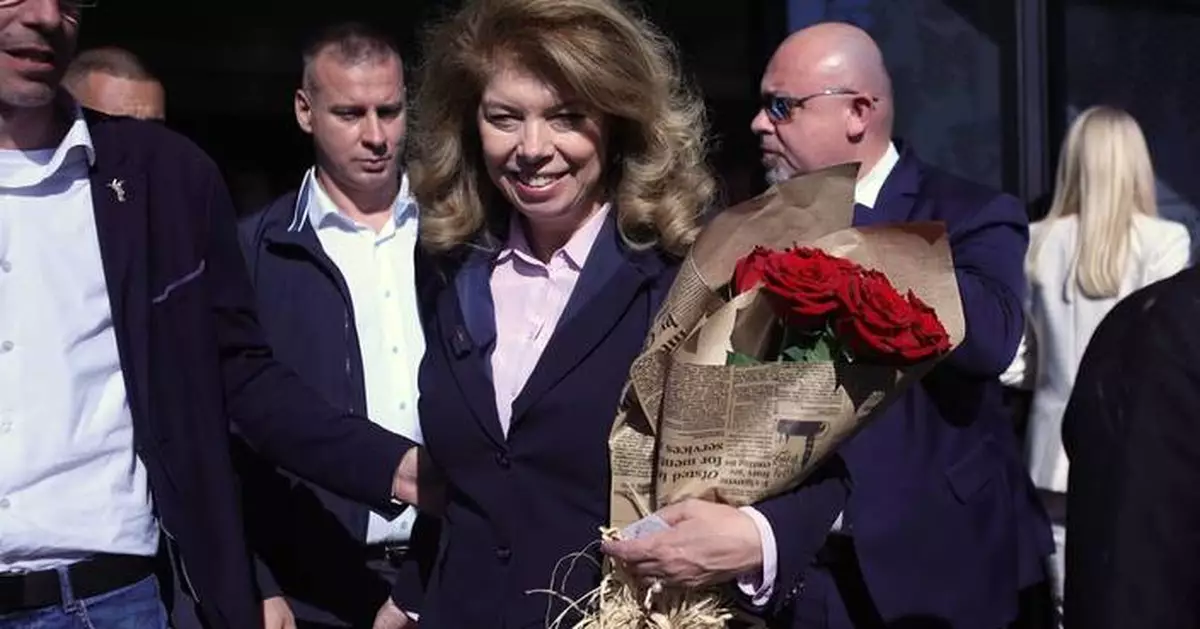
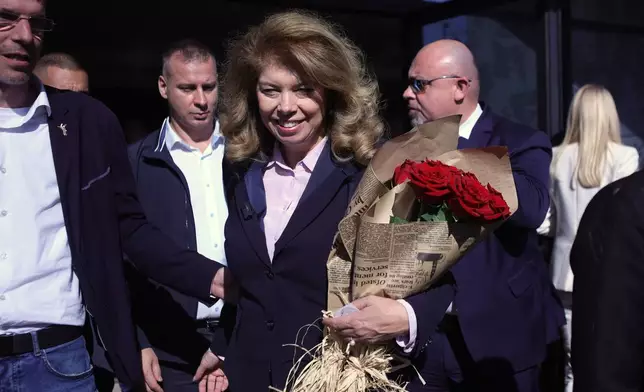
Incumbent President and presidential candidate Iliana Yotova attends pre-election campaign event in Sofia, Bulgaria, on Oct. 20, 2026. (AP Photo/Valentina Petrova)
Bulgaria’s presidency is primarily ceremonial. Although the head of state has no executive powers, and all major policies must be approved by Parliament, direct election gives the president greater political authority. The president leads the armed forces and can veto legislation, signs international treaties and appoints ambassadors.
Presidents in Bulgaria are elected directly for a five-year term and can serve no more than two terms.
Analysts expect none of the 27 candidates to win outright on Sunday. Turnout must be above 50% of 6.6 million registered voters and the winner needs a majority of the votes. Sunday’s turnout is expected to be less than 40%, which means a runoff on Nov. 1.
Incumbent Iliana Yotova, a 62-year-old journalist and former member of the European Parliament, is a front-runner. She previously served as vice president under Rumen Radev, the current prime minister, during his two terms as head of state. She took over the presidency in January 2026, when Radev stepped down to run for parliament, and is seeking her own mandate.
Radev's center-left Progressive Bulgaria party won a landslide victory in April’s general election. Yotova is running as an independent, but also has the official backing of Progressive Bulgaria and the Socialist Party, where her career began.
Her main challenger is economist Andrei Gyurov, a former deputy governor of the central bank and caretaker prime minister who led the country in the early months of 2026. He is supported by the pro-Western reformist opposition. Observers believe his best chance of winning would come in a runoff.
Yotova's victory would keep the presidency in the hands of the ruling majority, a departure from the country's post-communist history.
The Balkan country joined NATO in 2004 and the European Union in 2007, and while there is a broad consensus among the parties in Parliament on the country's pro-Western path, widespread pro-Russian sentiments based on traditional historical and cultural ties with Russia have divided society, particularly since the start of Moscow’s full-scale invasion in Ukraine.
Radev has often stated that he would keep Bulgaria on its European path but at the same time he has called for improved relations with Russia and the lifting of sanctions. Analysts expect Yotova to continue Radev’s policy.
Dobromir Zhivkov, managing director of Market Links polling agency, said that Yotova belongs to the political class that advocates a more neutral position for Bulgaria.
“They call for an end to aid for Ukraine and a halt to arms deliveries to Ukraine; we often hear them use Kremlin rhetoric and terminology borrowed directly from Kremlin propaganda” he told The Associated Press.
Addressing supporters at a rally this week, Yotova said that one of the main points of divergence from her opponents was the war in Ukraine. She said she advocated for peace through negotiations, rather than force.
“Do we want the Black Sea to become a closed military zone? We will categorically not agree to such a decision. I will not accept this warmongering,” she said.
A string of drone attacks on at least seven cargo vessels in the Black Sea this month, off the coasts of NATO members Romania and Bulgaria, has raised concerns over Russia's intentions to escalate the conflict. The attacks in the two countries’ exclusive economic zones threaten a global shipping route and have left three people dead with at least 28 missing. They also run the risk of drawing other countries directly into the war for Ukraine.
A poll conducted Oct. 13-19 by Market Links gave Yotova 47.3% versus Gyurov's 30.6%. The poll was conducted among 1,006 Bulgarians and has a margin of error of 3 percentage points.
If she wins, Yotova would become Bulgaria's first elected female president.

Posters featuring independent presidential candidate Andrey Gyurov and his vice-presidential running mate, Georgi Kandev are displayed on screens during their campaign's closing event in Plovdiv, Bulgaria, on Oct. 21, 2026. (AP Photo/Valentina Petrova)
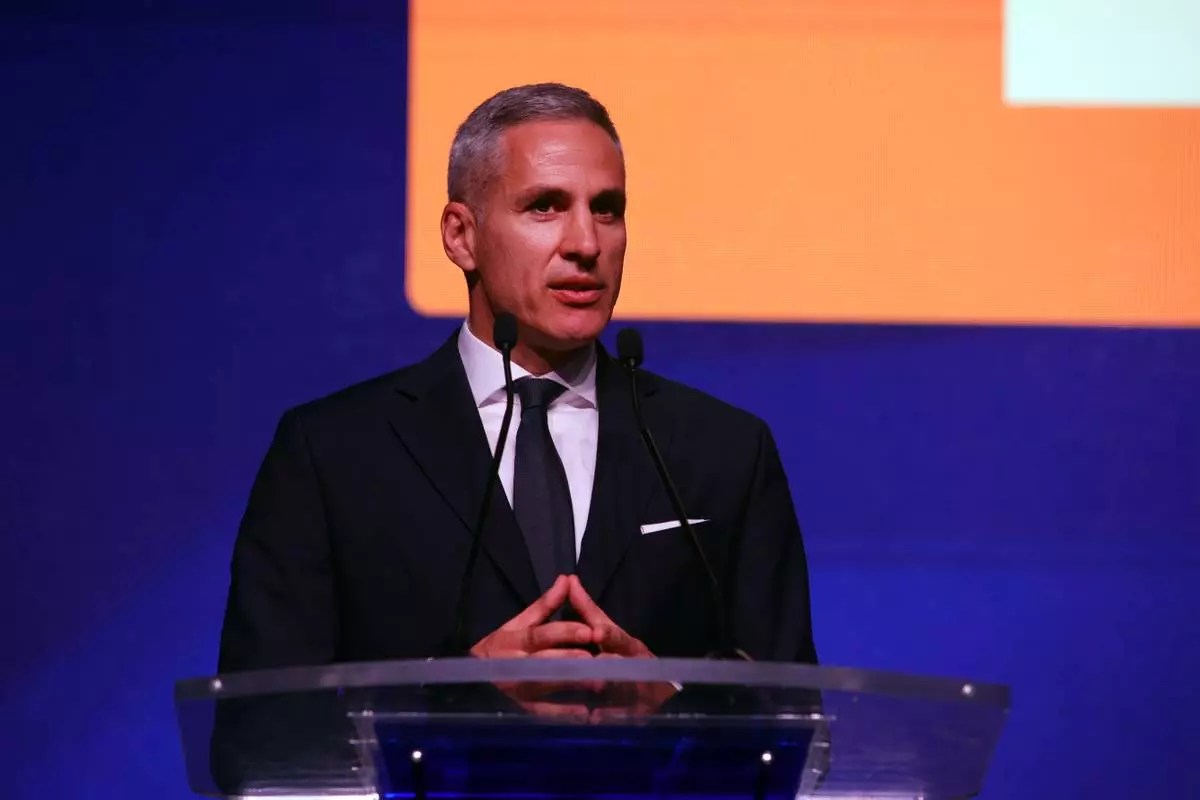
Independent presidential candidate Andrey Gyurov speaks during campaign's closing event in Plovdiv, Bulgaria, on Oct. 21, 2026. (AP Photo/Valentina Petrova)
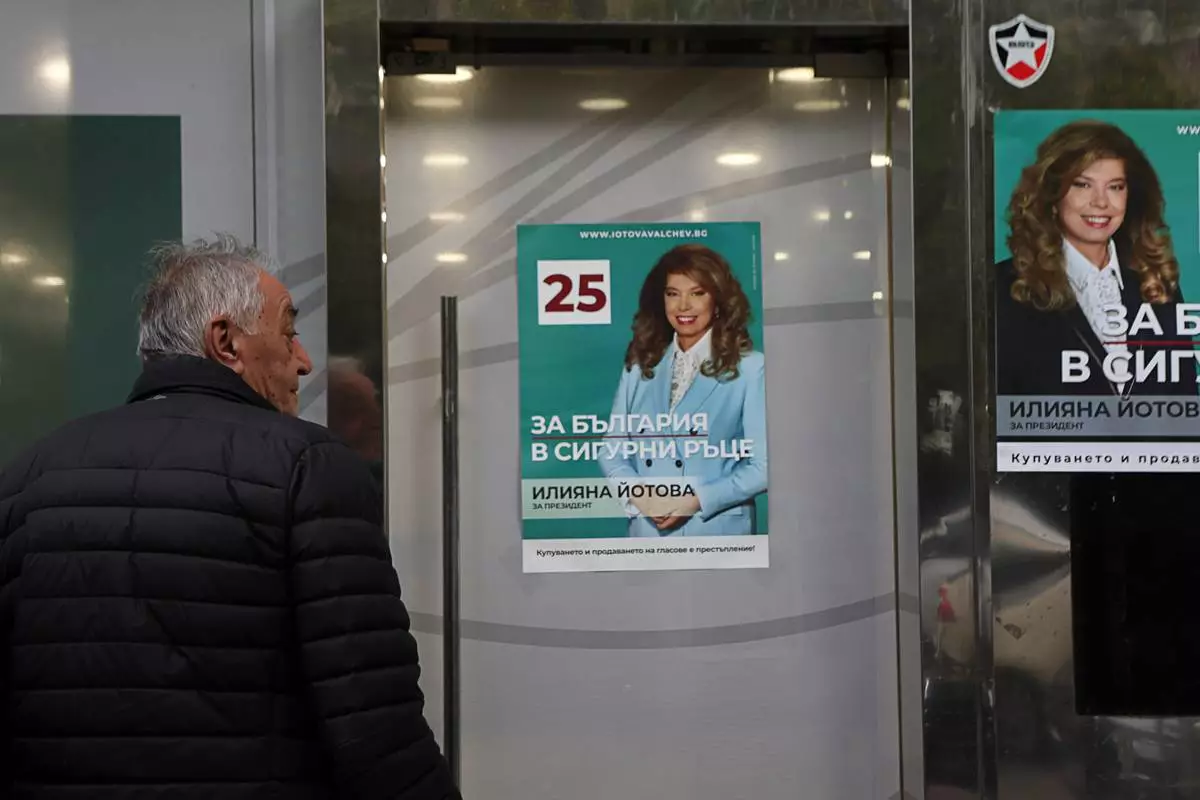
Poster of incumbent President and presidential candidate Iliana Yotova is seen in Sofia, Bulgaria, Thursday, Oct. 22, 2026, before presidential elections on Sunday, Oct. 25. (AP Photo/Valentina Petrova)

Incumbent President and presidential candidate Iliana Yotova attends pre-election campaign event in Sofia, Bulgaria, on Oct. 20, 2026. (AP Photo/Valentina Petrova)
SAN FRANCISCO (AP) — Most of the immigrants targeted by federal authorities in California this week for alleged voter fraud had applied for U.S. citizenship and now face charges related to lying on forms or during interviews. Those charges could lead to years in prison and thwart their efforts to naturalize.
One of them is José Antonio Bañuelos-Díaz, 42, who applied for citizenship in October 2025 after living in the country for 40 years and spending his entire adult life as a legal permanent resident. The federal government has alleged in charging documents that he improperly claimed to be a citizen in 2007 when registering to vote, then later lied about it on his immigration paperwork. The government hasn't accused him of casting a ballot.
Bañuelos-Díaz told The Associated Press he had no idea he had registered to vote until he was arrested Monday outside his Los Angeles home, though he recalls getting a driver's license around 2007. In California, people are prompted to register to vote when applying for a driver’s license.
“I have never voted because I know I can’t vote,” he said. “If there was a mistake, they should have called me out right away, not 20 years later.”
He was released from custody after his arrest but faces up to five years in prison if convicted.
Federal authorities on Monday charged more than two dozen legal permanent residents in California in a crackdown on people accused of illegally voting or registering to do so. As of Thursday morning, the government had filed charging documents in 10 of the 28 cases, offering additional details about how authorities relied on voter registration data to pursue broader criminal charges around immigration status.
Most of the immigrants charged in California have lived in the country for at least five years, and some of them for decades. They registered as Republicans, Democrats and independents, according to voter data, and they could face deportation if they lied on their citizenship application.
Immigrants convicted of illegally voting in the United States face up to a year in prison. Those convicted of lying on applications to become American citizens face up to a decade.
The Justice Department said in a statement that six people would be charged with voting as a noncitizen, a misdemeanor. The 22 others were facing a combination of felony charges including lying on their naturalization application during interviews or on voter registration forms.
In one case, Homeland Security agents arrested Pamele Arbues Line immediately following her Oct. 15 naturalization interview in San Diego.
In charging documents, the federal government said Line had allegedly registered to vote five times and had submitted ballots in several elections but said in her paperwork and in the interview that she had never voted or claimed to be a U.S. citizen. She later admitted to registering to vote while getting her driver’s license renewed last year and said she voted once, according to the charging documents.
Line, who is from the Philippines, told authorities she thought she was a U.S. citizen because her mother had become naturalized after they moved to the United States more than four decades ago. But Line, now 56, was 19 at the time and not covered by her mother's citizenship, according to the government. She learned she was not a citizen in June when she went to get a renewed Social Security card, and she told agents she applied for naturalization the same day, according to the documents.
She faces at least 10 years in prison if convicted of two charges.
The cases are part of a Trump administration effort to root out noncitizen voting ahead of the midterm elections, even though data shows that the problem is incredibly rare, difficult to prove and has not been shown to change the outcome of races.
The Department of Justice has sued California for not complying with a request to verify the citizenship of roughly 20,000 registered voters it says may be noncitizens. California, which has more than 23 million registered voters, has argued the state complies with federal law and that the Trump administration's numbers are likely significantly inflated.
State election officials also noted once a ballot is mailed in, it is separated from any individual voter identification, making it impossible to separate based on the information provided by the federal government.
Beyond voting, the Trump administration has also ramped up immigration enforcement nationwide and slowed down the approval of naturalization applications. Government data shows officials approved 58,000 naturalization applications between April and June 2026, less than a quarter of the number approved in the same period in 2025, according to the data.
Immigrants can apply to become U.S. citizens after holding green cards for at least three years. They must answer extensive questions about activities related to voting, political activities and crime, pass background checks and a civics test and meet English language requirements.
The Department of Homeland Security did not say what initially drew attention to the immigrants charged but said in an email that the agency reviewed naturalization and other records in its investigation. Some of the court documents in the cases describe a benefits fraud audit performed by Homeland Security in August that started the process of identifying those charged this week.
“The voting rights of American citizens must be protected,” First Assistant U.S. Attorney Bill Essayli said in a statement announcing the charges this week.
Amandeep Kaur, who is among those charged, has lived in the country for eight years and is in the process of becoming a naturalized U.S. citizen, said her husband, Kulwinder Singh.
Singh said she got her driver's license in 2024 but took the written test at the DMV in Hindi because she struggles with English. He doesn’t know if she registered to vote then. He said she received and returned a ballot in 2024 but they both thought it was a registration form.
Now, he said his wife is distraught with the news that she may have done something illegal.
“All she does is cry. It’s heartbreaking,” said Singh, who is a U.S. citizen.
Lauer contributed from Philadelphia and Taxin from Santa Ana, California.

A Homeland Security Investigations task force officer stands near police tape marking a perimeter during a federal operation targeting suspected illegal voter registration in Commerce, Calif., Monday, Oct. 19, 2026. (AP Photo/Jae C. Hong)

Acting U.S. Deputy Attorney General Trent McCotter stands next to a display showing photos of people charged with illegally registering to vote during a news conference in Los Angeles, Monday, Oct. 19, 2026. (AP Photo/Jae C. Hong)

Homeland Security Investigations task force officers escort a suspect accused of illegally registering to vote during a federal operation in Commerce, Calif., Monday, Oct. 19, 2026. (AP Photo/Jae C. Hong)

Homeland Security Investigations officers leave a home after arresting a suspect accused of illegally registering to vote during a federal operation in Commerce, Calif., Monday, Oct. 19, 2026. (AP Photo/Jae C. Hong)