SYDNEY (AP) — New Zealand rugby great Sonny Bill Williams says he has had successful open-heart surgery.
In a long video documenting the health issue on his YouTube channel, the 41-year-old Williams said he discovered he had been born with a heart defect after going for a routine checkup following a neck operation.
In footage taken after heart surgery, Williams said it was a success and that he was making it his “mission” to raise awareness of the need to take heart checks.
Williams started out as a rugby league player, becoming a superstar in the 13-man code, before switching to 15-man rugby union and winning the World Cup twice with the All Blacks, in 2011 and 2015.
He retired from both rugby codes in 2021 and has since taken up professional boxing, his most recent heavyweight fight coming last year.
Williams said doctors told him that having a heart defect would have affected his sporting career.
“Upon reflecting, I feel like toward my late 20s, I definitely felt like I couldn't get as fit as I used to,” he said.
“The doctors both said,” he added, “it is a miracle that you found it (the defect) because it's a case of a perfectly fit-looking person dropping dead.”
Speaking from inside the hospital, Williams said he has a “better heart than when I walked in here.”
See AP’s full rugby coverage here

FILE - New Zealand's Sonny Bill Williams handles the ball during the Rugby World Cup Pool B game at Oita Stadium between New Zealand and Canada in Oita, Japan Oct. 2, 2019. (AP Photo/Aaron Favila)
Asian shares were mostly lower Friday after the latest shudder for artificial-intelligence stocks weighed on markets around the world, giving the benchmark S&P 500 its worst day since July.
Oil prices were hovering at their highest levels since May on worries about the war with Iran, with Brent crude up 0.5% at $113.73 per barrel. U.S. benchmark crude oil added 0.6% to $100.08 per barrel.
In share trading, Tokyo's Nikkei 225 lost 1.7% to 61,825.26, while the Kospi in South Korea declined 2.4% to 5,403.32.
Hong Kong's Hang Seng climbed 0.2% to 22,983.80 and the Shanghai Composite index slipped 1.3% to 3,610.52.
In Australia, the S&P/ASX 200 shed 0.2% to 8,777.00.
On Thursday, the S&P 500 fell 1.2%, while the Nasdaq composite tumbled 2.6%. The weakness for tech stocks was so overwhelming that it masked strength for the rest of the U.S. market, where the majority of stocks actually rose. The Dow Jones Industrial Average added less than 0.1%.
AI-related stocks have been swinging on worries that their boom may be under threat because of how expensive it’s become to borrow money to build data centers and buy more AI chips. Investors fear their prices shot too high during a yearslong frenzy, even though companies in the industry continue to report growth.
Meta Platforms, which is pushing its Muse AI agent, lost 7% after reporting stronger revenue for the latest quarter than analysts expected, though its profit fell short. The company behind Facebook and Instagram also said it’s creating a new class of stock to raise money to pay for AI investments and other expenses.
Tesla fell 3.1% after reporting a stronger profit for the summer than analysts expected, though its revenue was weaker than forecast.
The global tide against AI stocks knocked Nvidia down 4.4%. Because the chip giant is the largest company on Wall Street by total value, movements for its stock carry more weight on the S&P 500 than any other, and it was the single strongest force pulling the index lower.
CoreWeave, which has borrowed money to buy Nvidia’s AI chips that it rents out to customers over the cloud, has been particularly shaky in recent weeks because of worries about its debt. It dropped 10.1%.
Higher oil prices also have been weighing on stocks. The price for a barrel of Brent crude oil leaped 4% on Thursday and has shot up from less than $97 at the start of the month on uncertainty about when the war with Iran will allow the global energy industry to return to normal.
Worries about big government debt loads and strained budgets are hanging over almost every developed economy. Protests across France have raised pressure on the government to increase spending, which could add further to its debt.
In the United States, such concerns, along with high inflation, signals of a still-strong U.S. economy and other factors, have pushed yields in the U.S. bond market recently to their highest levels in decades.
But U.S. yields fell sharply Thursday in a signal that investors were buying U.S. government bonds in search of something safer to own as AI stocks tumbled.
The yield on the 10-year Treasury tumbled to 4.97% from 5.13% late Wednesday and from more than 5.30% earlier this month. That’s a major move for the bond market.
Thursday’s drop in yields came even as another report suggested the U.S. economy may be doing better than economists expected. It said fewer U.S. workers applied for unemployment benefits last week, which could signal that layoffs remain low across the country.
In other dealings early Friday, the U.S. dollar rose to 156.93 Japanese yen from 156.77 yen. The euro was unchanged at $1.1215.
AP Business Writer Stan Choe in New York contributed to this report.
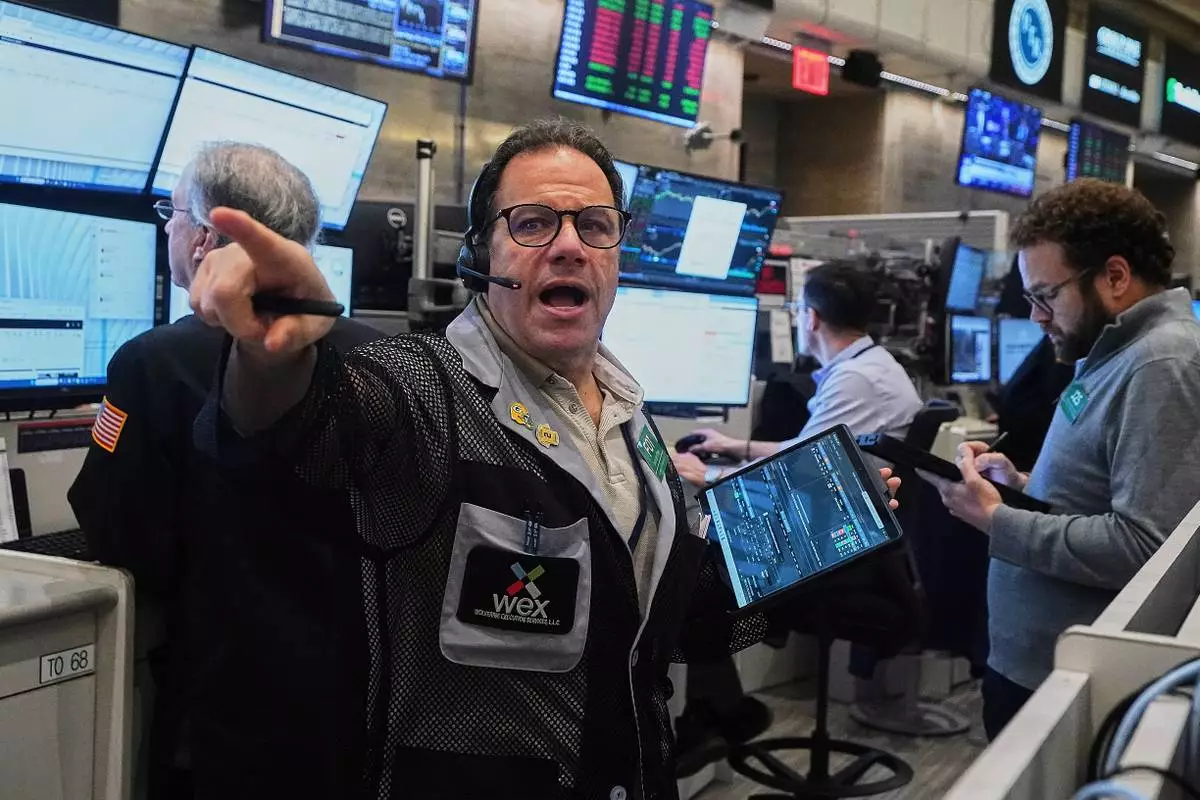
FILE - Options trader Anthony Spina works on the floor of the New York Stock Exchange, Wednesday, Jan. 7, 2026. (AP Photo/Richard Drew, File)
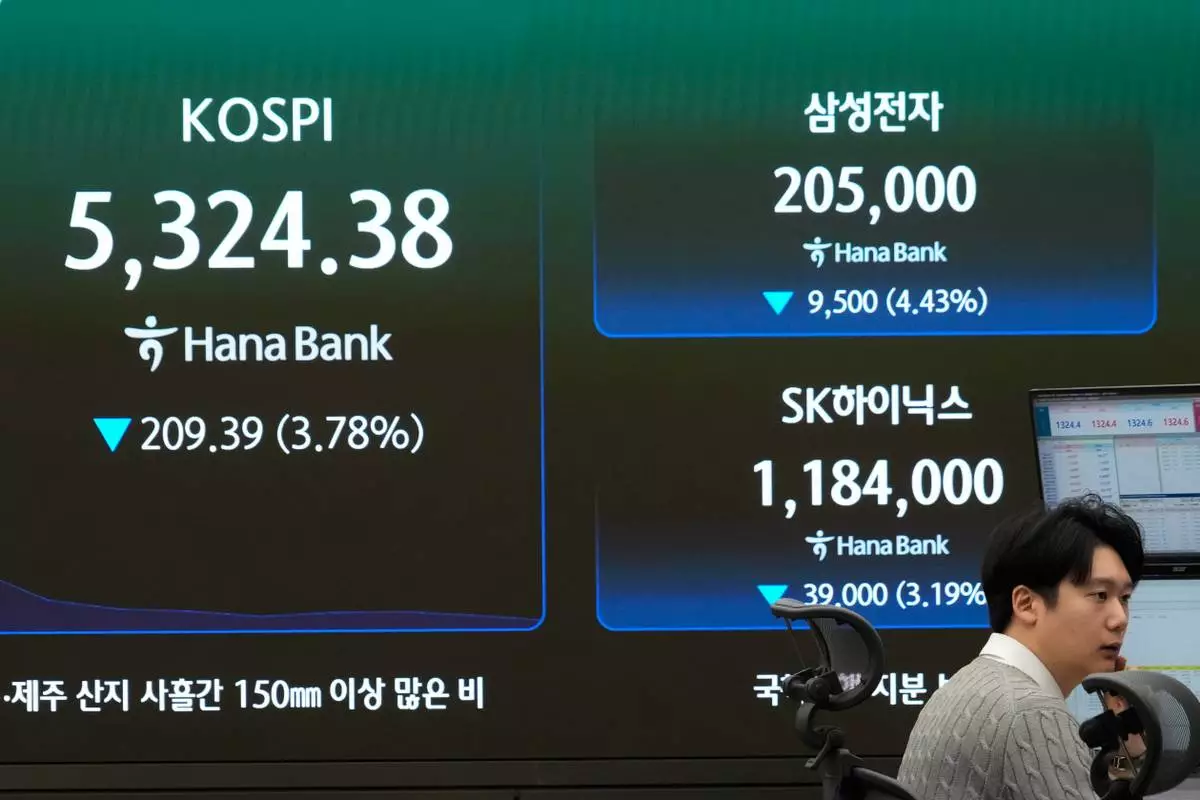
A screen shows the Korea Composite Stock Price Index (KOSPI), SK Hynix and Samsung Electronics Co. stock price at the foreign exchange dealing room of the Hana Bank headquarters in Seoul, South Korea, Friday, Oct. 23, 2026. (AP Photo/Ahn Young-joon)

Currency traders watch monitors near a screen showing the Korea Composite Stock Price Index (KOSPI) at the foreign exchange dealing room of the Hana Bank headquarters in Seoul, South Korea, Friday, Oct. 23, 2026. (AP Photo/Ahn Young-joon)

Currency traders work at the foreign exchange dealing room of the Hana Bank headquarters in Seoul, South Korea, Friday, Oct. 23, 2026. (AP Photo/Ahn Young-joon)