SAO PAULO (AP) — Since finishing behind Flávio Bolsonaro in the first round of Brazil’s presidential election, President Luiz Inácio Lula da Silva has leaned into populist promises to boost his chances of winning the runoff.
Should he win Sunday's vote, turning those promises into reality would come at a heavy cost to Brazil.
Lula, 80, is seeking his fourth nonconsecutive term against 45-year-old Bolsonaro, an ally of U.S. President Donald Trump. A defeat for the incumbent would mean a big boost to Trump's influence in the region and a return to office for the right-wing Bolsonaro family.
The promises made by Lula as he attempts to close the gap with Bolsonaro include:
Legislation to reduce the country’s workweek from six days to five and weekly working hours from 44 to 40 without reducing pay was approved by Congress 10 days before the runoff. Bolsonaro endorsed the measure late in the campaign. Many business leaders say cutting working hours without corresponding productivity gains raises labor costs, hurts small businesses and risks fueling inflation and informal employment.
In September, Lula announced a 15% increase in payments under Brazil’s main welfare program, Bolsa Família, which bases benefits on family size and the number of children. The increase took effect this week, days before the election, and will benefit nearly 50 million people. Critics describe permanent government-funded income transfers as a classic populist tool for securing voter loyalty. The government said the increase will cost taxpayers 5.8 billion reais ($1.2 billion) for the rest of the year.
Lula on Wednesday endorsed credit relief and tax incentives for small businesses, giving them access to low-interest government loans through public banks and allowing them to renegotiate some of their debt. The government estimates the program will cost 3 billion reais ($600 million) over the next three years.
He also introduced a national debt refinancing program aimed at clearing default records for millions of low-income Brazilians. Opposition analysts and market commentators describe the state-backed debt forgiveness and subsidized renegotiations as short-term relief that fails to address gaps in financial literacy.
Lula issued some executive measures aimed at curbing fuel costs, including a decree that eliminates federal taxes on the import and sale of gasoline for a 30-day period, with the option for further extensions. These moves increased federal tax relief on gasoline and subsidized diesel costs for importers. The government also extended tax exemptions and expanded support for ethanol to keep alternative biofuels competitive at the pump. The estimated cost of the measures is 5.2 billion reais ($1 billion), Brazil's government says.
Lula also is sending to Congress a bill to establish zero-fare public transportation on weekends. Experts say the cost of such an initiative depends on the chosen model and ranges from 5 billion to 16 billion reais ($1 billion to $3.2 billion).
Follow AP’s coverage of Latin America and the Caribbean at https://apnews.com/hub/latin-america

Brazilian President Luiz Inacio Lula da Silva, who is running for reelection, speaks and gestures during a televised presidential debate one week before the presidential runoff election in Sao Paulo, Brazil, Sunday, Oct. 18, 2026. (AP Photo/Andre Penner)
LOS ANGELES (AP) — Strapped into a harness, Josh Law was lowered from a U.S. Coast Guard helicopter into the rough Pacific Ocean in the pitch black night, far off the Mexican coast.
The force of the helicopter blades pummeled the water, whipping up spray and turbulence. The Coast Guard rescue swimmer couldn’t hear anything over the noise or see anything in the darkness. Waves of 6 to 8 feet (1.8 to 2.4 meters) hit him.
All he could do was follow the searchlight from the helicopter with the hope it would lead him to the more than two dozen people flung into the cold waters some 140 miles (225 kilometers) off the coast of Mexico’s Baja peninsula. He would personally rescue 16 of them.
“I was experiencing exhaustion at that point," Law, 24, told The Associated Press in his first interview since the rescue. "We had very little sleep. But what I was experiencing was nothing compared to what they were at that point ... I just had to keep that in mind.”
Over the next two hours in the predawn hours of Oct. 16, Law was the sole person in the water who would get the people whose boat had capsized out of the water. Eleven others were never found. The Coast Guard called off its search late Sunday.
Law described the dramatic operation to save lives along a remote route frequented by migrant smuggling boats. What the boat was doing out there and where it originated from are part of a federal investigation. It was unclear if the vessel got lost, had engine failure, was swept out to sea or meant to go that far. Only what were believed to be pieces of the boat were found. All who were rescued are Mexican, the Mexican consulate said.
The Coast Guard said U.S. Customs and Border Protection was investigating and interviewing the survivors, but the agency did not respond to multiple inquiries on whether the vessel was a migrant smuggling boat.
The mayday call came in around 1 a.m.
Someone said their boat was sinking in the middle of the Pacific Ocean off the coast of Ensenada, Mexico.
Within minutes, the alarm sounded at the U.S. Coast Guard Air Station in Ventura, northwest of Los Angeles, rousing Law and his colleagues from their sleep.
Helicopter pilot Lt. Miyako Miller checked flying conditions and planned the flight route that would take the crew of four over the vast ocean south of the U.S. border.
Law prepared his dry suit, fins and medical items, then put on a harness that would be hooked onto a cable to lower him down from the aircraft into the ocean.
By 2 a.m., they were taking off from the Coast Guard station in Ventura.
Miller wore night vision goggles to help her fly in the dark. She said she relied on the stars, with no moonlight that night.
As the crew approached the reported location of the sinking, Miller spotted a tiny flicker of light in the distance.
Then she spotted what looked like debris floating in the water, but it was difficult to distinguish what it was. Miller carefully navigated the helicopter over the area, lowering the aircraft until it was hovering about 40 feet (12 meters) above the water.
“I’m doing my best to maintain my references externally by looking outside through the night vision goggles," Miller said, adding that meanwhile “the flight mechanic is telling me where to position the helicopter.”
Some 250 miles (400 kilometers) southwest of Ensenada, Mexico, is Guadalupe Island, a biosphere reserve that is well known as a place brimming with great white sharks.
Law said he didn’t think about what was in the water as he hooked himself to a cable and zipped into the ocean, strapped in a harness.
There was no time to waste. While Law’s dry suit provided some warmth, he knew the others had already spent hours in hypothermic temperature waters.
Law said he was guided by a searchlight from the crew, which allowed him to catch a glimpse of the people in the water.
They were scattered across a wide area. Some were wearing life vests that had tiny lights that produced the flicker first spotted by Miller. Others clung onto one another, buoys and pieces of wreckage, shivering and treading water to stay afloat.
Law said he swam to them, flipped them on their backs, put his arm over them and pulled them up using the “buddy tow” technique. Kicking his legs to swim, he carried them to the spot where he could signal the flight mechanic to lower a basket for them to be picked up.
“With one hand, I’m holding the survivor. With the other, I am signaling to the helicopter and working with the device,” he said.
He placed them into the basket, one by one. Then it was hoisted up to the helicopter where the crew got each person into the aircraft before lowering the basket again.
Law’s dry suit slowly filled up to his knees with water, feeling like weights pulling on him as he swam.
Over the next 90 minutes, Law battled heavy waves while swimming back and forth.
With a packed helicopter and dwindling fuel, the crew decided to head to the Coast Guard station in San Diego where ambulances were waiting.
On the flight, Law treated three people with what he described as “bad” wounds, staunching the bleeding. Several of the injuries were “consistent with shark bites" and the Coast Guard provided life-saving first aid, the agency said in a statement Saturday.
Customs and Border Protection officers went to a hospital and said they would process the survivors according to immigration laws after they were medically cleared. Nearly half of those rescued have since been returned to Mexico, U.S. officials said.
Law and his crew returned to Ventura that morning — it was by far the longest rescue operation he had ever done, he said.
The search for the 11 others continued for another two days to no avail. The Coast Guard, alongside Mexico and the U.S. Navy, searched more than 2,441 square miles (6,322 square kilometers) for a combined 89 hours.
Migrants are increasingly turning to the risky alternative offered by smugglers to travel by sea to avoid heavily guarded land borders. Small boats called pangas leave Baja at night and sometimes travel hundreds of miles (kilometers) north.
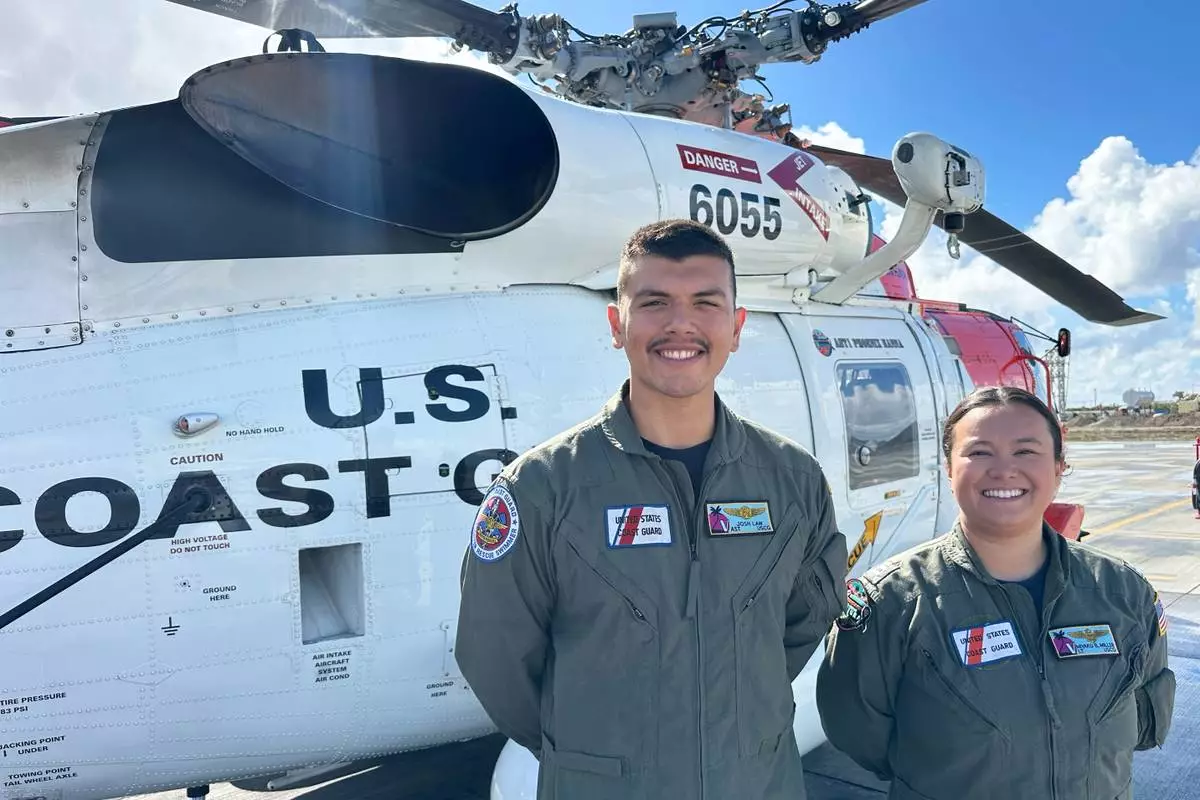
This photo made with a smartphone shows U.S. Coast Guard officer Josh Law, left, and lieutenant Miyako Miller standing in front of a rescue helicopter at the U.S. Coast Guard Air Station in Ventura, Calif., Thursday, Oct. 22, 2026. (AP Photo/Eugene Garcia)