IPSWICH, England (AP) — Nottingham Forest climbed out of the Premier League drop zone after it was held by Ipswich to 1-1 at Portman Road on Friday.
On a blustery night, Forest played with the wind behind them during the first half and it was a swirling ball that led to the opener.
Daniel Munoz threw in a high cross from the right and Neco Williams was unmarked in the box and guided his volley into the net.
Ipswich drew level four minutes before halftime when Nikola Milenkovic was caught in possession by Julio Enciso. The Paraguayan midfielder ran on to calmly slot the ball past diving goalkeeper Matz Sels.
The big talking point was the 48th minute decision not to send off Issa Diop after he felled James McAtee as he headed towards the Ipswich goal. The video referee looked at the decision and Diop was yellow-carded.
Forest had the bulk of the chances in a gritty second period but could not make its superiority count.
It rose to 16th place. Ipswich climbed one place into ninth.
See AP’s full soccer coverage here

Nottingham Forest's Xaver Schlager, left, and Ipswich Town's Exequiel Palacios in action during the English Premier League soccer match between Ipswich Town and Nottingham Forest in Ipswich, England, Friday Oct. 23, 2026. (Mike Egerton/PA via AP)

Nottingham Forest's Neco Williams goes down injured during the English Premier League soccer match between Ipswich Town and Nottingham Forest in Ipswich, England, Friday Oct. 23, 2026. (Mike Egerton/PA via AP)
WASHINGTON (AP) — President Donald Trump, seeking to help Republican Sen. Susan Collins in a tough reelection battle in Maine, is exempting some imports — including plywood sheets, packing crates and some machinery — from the 50% tariffs he slapped on $20 billion worth of Canadian products over the summer. The changes will take effect Oct. 30.
The White House said the president was seeking to offset "the burden to U.S. commerce while better serving the public interest.''
Collins, locked in a tight race with Democratic challenger Troy Jackson, issued a statement saying she'd spoken with Trump's top trade negotiator, Jamieson Greer, and Commerce Secretary Howard Lutnick "about the toll tariffs are taking on Maine families, businesses, farmers, and growers.''
"Many of our farmers and growers rely on specialized equipment, packaging materials, and other products from Canada that are either unavailable from American suppliers or cannot be replaced without incurring significant expense,” Collins said.
She said she asked for tariff relief for such products “and stressed the burdens additional costs impose on Maine businesses and families.”
Collins said she'd seek "additional relief from tariffs and encourage a broader trade agreement with Canada, our neighbor, ally, and largest trading partner.”
Trump started a trade war with America’s longstanding ally and northern neighbor, reaching back to a Depression-era trade law to impose tariffs on Canadian imports. He charged that Canada discriminates against U.S. dairy, auto and alcoholic beverage producers. Canada promptly lashed back with tariffs of 15% to 50% on American products, matching Trump’s import taxes dollar for dollar.
Trump ratcheted the dispute up from there last month by imposing a flat-out ban on $1 billion worth of Canadian imports, including alcoholic beverages, dairy products and motorcycles.
The U.S. president has claimed that foreign countries pay his tariffs. In fact, U.S. importers do. And they often face the tough choice of having to pass along the higher costs to their customers or absorb them.
As the Nov. 3 midterm elections approach, many Americans are furious about the cost of living. An Associated Press-NORC Center for Public Affairs Research poll of 2,140 U.S. adults, conducted Sept. 24-28, found that 65% now blame Trump’s policies for persistently high prices more than factors outside of his control, signaling weariness over his aggressive use of tariffs and unhappiness with the war with Iran, which has driven up the price of gasoline.
Oregon Sen. Ron Wyden, the top Democrat on the Senate Finance Committee, said in a statement, “Trump’s desperate, 11th hour attempt to save Susan Collins’ political career is an admission that American voters are rejecting his toxic tariff policies.”
Collins complained that Trump’s levies were hurting Maine farms and businesses that rely on Canadian imports when U.S.-made alternatives are not available. Her office cited the example of Maine wild blueberry growers who need specialized harvesting boxes from Canada that work with their processing equipment.
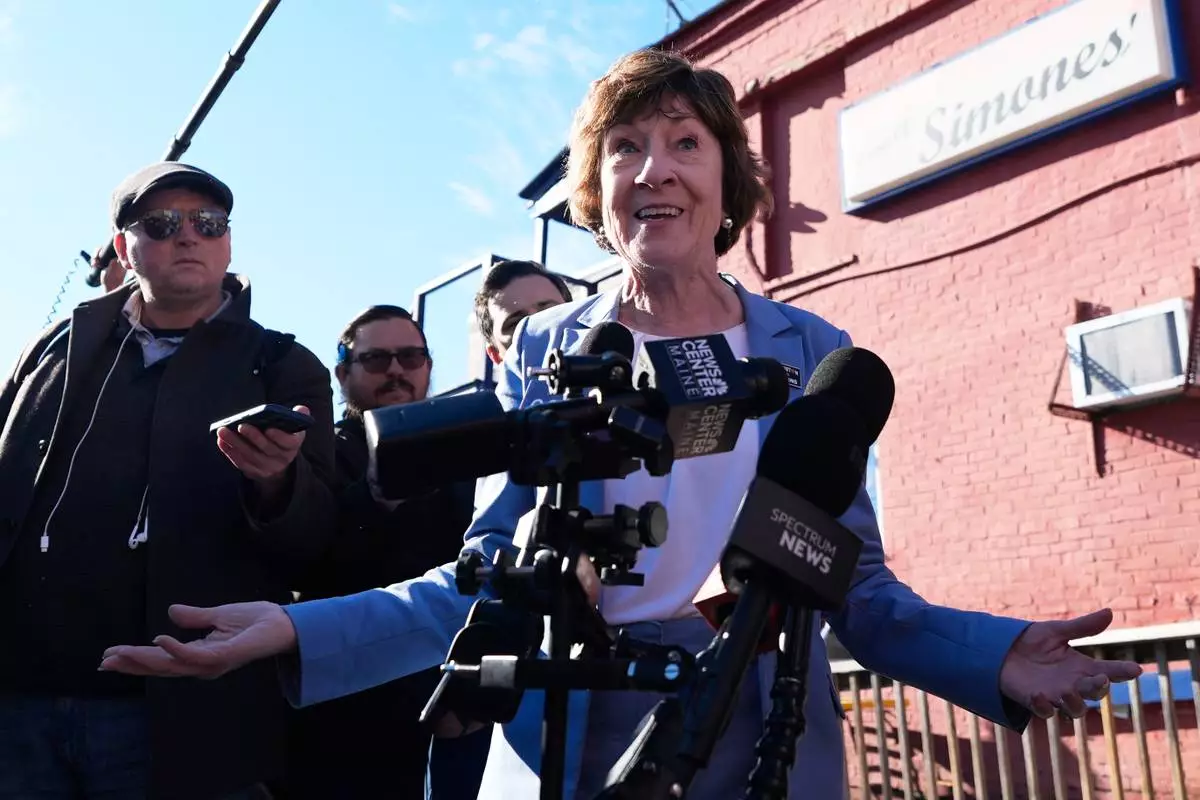
Sen. Susan Collins speaks to reporters following a campaign stop Wednesday, Oct. 21, 2026, in Lewiston, Maine. (AP Photo/Robert F. Bukaty)