TOKYO (AP) — Japan's unpopular revisions to the Imperial House Law that reinforce the male-only succession rules took effect Saturday. The new rules are expected to bring historic changes to Japan's 1,500-year-old monarchy.
The changes include allowing the adoption of distant male relatives raised as commoners to become royals and father future heirs, and letting princesses keep their royal status after marrying commoners.
But the revised law bars Emperor Naruhito 's hugely popular daughter Princess Aiko, 24, from becoming his successor, and her future possible children from even becoming royals.
Critics say the revisions discriminate against people based on their family background or gender and put pressure on younger members of the royal family to produce male offspring.
The Imperial Household Agency has said officials are studying how to implement the measures.
The male-only succession rule means the line must move to the emperor’s younger brother Akishino, then to his 20-year-old nephew Prince Hisahito. Next in line after him is the emperor’s 90-year-old uncle.
The revised law allows adoption of unmarried male descendants, aged 15 or older, of distant imperial relatives — but only of paternal lineage — into a branch of the royal family.
The plan is to find candidates from families that renounced their royal status in 1947, which at the time was to ease the postwar financial burden on the monarchy. Four of the 11 such families remain, but they are at least 36 generations removed from Naruhito after splitting from a common male-line ancestor 600 years ago, officials said.
The government efforts to make sure that male royals are producing male emperors have triggered criticisms.
Conservative scholars say there are a number of candidates, but so far nobody has come forward and many are skeptical if anyone will volunteer. Experts also raise questions about the lack of transparency in the selection process.
Previously, princesses who marry a commoner had to renounce their royal status and leave the royal family. The last one who did so, though willingly, was Mako, one of two nieces of Naruhito, who married her college boyfriend in 2021 and has moved to the U.S. where he became a lawyer.
Five single princesses, including Aiko and her cousin, Kako, 31, can now choose whether to remain as royals if they marry.
The change is intended to keep female royals from leaving, allowing them to pursue their work and help in official duties as the imperial lineage ages and declines.
But experts say the effect will be limited because the law does not give royal status to their future husbands and children.
The measure raises many questions and concerns. They include wedding rituals, where the princesses should live after marriage, and whether husbands or children can accompany princesses on official duties. Experts say their main concern is a possibility that some civil rights of commoner husbands and their children could be restricted as with the royals.
Barring husbands and children from having royal status is clearly an attempt to prevent maternal-line succession, said Hideya Kawanishi, a Nagoya University professor and expert on monarchy. “We will find all kinds of issues that are incoherent.”
All but one mainstream newspaper have criticized the revisions, and media surveys show a large majority of the public support female monarchs or maternal-line succession.
Influential cartoonist Yoshinori Kobayashi, who has written political comics and supports female monarchs and maternal-line succession, calls the revised law unconstitutional and is set to file a lawsuit against the government.
Japanese people, largely conservatives who are fans of Aiko or oppose the male-line succession, have taken to the streets in recent weeks and their movement is growing.
Earlier in October, hundreds of people marched in downtown Tokyo to campaign for Aiko's succession rights and ask for another revision to the law. “Aiko-sama for crown prince!” they chanted.

FILE -Japan's Prince Hisahito, son of Crown Prince Akishino and Crown Princess Kiko, walks after greeting to well-wishers from the balcony during a public appearance for New Year's Day with his imperial families at Imperial Palace, Jan. 2, 2026, in Tokyo. (AP Photo/Eugene Hoshiko, File)

FILE -Japanese Princess Aiko waves to well-wishers from the balcony during a public appearance for New Year's Day with her imperial families at Imperial Palace, Jan. 2, 2026, in Tokyo. (AP Photo/Eugene Hoshiko, File)

FILE - Japan's Emperor Naruhito, fourth left, Empress Masako, fifth left, and other royal family members greet well-wishers from the balcony during a public appearance for New Year's celebrations at the Imperial Palace, Jan. 2, 2026, in Tokyo. (AP Photo/Eugene Hoshiko, File)
Israel imposed widespread closures and displaced residents in the West Bank city of Hebron on Saturday following attacks by Palestinian gunmen that Israel said killed two of its soldiers.
Meanwhile, an airstrike killed four people in Yemen, and a senior Iranian military commander said the country would not allow U.S. warships to enter the Persian Gulf. The comments come as attacks have increased in the Strait of Hormuz as tensions rise over concerns about a return to all-out war.
Here is the latest news from the Middle East on Saturday. Read our full coverage here.
On Saturday, Israel imposed widespread closures and displaced people across the city of Hebron following attacks by Palestinian gunmen the day prior that Israel said killed two of its soldiers.
Taxis piled up behind gates controlled by Israel's military outside Hebron waiting for Palestinians forced to cross on foot. All gates leading in and out of the city were impassable by car, according to Basma Radio, a crowdsourced Telegram channel Palestinians use to monitor checkpoints and road closures.
Palestinian news outlet WAFA said Saturday that Israeli troops forced dozens of residents to evacuate their homes in some neighborhoods of Hebron and closed all entrances and roads leading into the city.
Israel's army didn't respond to questions about Saturday's evacuations. On Friday, it said that in response to the killing of two soldiers and wounding of others, its forces had begun “conducting precise, targeted and thorough searches” in the area of Hebron from which the two gunmen had operated.
Such closures in the West Bank have grown increasingly common, particularly around Hebron. They have disrupted Palestinians’ ability to travel to work, attend school and move between villages.
On Saturday morning, Reem Al Jiyawi waited behind a closed gate trying to take her 11-year-old daughter to a cancer-related doctor’s appointment at a hospital in Dura. Unable to drive directly from her village west of Hebron, her daughter was dropped off at the gate so she could cross on foot and take a shared taxi on the other side.
An eighth person has died after gunmen opened fire during a funeral at a church in Jordan, said the health minister on Saturday.
During an interview with Al-Mamlaka TV, Ibrahim Badour said one of the critically injured people had died, bringing the death toll to eight. He said more than two dozen people were still receiving treatment in Jordanian hospitals, with one person in critical condition.
His comments come one day after gunmen opened fire at a Greek Orthodox church in Karak, south of Jordan's capital, Amman.
Footage broadcast on Jordanian state television showed two gunmen who appear to be holding pistols approaching the church and firing shots. A third man, who appears to be holding a semiautomatic rifle, then approaches and opens fire, and all three then run toward the church.
Video footage taken by witnesses shows broken glass and pools of blood on the floor of the church.
Karak is home to a minority Christian population.
In 2016, gunmen ambushed police in a series of attacks in Karak, including at a Crusader castle popular with tourists, killing 10 people, including seven officers, and wounding dozens. Jordanian security forces killed those gunmen after a long standoff.
An airstrike in Yemen killed four people from the same family, including women and children, said the Iranian-backed Houthi health authorities on Saturday.
The strike late Friday night hit a house in the town of Hiba near the city of Taiz, a hotbed of violence in the country’s revived civil war.
Anees al-Asbahi, the health ministry’s spokesperson, said in a statement that the strike also wounded five others, including some who were seriously hurt. A separate strike early Saturday hit a shelter for African migrants in the northern city of Saada, injuring seven people, he said.
Al-Asbahi blamed Saudi Arabia for both strikes, which came amid a major escalation of fighting between the kingdom and the Iranian-backed rebels.
Saudi Arabia did not respond to a request for comment.
The Saudi-led coalition fighting against the Houthis said it intercepted and destroyed a ballistic missile fired by the Houthis early Saturday toward the Saudi capital of Riyadh. It also said it destroyed a drone over the country's eastern region.
A senior Iranian military commander said Saturday that Iran will not allow U.S. warships to enter the Persian Gulf, according to IRNA state-run media.
Gen. Ali Abdollahi, chief of staff for Iran’s armed forces and commander of its joint military command, said U.S. naval forces were no longer able to approach waters around the Persian Gulf or Iran’s territorial waters.
He also warned U.S. President Donald Trump that U.S. forces would never return to the waterway and criticized Trump’s claims that U.S. strikes had destroyed Iran’s nuclear facilities.
Abdollahi warned that Iran would continue confronting the U.S. and Israel, saying a prolonged confrontation would further weaken them.
The comments come as attacks have increased in the Strait of Hormuz, increasing concerns about a return to all-out war. Earlier this week, seven oil tankers caught fire or were damaged after being hit by Iran or striking naval mines.
Israeli strikes Saturday killed at least one person in Gaza City and injured others, said health officials at Shifa hospital.
Israel's army didn't immediately respond for comment. They follow strikes on Friday that killed three people in southern Gaza and Gaza City.
More than 1,500 Palestinians in Gaza have been killed by the Israeli military since the ceasefire between Israel and Hamas began in October 2025, according to the territory’s health ministry.
The ministry maintains detailed records and is regarded as generally reliable by U.N. agencies and independent experts. Part of the Hamas-run government, the ministry does not distinguish between civilians and militants but says women and children make up nearly half of those killed.
This report will be updated throughout the day as new developments emerge.
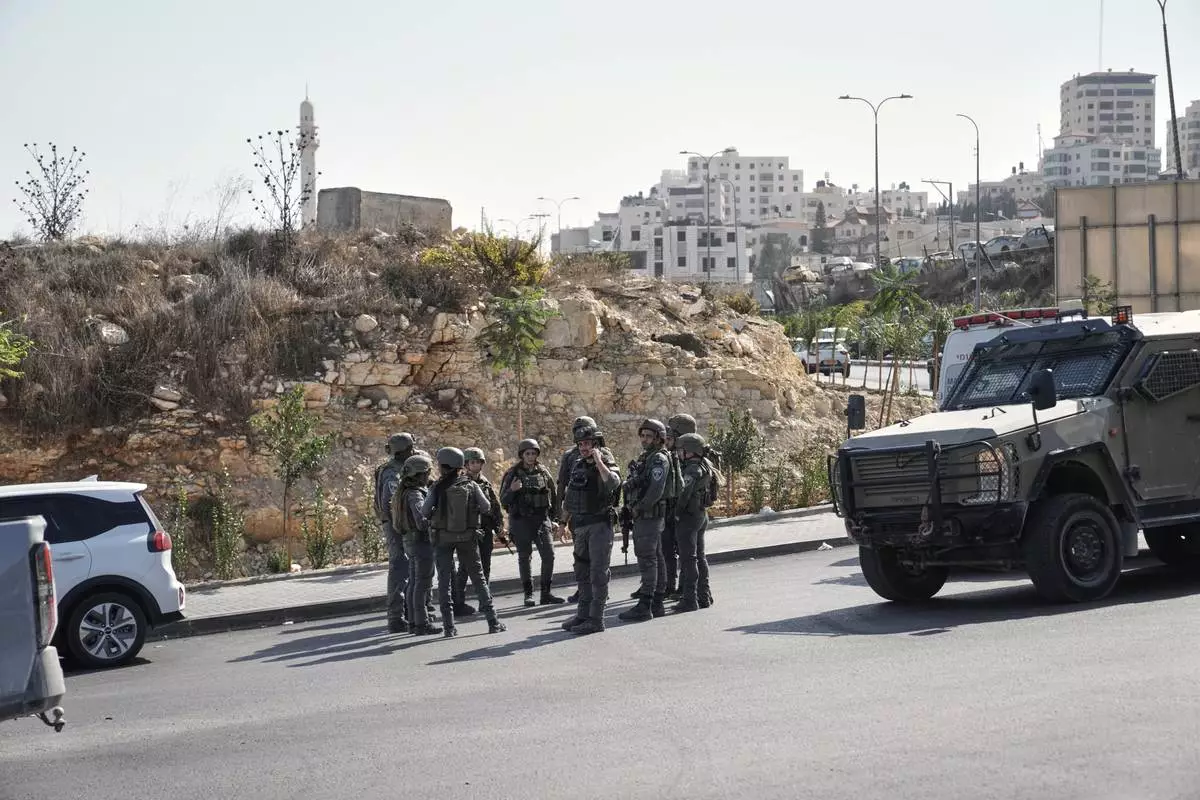
Israeli soldiers gather at the scene of a shooting attack carried out by Palestinian gunmen at a junction near Hebron in the occupied West Bank on Friday, Oct. 23, 2026. (AP Photo/Mahmoud Illean)
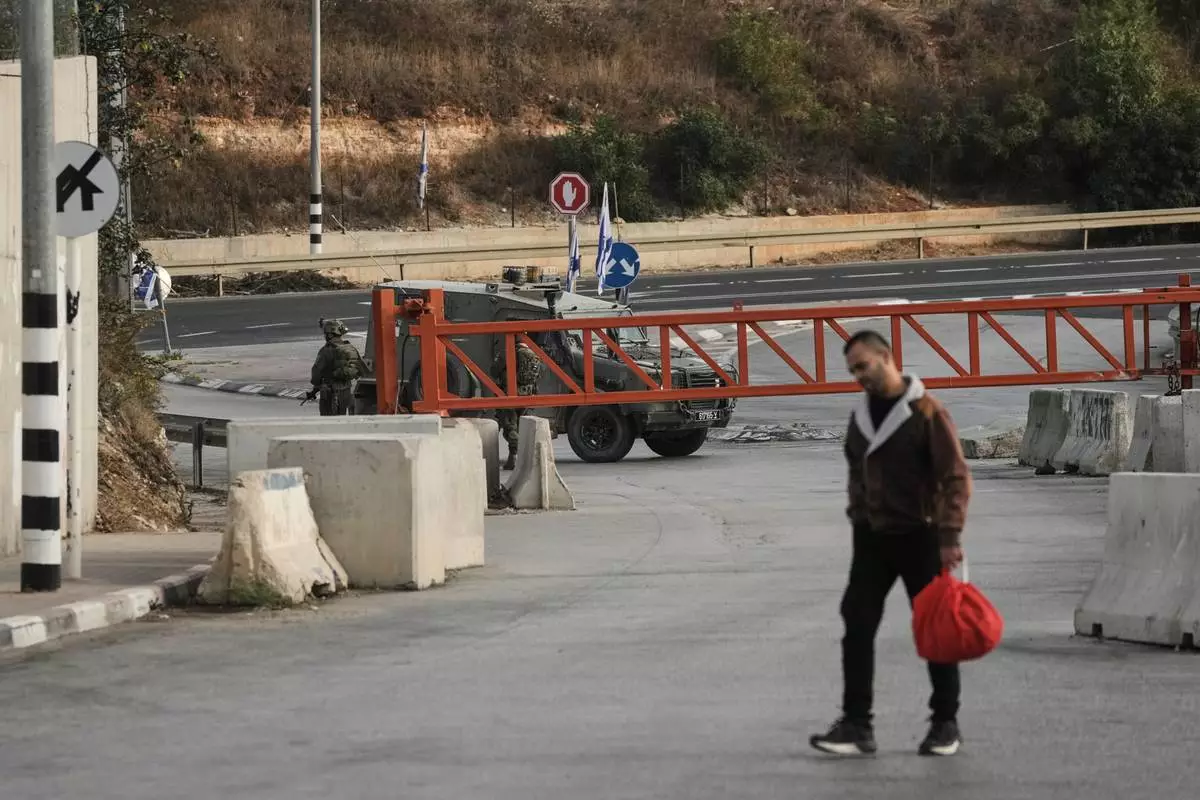
Palestinians cross on foot past a military gate closed to vehicles during an Israeli army operation in Hebron in the occupied West Bank Saturday, Oct. 24, 2026, a day after a Palestinian shooting attack in the area. (AP Photo/Mahmoud Illean)
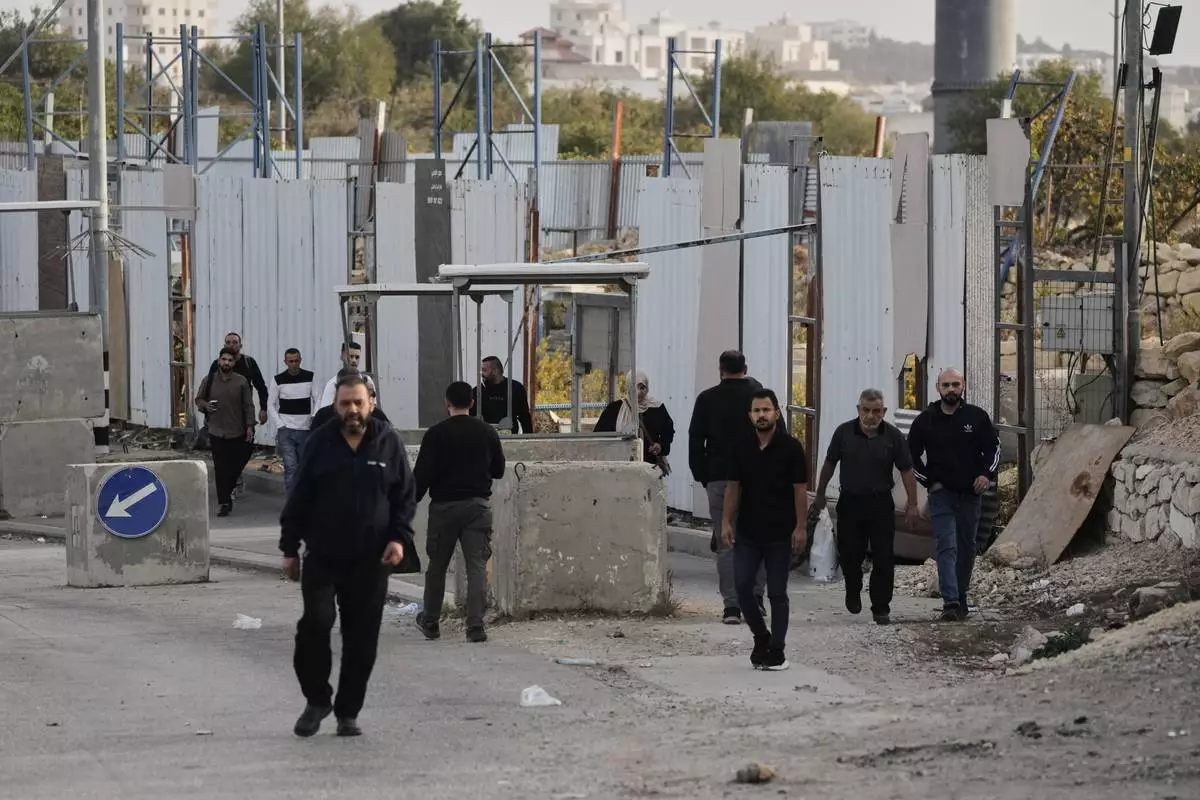
Palestinians cross on foot past a military gate closed to vehicles during an Israeli army operation in Hebron in the occupied West Bank Saturday, Oct. 24, 2026, a day after a Palestinian shooting attack in the area. (AP Photo/Mahmoud Illean)
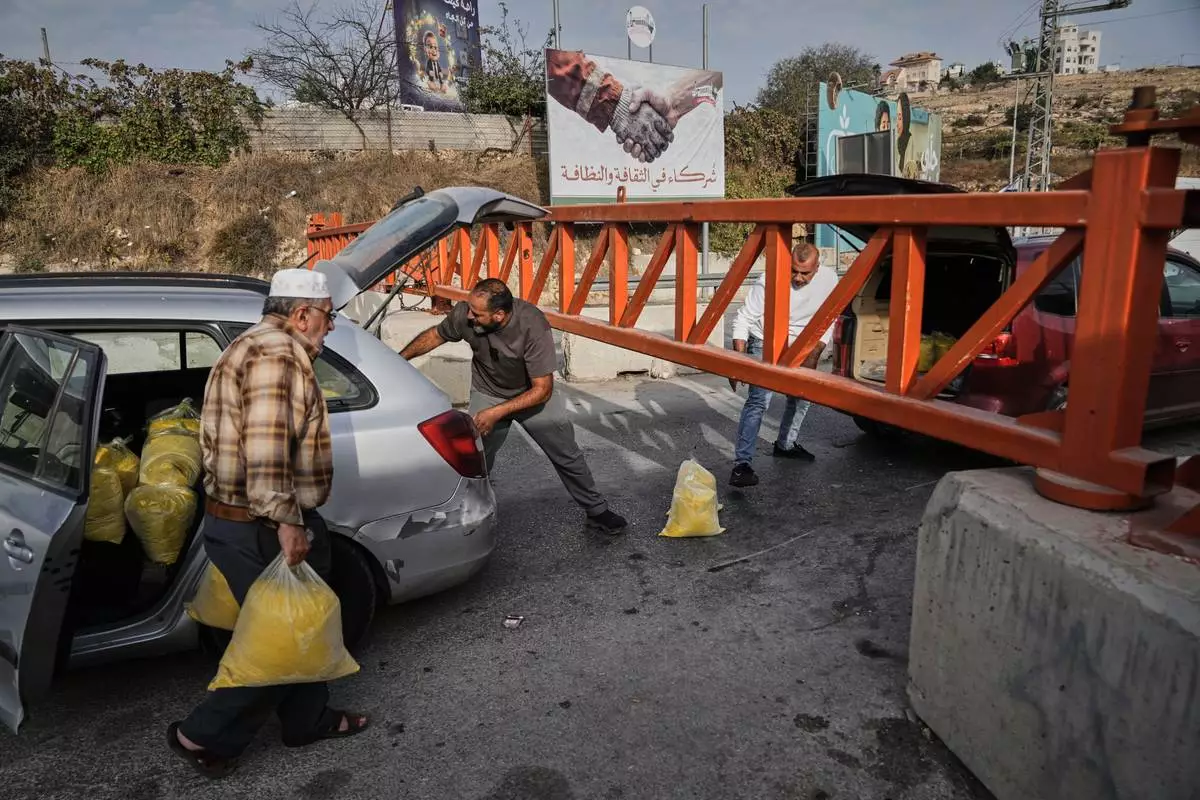
Palestinians transport bags of semolina past a military gate closed to vehicles during an Israeli army operation in Hebron, in the occupied West Bank, Saturday, Oct. 24, 2026, a day after a Palestinian shooting attack in the area. (AP Photo/Mahmoud Illean)