LOS ANGELES (AP) — Local election officials across California are confused and frustrated after receiving letters from President Donald Trump's Justice Department demanding that county registrars sequester ballots that the federal government believes were sent to noncitizen voters ahead of the midterm elections.
The letters, which were sent on Friday, ask for sensitive information, including Social Security numbers, on roughly 20,000 voters. It is illegal for noncitizens to register to vote or cast a ballot. The administration has insisted that immigrants voting is a major problem nationwide, when in fact it is quite rare, as even its own investigations have shown.
“All of this is simply meant to raise huge doubts about the integrity of this election,” said John Tuteur, the registrar of voters for Napa County in California’s wine country.
Tuteur and other election officials who spoke to The Associated Press on Saturday said they have already started to count ballots that have trickled in from the state's 23 million registered voters.
“We’re not changing anything we’re doing. We’re proceeding with the election,” he said.
The federal government set a 48-hour deadline to provide information, and it warned that legal action could be taken against any official who knowingly counted a noncitizen's vote.
However, the California attorney general's office said the letters contained errors. For example, Mendocino County officials received a list of people who were not residents there, according to the state's court filing.
The letters are the latest escalation in a legal battle between Democratic-dominated California and Trump's Department of Justice ahead of the midterms. The federal government sued on Oct. 15, roughly three weeks before elections, asking a judge to bar the state from counting mail-in ballots from people the federal government has identified as likely noncitizens. A panel of 9th Circuit appeals court judges will hear arguments on Sunday about whether California can be compelled to comply with the federal government’s demands.
Tuteur said that two uniformed Department of Homeland Security officers delivered a letter to his office late on Friday afternoon. The letter included the names of 42 people who the federal government accused of being noncitizens illegally registered to vote. There are roughly 86,000 people registered to vote across the county of over 130,000 people, Tuteur said. Approximately 11,000 people had already cast a mail-in ballot as of Friday. In larger counties like Los Angeles, that number has already reached over 331,000 counted mail-in votes.
He said his employees and his relatives were worried about what could come next.
“My family’s upset, worried about what’s going to happen to me,” he said.
The letter sent to Clerk-Recorder Kim Grady's office in rural Amador County listed four people allegedly illegally registered to vote in the county. Grady was waiting on more guidance from the state about what she should do, and she wasn't sure if she would get any clarity before the deadline.
Department of Justice spokeswoman Kiersten Pels emphasized in a statement on Saturday that the department is explicitly “not requesting a purge, cancellation of registrations, or any programmatic action."
Instead, Pels wrote, federal officials are asking for collaboration to “ensure the most secure election in California history.”
The letters on Friday came on the heels of a statewide sweep by federal authorities on Monday, where 28 people from the list of 20,000 were charged with illegally registering to vote. Some were also charged with illegally voting and lying on naturalization paperwork. Those charges could lead to years in prison.
Bill Essayli, the top federal prosecutor in Los Angeles, said that the clerks who didn't comply with the government's demands could face prosecution as well.
“The letters speak for themselves. Any election official who knowingly processes the ballot of a noncitizen is opening themselves to legal jeopardy," Essayli said in a statement.
Noncitizen voting is very rare. For example, earlier this month Attorney General Todd Blanche announced federal charges against 10 people in Minnesota alleged to have voted illegally over the last three elections, a period in which more than 8 million ballots were cast in the state.
But Essayli said on Monday that even a small number of illegal voters could “dilute” the vote and undermine confidence in elections.
Some election officials who spoke to The Associated Press on Saturday have questioned the accuracy of the federal government's list of 20,000 voters.
“I expect this accusation to fall apart like we saw recently in Nevada,” Kristin B. Connelly, the Contra Costa County clerk-recorder and registrar of voters said, referring to remarks Trump made in July, when he claimed the neighboring state had 1,500 noncitizen voters on its rolls. After his administration was asked to identify them, the number of actual registered noncitizens turned out to be zero.
Officials in Los Angeles County, who are named as defendants in the federal lawsuit, have echoed Connelly's concerns about the federal government's data. A preliminary analysis of 200 names from the statewide list of 20,000 found that over 40% had canceled registrations, according to a court filing from county officials on Wednesday. More than 70% of that sample had no voting history whatsoever, and nearly 4 in 10 were born in the United States.
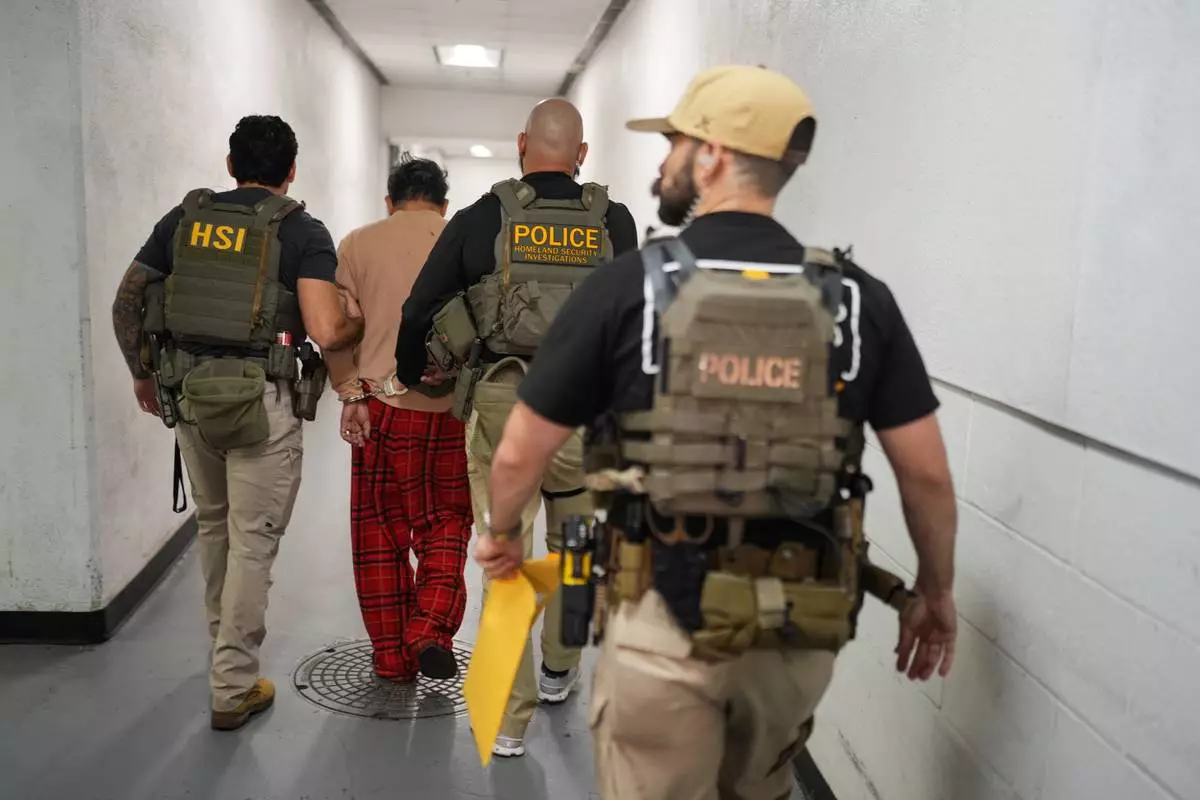
Homeland Security Investigations task force officers escort a suspect accused of illegally registering to vote to a processing facility at Federal Building in Los Angeles, Monday, Oct. 19, 2026. (AP Photo/Jae C. Hong)
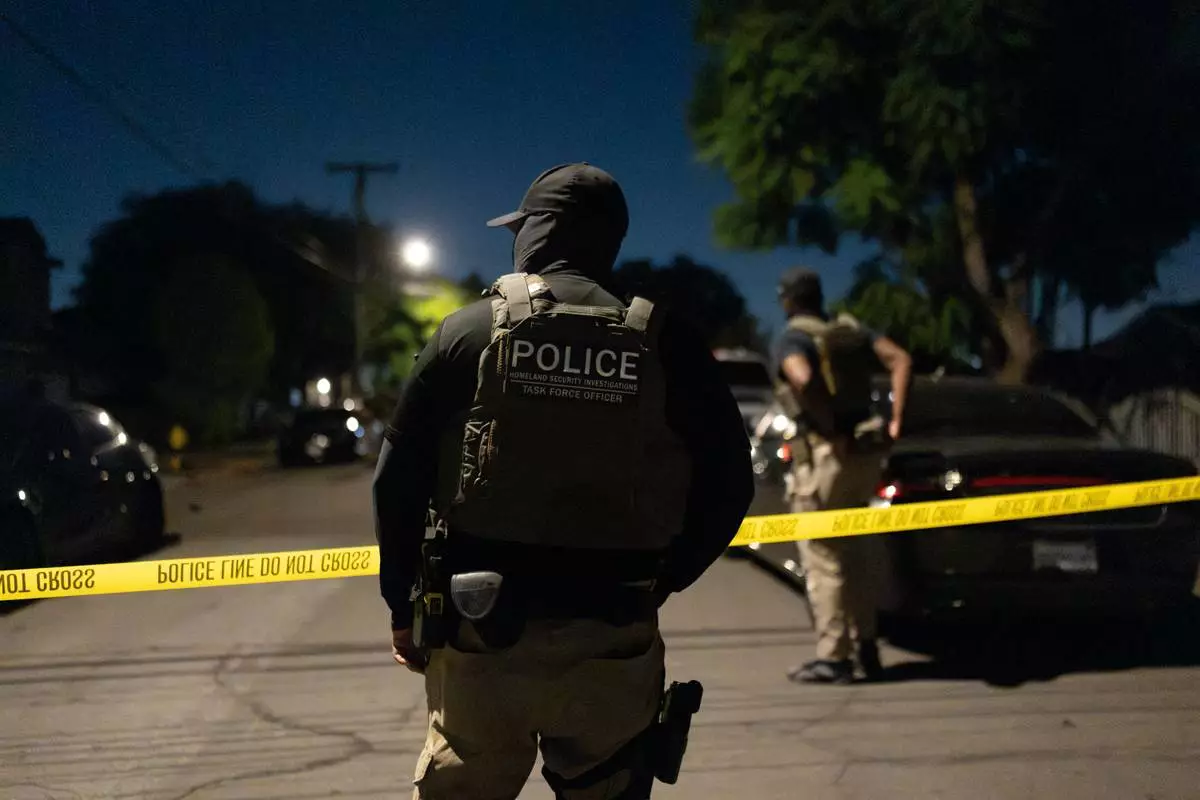
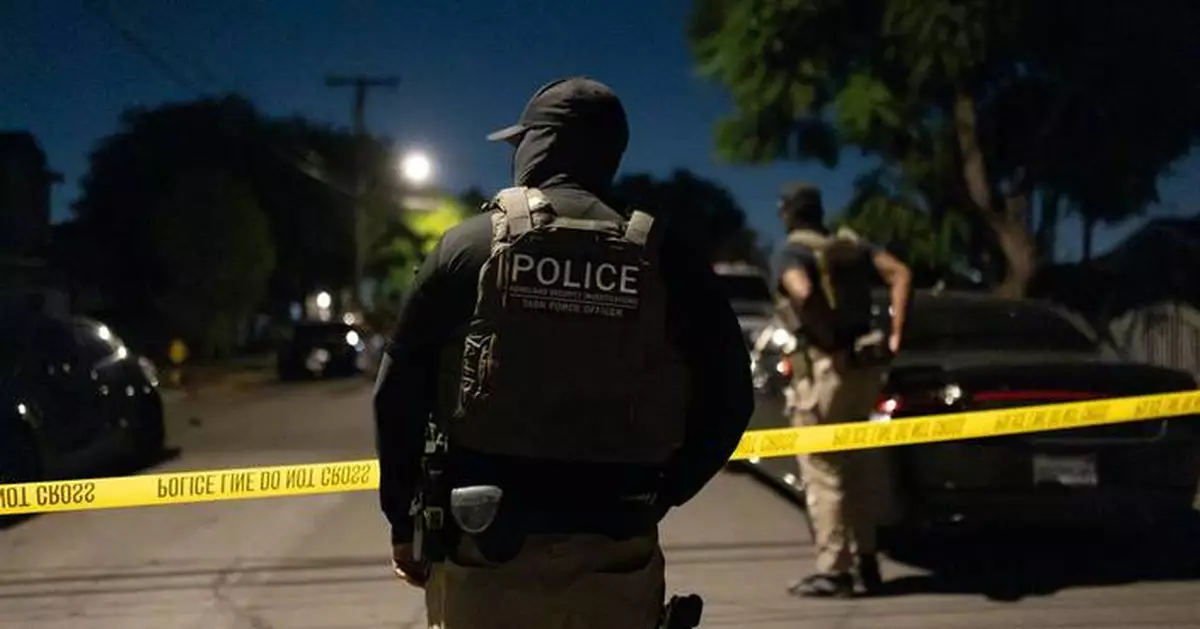
A Homeland Security Investigations task force officer stands near police tape marking a perimeter during a federal operation targeting suspected illegal voter registration in Commerce, Calif., Monday, Oct. 19, 2026. (AP Photo/Jae C. Hong)
KALAMA, Wash. (AP) — Colorado and Washington are reliably Democratic states where elected officials have rejected moves to ban transgender women and girls from female sports competitions. Now activists have gone around lawmakers to put proposed bans on both states' ballots.
At a time when some Democratic leaders nationwide are recalibrating their approach to transgender issues, particularly sports, and polls show Americans generally back the bans, supporters are optimistic they will pass and open the door to similar efforts in other places where lawmakers have blocked bans.
Though the issue has been debated in many legislatures, this is the first time it's going to voters.
“What is happening in 2026 is a testing ground for the future,” said Chris Melody Fields Figueredo, executive director of the Ballot Initiative Strategy Center, which supports LGBTQ+ rights.
Twenty-seven states — including all where Republicans control both the legislature and governor’s office — already have such laws.
The efforts are billed as a way to protect women and girls and keep separate spaces for them, tapping into a concern that’s gained momentum. President Donald Trump has taken steps to roll back transgender rights. The Supreme Court has upheld state sports bans.
A June poll from Quinnipiac University found that about 7 in 10 registered voters think transgender women and girls should not be allowed to play on female sports teams. About one-quarter think they should. Democrats are divided, with about half saying transgender women and girls should be allowed and about half saying they should not.
Robert Preuhs, a professor of political science at Metropolitan State University of Denver, said the absence of public polls on Colorado's ballot measure, which also covers college sports, makes it hard to predict whether it will pass. “It’s probably going to get more support than some of the Republican candidates that will run,” he said.
Since transgender restrictions gained traction this decade, states with Democratic-led governors' offices and legislatures generally have rejected proposals such as banning transgender people from the bathrooms that match their gender identity and restricting gender-affirming care. Most Republican-led states have adopted those policies.
In addition to the two blue-state questions, a measure in Arizona would broaden an existing ban to include private schools, and one in Nebraska would add an existing state law to the state constitution.
There’s not a clear consensus on whether transgender women and girls have a competitive advantage. Factors include the age of the athlete, the sport, whether the athlete went through male puberty and how long they’ve received hormone therapy.
But the idea that girls are being cheated is personal for some athletes.
Ahnaleigh Wilson, a 17-year-old junior at Eastmont High School, about 150 miles (241 kilometers) east of Seattle, has been speaking out against allowing transgender girls to compete in girls’ sports since she was in junior high. She said she’d won all her 1,600-meter races in seventh and eighth grade — until she finished second to a transgender athlete in a major meet.
“I knew it wasn’t right and it wasn’t fair,” she said.
Wilson said three other transgender athletes she's competed against since then placed better in girls races than they would have with the same times against boys.
“Women have fought for Title IX and our own categories and it’s very important that we keep the dignity of that, and let women have their own sports and their own spaces to be safe and completely fair,” she said, referencing the federal law that prohibits discrimination based on sex in education programs and activities, including athletics.
Opponents say excluding transgender girls is also unfair.
“They will say that they want to protect kids and in particular, young girls,” said Nadine Bridges, executive director of One Colorado, which is leading the opposition to the measure there, “but I don’t understand how you can protect kids and discriminate against kids at the same time.”
The number of transgender girls in school sports is believed to be a sliver of the total participants. Neither Colorado nor Washington has an official count.
Let's Go Washington, which is behind the measure in that state, says it’s counted 16 such athletes and that there could be more. The Washington Interscholastic Activities Association has counted about 101,000 girls in sports that it oversees — a figure that double-counts girls who play in multiple sports.
Imara Jones, an advocate who runs a website that features the stories of transgender people, said the issue is attractive for conservatives because some Democrats agree with them.
Hedge fund manager Brian Heywood is funding Let's Go Washington, which is also behind two other measures. One would expand parent access to school social work and counseling records for their children and one would repeal a newly adopted tax on incomes over $1 million.
Western Washington University political scientist Todd Donovan said Let's Go is hoping that voters supporting the transgender sports ban would also favor overturning the tax.
Tracy Flint of Ridgefield, Washington, a Democrat and former graphic artist, said she’s wrestling with how to vote.
“It’s new to my brain, so it’s a really tough one for me,” she said.
Her husband, Dave Flint, 60, a former Republican who opposes Trump and now votes for Democrats, lamented that an issue affecting so few people has become such a national controversy. “But I guess you still have to address it,” he said.
One Colorado's Bridges said she believes that many voters can be persuaded to oppose the measure there, though the challenge is reaching them. Groups registered as opposing the transgender-related measures in Colorado have raised nearly $4 million — more than 20 times what proponents have brought in, but not a lot for a statewide campaign.
In Washington, Let's Go has raised more than $7.8 million to campaign for the three measures — nearly twice as much as the ban opponents.
The Washington measure would require that a healthcare provider verify the student's “biological sex, relying only on one or more of the following: The student’s reproductive anatomy, genetic makeup, or normal endogenously produced testosterone levels.”
“We see that as being as simple as a checkbox,” said Let's Go Washington spokesperson Hallie Herzberg. “Doctors can use the history of the patient from treating them all their lives or their medical history forms.”
But Dr. Libby Loft, who opposes the measure, says the language calls for a genital inspection as part of a physical, or expensive testing.
“I think it doesn't make any sense to force the working families of … girl sports players in Washington to pay for unnecessary medical tests to be able to weed out an estimated five or 10 girls in the state of Washington, trans girls,” Loft said.
She fears the verification requirement will lead to fewer girls — trans or not — playing sports.
The idea of exams bothers some voters.
“I’m voting against it primarily because I think medical exams of girls’ genitalia is, like, Middle Ages,” said Rosemary Kacorozki of Renton, Washington, 63, a language interpreter.
This story has been corrected to say that Eastmont High School is about 150 miles (241 kilometers) east of Seattle.
Mulvihill reported from Haddonfield, New Jersey.
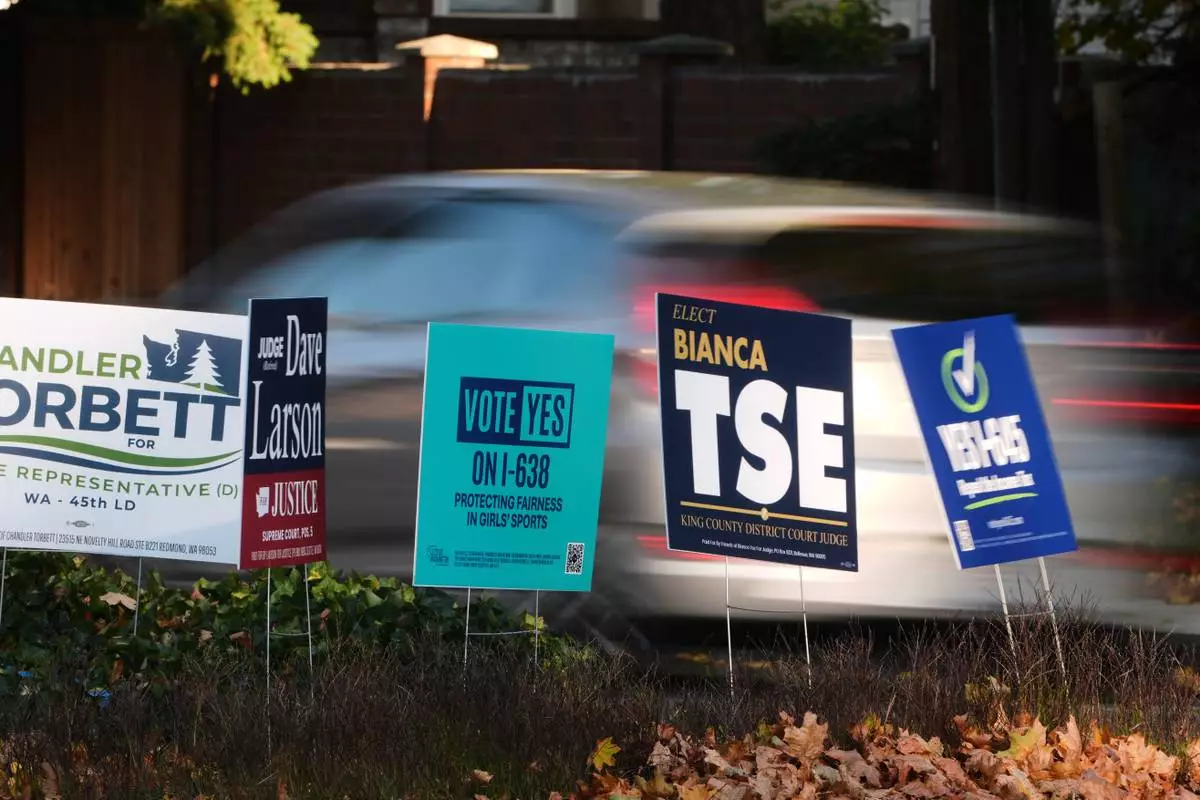
A yard sign supporting Washington State Initiative 638, which would prohibit transgender girls from competing in girls' sports, is seen in a median Monday, Oct. 19, 2026, in Redmond, Wash. (AP Photo/Lindsey Wasson)
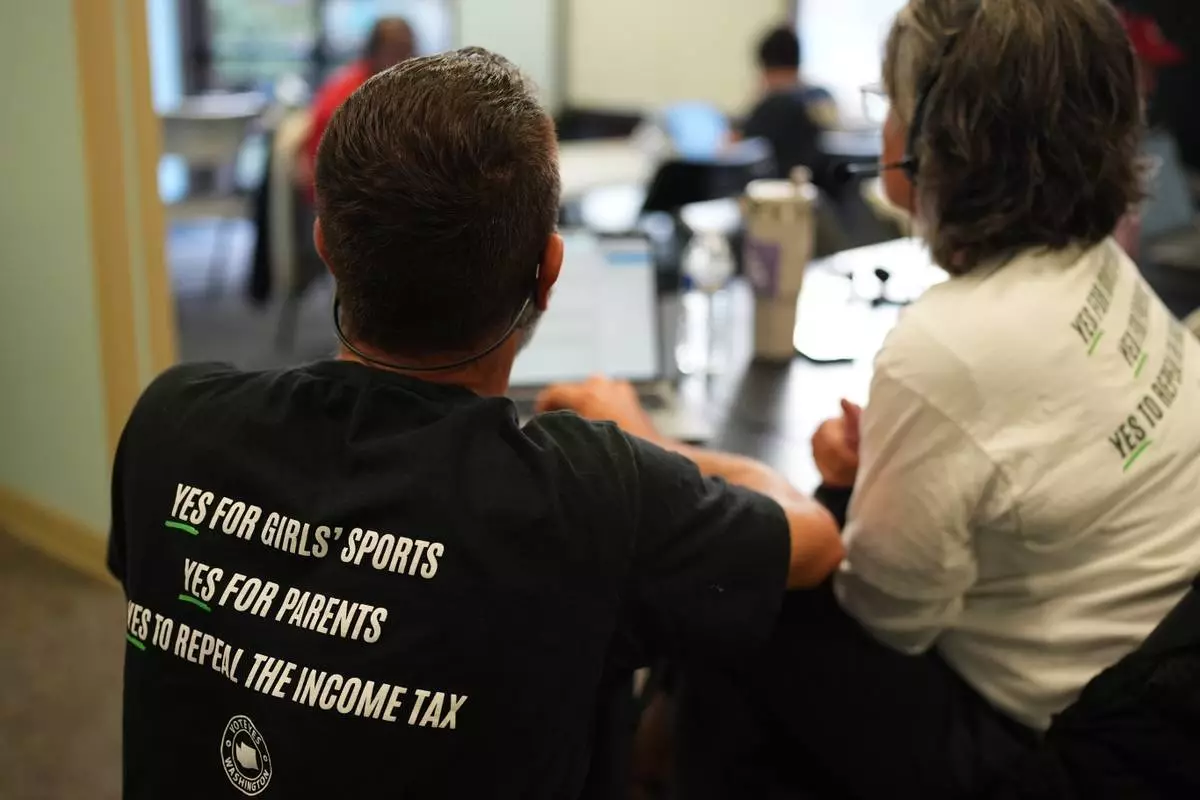
Let's Go Washington staff member Josh Johnson, left, helps a volunteer while phone banking in support of Washington State Initiative 638, which would prohibit transgender girls from competing in girls' sports, Monday, Oct. 19, 2026, in Bellevue, Wash. (AP Photo/Lindsey Wasson)
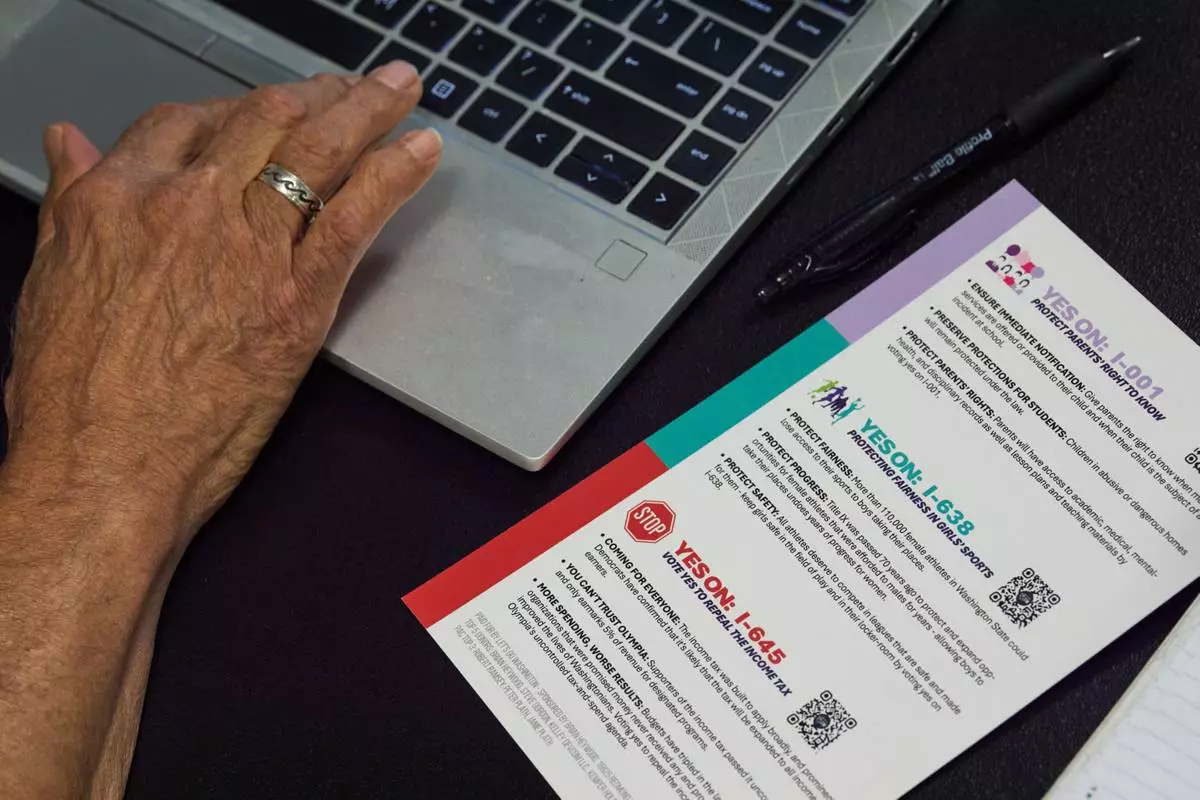
A volunteer uses a reference card while phone banking for Let's Go Washington, a group backing Washington State Initiative 638, which would prohibit transgender girls from competing in girls' sports, Monday, Oct. 19, 2026, in Bellevue, Wash. (AP Photo/Lindsey Wasson)
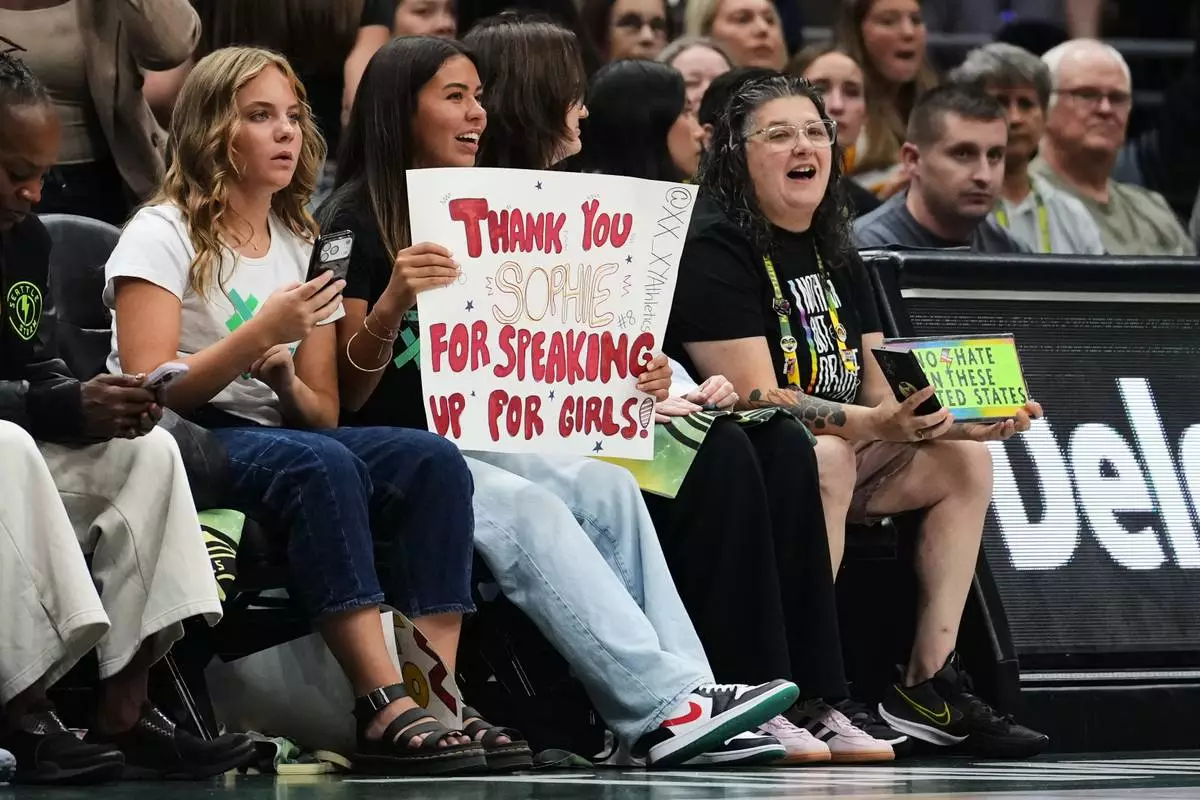
FILE- Ahnaleigh Wilson, 17, a track athlete who says she has competed against and placed behind transgender athletes at meets, holds a sign for Indiana Fever guard Sophie Cunningham in reference to her comments on transgender athletes during the first half of a WNBA basketball game between the Fever and Seattle Storm, Tuesday, July 28, 2026, in Seattle. (AP Photo/Lindsey Wasson, File)
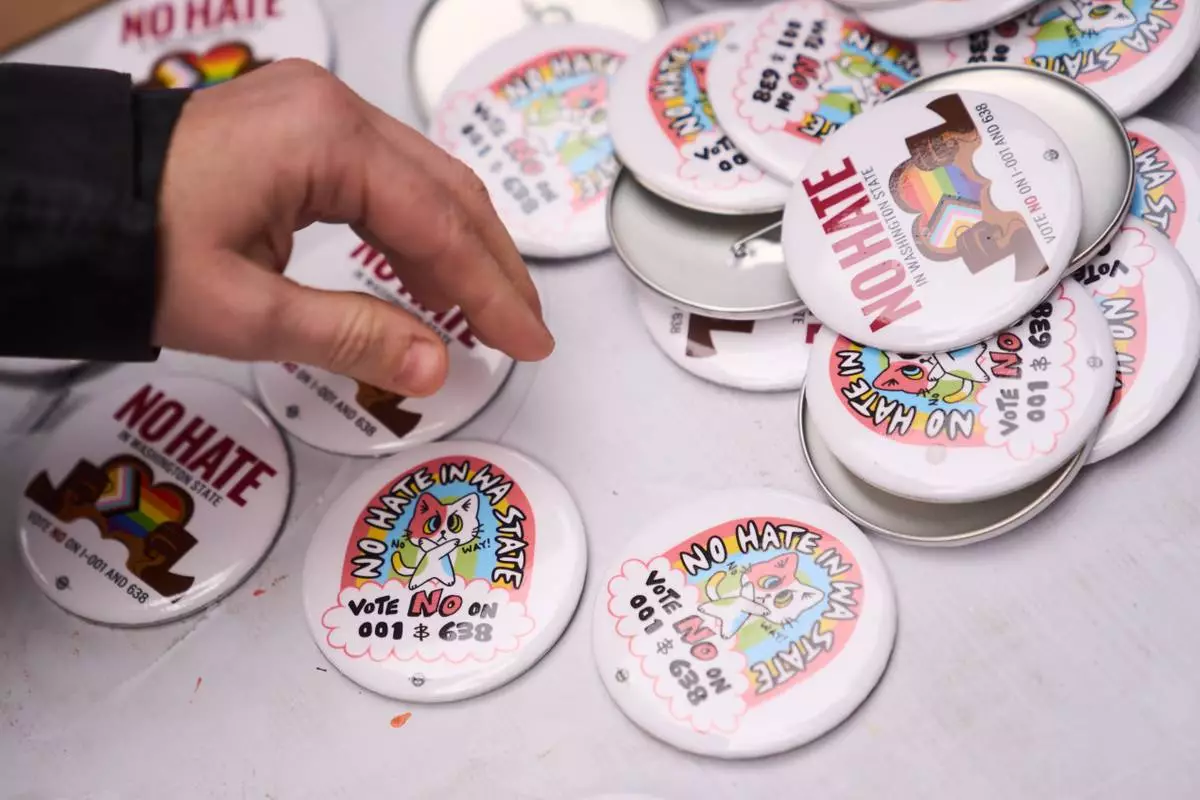
A person picks up a button during a "No Hate in WA State" rally against multiple initiatives on the November ballot, including Washington State Initiative 638, which would prohibit transgender girls from competing in girls' sports, Saturday, Oct. 17, 2026, in Seattle. (AP Photo/Lindsey Wasson)