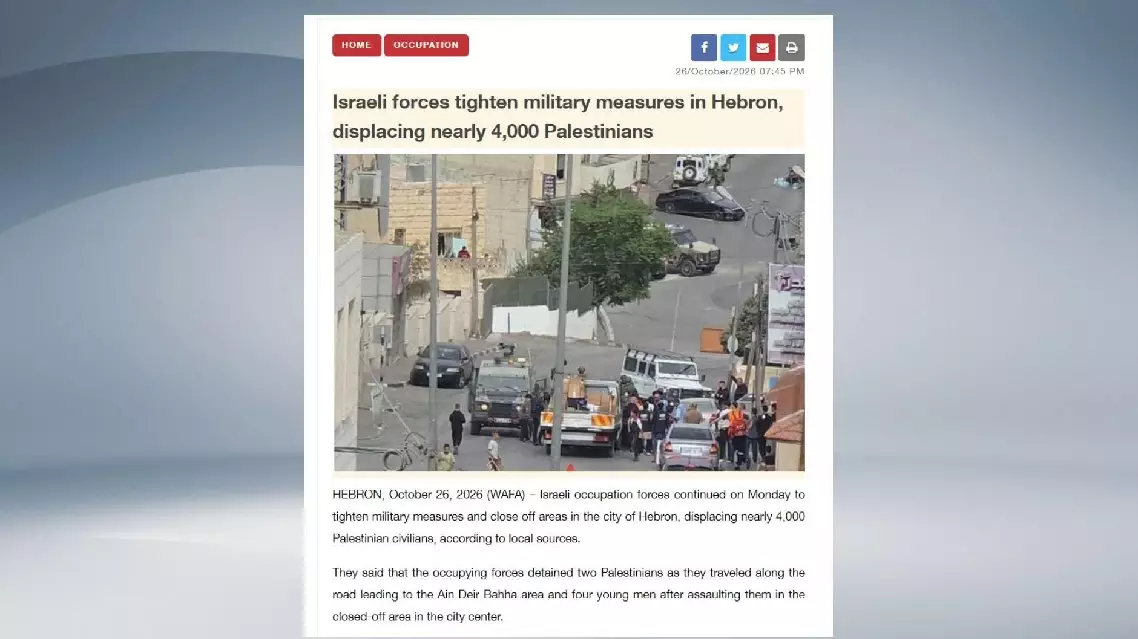
Israel's military forces on Monday continued to tighten military measures and close off areas in the city of Hebron in the West Bank, displacing nearly 4,000 Palestinian civilians, according to the WAFA News Agency, citing local sources.
The number of families affected by Israel's ongoing offensive in parts of Hebron, launched after an armed attack near the city killed two Israel Defense Forces (IDF) soldiers on Friday, has risen to 619, the agency said. It added that some 3,971 Palestinians have been forcibly displaced from their homes, while 85 others have been detained.
The military operations and forced closures of areas in Hebron have damaged many civilian and commercial facilities, causing extensive property losses, it said.
Israeli Prime Minister Benjamin Netanyahu reportedly rejected a proposal by IDF Chief of Staff Eyal Zamir to end the operation in Hebron, according to the Kan public broadcaster on Monday.
Although the military made it clear that all objectives had been achieved, Netanyahu still ordered the operation to continue, according to the report.
Quoting a military source, Kan said the operation has fulfilled its aims: establishing deterrence, finding "terrorist" facilities and gathering intelligence. Troops have searched 500 buildings across the city, yet only seized two firearms.
Apart from Hebron, a comprehensive lockdown covering the whole occupied West Bank has also been put in place after the lethal shooting on Friday.
Palestinians in some areas have been advised to keep their children home from school, while many are unable to go to work as the lockdown is set to remain in place through Israel's election day on Tuesday.
At one of the bus stations outside of Ramallah, all buses were stranded, with drivers simply waiting around for the lockdown to be lifted since nobody can move around within the West Bank.
"I'm talking about the roadblocks and closures throughout the West Bank in general, and in the Northwest Ramallah area in particular, the area where I live and work today. The entire West Bank is full of checkpoints. These checkpoints control people's lives: they control students' lives, patients' lives, and workers' lives. At any moment, the gate can be closed; at any moment, it can be opened, causing a delay of half an hour or more. My commute used to take a few minutes, but now I've been on the road for 90 minutes because I had to drive along dirt paths and mountain roads," said bus driver Tahir Shalatwa.
Israeli military operations displace nearly 4,000 in West Bank's Hebron: Palestinian media