UNITED NATIONS (AP) — The head of the U.N. nuclear agency said Tuesday there has been no indication Iran has tried to repair or reconstruct its nuclear facilities damaged in U.S. and Israeli military strikes this year or last year.
President Donald Trump has said one of the major reasons the U.S. went to war with Iran on Feb. 28 was to deny Tehran the ability to develop nuclear weapons, even as he has insisted that strikes the U.S. carried out on Iranian nuclear sites in June 2025 “obliterated” the country’s atomic program.
During a U.N. Security Council meeting, International Atomic Energy Agency chief Rafael Grossi urged Iran to give inspectors access to all nuclear sites, including those damaged in the military attacks. The IAEA has not been able to verify the status of Iran’s stockpile of near weapons-grade uranium since the U.S. bombed its sites last year.
However, Grossi said that “since June 2025, we have not identified any activity to repair or reconstruct any of the facilities damaged in the military attacks of 2025 and 2026."
Trump has consistently downplayed the economic impact of the Iran war, which has emerged as a liability for Republicans heading into next week’s midterm elections, and has argued that higher fuel prices are worth paying to prevent a nuclear-armed Iran. The White House didn’t immediately respond Tuesday evening to a request for comment on Grossi's remarks.
Iran maintains that its nuclear program is peaceful. However, the IAEA says the country has a stockpile of 440.9 kilograms (972 pounds) of uranium enriched up to 60% purity — a short, technical step away from weapons-grade levels of 90%.
The U.N. meeting on Tuesday was called by Bahrain, Denmark, Latvia, France, the United Kingdom and United States after the IAEA referred Iran to the Security Council for failing to comply with its nuclear nonproliferation obligations. Russia and China, allies of Iran, tried unsuccessfully to prevent the meeting.
Under those obligations, which are part of the Nuclear Non-Proliferation Treaty, Iran is legally bound to declare all nuclear material and activities and allow IAEA inspectors to verify that none of it is being diverted from peaceful uses.
Iran’s U.N. deputy ambassador Gholamhossein Darzi attacked the council for its silence after the U.S.-Israeli attacks, denouncing their “wars of aggression against Iran” and accusing the U.S. of committing war crimes against the Iranian people.
He never mentioned the IAEA’s unanswered questions or the demand to return its inspectors. Instead, he asserted that “Israel possesses nuclear weapons, yet your concern is the absence of inspectors in Iran.” Israel has never confirmed that it possesses nuclear weapons.
U.S. Ambassador to the U.N. Mike Waltz called Iran a “brutal dictatorship” and asked if the Iranian ambassador wanted to apologize to Bahrain’s envoy, a council member, for attacking his country.
“We’ve heard tireless allegations against the United States, ” he said. “What we have not heard today is an explanation for Iran’s continued failure to satisfy its safeguard obligations.”
The IAEA asked Iran for answers, Waltz said, and it would be smart for the Iranian representative to start providing some answers.
“Your lies are no good here,” he said.
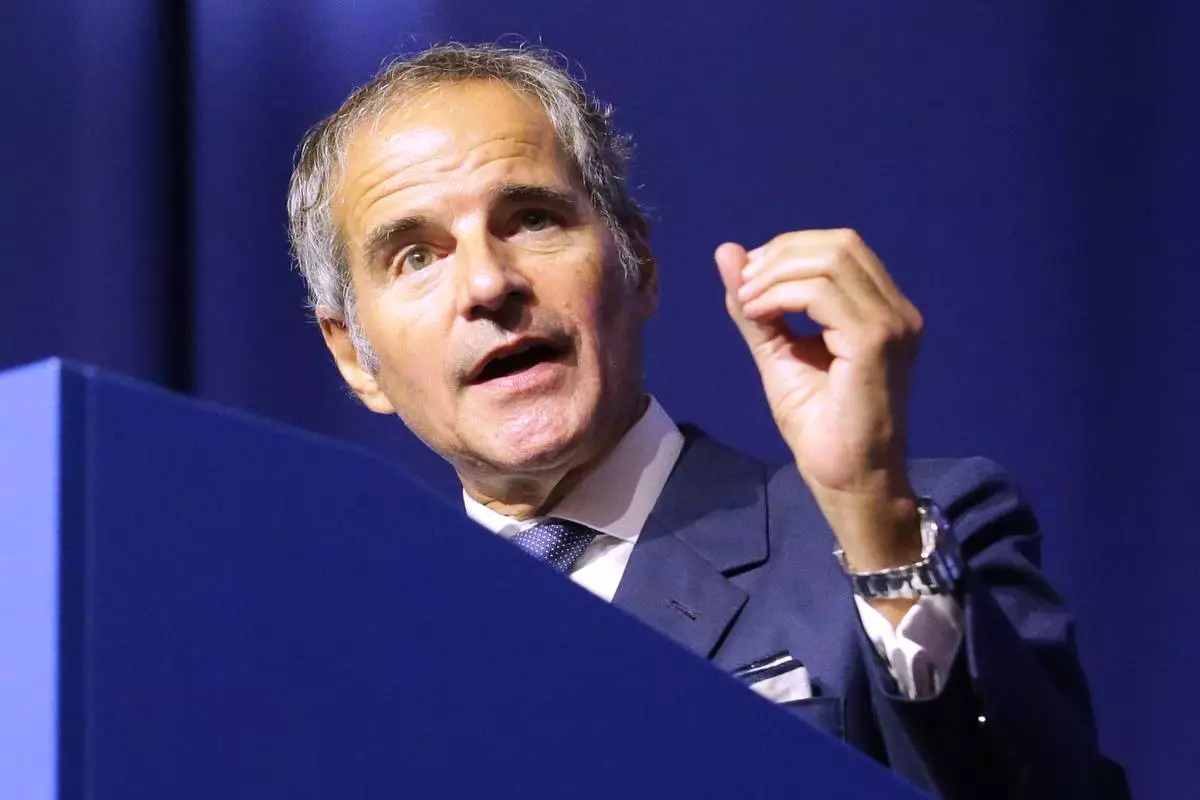
FILE - IAEA Director General Rafael Grossi speaks during the annual General Conference of the International Atomic Energy Agency in Vienna, Austria, Sept. 14, 2026. (AP Photo/Heinz-Peter Bader, file)
PALO ALTO, Calif.--(BUSINESS WIRE)--Oct 28, 2026--
This press release features multimedia. View the full release here: https://www.businesswire.com/news/home/20261028854882/en/
The HTEC AI Value Realization Report 2026: Financial Services & Insurance, found that among FSI respondents currently pursuing AI adoption, 88% report increasing investment over the past 12 months. Forty-two per cent describe the increase as significant, compared with 28% across all industries. Yet 44% of FSI organizations are at the scaling stage or already AI-native, exactly the same proportion as the overall sample.
The findings suggest that high levels of investment alone are not translating into a sector-wide maturity advantage. Seventy-eight per cent of FSI respondents agree that people and processes limit the value organizations derive from AI more than technology does.
“ Financial institutions are investing heavily, but technology alone does not determine whether AI creates value,” said Philip Otley, Global Managing Partner at HTEC. “ Results depend heavily on what happens around the technology: how AI is integrated into workflows, who owns the outcome, and whether employees are equipped to use it consistently.”
Better decisions, not simply lower costs
The research also points to what FSI leaders want AI investment to deliver.
Better decision quality is the most desired outcome of AI investment, cited by 31% of executives, compared with 17% who prioritize cost reduction.
The finding reinforces the importance of being able to demonstrate value beyond traditional efficiency measures. Improvements in decision quality require credible baselines, trustworthy data, and evidence connecting AI-supported decisions to business outcomes.
However, the research shows significant differences in when organizations establish and assess financial returns. Thirty-four per cent require a formal ROI model before an AI initiative is approved, while 29% assess returns only after implementation.
Together, these findings indicate that defining and measuring value throughout the AI investment lifecycle remains an important part of the maturity challenge.
AI risk measurement remains inconsistent
The research identifies a parallel challenge around governance.
Forty-two per cent of FSI respondents consider AI risk informally alongside value, while only 16% measure risk consistently across their portfolios.
As AI becomes more deeply embedded into financial services workflows, HTEC believes appropriate oversight will become increasingly important, particularly where AI supports consequential decisions within regulated operations.
“ Not every AI-assisted decision requires the same level of oversight,” said Lawrence Whittle, Chief Strategy Officer at HTEC. “ The challenge is designing review processes that are proportionate to the risk involved, while ensuring that people have enough context and authority to exercise meaningful judgment when it matters.”
Organizations are also relying more heavily on external expertise
The research suggests that the complexity of moving AI beyond individual initiatives is also affecting how FSI organizations work with external partners.
21.5% of FSI respondents report greater dependence on external partners or consultants than they had anticipated, indicating that moving AI from isolated use cases towards enterprise-wide deployment increasingly requires strategy, data, engineering, and governance to work together. Multidisciplinary teams can work alongside internal stakeholders to connect these capabilities as use cases move from roadmap to production.
Turning investment into value
Taken together, the findings suggest that the next phase of AI adoption in financial services and insurance will depend not simply on deploying more technology, but on strengthening the conditions around it.
The research points towards five areas: clear business outcomes, trustworthy data, defined ownership, consistent measurement, and proportionate governance.
For HTEC, this also changes the role of technology partners. Financial institutions increasingly need strategy and engineering to connect with implementation and organizational change, together with the transparency, safeguards, and traceability required to understand how AI-supported decisions were reached and whether they delivered the intended outcome.
About the Research
The findings are based on responses from 235 financial services and insurance C-suite executives within a global survey of 1,500. The research was commissioned by HTEC and conducted by Censuswide in July 2026.
The full HTEC AI Value Realization Report 2026: Financial Services & Insurance is available at https://htec.com/insights/reports/the-htec-ai-value-realization-report-2026-financial-services-insurance/.
About HTEC
HTEC Group Inc. HTEC is a global technology and engineering company that helps organizations build AI capabilities from silicon to outcomes. HTEC helps its customers build an adaptive, vendor-agnostic AI stack designed to evolve as technologies, models, and platforms change.
Through its forward-deployed model, HTEC works alongside customer’s teams to connect AI to business strategy and create a repeatable capability consistently and faster each time. OneLoopAi is at the heart of this approach and brings greater transparency in measuring progress and continuously improves how AI is developed and deployed. The result is a stronger path from AI investment to measurable business value and AI at scale.
With more than 15 years of experience working with AI and machine learning, HTEC combines deep engineering expertise with strategy, product, design, and data capabilities to turn AI ambition into production.

HTEC, the global AI technology and engineering leader, today released its research on AI Value realization in financial services and Insurance. Organizations in this sector are increasing AI investment more aggressively than the wider market, but the sector has yet to establish a corresponding lead in AI maturity, according to new research from HTEC.