SHANGHAI, Oct. 28, 2026 /PRNewswire/ -- At the 2026 European Society for Medical Oncology (ESMO) Congress, 3SBio presented long-term follow-up results from a Chinese Phase II clinical study of SSGJ-707 combined with chemotherapy as a first-line treatment for advanced non-small cell lung cancer (NSCLC). The steadily growing efficacy benefit not only showed a significant improvement in objective response rate (ORR) versus the data first disclosed at last year's SITC (Society for Immunotherapy of Cancer) Annual Meeting, but also delivered excellent median progression-free survival (mPFS) of 13.6 and 13.8 months in squamous and non-squamous NSCLC, respectively—adding strong clinical evidence for this China-developed, bispecific antibody that has been out-licensed to a global partner.
Main Text
The updated poster reports long-term follow-up data from the Phase II study of tivunatamig (PF-08634404/SSGJ-707) combined with chemotherapy as a first-line treatment for advanced NSCLC in China. A total of 261 patients were enrolled, including 122 with non-squamous (nsq) NSCLC and 139 with squamous (sq) NSCLC. 50% of patients were aged ≥65 years, 80% had a history of smoking, and more than 40% had a PD-L1 tumor proportion score (TPS) < 1%.
At the selected dose of 10 mg/kg Q3W, the confirmed objective response rate (cORR) for tivunatamig combined with carboplatin + paclitaxel in squamous NSCLC (sq-NSCLC) was 80.7% (vs. 67.7% in the control group), while the cORR for tivunatamig combined with carboplatin + pemetrexed in non-squamous NSCLC (nsq-NSCLC) was 77.5% (vs. 44.7% in the control group).
| Table 1. Best Overall Response | |||||
| Parameter | Tivunatamig 10 mg/kg + Carboplatin + Pemetrexed (Part 1, nsq) | Tislelizumab + Carboplatin + Pemetrexed (Part 1, nsq) | Tivunatamig 10 mg/kg + Carboplatin + Paclitaxel (Part 2, sq) | Tivunatamig 10 mg/kg + Carboplatin + Nab-paclitaxel (Part 2, sq) | Tislelizumab + Carboplatin + Paclitaxel (Part 2, sq) |
| Patients evaluable, n | 40 | 38 | 57 | 13 | 31 |
| Confirmed ORR, % | 77.5 | 44.7 | 80.7 | 69.2 | 67.7 |
| (95% CI) | (61.5–89.2) | (28.6–61.7) | (68.1–90.0) | (38.6–90.9) | (48.6–83.3) |
| Best Overall Response, n (%) | |||||
| CR | 0 | 0 | 1 (1.8) | 0 | 0 |
| PR | 31 (77.5) | 17 (44.7) | 45 (78.9) | 9 (69.2) | 21 (67.7) |
| SD | 8 (20.0) | 16 (42.1) | 10 (17.5) | 4 (30.8) | 9 (29.0) |
| Unconfirmed PR | 0 | 0 | 0 | 1 (7.7) | 0 |
| PD | 1 (2.5) | 4 (10.5) | 1 (1.8) | 0 | 1 (3.2) |
| NE | 0 | 1 (2.6) | 0 | 0 | 0 |
Table 1. Best Overall Response
Parameter
Tivunatamig 10 mg/kg + Carboplatin + Pemetrexed (Part 1, nsq)
Tislelizumab + Carboplatin + Pemetrexed (Part 1, nsq)
Tivunatamig 10 mg/kg + Carboplatin + Paclitaxel (Part 2, sq)
Tivunatamig 10 mg/kg + Carboplatin + Nab-paclitaxel (Part 2, sq)
Tislelizumab + Carboplatin + Paclitaxel (Part 2, sq)
Patients evaluable, n
40
38
57
13
31
Confirmed ORR, %
77.5
44.7
80.7
69.2
67.7
(95% CI)
(61.5–89.2)
(28.6–61.7)
(68.1–90.0)
(38.6–90.9)
(48.6–83.3)
Best Overall Response, n (%)
CR
0
0
1 (1.8)
0
0
PR
31 (77.5)
17 (44.7)
45 (78.9)
9 (69.2)
21 (67.7)
SD
8 (20.0)
16 (42.1)
10 (17.5)
4 (30.8)
9 (29.0)
Unconfirmed PR
0
0
0
1 (7.7)
0
PD
1 (2.5)
4 (10.5)
1 (1.8)
0
1 (3.2)
NE
0
1 (2.6)
0
0
0
The poster disclosed the median PFS data for tivunatamig combined with chemotherapy, with the data cutoff date updated to August 6, 2026. Median PFS was 13.6 months in squamous NSCLC versus 8.3 months in the control group, and 13.8 months in non-squamous NSCLC versus 9.7 months in the control group. Although no head-to-head comparison is available, the mPFS for SSGJ-707 is the longest reported to date among PD-1/VEGF bispecific antibodies.
Furthermore, compared with the abstract data at the February cutoff, the extended follow-up shows that overall PFS has continued to improve, with tivunatamig demonstrating a positive signal of "longer follow-up, more robust efficacy signal." This pattern of sustained benefit with prolonged follow-up carries important positive implications: on one hand, it indicates that the high response rate is not a transient effect seen in short-term evaluation and that responses are durable; on the other hand, the treatment group's advantage has not narrowed over time but the benefit has sustained. For a Phase II study, this is a key positive signal supporting subsequent confirmatory Phase III trials.
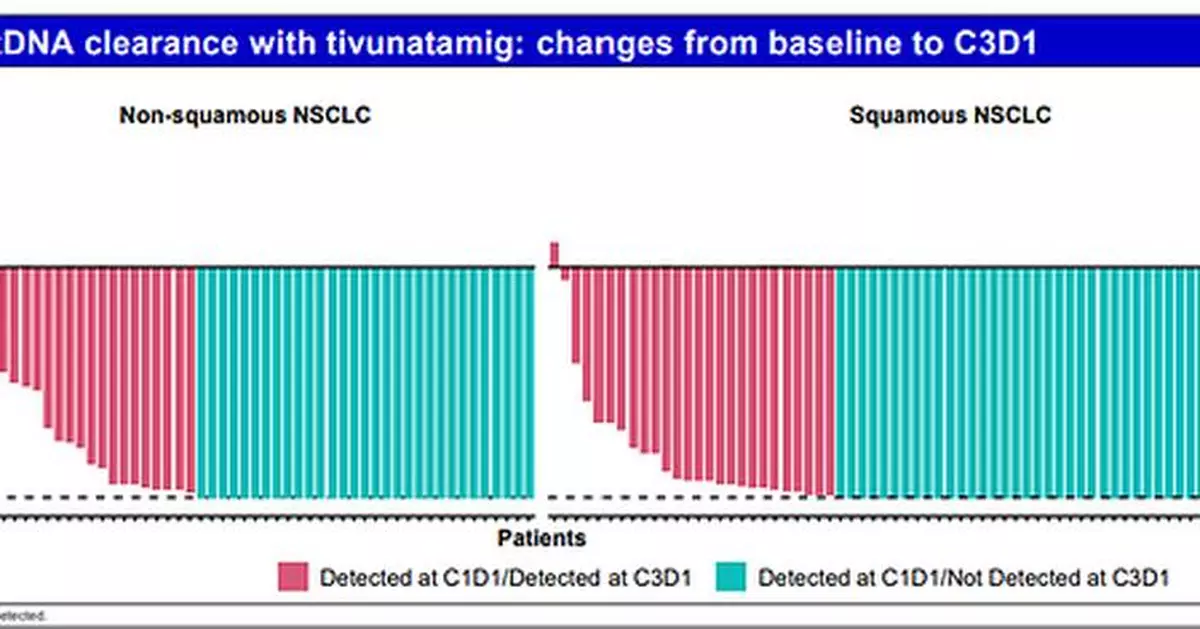
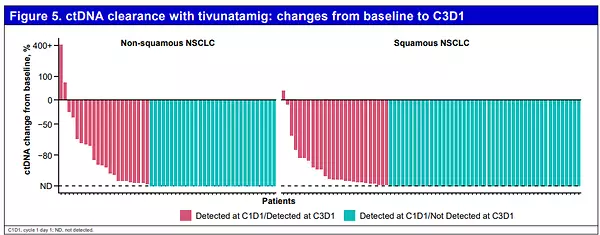
Additionally, the ctDNA clearance analysis presented in the poster is another differentiating highlight of the study. Among 126 patients with detectable baseline ctDNA who completed paired sampling, 61.9% achieved ctDNA clearance at C3D1 (Cycle 3 Day 1, approximately 9 weeks). Updated follow-up data showed that median PFS in the ctDNA-clearance population reached 16.4 months, significantly longer than the 9.6 months in the non-clearance population.
Unlike the macroscopic tumor lesion shrinkage observed on imaging, ctDNA clearance points to the microscopic level: the DNA burden from tumor cells in the blood has dropped below the limit of detection. ctDNA clearance is a molecular signal of rapid, deep tumor killing by the drug, and the significantly longer median PFS in the ctDNA-clearance population also suggests it could serve as an early predictive biomarker for treatment benefit. Looking across the PD-1/VEGF bispecific antibody landscape, the uniqueness of SSGJ-707 combined with chemotherapy lies in the early observation of ctDNA clearance and the outstanding mPFS advantage in this population; this early molecular deep response implies the potential for superior long-term survival.
In terms of safety, the incidence of ≥ Grade 3 treatment-related adverse events (TRAEs) with tivunatamig combined with platinum-based chemotherapy was broadly comparable to the tislelizumab control group. Since the SITC data disclosure, no new Grade 5 TRAEs were reported in the tivunatamig arm.
Overall, for the PD-1/VEGF bispecific antibody landscape, the value of this long-term data extends beyond the impressive ORR and PFS results. The combination of manageable safety and ctDNA conversion signals enables tivunatamig to establish a differentiated advantage among comparable competing products, pending further validation in Phase III studies.
Addressing Unmet Clinical Needs in Lung Cancer, Aiming to Become an IO 2.0 backbone Therapy
Lung cancer is one of the malignancies with the heaviest global disease burden. According to GLOBOCAN 2022 statistics, there are approximately 2.48 million new cases of lung cancer globally each year, with more than 1.06 million new cases in China—accounting for over 40% of the global total—and non-small cell lung cancer (NSCLC) accounts for 85% of all lung cancers.
The large patient population has made the first-line advanced NSCLC landscape a highly competitive arena for both Chinese and global pharmaceutical companies. For a long time, this field has faced three challenges: the efficacy of existing immunotherapy combinations is approaching a plateau, anti-angiogenic regimens are underused in the lung squamous carcinoma population, and multi-drug combination regimens are cumbersome to administer—all areas of continuous industry effort. As described in the mechanism section of the abstract, by enhancing the inhibition of VEGF and the synergistic binding with PD-1, the agent effectively activates immune responses in the tumor microenvironment, achieving efficacy improvement under a safety profile. The PD-1/VEGF bispecific antibody is a crucial component of the IO 2.0 paradigm.
Latest Development Status of tivunatamig (PF-08634404/SSGJ-707)
Tivunatamig (PF-08634404/SSGJ-707) was independently developed by 3SBio. In 2025, 3SBio granted Pfizer the global development and commercialization rights for SSGJ-707, with a total potential transaction value exceeding $6 billion. The $1.4 billion upfront payment and $100 million equity investment set a new record for the largest upfront payment in a single out-licensing transaction for a Chinese innovative drug. Consequently, SSGJ-707 continues to attract significant industry attention and is regarded as a highly promising candidate among next-generation tumor immunotherapies.
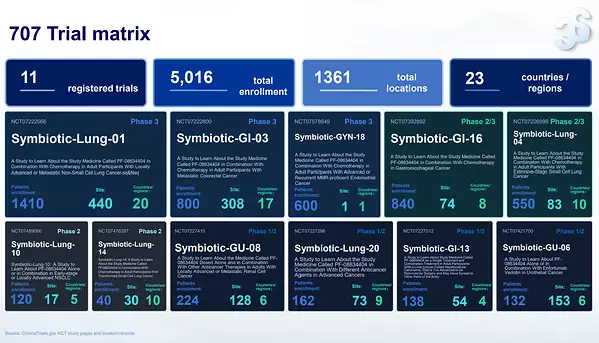
Since Pfizer took over the program, multiple global pivotal Phase III studies and indication-exploring Phase I/II studies of tivunatamig (PF-08634404/SSGJ-707) are currently underway. According to information disclosed by the company at recent industry conferences, tivunatamig has registered 11 international clinical trials and is being evaluated at more than 1,500 medical institutions globally.
These long-term follow-up data represent an important step in the global validation journey of China's innovative drugs.
A series of milestones traces the growth trajectory of SSGJ-707: securing clinical value through regulatory milestones, opening global pathways through BD collaboration, continuously generating efficacy evidence from the clinical program, and advancing global validation with high-density investment from a multinational pharmaceutical company. The long-term follow-up data announced at this ESMO Congress is the latest link in this trajectory—with PFS standing at the forefront among comparable Phase II studies, leaving room for differentiation in subsequent confirmatory Phase III studies. As a landmark project for the out-licensing of Chinese innovative drugs, its subsequent Phase III data will not only determine the commercial success of this bispecific antibody itself, but will also provide an important reference point for the PD-1/VEGF bispecific antibody landscape and the global development of Chinese innovative drugs.
** This press release is distributed by PR Newswire through automated distribution system, for which the client assumes full responsibility. **
Median PFS Approaches 14 Months! 3SBio's PD-1/VEGF Bispecific Antibody Posts Impressive Data at ESMO 2026
Median PFS Approaches 14 Months! 3SBio's PD-1/VEGF Bispecific Antibody Posts Impressive Data at ESMO 2026