LONDON--(BUSINESS WIRE)--Oct 28, 2026--
Preply, the #1 global language learning marketplace, published its first annual Progress Report, exploring how technology is changing the way people learn, and what real progress looks like in the age of AI. Combining a global survey of more than 5,000 working professionals, external research, and insight from learning experts, the report finds a disconnect between learning and application in the real world.
This press release features multimedia. View the full release here: https://www.businesswire.com/news/home/20261028517742/en/
The research identifies what Preply calls "The Progress Gap," the distance between the progress people feel they are making while learning and their confidence applying those skills in real-world situations.
KEY FINDINGS INCLUDE:
Together, the findings suggest that achieving real progress depends on more than access to knowledge alone.
According to the survey, 78% of UK respondents say they spend more time learning today than they did two years ago, using different learning methods, ranging from AI tools to employer training, online courses, short video learnings and more. However, 47% of UK respondents say they are spending more time learning without always seeing better results.
The findings come as AI rapidly transforms how people learn. Today, 88% of UK professionals surveyed already use AI as part of their learning, making it an increasingly common part of how they build new skills. Yet 68% of respondents agree that having access to information does not automatically lead to progress.
Preply's research points to the value of AI, but also the continued importance of human expertise as AI becomes more embedded in learning.
While global survey participants say that AI helps them find answers to questions more quickly (47%) and makes learning more accessible and flexible (36%), 90% of UK respondents said they want AI to play a supporting role rather than lead their learning.
"People value AI because it helps them learn more easily," said Preply CEO Kirill Bigai. "They value people because they make learning stick, and translate knowledge into real world ability. This is the role that our more than 150,000 tutors around the world play every day. The way learning is evolving isn't about asking one to replace the other. Together, human expertise and AI are creating the conditions for real progress."
GEN Z EXPERIENCES THE BIGGEST PROGRESS GAP:
UK Gen Z has the highest AI adoption of any generation at 94%, but also reports one of the biggest challenges is turning learning into progress. When comparing Gen Z to Gen X globally:
71% feel busy learning without improving, vs. 56% of Gen X.
57% have struggled to apply what they've learned in real life, vs. 40% of Gen X.
68% abandoned learning in the past year, vs. 38% of Gen X.
Gen Z is also more likely than Gen X to say they rely on AI more than they'd like (31% vs. 24% ) and that learning with AI feels passive rather than active ( 31% vs. 23% ).
AI ADOPTION AND MOTIVATION LOOKS VERY DIFFERENT AROUND THE WORLD:
Geographically, Argentina and Poland have the highest overall AI adoption at 93%, compared with 85% in the US and Japan - the lowest rate of all countries surveyed. Argentina also has the highest daily use of any market at 42%.
Improving performance at work is the biggest motivation globally, but what drives professional learning varies considerably across markets.
The US and UK are among the most performance-driven, with 50% of US professionals and 54% of UK professionals reporting learning to improve in their current role, compared with 41% globally.
Germany and Poland are the only markets where personal interest comes first, ranking as the top motivation in Germany ( 33% vs. 28% improving performance) and Poland ( 30% vs. 25% ). By comparison, 23% of US professionals cite personal interest.
Japan stands apart for employer-driven learning: 26% are learning because their employer requires it, nearly twice the 14% global average and more than double the 12% in the US
The full Progress Report is available at Preply.com.
About Preply
Preply is the human-led, AI-enabled language learning platform building the future of learning. With a global network of more than 150,000 tutors teaching over 90 languages, we are the category leader and the largest online marketplace and app that brings human tutors together with learners from 180 countries, supporting them with always-on, AI-powered tools to deliver real progress with every lesson. A 2026 efficiency study found that 99% of users said Preply contributed more to their speaking confidence than the leading self-learning app.

A Preply tutor and learner in class
NEW YORK (AP) — U.S. stocks are drifting Wednesday as the countdown ticks toward this afternoon’s announcement from the Federal Reserve on what it will do with interest rates.
The S&P 500 rose 0.2% and pulled within 1% of its all-time high, which was set earlier this month. The Dow Jones Industrial Average was up 149 points, or 0.3%, as of 12:46 p.m. Eastern time, and the Nasdaq composite was mostly unchanged.
The day’s highlight will likely be what the Federal Reserve says, if anything, about where interest rates are heading. The Fed raised its main interest rate last month for the first time in three years in hopes of slowing the high inflation that’s squeezing the economy and discouraging Americans.
The widespread expectation on Wall Street is that the Fed will leave the federal funds rate alone at this meeting, and the question is whether it will give hints about what may happen at later meetings. Fed Chairman Kevin Warsh, though, has been adamant since taking over the Fed about wanting it to give fewer indications about its future moves.
Wall Street cares so much about interest rates because they are one of the main levers that set prices for stocks. The other big variable is how much profit companies are making, and several companies rallied Wednesday after joining the list of those beating analysts’ expectations for the summer.
GE HealthCare Technologies jumped 7.2% after delivering both profit and revenue for the summer that surpassed analysts’ expectations. It also raised its forecasts for revenue growth and other financial measures for the full year.
Etsy climbed 5.3% after its profit for the latest quarter blew past analysts’ forecasts. CEO Kruti Patel Goyal said the online marketplace saw growth in active buyers from prior-year levels for the first time in two years, while its active seller base grew at its fastest rate in two years.
Stocks in the artificial-intelligence industry were also relatively solid. They’ve stabilized this week following big swings on worries that high borrowing costs caused by high interest rates will undercut the boom in AI data centers largely built with borrowed money.
AI stocks got an additional boost after a major player in the industry, South Korea’s SK Hynix, soared 10.9% in Seoul following its latest profit report. The seller of memory chips said it’s in the midst of a virtuous cycle of rising AI usage, and it expects demand to continue to outpace supply through 2030.
On Wall Street, Micron Technology rose 4.7% and was the strongest force lifting the S&P 500. It also sells memory for computers.
Outside of tech and earnings, Wendy's soared 15.1% to $7.09 after Trian Fund Management, run by investor Nelson Peltz, offered to buy the chain for $7.35 per share in cash.
That helped offset a drop for Boston Scientific, which fell 5% even though the seller of medical devices reported a milder drop in profit for the latest quarter than analysts expected. It gave a forecast for profit in the current quarter that fell short of analysts’ expectations.
Robinhood Markets sank 4.2% after reporting weaker profit and revenue for the latest quarter than analysts expected.
In the bond market, Treasury yields ticked higher, and the yield on the 10-year Treasury rose to 5.03% from 4.99% late Tuesday.
It’s near the high end of its range since shooting upward from 3.97% when the war with Iran sent oil prices and worries about inflation much higher. But it’s pulled back after topping 5.30% earlier this month and touching its highest level since 2002.
Rising oil prices pushed upward on Treasury yields Wednesday as uncertainty continues about what will happen in the Middle East and the global energy industry. The price for a barrel of Brent crude, the international standard, climbed 2.7% to $112.39.
In stock markets abroad, South Korea’s Kospi jumped 6.6% following SK Hynix’s leap. Japan’s Nikkei 225 rose 1.1%, while France’s CAC 40 rose 0.1%.
AP Writer Elaine Lai contributed to this report.
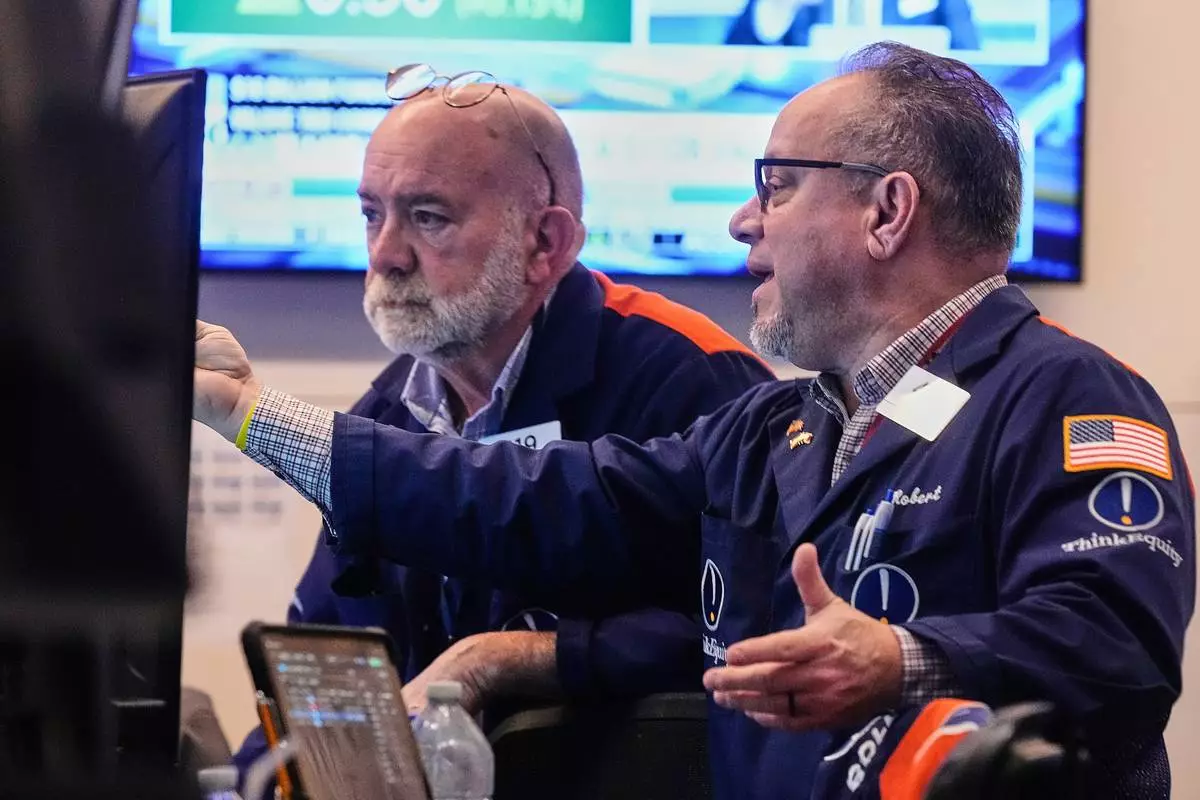
FILE - Traders Joseph Stevens, left, and Robert Arciero work on the floor of the New York Stock Exchange, Monday, Feb. 2, 2026. (AP Photo/Richard Drew, file)
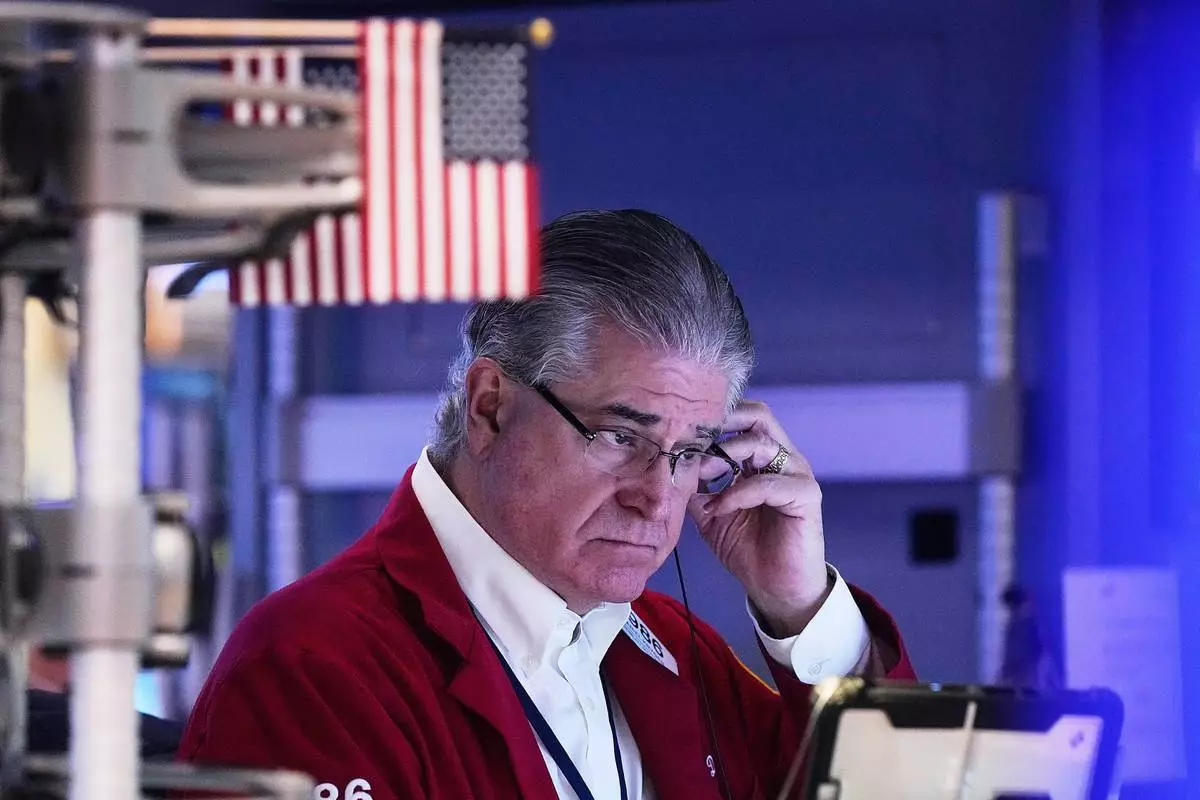
FILE - Trader Daniel Kryger works on the floor of the New York Stock Exchange, Monday, Feb. 2, 2026. (AP Photo/Richard Drew, File)

Employees work near the screens showing the Korea Composite Stock Price Index (KOSPI), the foreign exchange rate between the U.S. dollar and the South Korean won, and the Korea Securities Dealers Automated Quotations at a dealing room of Hana Bank in Seoul, South Korea, Wednesday, Oct. 28, 2026. (AP Photo/Lee Jin-man)
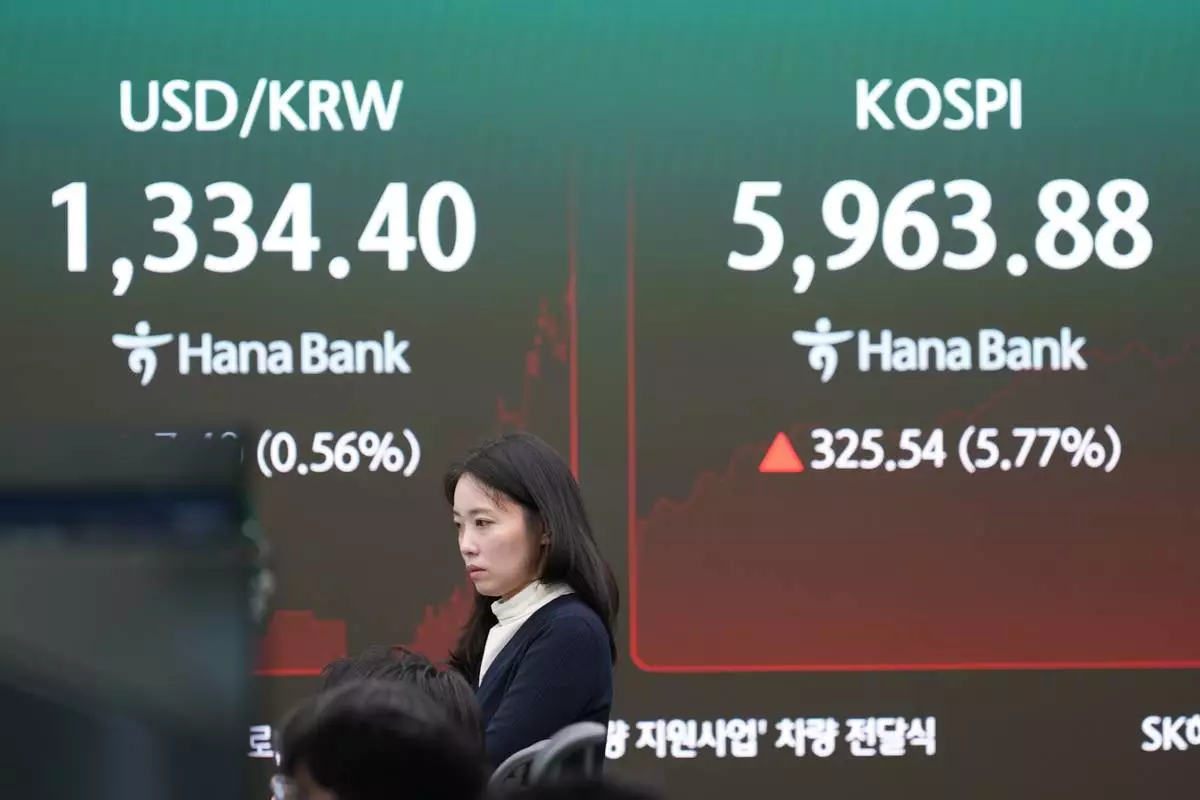
A dealer stands near the screens showing the Korea Composite Stock Price Index (KOSPI) and the foreign exchange rate between the U.S. dollar and the South Korean won in a dealing room of Hana Bank in Seoul, South Korea, Wednesday, Oct. 28, 2026. (AP Photo/Lee Jin-man)

A dealer walks near the screen showing the Korea Composite Stock Price Index (KOSPI) in a dealing room of Hana Bank in Seoul, South Korea, Wednesday, Oct. 28, 2026. (AP Photo/Lee Jin-man)