NEW YORK (AP) — A century after his death, Harry Houdini remains a man we're still trying to learn more about.
A rare essay by the iconic escape artist about magicians of the past has just been published for the first time, while a recent book revisits longtime questions about the cause and date of his death at Detroit’s Grace Hospital. Other centennial publications include a Houdini coloring book and an overview of his vast personal library.
His legacy will be debated at numerous Houdini events taking place this weekend, from a "Grand Houdini Centenarium" in his hometown of Budapest to an auction of memorabilia in Hollywood, California, to seances in cities he visited such as Chicago and Frederick, Maryland. His burial site, at Machpelah Cemetery in New York City, has long been a Halloween gathering place.
“I’m not sure many of the people who know the name ‘Houdini’ could pick him out of a lineup, specify when he lived, or say what he actually did in his performances. But, they know that 'Houdini' is synonymous with magic, an ability to do the impossible, or get out of a tight spot,” said Matthew Solomon, a film history professor at the University of Michigan and author of “Disappearing Tricks: Silent Film, Houdini, and the New Magic of the Twentieth Century,” which came out in 2010.
“For those who know a little more, he’s the epitome of the self-made man and immigrant success story. The fact that he (reportedly) died on Halloween certainly enhanced his mystique," Solomon added.
Houdini's “An Interesting Scrapbook" appears in the new issue of The Strand Magazine, which has published rare works by Mark Twain and Edith Wharton among others. Houdini offers tribute to some magicians who preceded him and laments that more wasn't known about them. He was inspired by playbills shared with him by cartoonist Kin Hubbard for appearances by such popular 19th century entertainers as Robert Heller and H.J. Sargent.
“The following information was presented to my gaze, and I herewith present it, so that we can eventually form a list of the early American magicians," Houdini writes. “American magicians never were thought of enough to be placed in books or chronicle lists so that the future generation could read of the various old-timers; no, magicians were in a class by themselves, and it is only of late years, when Vaudeville had to make use of them as headliners and drawing cards, that magicians became prominent enough to be listed as real acts.”
Eric Colleary, whose “Houdini's Library” came out in September, says that Houdini had a deep interest in other magicians, to the point of visiting their graves and even personally paying to have the graves maintained. The magicians' families would in turn give him scrapbooks, playbills and other items “so that he could keep their memories alive,” says Colleary, the curator of Theatre and Performing Arts at the Harry Ransom Center at The University of Texas at Austin.
Houdini was born Erik Weisz in 1874, a rabbi's son whose family emigrated to the U.S. in part to escape the antisemitism of what was then Austria-Hungary. By his teens, he was a professional magician and by age 30 an international celebrity known for his astounding ability to break out of handcuffs, shackles and other restraints. He was also an author, a movie actor and a spoken word recording artist whose audio archive was purchased by magician David Copperfield.
According to contemporary media accounts, Houdini died Oct. 31, 1926, from diffuse peritonitis after being hospitalized with appendicitis, possibly aggravated days earlier when a college student in Montreal tested his legendary strength by punching him in the stomach. His demise on Halloween fit well — too well, some allege — with his mysterious, even supernatural aura.
Aided in part by no autopsy being performed, alternate theories have thrived ever since, including that he was poisoned by a cabal of circus performers. In “Houdini: The Man Who Died Twice," author Larrian Gillespie draws upon medical records, his death certificate and other materials to challenge the official diagnosis and to contend that he actually died Oct. 30.
The real cause of death, she writes, was intestinal blockage, caused by a doctor's fatal decision to allow Houdini to eat a bowl of vegetables and sour cream while he was recovering from surgery. She also cites conflicting records of his date of death: a doctor's affidavit among other documents lists it as Oct. 30, while the state death certificate — which she found highly flawed — has him dying on the 31st.
Houdini's inner circle wanted his death to be on Halloween “so he would always be remembered,” says Gillespie, a forensic medical researcher who has also written books on menopause, dieting and cystitis.
“Houdini: The Man Who Died Twice” received a starred review from the book industry publication Kirkus, which called it an “absorbing, argument-starting account." Houdini's great- nephew, George Hardeen, told The Associated Press that he found the book ”convincing and persuasive" and had “zero doubts" about Gillespie's findings.
Others were skeptical, including two experts Gillespie cites in her book as among “the most respected and knowledgeable men in the Houdini world.”
Bruce Averbook told the AP he doubted that the date was altered so it could land on Halloween.
"The family was in significant grief and not thinking about legacy," he said. Averbook, a Houdini scholar, added that writings from Houdini's personal assistant list his death as Oct. 31.
“He had no reason to lie about this,” Averbook said.
Another man praised in her book, John Cox, told the AP that while the “book does have some very good new information” about his career, a “second opinion” was still needed about his death. Cox, a Houdini blogger and founder of the Houdini publishing imprint Wild About Harry Press, acknowledged there was “confusion about his death and a desire for clarity.”
“But I think his death is a very small part of the story,” he said. “Houdini’s fame, and why he’s remembered today, comes from his remarkable life.”
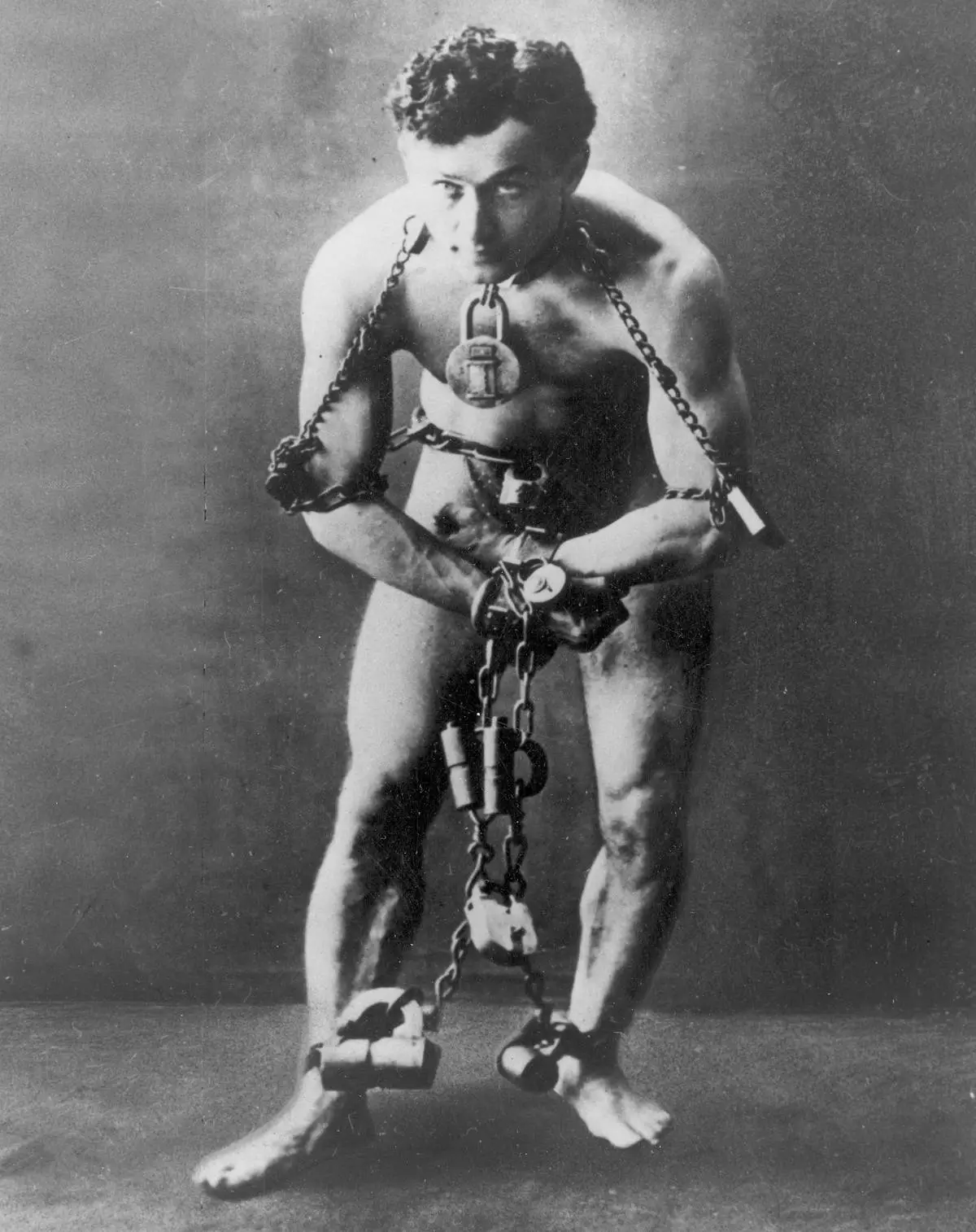
FILE - This circa 1899, file photo, shows escape artist Harry Houdini in chains. (AP Photo/File)
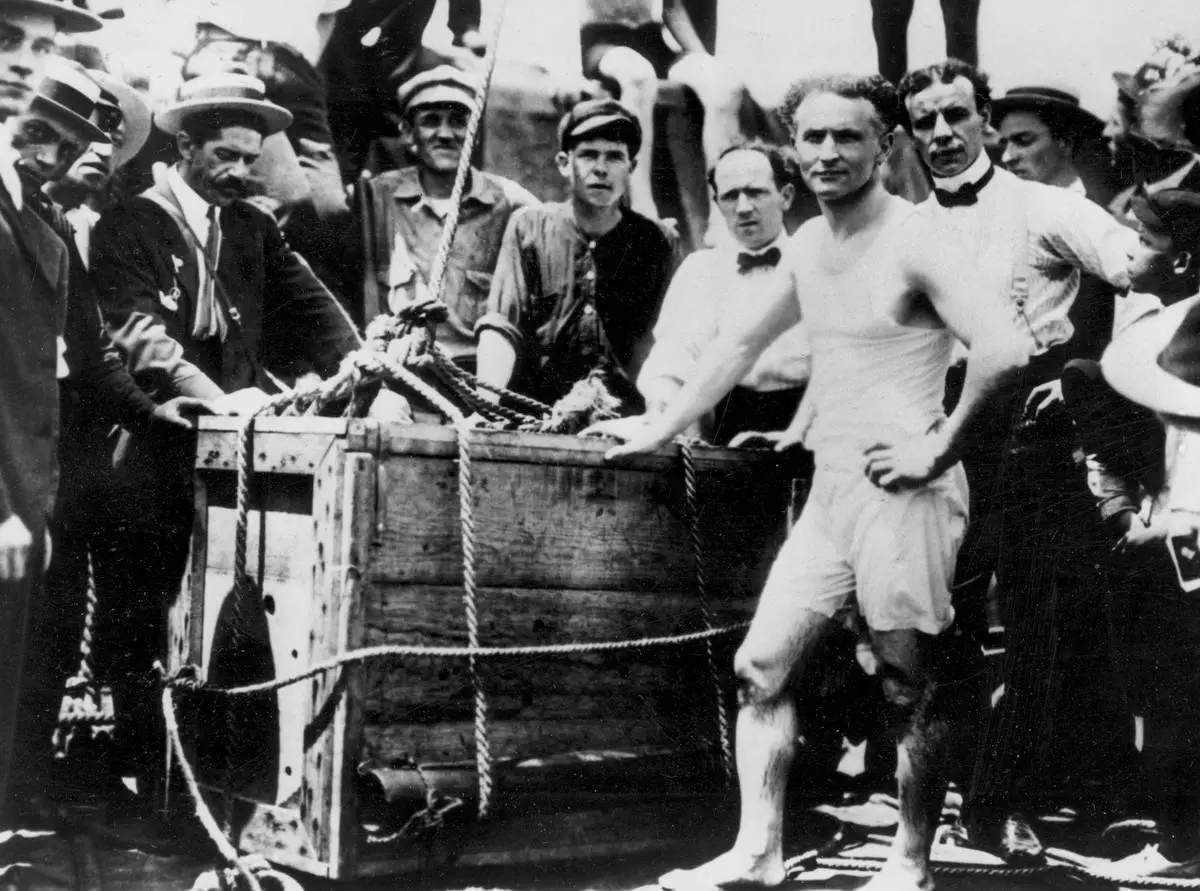
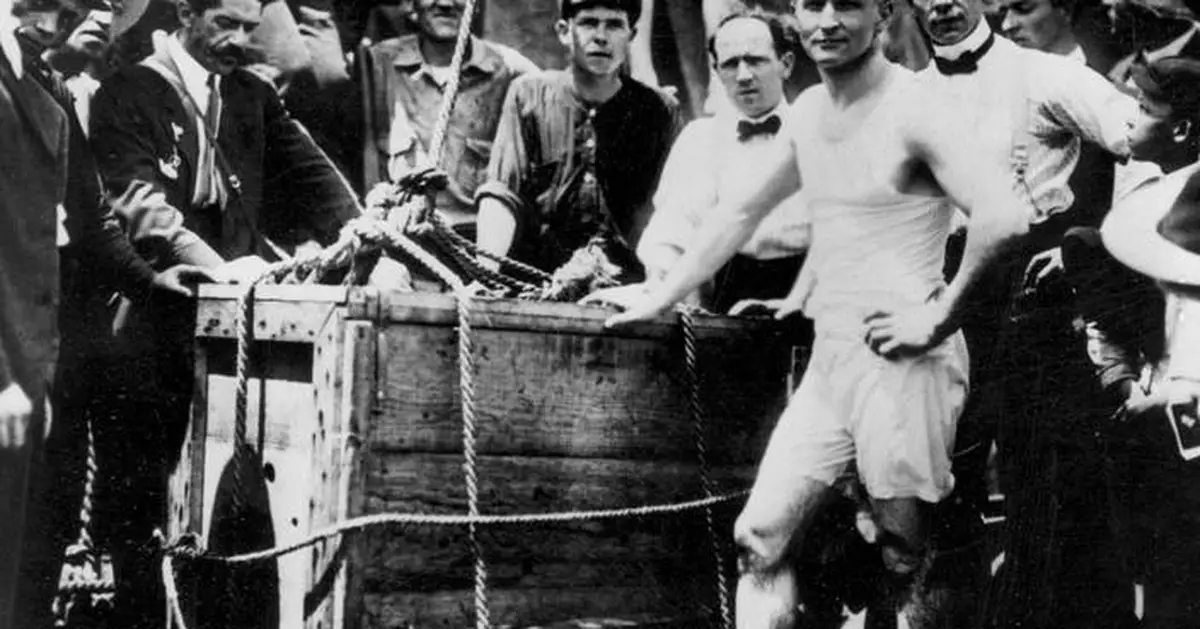
FILE - Escape artist Harry Houdini appears before being lowered in a packing crate into the ice-covered Detroit River in 1907. (AP Photo)
MARKET RASEN, England (AP) — Karl Bushby has spent 28 years walking home, but as he approaches the finish Monday, it’s not clear he's ready for the audacious journey to end.
Pushing a cart loaded with camping gear up a busy country road in northern England about 50 kilometers (30 miles) from the finish line, Bushby was uncertain of the future, anxious about the prospect of living in his mom’s basement and facing an identity crisis.
“My purpose and reason for living is about to end,” he said. “It’s going to be difficult … trying to blend back into a society that you just don’t know anymore.”
Bushby, 57, was just shy of 30 when he entered the unknown at the tip of South America on Nov. 1, 1998. Since then, he has walked 31,000 miles (50,000 kilometers) across four continents, navigated shifting ice over the Bering Strait and swam — a generous description of his technique — across the Caspian Sea and English Channel. He has battled almost every type of element and terrain imaginable through 30 foreign countries to get back to where he started half a lifetime ago.
Swampy jungle, scorching desert and frozen tundra slowed him down, but mountains of red tape helped turn what was supposed to be a 12-year trek into the epic he has dubbed the “Goliath Expedition.”
It’s taken nearly three times as long for Bushby to return to his mother, Angela, in Hull, as it took the hero in “ The Odyssey ” to make it back to his wife, Penelope, in Ithaca.
“Odysseus was a bit of an amateur,” Bushby quipped. “But, you know, I’ll cut him some slack — I haven’t met any giant Cyclops.”
The real world provided plenty of menaces of its own: there was a standoff with a polar bear; he floated through crocodile-infested waters to avoid a guerrilla war in Colombia; a mob attacked him in Peru; and he was rescued by helicopter from an ice floe drifting out to sea.
The former British paratrooper's mission was sparked by a birthday card from his father, Keith, in the mid-90s. Keith, an Army veteran himself, mentioned an argument special forces troops once had about the possibility of walking from London to New York over the Bering land bridge believed by some scientists to have been used by early humans to migrate from Asia to the Americas at a time of lower sea levels.
Bushby drew a continuous line on a map across Europe and Asia to North America and — instead of going to New York — carried on straight down to the tip of Chile.
“And that was it,” he said. “With that under my skin, there was no going back.”
Explorers have long circled the planet by boat, plane, balloon, bicycle and even on foot. But most walkers have relied on transport to cross oceans.
Bushby imposed two strict rules for his journey: transportation could not be used to move forward and he had to return home on foot.
He set out with $500 and soon found himself fighting hurricane-force winds on the Patagonian Steppe. He dodged war in the dangerous Darién Gap, the roadless and rugged jungle, rainforest and mountains between South and Central America, in 2001 and was then jailed for 18 days after crossing a restricted border zone in Panama.
After being airlifted to safety during the 56-mile Bering Strait crossing in 2006 with American adventurer Dimitry Kieffer, he had a near-death plunge into freezing waters and they nearly lost all their supplies. After managing the rare crossing, they were jailed and faced deportation for entering Russia illegally.
It took almost 10 years to get through Russia because of visa issues and weather that only allowed travel a few months a year. When Russia denied him a visa in 2012, Bushby walked in protest from Los Angeles to the Russian Embassy in Washington, D.C., which eventually led to him getting the proper paperwork.
With each setback, he would retreat to the U.S. or Mexico, where living was much cheaper, and wait for his next chance to return to the point where he left off.
He was trailed by police through China, had a lengthy setback from the pandemic and was forced to swim 31 days across the Caspian Sea because geopolitical problems had closed off Russia and Iran. He is not a good swimmer and relied on a flotation vest and wetsuit as he plodded backward by flapping his arms in a technique he calls “floatimming,” a hybrid of floating and swimming.
Europe presented its own challenges, with 90-day limits on visits that forced him to travel in three-month chunks.
Romance has also intervened. He spent seven years with a Colombian woman, and three with a woman from Japan. Each relationship ended in heartbreak that seemed fated by such an itinerant lifestyle.
It's been tough on his family. Bushby has a son from an early marriage to a Belfast woman that ended in divorce. His son mostly grew up without him and is now in his mid-30s. His father met him on the beach in Dover when he crossed the channel, but Bushby hasn't seen his mother in a decade, which adds to the trepidation about his return.
He has been helped by a shifting group of sponsors that have come and gone as the trip dragged on and fortunes tumbled in the 2008 financial crisis. For the past 16 years, he has relied mainly on a production company founded by “House of Cards” creator Beau Willimon and music producer Jordan Tappis, who are backing a documentary in the works by filmmaker Werner Herzog.
It has been the kindness of countless strangers, though, that has buoyed and propelled him throughout, particularly from those who have the least to offer.
He's been welcomed into shacks assembled from car parts, nursed back to health from a bad stomach infection by a Peruvian doctor's family, and fed countless meals of just rice and water by people seeking nothing in return.
“I’ve been welcomed in by the poorest of the poor,” he said. “I’ve met 99.9999% of the very best of humanity. Every culture, every country has been the same response.”
There have been endless stretches of loneliness that have made his final push almost surreal as word spreads of his passage through the rolling green fields that lead to his native Yorkshire. Big rigs literally blowing past him on the road near the town of Market Rasen on Wednesday tooted their horns, drivers waved and a group of motorcyclists stopped to take selfies.
Howard Denton pulled his car over and couldn't understand how a couple of cyclists he had spoken with briefly hadn't taken note of their fellow traveler.
“I said to them, ’Did you see that bloke who’s walked around the world?'” Denton said. “They said, ‘No.’ They didn’t think of asking him where he was going. I just couldn’t believe how stupid they were. I think he’s incredible. I think he’s amazing.”
With each mile, the end draws closer.
When Bushby started out, he looked like Kurt Cobain and even inspired an internet mock conspiracy that the late Nirvana leader was still alive, and walking around the world under a pseudonym.
He's more weathered today, softer in the midsection and has a salty beard. But his bright blue eyes, blond hair and tan belie his age.
He may not know what lies ahead but one thing is certain: he won't miss the thousands of steps he takes each day.
“I’m not doing it because I like walking,” he said. “It’s a means of getting somewhere.”
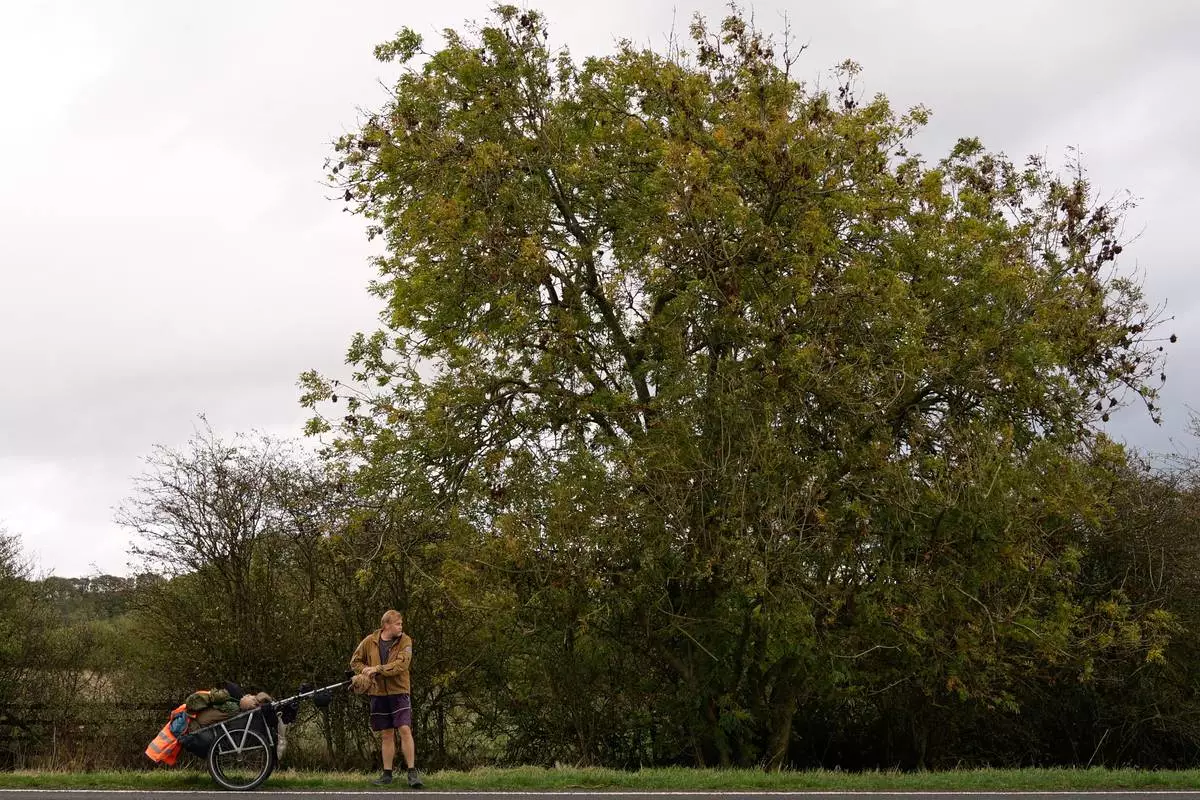
British adventurer Karl Bushby walks near Market Rasen, Lincolnshire, England, Wednesday, Oct. 28, 2026, on the final stretch of his 28-year walk around the world to get back to his mother's home in Hull. (AP Photo/Brian Melley)
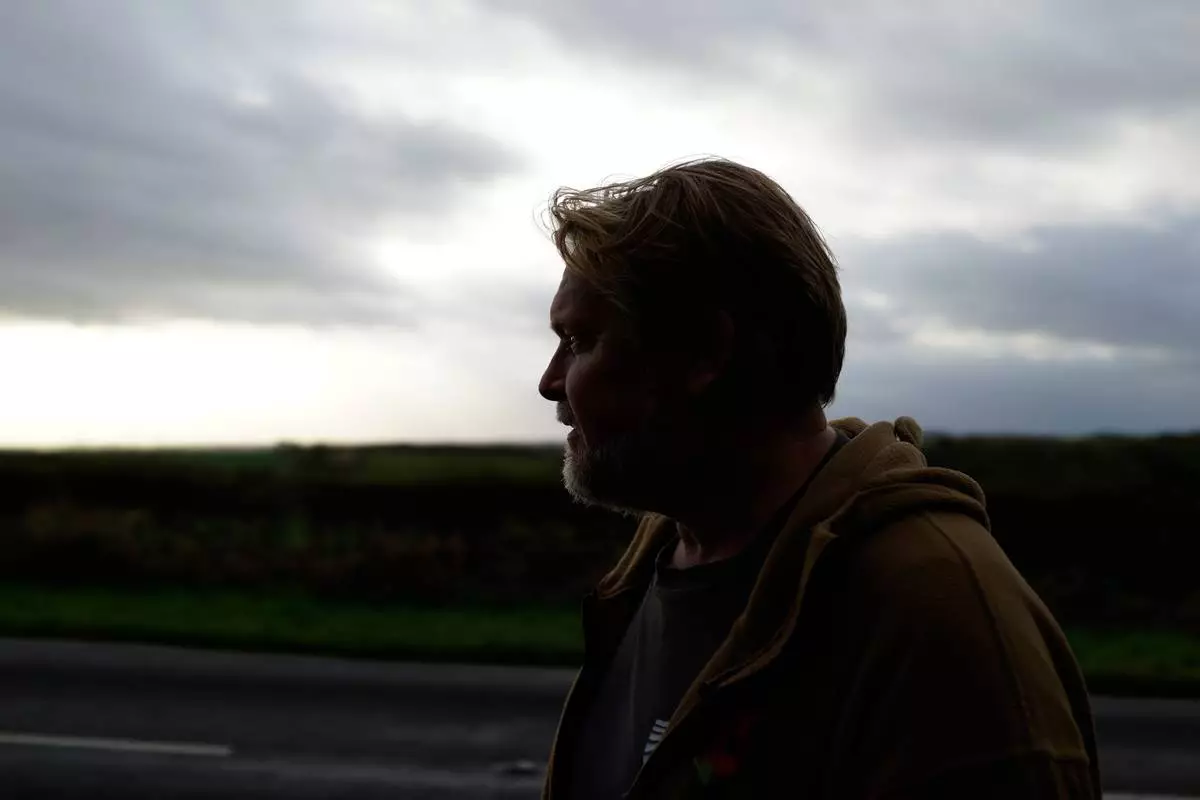
British adventurer Karl Bushby pauses near Market Rasen, Lincolnshire, England, Wednesday, Oct. 28, 2026, on the final stretch of his 28-year walk around the world to get back to his mother's home in Hull. (AP Photo/Brian Melley)
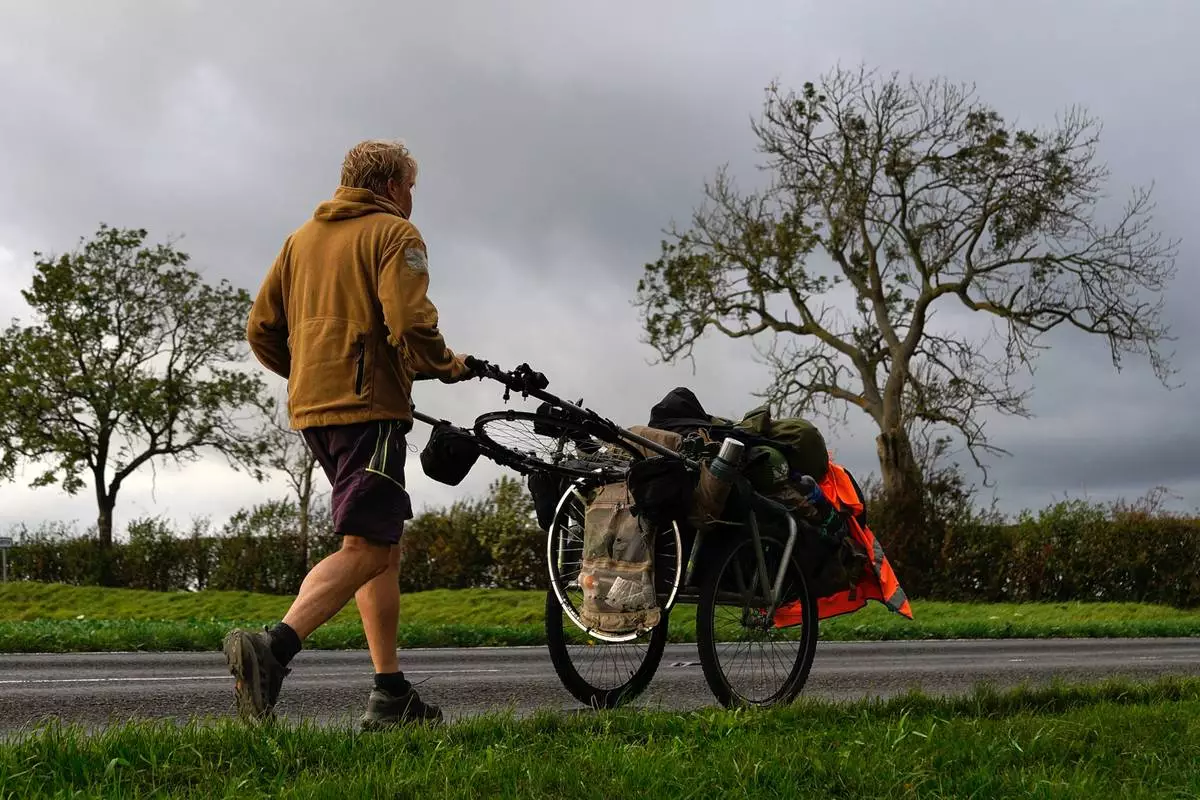
British adventurer Karl Bushby walks near Market Rasen, Lincolnshire, England, Wednesday, Oct. 28, 2026, on the final stretch of his 28-year walk around the world to get back to his mother's home in Hull. (AP Photo/Brian Melley)

British adventurer Karl Bushby pauses during his walk near Market Rasen, Lincolnshire, England, Wednesday, Oct. 28, 2026, on the final stretch of his 28-year walk around the world to get back to his mother's home in Hull. (AP Photo/Brian Melley)
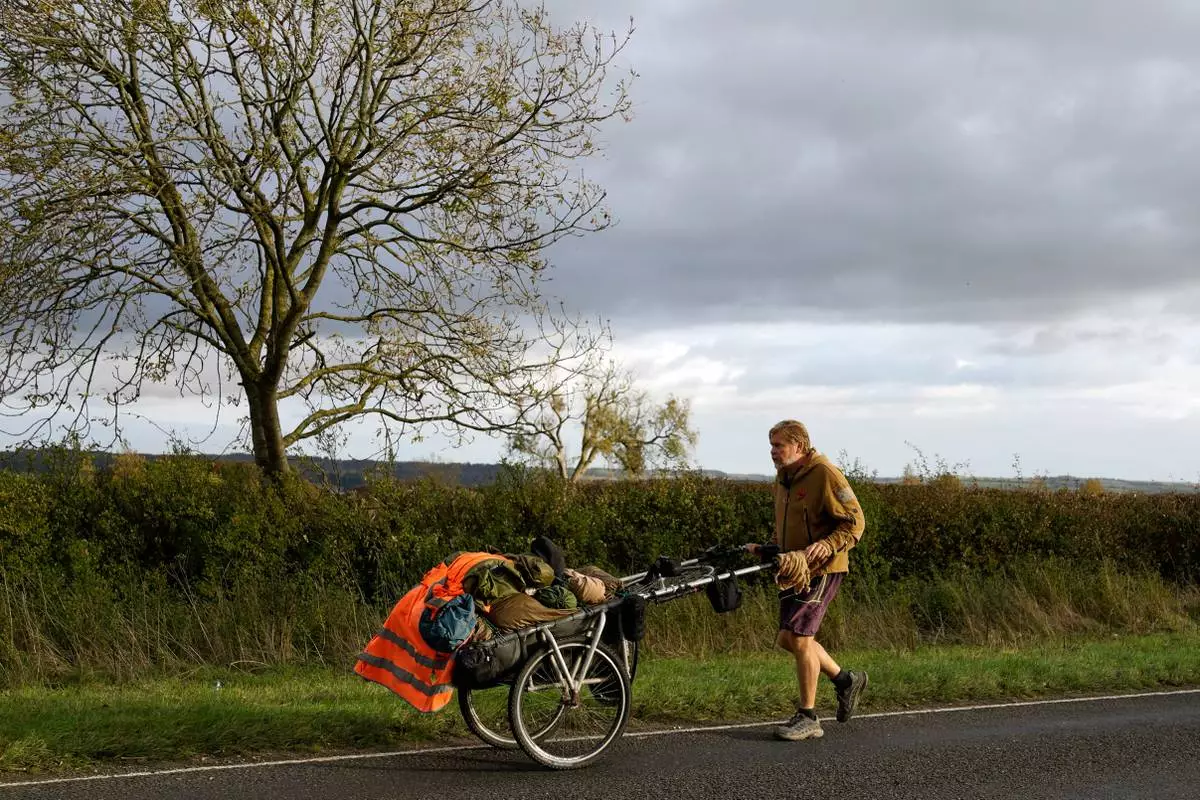
British adventurer Karl Bushby walks near Market Rasen, Lincolnshire, England, Wednesday, Oct. 28, 2026, on the final stretch of his 28-year walk around the world to get back to his mother's home in Hull. (AP Photo/Brian Melley)