RIO DE JANEIRO (AP) — Political memes have exploded in Brazil since Sunday’s election that saw President Luiz Inácio Lula da Silva beat his opponent Flávio Bolsonaro, who responded to his loss by fleeing the country.
Social media played an outsized role in Lula's win, with the unprecedented mobilization of the country's left on digital networks a critical factor in how Sunday's vote played out. Bolsonaro, who is under investigation for money laundering and corruption, said on Monday that he had no intentions of leaving Brazil, then departed the country shortly thereafter.
The extraordinary sequence of events kicked Brazil’s famed meme-making machine into overdrive, turbo-charged by artificial intelligence. The posts got hundreds of thousands of likes and shares on multiple social media platforms.
“Brazilians treat serious questions with lightness, irony and humor,” said Carolina Terra, a professor at the University of Sao Paulo’s communications and arts school. “Everything that is extremely relevant and important, whether political or not, tends to turn into memes that become viral.”
“Where is Flávio?” many on the internet asked, depicting former President Jair Bolsonaro’s eldest son as Waldo, the famous character of a children’s puzzle book series.
One meme titled “Which costume would you use to flee?” presented Bolsonaro in a range of outfits to resemble a Rastafarian, Mario, former soccer player Ronaldo and John Lennon, among others.
Another showed “Flyvio Bolsonaro” as the captain of a “Fly 22 Airlines” – a reference to the number of Brazilians who voted for him punched into the country’s electronic voting machines.
The 45-year-old Trump ally landed in Miami on Wednesday and posted a letter in which he declared himself the “true president-elect of Brazil” — a term he later softened to “leader” — and said the vote was fraudulent, without offering evidence. He compared himself — among other figures — to Charles de Gaulle, who led the French resistance to the Nazi occupation of France from London during World War II.
The letter, posted on X, also used a coat of arms referring to Brazil as “United States of Brazil” instead of the “Federative Republic of Brazil” as the country has been known since 1967. It also misspelled Brazil in Portuguese, using the English spelling with a “z” rather than the Portuguese “Brasil.”
Some Brazilians received an “invitation” to a mock inauguration of Bolsonaro as the president of the “United States of Brazil,” signed by cartoon character Goofy and with Disneyland in the background.
Other internet users declared themselves all sorts of things — from the King of Soccer, a reference to Pelé, to Brazil’s president.
Some social media users parodied the slogan “God, homeland and family”, which became “Goodbye, homeland and family”.
Other memes drew inspiration from famous movies. An AI-modified version of the poster for “Catch me if you can” replaced Leonardo DiCaprio with Bolsonaro and Tom Hanks with Supreme Court Justice Alexandre de Moraes, who issued the order canceling Bolsonaro’s passports on Sunday night.
Another tampered with the poster for “Home Alone” and pictured Flávio and his brother Eduardo — who also lives in the U.S. — as the thieves in the background, and a shocked-looking Jair Bolsonaro in a red jumper at the forefront.
One referenced the movie “Dark Horse” — a biopic and propaganda film about Jair Bolsonaro.
Flávio Bolsonaro is under investigation for corruption, money laundering and tax evasion for receiving millions of dollars from a disgraced banker to finance the movie. The meme depicted the poster for an imagined “Dark Horse 2” — showing Bolsonaro on a horse bearing a presidential sash galloping on a highway toward an airport. “The fugitive is different” read the poster, referencing the elder Bolsonaro’s similar departure to Florida after he lost the 2022 election and also refused to concede. He was later sentenced to 27 years in prison for attempting a coup.
Fewer memes circulated in Brazil during this year's election campaign due to a lack of opportunities ahead of the first round because there were no debates involving the two main candidates, said Viktor Chagas, a professor at Fluminense Federal University and coordinator of the Colab research group that analyzes political memes.
In the lead up to the runoff vote, the two debates did generate more memes but the three-week period was principally characterized by high political tension, Chagas said.
“The memes regarding Bolsonaro’s departure to the U.S. have a cathartic element” for Lula's supporters, said Chagas. “The idea is: Now that we’re back on track, so to speak, we can laugh together.”
Follow AP’s coverage of Latin America and the Caribbean at https://apnews.com/hub/latin-america
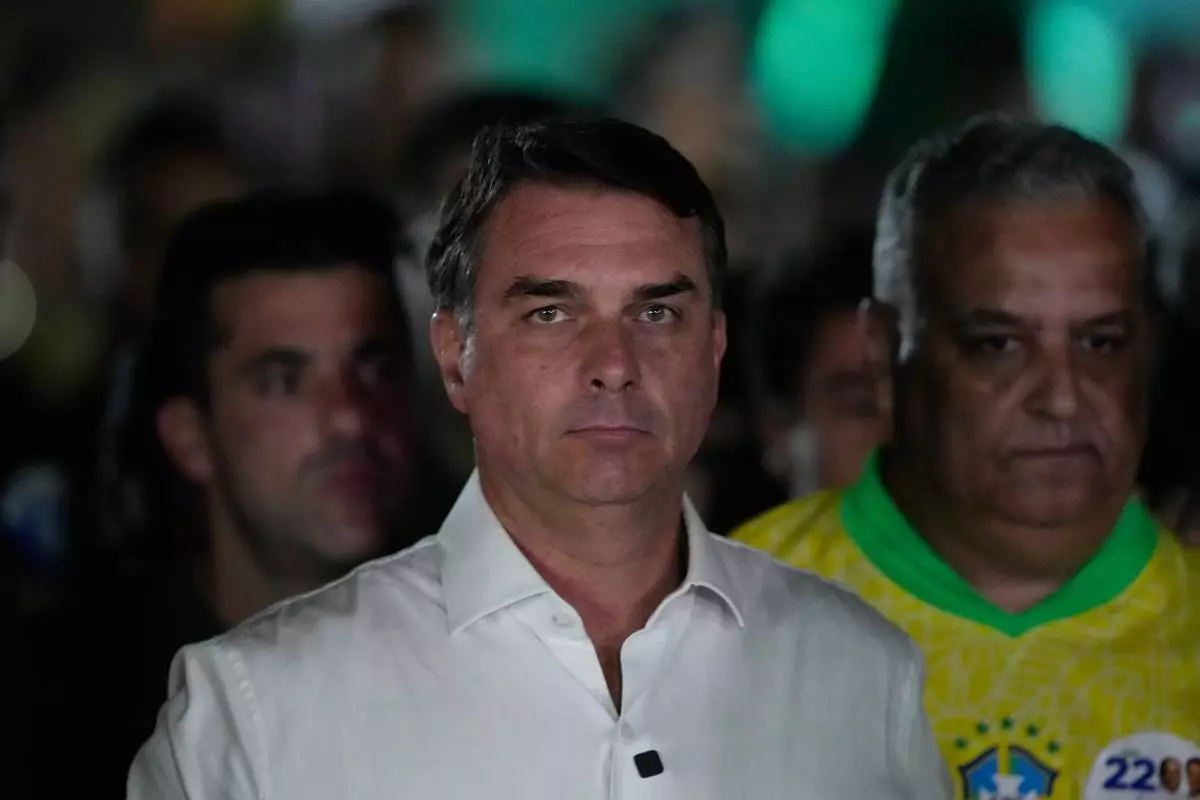
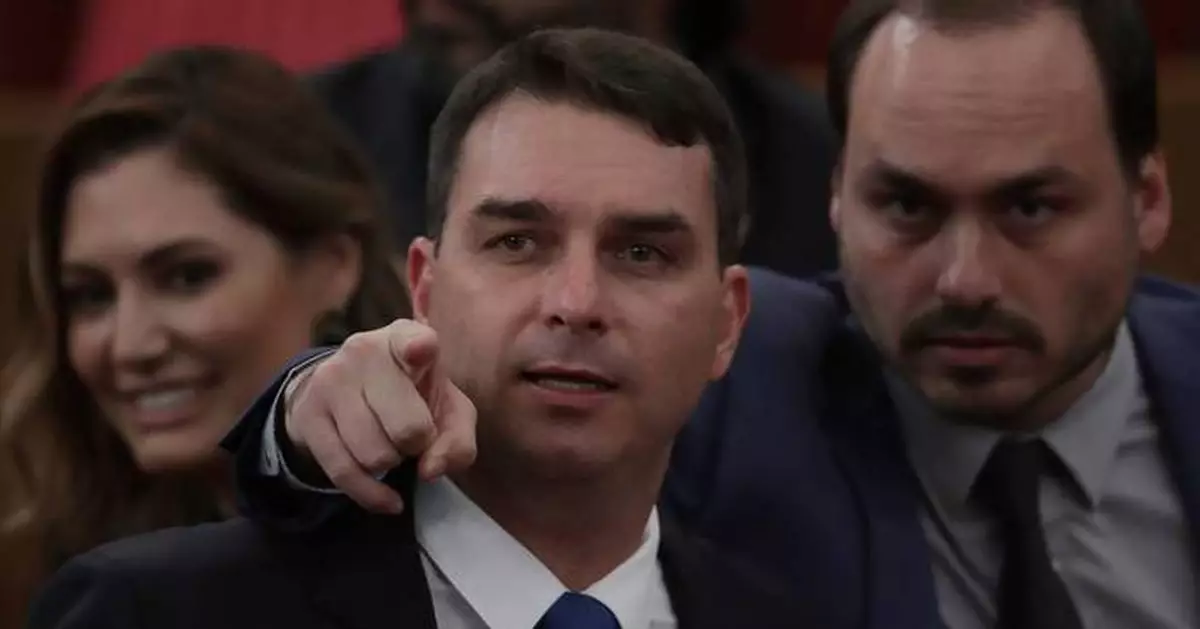
Opposition presidential candidate Sen. Flavio Bolsonaro arrives at his election night event after the presidential runoff in Brasilia, Brazil, Sunday, Oct. 25, 2026.(AP Photo/Eraldo Peres)

FILE - Brazil's former President Jair Bolsonaro, center, his wife Michelle Bolsonaro, left, and his son Flavio Bolsonaro, listen to the national anthem during a motorcycle caravan to protest his Supreme Court trial where he faces charges for alleged involvement in a 2022 coup attempt, in Brasilia, Brazil, July 29, 2025. (AP Photo/Eraldo Peres, File)
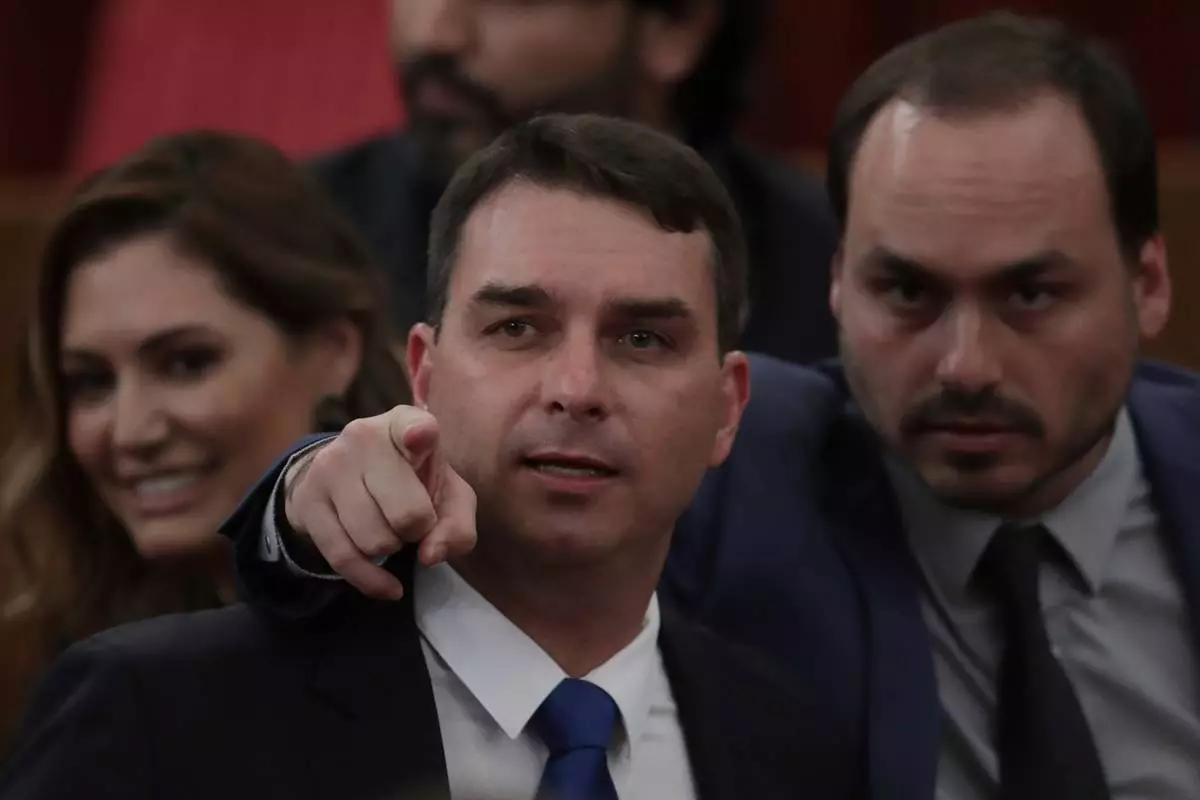
FILE - Flavio Bosonaro, center, and Carlos Bolsonaro, sons of Brazil's President-elect Jair Bolsonaro, attend a ceremony officially confirming the presidential elections results which their dad won at the Supreme Electoral Court in Brasilia Brazil, Dec. 10, 2018. (AP Photo/Eraldo Peres, File)
LAS VEGAS (AP) — Fawn Douglas puts an urban spin on traditional basketmaking.
Instead of using desert plants, she tightly weaves heavy conduit wire to form the base of a basket she plans to display at the new Wai Gallery in Las Vegas. There, she and her partner, A.B. Wilkinson, showcase pieces from Indigenous artists and host free art programs, from collage projects to sidewalk chalk paintings.
Douglas, a Las Vegas Paiute Tribe citizen, says she sees how art can heal and bring people together.
“They’re off their phones. They’re having actual conversations together,” Douglas said.
The gallery and IndigenousAF storefront dismantle stereotypes, including that Native Americans and Alaska Natives are a monolith and all live on reservations, she said. It opened just ahead of National Native American Heritage Month, which celebrates the diverse histories and cultures of hundreds of tribal communities across the U.S. in November.
Native American art isn’t just geometric, Douglas said, and each piece has a narrative.
A painting behind her featured a silhouetted Joshua tree and a backlit mountain range with a brilliant night sky. It’s a desert twist on Vincent Van Gogh’s “Starry Night” — and it acted as a call to action for turning Gold Butte into a national monument in Nevada.
A black-and-white underwater photograph depicts a Hawaiian dancer, seemingly floating in space. It is called “Ha’ina ’ia mai,” which translates to “let the story be told.”
Here is a collection of short stories highlighting joy in Native American and Alaska Native communities:
When the salmonberries are ripe in Kipnuk, Alaska, the Paul family isn’t far behind.
They are one of several families who returned to practice subsistence gathering a year after Typhoon Halong struck their village, damaging 90% of its buildings, floating some houses miles away and leaving nearly all of the community’s residents displaced.
It’s been an especially good year for salmonberries because of heavy snow last winter, locals say.
From a boat, Burt Paul scanned the tundra for the orange berries — or naunraqs as they’re called in coastal Yup’ik — like orange carpet on a sea of green grass. They giggled as the dogs ferociously defended them against two musk oxen grazing on shore.
The Pauls typically camp out for several days and pick berries. But this summer was broken up into shorter trips when Burt Paul’s scattered family could return together.
The family never misses a year of berry picking, they said.
“Coming home, seeing everyone, the community — it’s heartwarming,” Caley Paul said.
When the day ended, the family had a five-gallon bucket filled to the brim. Not as much as most years but enough for Burt Paul to make his famous naunraq pie. Enough for everyone to have a taste.
— Samantha Watson, KYUK
Foster care didn’t separate Rosa Soto Alvarez from her Pascua Yaqui community.
She and her siblings were placed with another family on the tribe’s reservation in Arizona, where their foster mother served up tortillas and fry bread with pots of chile con carne. They grew up surrounded by saguaros and the sounds of relatives speaking the Yaqui language. They took road trips to powwows.
Under the 1978 Indian Child Welfare Act, tribal children taken into foster care have the right to remain with Indigenous families.
That experience has guided Alvarez’s life work. At 50, she is a mother and grandmother who has cared for 25 foster children in her home. She leads the tribe’s ICWA Committee, coordinating statewide advocacy that supports the federal child welfare law and encourages states to adopt versions of it.
Nationwide, Native children are disproportionately represented in state foster care systems.
“I’m just a rez girl trying to make a difference,” she said. “There’s so many children out there who don’t have a voice, and I know I have to be that voice.”
— Nancy Marie Spears, The Imprint
A group of Indigenous girls carried a vessel of river water to the Eastern Band of Cherokee Indians Tribal Council and walked out with rights for the river.
The council unanimously passed a resolution this year recognizing the rights of the water system that rises in the Great Smoky Mountains and flows into the Gulf of Mexico. To the Cherokee, these waterways are known as Longperson and are a living relative.
The NAIWA Daughters, girls ages 10 to 17, brought the resolution forward after receiving training on the rights of nature, hosting community dinners, conducting surveys and meeting with council members. The Earth Law Center says it’s the first all-female-led rights-of-nature effort in the U.S.
The resolution grants the waterway five rights, including the right to flow freely and to be free from pollution.
The council later passed another resolution to raise money to remove the decommissioned Ela Dam in North Carolina, which has blocked the sicklefin redhorse, a freshwater fish, for more than a century.
“We hold the responsibility of stewarding the headwaters, so every living being downstream has water for life,” said NAIWA Daughters co-founder and Chairwoman Jasmine Smith.
— Liz Kimbrough, Mongabay
Sugarbush is a springtime tradition in many Native communities.
Students in the Minneapolis-based Wicoie Nandagikendan early childhood program trekked through the snow this past winter to learn about tapping maple trees and processing the syrup at Porky’s Sugarbush Camp.
The children and their parents walked past colorful buckets hanging on trees to catch the sap. They helped stir syrup already boiling in a large black kettle and helped make sugar and cakes. One student placed tobacco at a maple tree during a ceremony.
For parents like Christian Swor, the program provided his son and family an opportunity to connect with Indigenous culture and language. The early childhood program immerses children in the Ojibwe and Dakota languages.
Other cultural activities in the curriculum include how to cook dishes with rabbit or duck and how to process wild rice.
“We do hit all the state standards, but it’s like hitting all those early childhood indicators, progress and more,” said Ojibwe classroom teacher Liz Zoongwegiizhigook Zinsli.
— Chandra Colvin, Report for America corps member, MPR News
At 67, Kerry Butler still fits into his old Tulsa Indian Youth Center boxing jacket.
He joined the team for three years in the 1970s when he was 15. The center served a vital role for Native Americans after the federal government pushed them off their ancestral homelands and into major cities to assimilate them into white society.
Many Native youth had low self-esteem in those days, but a common gathering space and boxing helped change that, Butler said.
“When you got in front of a crowd of people, and they were cheering for you, and when you got into the ring, and people were clapping, ‘Awesome! Let’s go, Kerry! You can do it!’"
"It just rose up confidence inside that you never felt before,” Butler, who is Muscogee and Cherokee, added.
The youth center no longer exists. But a nonprofit called Tulsa Indian Community Center, Inc., recently formed with a vision to provide another gathering space for youth.
More than 60 tribes are represented in the Tulsa Public Schools district.
— Brittany Harlow, Crosswinds News
Hodokii Johnson leans in closely, as they tattoo three brown lines on each of Kristin Gentry’s fingers.
One is for the strength of Gentry’s mother. One is for Gentry. And one is for Gentry’s daughter.
When all the lines are darkened, the two say a prayer.
Johnson, a 24-year-old Muscogee Nation citizen and descendant of the Cheyenne and Arapaho Tribes, have been interested in body art since they were a teenager to cope with mental health struggles and now sees it with greater purpose.
They’ve worked with Inchunwa, a project dedicated to healing through traditional tattoos from the southeastern U.S., and recently attended a convention highlighting Indigenous tattoo practitioners in Oklahoma City.
Giving tattoos and ancestral markings is sacred work, they say, because of the permanence and deeper meaning.
“So much of the tattoo tradition that we had has since been weeded out through the efforts of colonization,” Johnson said. “Tattoos are seen as a taboo, unholy thing. When we talk about ancestral markings, it’s rather the opposite.”
— Sarah Liese, KOSU

Fawn Douglas puts a cup on a shelf at IndigenousAF, her store and gallery in Las Vegas, Thursday, Oct. 29, 2026. (AP Photo/Ty ONeil)

Students use wooden paddles to process maple syrup at a skigamizigan (sugarbush) camp in Maple Plain, Minn., Wednesday, March 18, 2026. (Kerem Yücel/Minnesota Public Radio via AP)