The Trump administration’s online accounts are circulating images of a pumpkin carved with a sombrero design and a fake Halloween-themed background around a Black man apparently accused of food assistance fraud, in social media posts slammed by critics as inflammatory rhetoric.
Only days before the midterm elections, the posts coincide with the government’s sweeping campaign to show its aggressive immigration enforcement, and highlight efforts to crack down on fraud to save taxpayers money when rising healthcare costs and other economic stressors have made affordability a top voter concern.
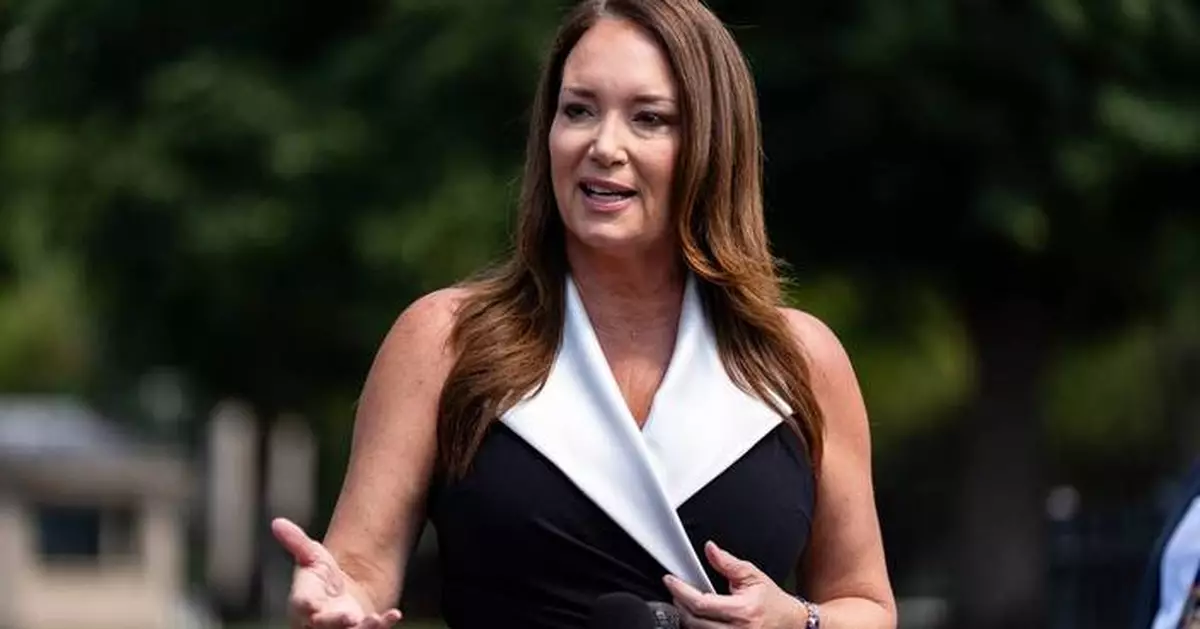
Agriculture Secretary Brooke Rollins posted Saturday on the social platform X a photo of the Black man standing in front of stacks of what appear to be U.S. currency with the headline, SNAP FRAUDSTER, an apparent reference to the Supplemental Nutrition Assistance Program, formerly known as food stamps.
He is holding aloft what appears to be a bill set aflame.
“Some costumes come with a price tag. This one comes with a prison sentence,” it says to the backdrop of fake Spirit Halloween costume packaging.
Another photo posted by the White House on X on Thursday showed a pumpkin with the shape of a sombrero carved across it and the words “Spooky szn is here.”
The post by Rollins, who was nominated by Trump to serve as the U.S. Secretary of Agriculture in November 2024, appears to be taken from an Instagram post from September 2025 by an account under the name Shawty Dred.
Earlier this month, Mercedes Reshard New, identified by the Justice Department as a social media personality also known as “Shawty Dred,” was arrested on federal charges for fraudulently obtaining more than $4 million in Supplemental Nutrition Assistance Program benefits in Georgia.
It’s not the first time the White House has been accused of posting inflammatory images on official government social media accounts.
Just over a year ago during the government shutdown, the White House revived a deepfake video posted by Trump of House Democratic leader Hakeem Jeffries in a fake mustache and sombrero to accuse the Democrats of acting on behalf of illegal immigrants instead of U.S. citizens. Jeffries described the meme as bigoted. They played it on repeat in the White House briefing room, though Vice President JD Vance promised that the “sombrero memes will stop” when Democrats agreed to end the shutdown.
The NAACP did not respond to an email seeking comment, nor did the White House or Rollins.
The Trump administration in recent weeks has ratcheted up its anti-immigrant rhetoric and accusations of fraud, including against U.S. Rep. Ilhan Omar whose Washington, D.C., home was searched by federal agents earlier this month. Federal authorities are investigating potential fraud in her family’s immigration paperwork. Omar, who was born in Somalia, is a naturalized U.S. citizen.
It also has taken a series of punitive steps linked to allegations of fraud in mostly Democratic-led states, including California and Minnesota whose governors accused the federal government of targeting their states for political reasons.
Federal prosecutors said in a news release Oct. 21 that the influencer, New, controlled more than 350 fraudulent SNAP accounts under stolen identities between January 2020 and July 2026. He allegedly applied for his company, Shawty Dred LLC, to become an authorized SNAP retailer and used EBT debit cards to extract about $4 million from the accounts.
New’s Instagram account, which has more than two million followers, has flaunted his extravagant lifestyle, federal prosecutors said. Posts depict him flying on private jets, posing with Rolls-Royce vehicles in front of his “super mansion,” and handling massive stacks of cash.
“Instead of this money feeding families in need, New, the social media personality known as ‘Shawty Dred,’ allegedly used the cash to bankroll a life of luxury,” Special Agent in Charge of FBI Atlanta Marlo Graham said in the release.
New was indicted by a federal grand jury Oct. 7 on dozens of counts of mail fraud and aggravated identity theft, and one count each of SNAP fraud and illegal transactions with access devices. He was arrested Oct. 13 and remains in federal custody.
According to Fulton County jail records, New has been arrested multiple times on suspicion of crimes including identity theft, insurance fraud, financial transaction card fraud, forgery and simple assault.
A federal defender listed in court records as representing New, Joseph Austin, did not return a phone message.
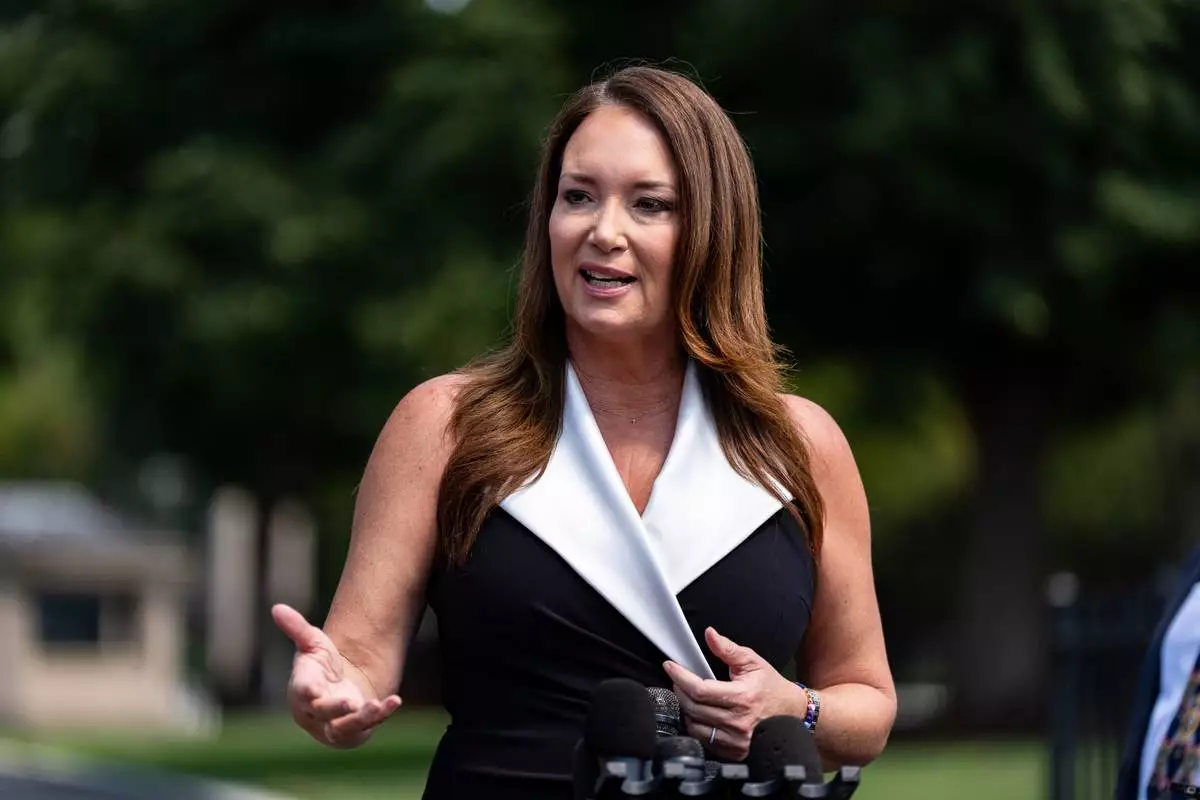
FILE - Agriculture Secretary Brooke Rollins speaks with reporters at the White House, Aug. 25, 2026, in Washington. (AP Photo/Alex Brandon, File)
MANILA, Philippines (AP) — Her father may no longer be with her, but Lorita Santos keeps the memories they shared close to her heart.
She was among thousands of Filipinos who flocked to cemeteries across Manila on Sunday to visit the graves of their loved ones, marking All Saints’ Day.
For generations, the tradition known locally as Undas has brought families together to remember and honor their dead. The name derives from the Spanish word “honras,” meaning “honors.”
“Just because they have passed away does not mean we should forget them,” said Santos, who visited the resting places of her father and three other relatives.
Her family marks the occasion by offering flowers and candles. Together, they also pray and share snacks.
The visits are an opportunity to share stories about those who have passed away. Santos fondly remembers how her father would give his children and grandchildren small gifts every payday.
“We will never forget that,” she added.
Santos grew up visiting the graves of her relatives, even outside All Saints’ Day. Now, she is teaching her kids to do the same.
“We pass this on to our children to make sure they are aware of the tradition, so that if something happens to us, they know what to do,” Santos said.
Encompassing All Saints’ Day and All Souls’ Day, Nov. 1 and 2, Undas is rooted in Catholic observances but also incorporates beliefs and customs that predate Spanish colonization.
“There is a very long tradition of ancestor worship in the Philippines,” said Nestor Castro, an anthropology lecturer at the University of the Philippines Diliman.
Long before the Spanish arrived, Filipinos honored ancestral spirits known as anito by offering food and other gifts to the dead. These practices were not tied to a particular date but formed part of a broader tradition of ancestor veneration, Castro explained.
The tradition evolved after the Spanish arrived in 1565 and introduced Catholicism and new religious practices, some of which may have come from Mexico.
The two countries have historical ties dating back to Spanish colonial rule, when the Manila-Acapulco galleon trade connected them for centuries. Today, they also have similar customs for honoring the dead and remembering loved ones.
In Mexico, many families also honor their departed loved ones by spending a day or night at their graves or setting up altars at home. It is a joyful occasion filled with marigolds, music and food.
Similar customs are observed in other countries with strong Catholic traditions, including Bolivia, Poland and Hungary, where families gather to honor their dead with flowers, candles and prayers.
In Filipino culture, death is not only a time to honor those who have passed away, but also an occasion that brings families together, Castro said.
During funeral wakes, he added, families wait for relatives who live far away to arrive before burying their loved ones. “That’s when family reunions occur. It’s a binding event.”
That sense of togetherness also extends to Undas. Sticky rice cakes are often shared for the occasion, symbolizing the bonds between relatives through their sticky texture.
“These events foster and solidify kinship relationships,” Castro said.
For Mike Mamaril, a 42-year-old school maintenance employee, visiting his parents’ graves is a custom passed down from his grandparents. He said he makes time for the annual visit, even though he rarely gets another opportunity to go.
The gatherings are also a chance to reminisce about his mother and father, including the lighter moments of his childhood.
“We always talk about who among us got scolded the most,” Mamaril said.
Hernández reported from Beijing.
Associated Press religion coverage receives support through the AP’s collaboration with The Conversation US, with funding from Lilly Endowment Inc. The AP is solely responsible for this content.
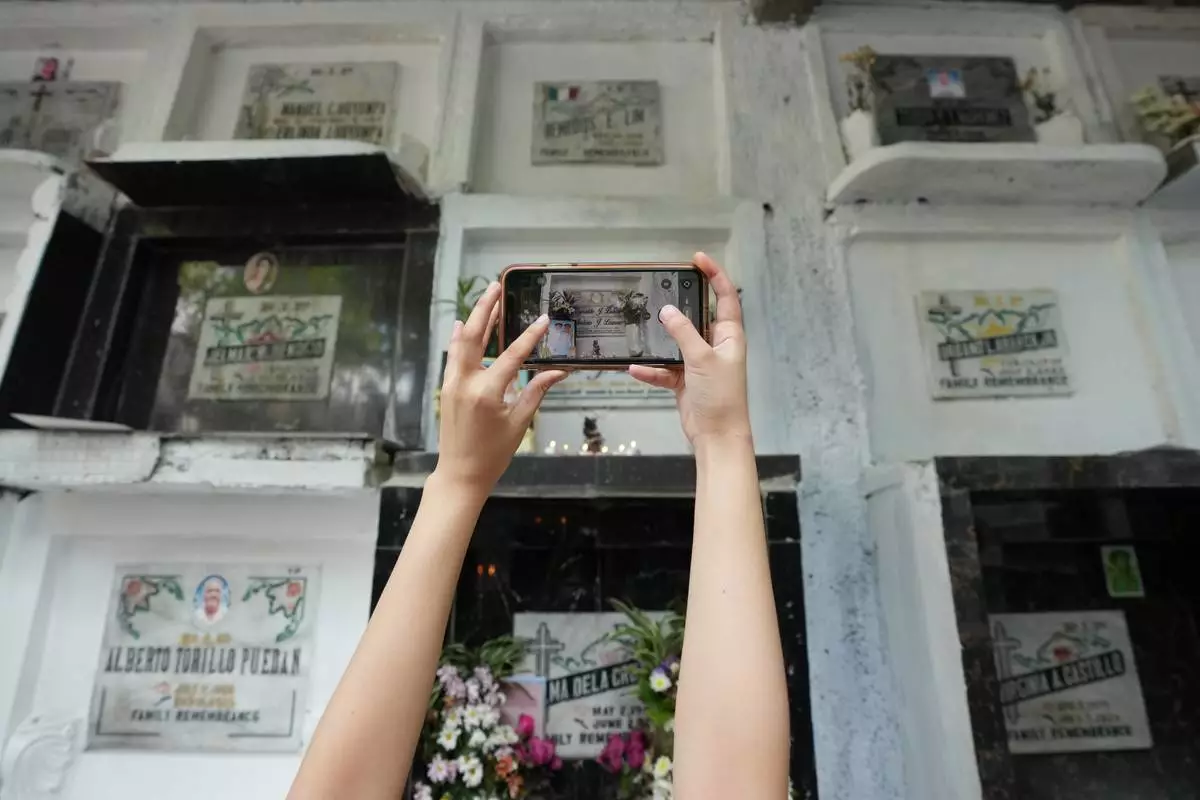
A woman takes photos using her smartphone as they visit their departed at Manila's North Cemetery, Philippines while the country observes All Saints' Day on Sunday, Nov. 1, 2026. (AP Photo/Aaron Favila)
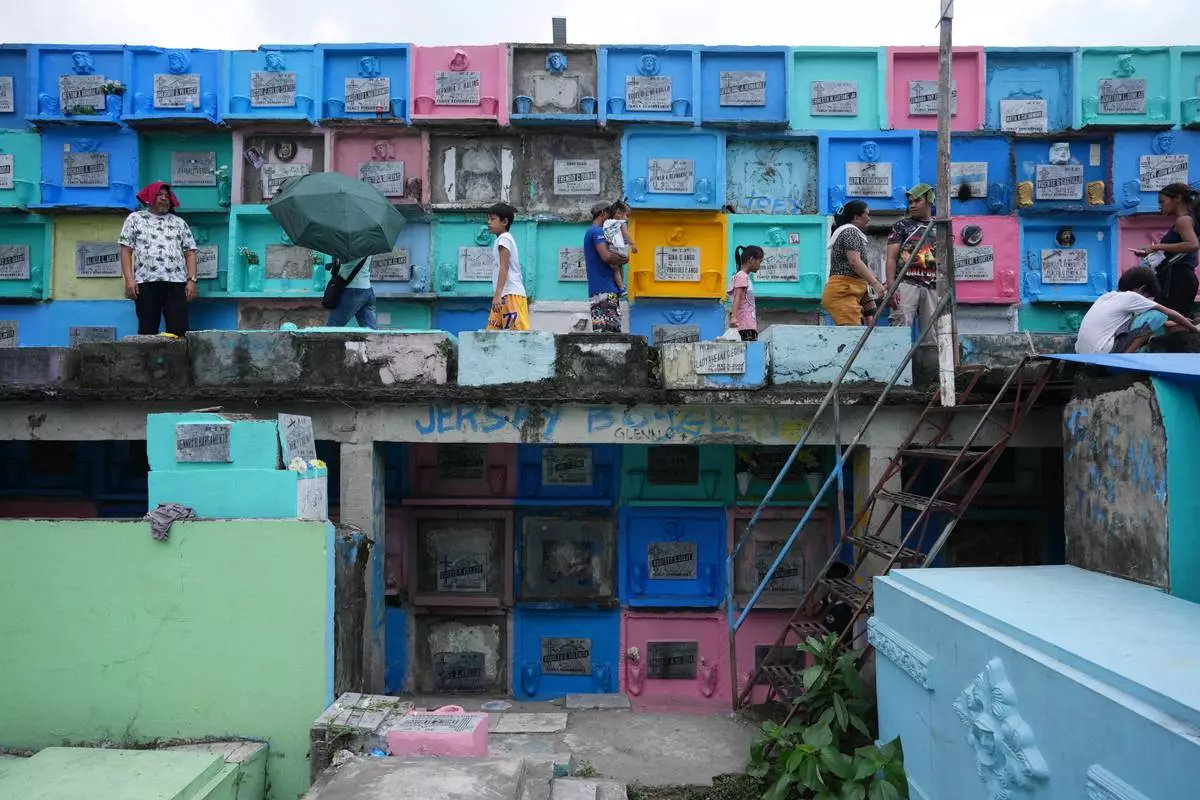
People walk beside apartment-type tombs at Manila's North Cemetery, Philippines as the country observes All Saints' Day on Sunday, Nov. 1, 2026. (AP Photo/Aaron Favila)
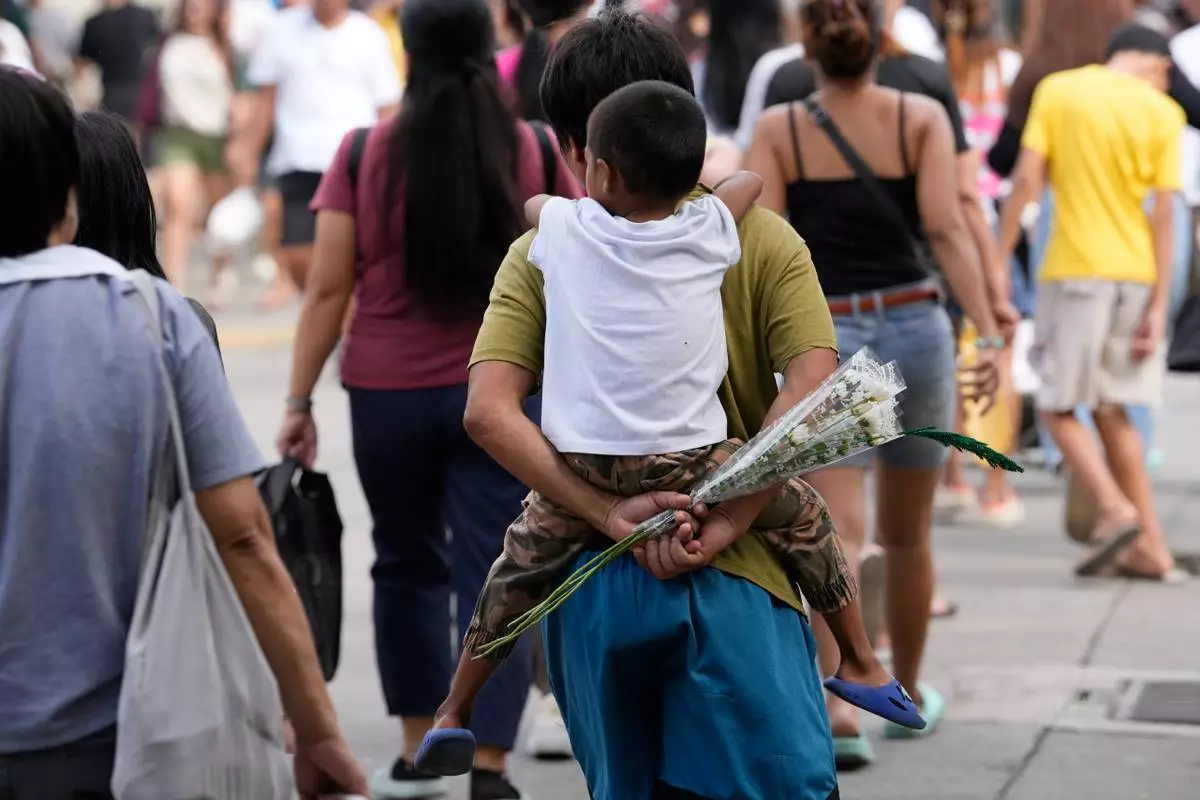
A man carries a child and flowers at Manila's North Cemetery, Philippines as the country observes All Saints' Day on Sunday, Nov. 1, 2026. (AP Photo/Aaron Favila)
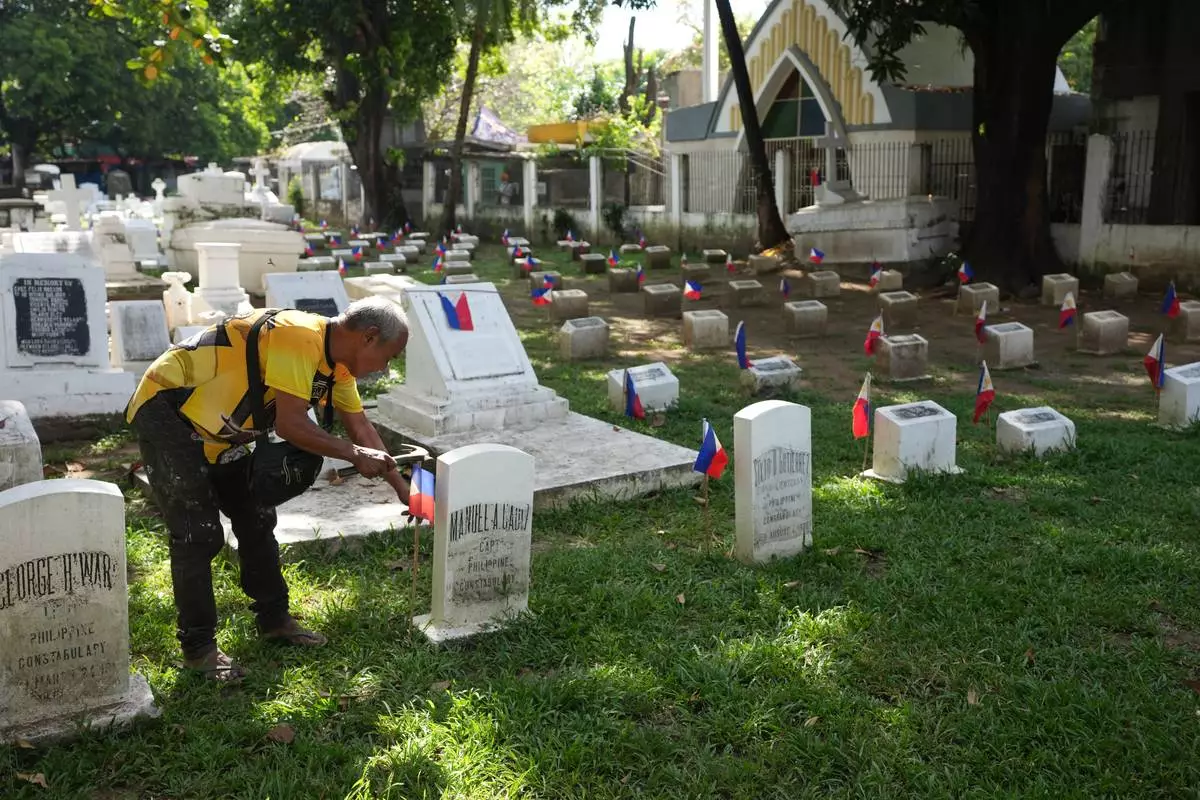
A man places Philippine flags on soldier's tombs at Manila's North Cemetery, Philippines as the country observes All Saints' Day on Sunday, Nov. 1, 2026. (AP Photo/Aaron Favila)
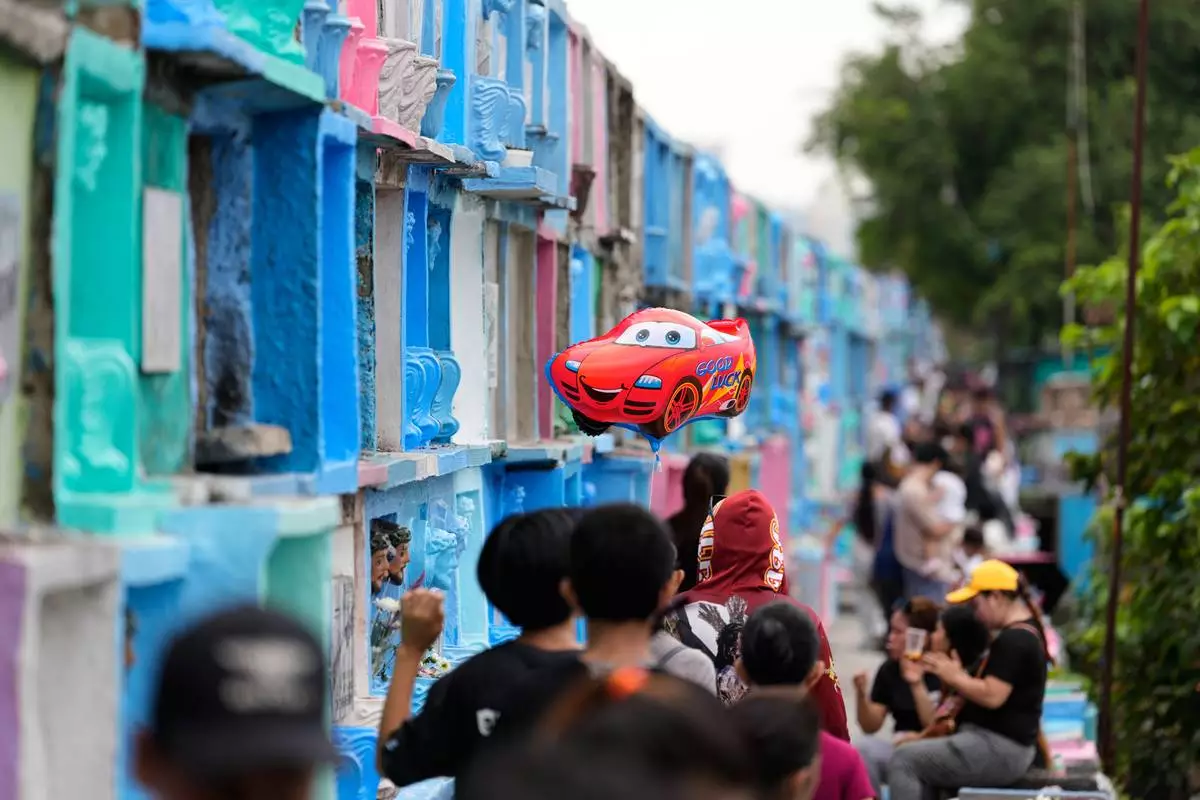
A man holds a balloon as he walks beside apartment-type tombs at Manila's North Cemetery, Philippines as the country observes All Saints' Day on Sunday, Nov. 1, 2026. (AP Photo/Aaron Favila)