COOPERSTOWN, N.Y. (AP) — Retired managers Dusty Baker, Bruce Bochy, Joe Maddon and Lou Piniella are among eight men on the ballot for the Hall of Fame’s contemporary era committee for managers, executives and umpires that meets on Dec. 6 at the winter meetings in San Diego.
Former general managers Sandy Alderson and Brian Sabean also are on the ballot along with the late Atlanta Braves owner Ted Turner and former player, broadcaster and National League President Bill White, the Hall announced Monday.
The identities of the 16 voters will be announced closer to the meeting, and 75% of the vote is needed for election. Anyone chosen will be inducted into the Hall next July 25 along with players voted in by the Baseball Writers’ Association of America, whose balloting will be announced on Jan. 19.
Piniella received 11 votes in 2023, when Jim Leyland was elected, and 11 in 2018, when Harold Baines and Lee Smith were voted by the today’s game era committee.
The Hall in 2022 restructured its veterans committees for the third time in 12 years, setting up panels to consider the contemporary baseball era from 1980 on and classic baseball era from before 1980. The contemporary baseball era holds separate ballots for players and another for managers, executives and umpires.
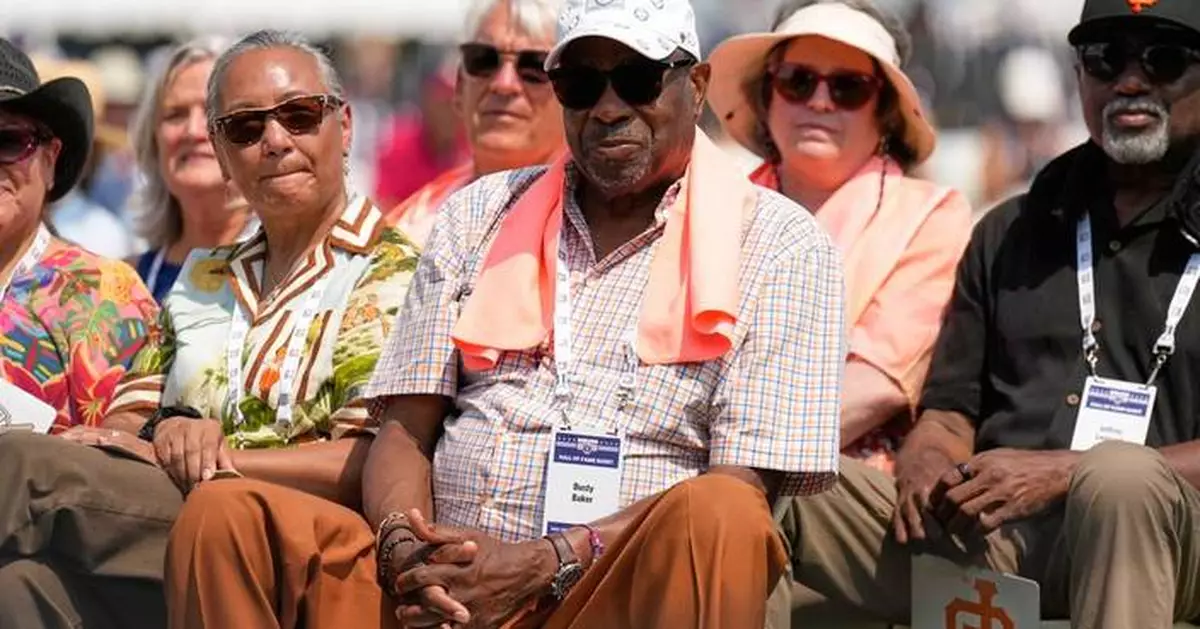
Baker, 77, was a two-time All-Star outfielder who hit .278 with 242 homers and 1,013 RBIs for the Los Angeles Dodgers, Atlanta, the Oakland Athletics and San Francisco Giants from 1968-86, then managed the Giants (1993-2002), Chicago Cubs (2003-06), Cincinnati (2008-13), Washington (2016-17) and Houston (2020-23). He had a 2,183-1,862 regular-season record as manager over 26 seasons, winning the 2022 World Series title. He was voted Manager of the Year in 1993, '97 and 2000.
Bochy, 71, caught for the Astros, New York Mets and San Diego from 1978-87, then managed the Padres (1995-2006), the Giants (2007-19) and Texas (2023-25). He had a 2,252-2,266 regular-season record as manager over 28 seasons, winning World Series titles in 2010, ‘12, ’14 and '23. He was voted NL Manager of the Year in 1996.
Maddon, 72, managed the Angels (1996, ‘99, 2020-22), Tampa Bay (2006-14) and Cubs (2015-19), leading the Cubs in 2016 to their first World Series title since 1908. He had a 1,382-1,216 regular-season record as manager over 19 seasons and won Manager of the Year awards in 2008, ’11 and '15.
Piniella, 83, was 1969 AL Rookie of the Year and a one-time All-Star outfielder while hitting .291 with 102 homers and 766 RBIs for Baltimore, Cleveland, Kansas City and the Yankees from 1964-84. He managed the Yankees (1986-88), Cincinnati (1990-92), Seattle (1993-2002), Tampa Bay (2003-05) and the Cubs (2007-10), compiling an 1,835-1,713 regular-season record over 23 seasons. He won a World Series title with the Reds in 1990 and was voted Manager of the Year in 1995, 2001 and '08.
Alderson, who turns 79 on Nov. 22, was Oakland's general manager from 1983-97, helping the A's win the 1989 World Series title. He was Major League Baseball's executive vice president for baseball operations from 1998 to 2005, CEO of the San Diego Padres from 2005-09 and worked for the Mets as general manager from 2010-18 and as team president from 2020-23.
Sabean, 70, was head coach at the University of Tampa in 1983 and ’84, then joined the Yankees as a scout. He moved up to director of scouting in 1986 and vice president of player development/scouting in 1990, then joined the Giants in 1993 as assistant to the general manager and vice president of scouting/player personnel. He was promoted to senior vice president of player personnel in 1995 and was general manager from 1996-14, winning three World Series titles. Sabean was the Giants' executive vice president of baseball operations from 2015-18.
Turner, who died on May 6 at age 87, bought the Braves in 1976 and led the team until 1996, when Turner Broadcasting System merged with Time Warner. He was a broadcasting innovator, turning WTBS into a superstation with national distribution. His Braves won the 1995 World Series title.
White, 92, was an All-Star in five seasons as a first baseman and occasional outfielder, hitting .286 with 202 homers and 870 RBIs for the New York and San Francisco Giants, St. Louis and Philadelphia from 1956-69. He won a World Series title with the 1964 Cardinals, was a Yankees broadcaster from 1971-88 and NL president from 1989-94.
Each committee meets every three years. Classic baseball meets in December 2027 and contemporary baseball/players in December 2028.
Managers and umpires were eligible if they had 10 or more big league seasons and have been retired for five years, though people 65 and older are eligible six months after retirement. Executives must be retired for five years, but active executives 70 or older are eligible.
A candidate who does not receive at least five of the 16 votes is not eligible for the next ballot of that committee three years later. A candidate who does not receive at least five of the 16 votes on multiple ballots would no longer be eligible for that committee.
The ballot was picked by a historical overview committee that included Adrian Burgos of the University of Illinois, Bob Elliott of the Canadian Baseball Network, historian Steve Hirdt, La Velle Neal of the Minnesota Star Tribune, former The Athletic writer David O’Brien, José de Jesus Ortiz of Our Esquina Media, BBWAA secretary-treasurer Jack O’Connell, former Fort Worth Star-Telegram writer Jim Reeves, former San Francisco Chronicle writer Glenn Schwarz, San Francisco Chronicle writer Susan Slusser and former Southern California News Group writer Mark Whicker.
Buster Posey, Jon Lester and Ryan Zimmerman are among players eligible for the BBWAA vote for the first time. Holdovers include Chase Utley, Andy Pettitte and Félix Hernández.
AP MLB: https://apnews.com/hub/mlb
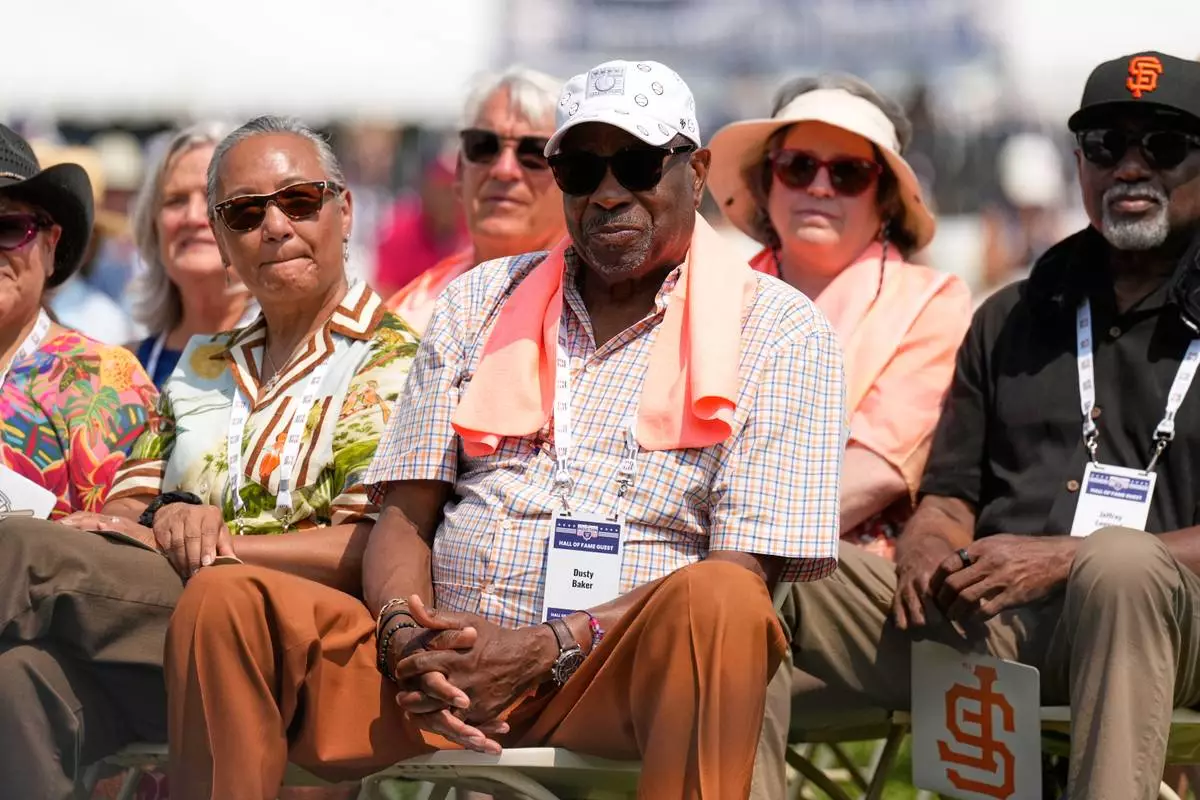
FILE - Dusty Baker attends the Baseball Hall of Fame induction ceremony in Cooperstown, N.Y., on July 26, 2026. (AP Photo/Seth Wenig, File)
President Donald Trumpclosed out the final weekend of a turbulent midterm campaign with rallies in two states he had handily won in the past. At the same time, Democrats began to fracture in Michigan, risking their effort to retake the Senate. Michigan Democrat Abdul El-Sayed’s former opponent in the U.S. Senate primary, Haley Stevens, stunned party officials Sunday by endorsing Republican Mike Rogers as Democratic tensions boiled over days before the election.
Trump will make his closing pitch of the midterm elections Monday afternoon at the Lincoln Memorial Reflecting Pool, pushing his slow, expensive and problem-plagued efforts to repair it back into the spotlight on the eve of Election Day.
The Latest:
In a new interview released Monday, the president indicated he’d have no qualms about issuing pardons to those surrounding him to protect them from potential criminal liability.
The comments come as Democrats could take control of at least one chamber of Congress, giving them investigative powers such as subpoena authority.
“I would if I needed to, sure,” Trump told the New York Post’s Miranda Devine on her “Pod Force One” podcast. “I would not even think about — I’d do it.”
He pointed to preemptive pardons former President Joe Biden issued to family members, administration officials and key lawmakers, such as those who worked on a special committee investigating the Jan. 6, 2021, insurrection at the Capitol.
The stakes in Tuesday’s midterm elections are so high that Shane Dunn voted for the first time in his life, at age 65.
After a career as a cook up and down the East Coast, Dunn moved to the Philadelphia suburbs and voted last week in Levittown. “I was always a busy man,” he said outside his polling place. But now, “I’m learning what’s going on within our country, and this is actually what brought me out.”
Voters across the United States are getting their word in, too, as they determine which party controls the Senate and the House and takes charge of governors’ offices, legislatures and state leadership posts in the final two years of Republican Donald Trump’s presidency.
In dozens of Associated Press interviews with people who cast ballots at advance polling places or drop boxes across the country, the angst was palpable, most sharply from those who oppose Trump but also from many who support him.
▶ Read more
For President Donald Trump, this week’s elections are about him. For his fellow Republicans, the risk is voters will agree.
Midterms almost always serve as a referendum on the president’s party, and losses typically ensue. But Trump’s decisions to impose tariffs, start a war and oversee extravagant Washington renovations — largely without congressional consultation — have made it harder for Republicans to navigate those historical headwinds.
There is a direct connection between his actions and higher gas prices, costlier groceries and persistently high inflation.
Republicans cannot blame the fallout from those decisions on past administrations when Trump has owned them so fulsomely. They also cannot easily distance themselves from an unpopular president who demands loyalty and routinely tells voters the economy is just fine.
At virtually every juncture before Election Day on Tuesday, Trump has complicated the task of protecting Republican majorities in Congress.
The Iran war is “making it exponentially harder for Republicans to keep the House and Senate,” Rep. Derrick Van Orden of Wisconsin, one of the most vulnerable House Republicans, said in a debate while noting his support for the effort.
The NAACP is asking a judge for an emergency order limiting which federal staffers can monitor the polls on Election Day.
The group wants law enforcement agents from the Federal Bureau of Prisons, the Drug Enforcement Administration and the Bureau of Alcohol, Tobacco, Firearms and Explosives to be barred from the role because they could intimidate voters.
“DOJ’s decision to deploy federal law enforcement agents and personnel to election sites is unlawful and serves a plain purpose: to intimidate voters and election workers alike, and to have a chilling effect on in-person voting on Election Day,” the group wrote in its overnight filing.
The Justice Department has insisted its election monitors around the country on Election Day will be there to observe and will not interfere with voting.
President Donald Trump’s administration has made $15 billion in promises to agricultural producers in the weeks before Tuesday’s midterm elections, initiatives intended to offset higher diesel and fertilizer costs that farmers have endured largely due to his tariffs and the Iran war.
Whether that will motivate more voters to turn out in agricultural states where traditionally Republican seats are now seen as competitive is unclear. It may explain Trump’s increased attention on rural areas, including visits Sunday to Iowa and Kansas.
Of the $15 billion, more than half will go toward a one-time payment plan for farmers impacted by soaring diesel prices. Beyond the $15 billion, the agency also plans $13.8 billion in payments to offset shortfalls during the 2025 crop year for farmers who grow key crops such as corn, soybeans, wheat and rice.
Increased fertilizer and fuel costs have made it difficult for farmers to turn a profit this year. Last year, tariffs drove up expenses for other equipment farmers use, and the trade war with China caused a near boycott of U.S. agricultural goods.
The Justice Department has defended the accuracy of a list that it says has more than 20,000 suspected noncitizens registered to vote in California and suggested that an immigrant rights group should face contempt charges over an analysis of the names.
U.S. District Court Chief Judge James Boasberg had allowed the Coalition for Humane Immigrant Rights access to data on people the Trump administration alleges are noncitizen voters. Boasberg ordered the plaintiffs not to disclose any names and to use the data only for arguments about why they have legal standing to challenge its use.
In a Saturday court filing, the group said more than 40% of the people on the list do not appear in the state’s voter file. The filing also identified 22 people who were likely naturalized U.S. citizens while saying that thousands more American citizens appeared to be on it.
The Justice Department argued Sunday that the group’s filing had nothing to do with its legal standing and therefore violated Boasberg’s order. The agency also suggested that Boasberg refer the matter for investigation into possible contempt of court.
▶ Read more
In dozens of Associated Press interviews across the United States, many voters say the America they’ve known is slipping away.
They see lawlessness coming from those who create the laws, hate stirred by politicians and a culture that doesn’t speak to how they live. The angst was palpable among people who cast ballots at advance polling places or drop boxes ahead of Tuesday’s election, which will determine the political party that controls Congress in the final two years of Republican Donald Trump’s presidency.
“He’s just destroying us,” Democrat Linda Markle, 72, said of the president. She spoke outside the Warminster Township library in Bucks County, Pennsylvania.
“I am so afraid for this country,” she said. “People used to look out for each other. Not anymore.”
Trump supporter Therese Mennell in Ohio said he gets it. “There’s that kind of arrogant vibe about him that people don’t like, and sometimes I shut him off because of the way he talks,” the retiree said in Wayne County. “But, I mean, he’s doing the right thing. He is saving our country.”
▶ Read more
In the sleepy Alaskan fishing community of Petersburg, nobody has seen Dan J. Sullivan for weeks.
His rustic home stood dark a day after FBI agents visited friends who donated to his quixotic campaign to unseat the Republican senator with the same first and last name — Dan S. Sullivan. The only display of politics at his home was a yard sign from the League of Women Voters: “Stand Up for Democracy: Vote 2026.”
What may have begun as a ploy to harm the reelection prospects of Sen. Sullivan has taken a serious turn as the Trump administration weighs criminal charges over a campaign tactic known as “ballot stacking.”
“It just seems like such a waste of our taxpayer money,” said Sharon Hunter, a Petersburg resident who, with her husband, donated $1,000 to Dan J. Sullivan, a former elementary school teacher. FBI agents knocked on her door Saturday during a round of interviews with the campaign’s dozen contributors.
“I’m a bit incredulous about their whole angle,” Hunter said, “because they’re targeting a person who’s been a real contributor in this community.”
▶ Read more
Trump is making his closing pitch of the midterm elections at the Lincoln Memorial Reflecting Pool, pushing his slow, expensive and problem-plagued efforts to repair it back into the spotlight on the eve of Election Day.
In comments to reporters as he deplaned from Air Force One for a Sunday rally in Iowa, Trump said his speaking at the site would “show how beautiful it is.”
“We might hold it tomorrow or something,” the president added, without giving specifics. Hours later, the White House formally announced he’d be giving a speech there Monday afternoon.
Rather than using Monday to travel to key states and try to energize his “Make America Great Again” supporters as his Republican Party tries to maintain control of Congress, Trump opted for an event at a Washington renovation project that has been embarrassing and contentious.
The unusual move marks a departure from Trump’s monthlong race to stage more than 25 rallies in largely conservative areas, hoping the GOP can overcome his own low approval ratings and polls predicting that the Iran war, high energy prices and cost of living increases could spell a strong election night for Democrats.
▶ Read more
Michigan Democrat Abdul El-Sayed’s former opponent in the U.S. Senate primary, Haley Stevens, stunned party officials Sunday by endorsing Republican Mike Rogers as Democratic tensions boiled over days before the election that could determine the balance of power on Capitol Hill.
Stevens endorsed Rogers after attending a Detroit church service with him. The remarkable show of support for the President Donald Trump-backed candidate in the tightly contested race comes after she was uninvited to a joint event the same day with El-Sayed, who defeated the congresswoman by a slim margin in the August primary.
“Our Democratic nominee for Senate said I was no longer welcome in his campaign and that I should stay away,” Stevens said in a video announcing the endorsement, which led her top aide to quit. “And he’s right. And that’s why I am endorsing Mike Rogers for the United States Senate today.”
El-Sayed dismissed the endorsement when asked about it by reporters later Sunday, saying he’s focused on issues voters care about, such as the high cost of living.
“At the end of the day, I actually don’t think about Haley Stevens,” he said, adding later: “None of this matters.”
▶ Read more
President Donald Trump closed out the final weekend of a turbulent midterm campaign with rallies in two states he has handily won in the past, while Democrats began to fracture in Michigan, risking their effort to retake the Senate.
The president was in Salina, Kansas, and Dubuque, Iowa, on Sunday. Republicans in both states are fending off robust challenges from Democrats, threatening GOP majorities in the Senate while they’re already at risk in the House.
But in Iowa, Trump insisted Republicans were on the verge of sweeping victories on Election Day on Tuesday.
“We’re going to elect ‘America first’ Republicans up and down the line,” he said near the start of a speech that lasted two hours, long even for Trump, who is known for his lengthy, freewheeling rallies.
Later, he arrived tardy in Kansas, where Air Force One performed a theatrical flyover before landing for an outdoor, airport rally. Hundreds of people started leaving midway through his nearly 90-minute speech in rural central Kansas, which didn’t end until nearly 10 p.m. local time.
▶ Read more
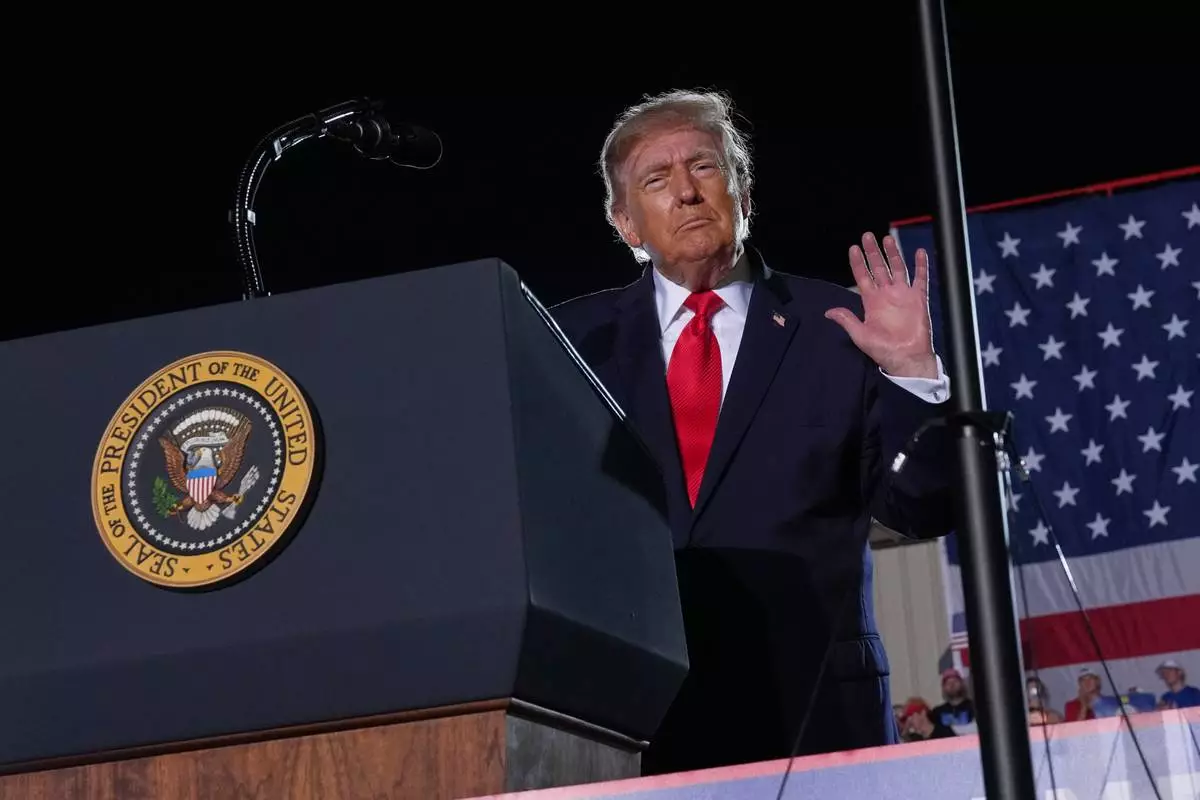
President Donald Trump speaks at a campaign rally at the Salina Regional Airport, Sunday, Nov. 1, 2026, in Salina Kan. (AP Photo/Jacquelyn Martin)
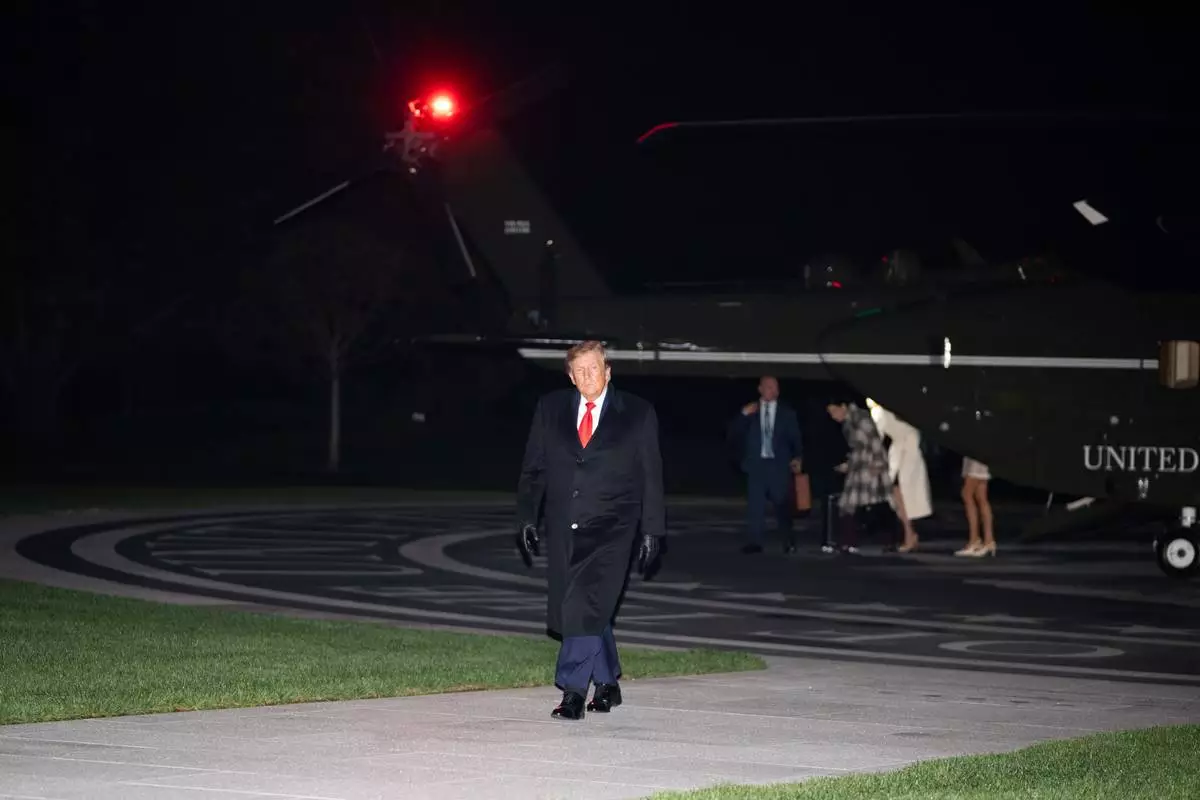
President Donald Trump walks across the South Lawn of the White House after stepping off Marine One, Monday, Nov. 2, 2026, in Washington. (AP Photo/Allison Robbert)
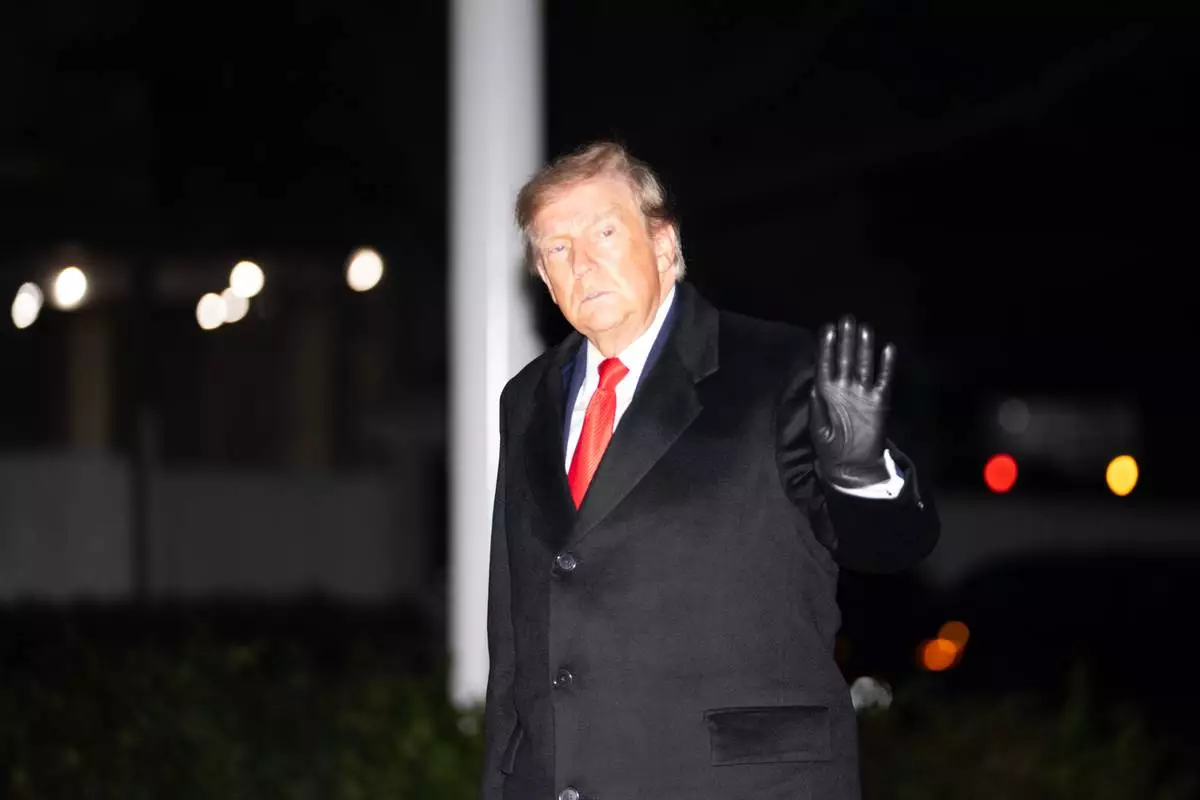
President Donald Trump walks across the South Lawn of the White House after stepping off Marine One, Monday, Nov. 2, 2026, in Washington. (AP Photo/Allison Robbert)