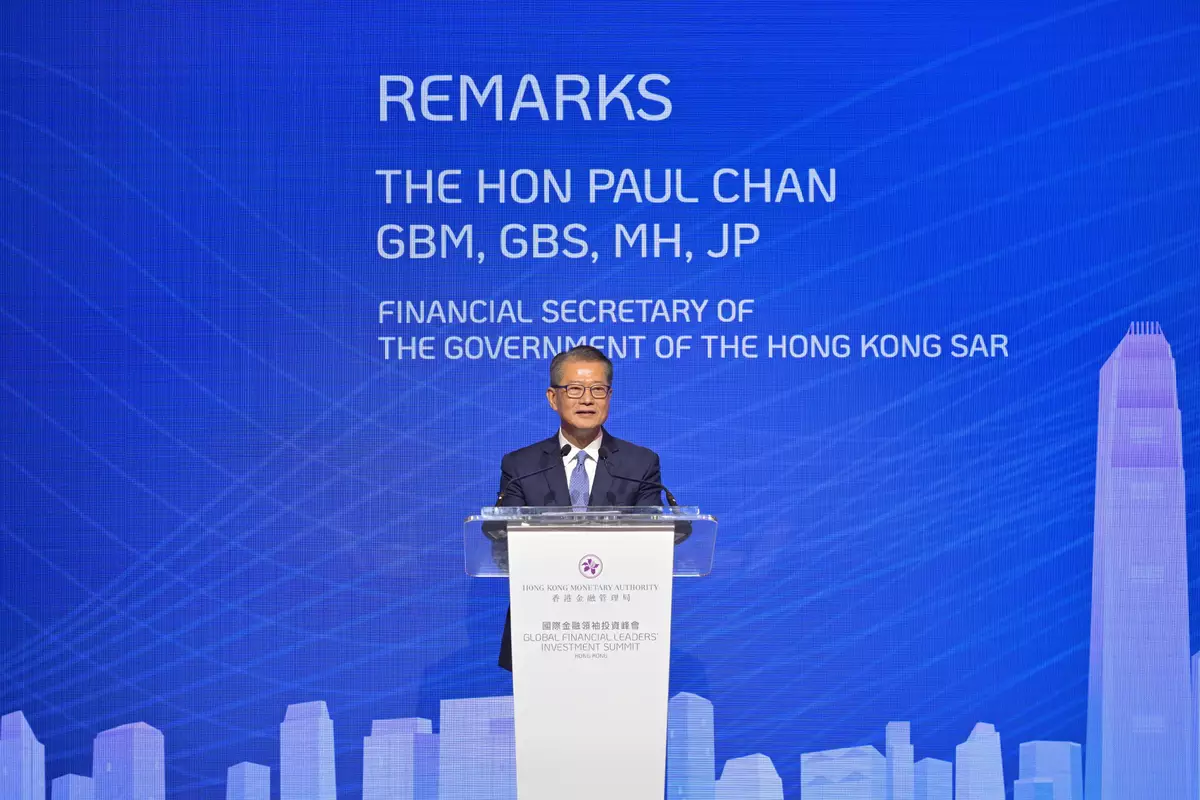
Speech by FS at Global Financial Leaders' Investment Summit luncheon
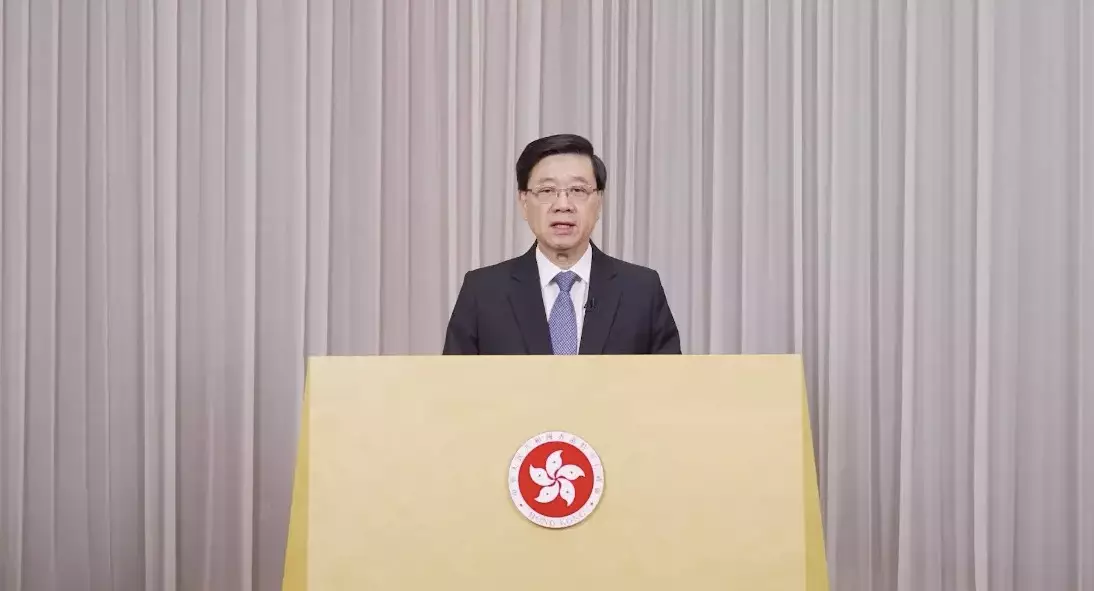
Following is the speech by the Financial Secretary, Mr Paul Chan, at the Global Financial Leaders' Investment Summit luncheon today (November 3):
Distinguished guests, ladies and gentlemen,
Good afternoon.
This morning's discussions have ranged from market developments to capital flows, drawing on the depth of experience in this room. I would like to look beyond the immediate outlook and focus on two questions.
Where will the next wave of growth come from for your company?
And which economies will offer the greatest opportunities?
For many of us, AI will be central to the answer to the first question. But that is only a starting point.
AI is becoming a basic business capability. We use it to assess investments, analyse information and improve efficiency. But as these tools become widely available, access to them will no longer be a competitive edge.
What will matter is how businesses change around them. And that is the distinction between having AI capabilities and being AI-native.
The electrification of factories, beginning in the late 19th century, offers a useful reflection. Initially, electric motors drove the same shafts and belts, leaving factory layouts largely unchanged. The gains in productivity were limited. Significant improvements came when each machine had its own motor, allowing factories to be redesigned around the flow of work.
To realise the full potential of electricity, changing the power source was not enough. The factory itself had to change.
Today, AI presents a similar opportunity. Applying it to existing processes can save time and money. But the real potential lies in redesigning products, organisations and business models.
In an AI-native business, data from real operations helps systems and products improve. Those improvements, in turn, strengthen the business and its ability to serve customers.
So, for investors, the issue is not simply whether a company uses AI, but whether AI is changing how it operates, serves customers and generates revenue.
Technology can improve individual tasks. But its greater promise is to improve how institutions work and how they serve people.
Realising that promise requires us to put AI to work in real-world settings, where new ideas can be tested with customers and under actual operating conditions.
That brings me to my second question: which economies will offer the greatest opportunities?
Across the Chinese Mainland, factories, hospitals and logistics networks provide extensive opportunities to test AI and develop new businesses. China's comprehensive industrial base and wealth of real-world applications make it fertile ground for AI-native growth.
But this is only part of the picture. We should also look to the Global South. The World Bank has highlighted how affordable "small AI" applications can help developing countries improve productivity in agriculture, healthcare and education.
These applications may attract less attention, but their value can be substantial. And with fewer established systems to replace, some businesses can move directly to new ways of working. This creates opportunities to leapfrog traditional stages of development.
The next sources of growth, therefore, will not be confined to today's technology leaders. They will also emerge where companies find new ways to apply AI to unmet needs.
For financial centres, these developments place new demands on us. We need to connect promising businesses with capital and partners, wherever they emerge, and giving investors trusted routes into unfamiliar sectors and economies.
Hong Kong is rising to these challenges and seizing new opportunities by adopting a "Finance+" strategy. That means leveraging our finance capability to empower different sectors, particularly the emerging and future industries, to help build the economy of tomorrow. In the area of technology and innovation, we approach this on two fronts.
Financing innovation and growth
First, by supporting innovative businesses through different stages of development.
Our public markets connect enterprises with international capital. A-plus-H listings help Mainland companies reach global investors and give those investors greater access to opportunities in China.
But public markets are only part of the equation. Promising ideas take time to become viable businesses, often long before a listing is possible. They need patient capital that can look beyond near-term returns and support them through uncertainty.
The Hong Kong Investment Corporation is helping to build that patient capital ecosystem, working with international investors, including sovereign wealth funds and pension funds.
Together, they give enterprises the time and support to build their businesses, establish partnerships and grow.
Building global enterprises
Capital is essential. But it creates the greatest value when it is connected with ideas, talent and commercial expertise.
This brings me to the second front: strengthening Hong Kong's own contribution to innovation.
Our ambition is not only to finance businesses created elsewhere, but also to help create the enterprises of tomorrow.
The Northern Metropolis is central to this effort. It will bring universities, research facilities and technology enterprises closer together, linking education, technology and talent more closely with industry.
It will provide a base for closer collaboration with other Greater Bay Area cities, including Shenzhen and Guangzhou, drawing on their strengths in commercialisation, engineering and advanced manufacturing.
We see China becoming a major source of multinational companies. Hong Kong is well placed to help the next generation of Chinese enterprises go global, while serving as a base for international businesses seeking new partnerships.
For investors, this means opportunities to participate directly in innovation, backing promising ventures and helping build the next generation of global businesses.
Connecting new opportunities
Another priority of ours is to widen Hong Kong's connections, both across economies and across asset classes.
We are deepening our engagement with the Global South, including Southeast Asia, the Middle East and Central Asia, and turning those relationships into investment channels.
In Southeast Asia, we are welcoming more enterprises from Indonesia, Thailand and Malaysia to list in Hong Kong.
In the Middle East, Hong Kong and Saudi Arabia have listed ETFs (exchange-traded funds) tracking each other's markets, giving investors new routes to invest.
In Central Asia, Kazakhstan has already tapped Hong Kong's equity and bond markets. We welcome more issuers to raise capital here through listings and bond issuance.
Beyond equities and bonds, we are broadening the range of assets and services available through Hong Kong. This will give investors more options to diversify and help businesses meet their trading, financing and risk management needs.
Gold and commodities are central to this effort. Our vision is to build an integrated market that brings together storage, physical trading and derivatives, supported by efficient clearing and settlement and connections established with Shanghai.
For gold, we are expanding storage capacity to over 2 000 tonnes initially within three years. We welcome central banks and international investors to store gold in Hong Kong. Our central clearing and settlement system is scheduled to launch in the first quarter of next year, while HKEX (Hong Kong Exchanges and Clearing) is preparing new RMB-denominated, physically settled gold futures.
For commodities, we are expanding warehousing capacity and the range of RMB-denominated products, while exploring tokenised warehouse receipts to facilitate financing. Together, these developments will give businesses more financing options and investors more ways to diversify and manage risks.
Concluding remarks
Ladies and gentlemen, Hong Kong's continued development opens new opportunities for your businesses. Your decisions will help shape which ideas take root, which enterprises thrive and how growth translates into wider prosperity.
For our part, we will continue to uphold openness, clear rules and investor protection on which confidence depends.
But Hong Kong is also a place that embraces new ideas and business models, where innovators find investors who understand their aspirations, where ideas are tested and developed in the market, and where businesses ready to redesign their factories find the capital and partners to grow.
Let us work together to seize the vast opportunities ahead. Thank you very much, and enjoy the rest of your lunch.
Speech by FS at Global Financial Leaders' Investment Summit luncheon Source: HKSAR Government Press Releases