NEW YORK (AP) — A rebound for several influential Big Tech stocks is helping to lift the U.S. market on Tuesday despite a fall for Apple and mixed trading elsewhere on Wall Street.
The S&P 500 rose 0.6%, even though more stocks fell within the index than rose. The Dow Jones Industrial Average was down 87 points, or 0.2%, as of 11 a.m. Eastern time, and the Nasdaq composite was 1.1% higher.
Click to Gallery

FILE - Traders Jonathan Mueller, left, and Michael Capolino work on the floor of the New York Stock Exchange, Thursday, Feb. 19, 2026. (AP Photo/Richard Drew, File)

A screen displays a news conference by Federal Reserve Board Chairman Kevin Warsh on the floor of the New York Stock Exchange, Wednesday, Oct. 28, 2026, in New York. (AP Photo/Yuki Iwamura)
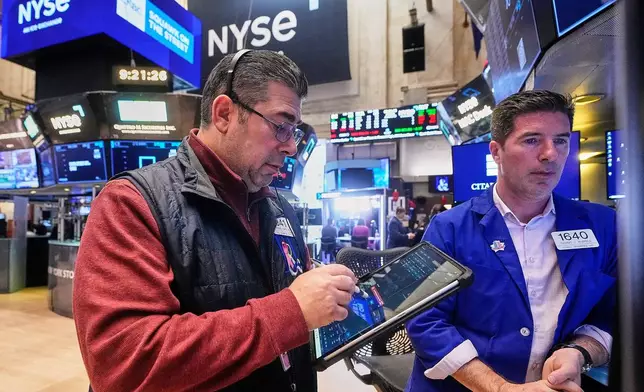
FILE - Trader Michael Capolino, left, and Specialist Thomas McArdle work on the floor of the New York Stock Exchange, Monday, Jan. 26, 2026. (AP Photo/Richard Drew, file)

A dealer watches computer monitors near the screens showing the Korea Composite Stock Price Index (KOSPI) at a dealing room of Hana Bank in Seoul, South Korea, Tuesday, Nov. 3, 2026. (AP Photo/Lee Jin-man)

A dealer walks near the screens showing the Korea Composite Stock Price Index (KOSPI) and SK Hynix stock price at a dealing room of Hana Bank in Seoul, South Korea, Tuesday, Nov. 3, 2026. (AP Photo/Lee Jin-man)

An employee works at a dealing room of Hana Bank in Seoul, South Korea, Tuesday, Nov. 3, 2026. (AP Photo/Lee Jin-man)

A TV cameraman films the screen displaying the Korea Composite Stock Price Index (KOSPI) in a dealing room of Hana Bank in Seoul, South Korea, Tuesday, Nov. 3, 2026. (AP Photo/Lee Jin-man)
The stock market has been shaky recently as technology and artificial-intelligence stocks have swung on worries their prices shot too high in the frenzy around AI. Several of the most influential AI-related stocks held firmer Tuesday, which supported the market, after flipping from gains in the morning to losses in the afternoon a day earlier.
Nvidia rose 2.9% and was the strongest force pushing upward on the S&P 500 Tuesday. Close behind were gains of 3.8% for Broadcom 5.5% for Advanced Micro Devices and 3% for Micron Technology.
Apple was long seen on Wall Street as a Big Tech company that’s less dependent on AI. But it’s still feeling the effects of the AI boom.
Memory chips for computers have become more expensive because of the demand created by the rush to build AI data centers. Those additional expenses are hitting Apple, which said it expects to make less profit from each $1 of its revenue during the final three months of this year.
That helped send Apple’s stock down 2.7%, even though the seller of iPhones and Mac computers reported stronger profit and revenue for the latest quarter than analysts expected.
Palantir Technologies fell 1.5% even though it likewise reported a better profit than expected. The software company said it made more money working with U.S. companies than from the U.S. government for the first time, as U.S. commercial revenue soared 148% from a year earlier.
Tuesday’s midterm elections may also be keeping financial markets unsteady, but history suggests they may not matter much for the broad market. Going back to 1970, the S&P 500 has had a positive return in the six months following a midterm election every time, according to Brock Weimer, an analyst at Edward Jones.
Some on Wall Street speculate that a Democratic sweep of Congress this time around could lead to more regulations and restrictions on AI development. But Donald Trump would still be president and have the power to veto. And Wall Street generally prefers split control of Washington, which it sees as offering less risk of transformative policies that could reshape the economy.
On the winning side of Wall Street Tuesday were stocks of several companies that reported stronger profits for the summer than analysts expected.
Celanese climbed 3.7%, and DuPont added 6.9%.
Revvity jumped 12% for one of the biggest gains in the S&P 500 after the life sciences company topped analysts’ expectations and CEO Prahlad Singh said end market conditions are continuing to improve.
Expectations are high for all kinds of companies to continue to deliver big gains in profits as the U.S. economy keeps chugging along, even with high inflation and elevated interest rates. That helped send the S&P 500 to a record high last month.
An encouraging report on the U.S. job market said Tuesday that employers were advertising more job openings at the end of September than economists expected. That helped push the yield on the 10-year Treasury up to 4.93% from 4.91% late Monday.
In the oil market, prices continued to swing. Brent climbed above $107 per barrel overnight before briefly dropping below $101 in the morning amid continued uncertainty about what will happen in the war with Iran. It was most recently down 1.6% at $103.13.
In stock markets abroad, indexes were mixed across Europe and Asia. South Korea’s Kospi dropped 3.6% for one of the world’s sharpest moves following losses for its two tech giants, Samsung Electronics and SK Hynix.
Stocks rose 0.3% in Australia after the country’s central bank raised its benchmark interest rate for the fifth time this year.
AP Writers Elaine Lai, David McHugh and Rod McGuirk contributed to this report.
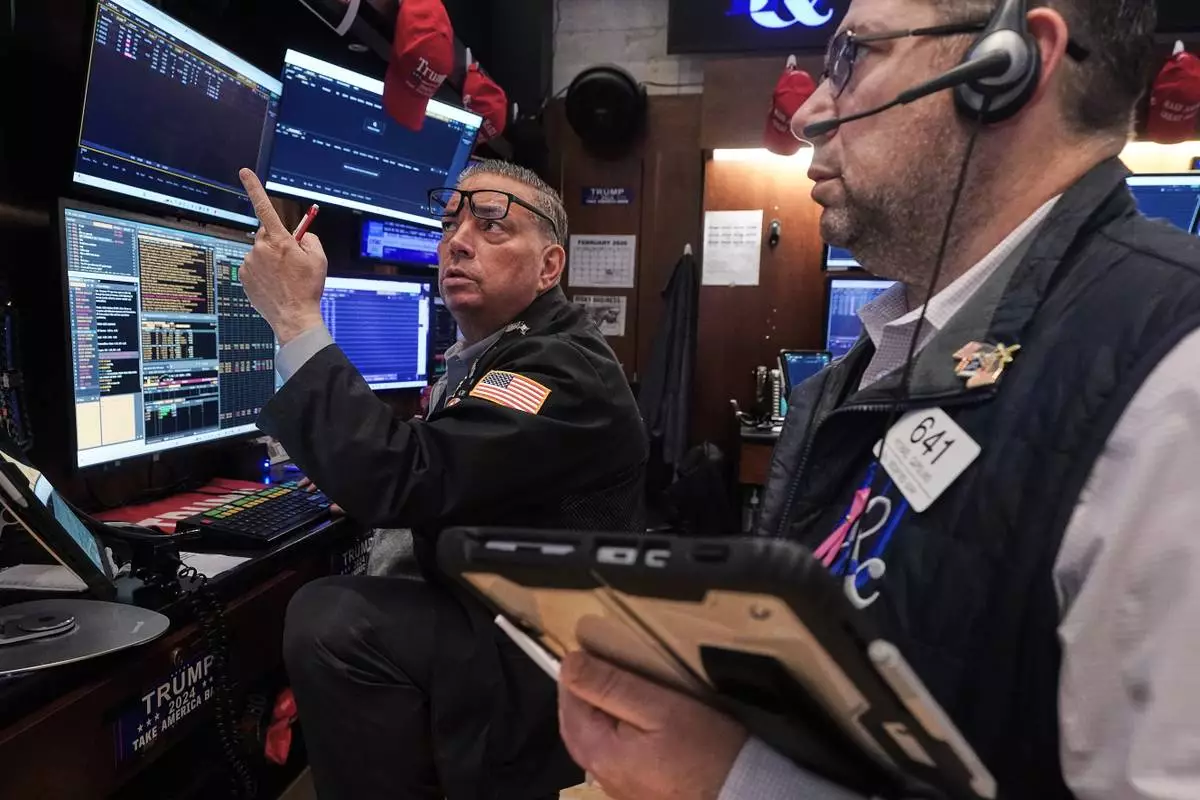
FILE - Traders Jonathan Mueller, left, and Michael Capolino work on the floor of the New York Stock Exchange, Thursday, Feb. 19, 2026. (AP Photo/Richard Drew, File)

A screen displays a news conference by Federal Reserve Board Chairman Kevin Warsh on the floor of the New York Stock Exchange, Wednesday, Oct. 28, 2026, in New York. (AP Photo/Yuki Iwamura)
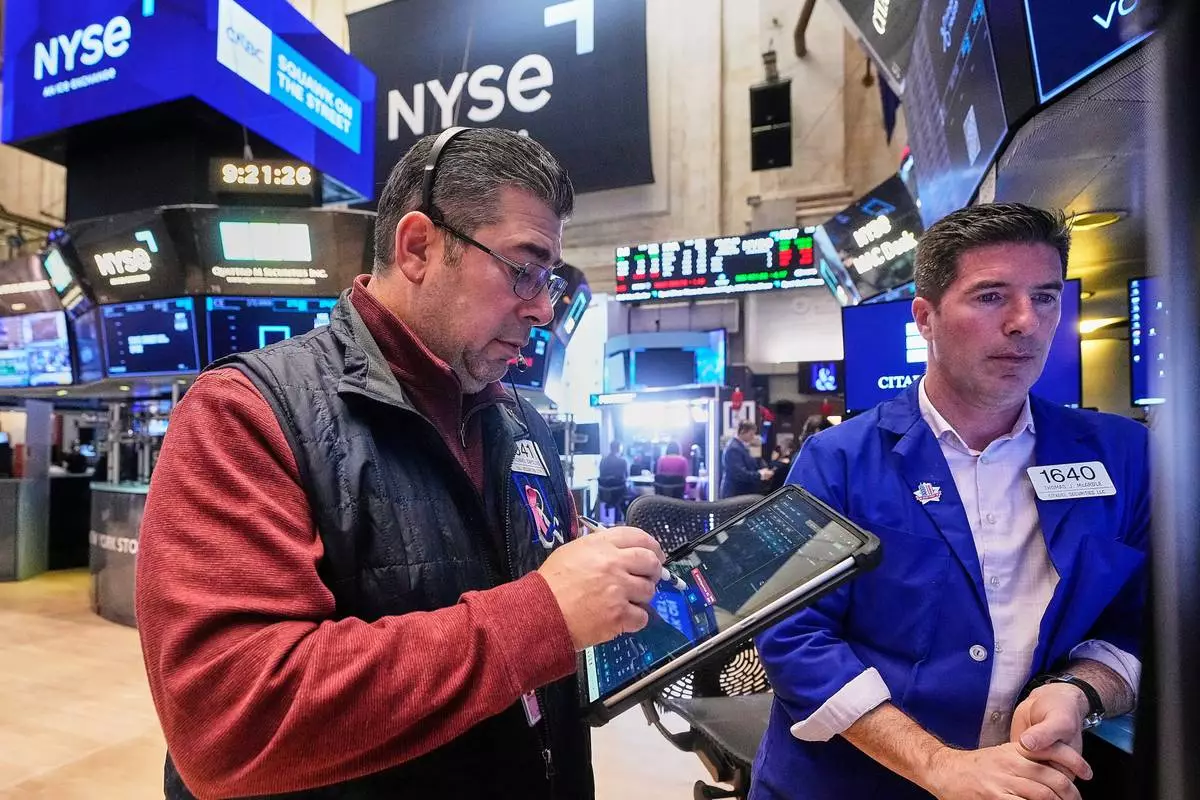
FILE - Trader Michael Capolino, left, and Specialist Thomas McArdle work on the floor of the New York Stock Exchange, Monday, Jan. 26, 2026. (AP Photo/Richard Drew, file)

A dealer watches computer monitors near the screens showing the Korea Composite Stock Price Index (KOSPI) at a dealing room of Hana Bank in Seoul, South Korea, Tuesday, Nov. 3, 2026. (AP Photo/Lee Jin-man)

A dealer walks near the screens showing the Korea Composite Stock Price Index (KOSPI) and SK Hynix stock price at a dealing room of Hana Bank in Seoul, South Korea, Tuesday, Nov. 3, 2026. (AP Photo/Lee Jin-man)

An employee works at a dealing room of Hana Bank in Seoul, South Korea, Tuesday, Nov. 3, 2026. (AP Photo/Lee Jin-man)

A TV cameraman films the screen displaying the Korea Composite Stock Price Index (KOSPI) in a dealing room of Hana Bank in Seoul, South Korea, Tuesday, Nov. 3, 2026. (AP Photo/Lee Jin-man)