Outstanding performance in QS Asia University Rankings followed by World Class University Presidents Forum underscores Hong Kong's higher education excellence on global stage
A spokesman for the Education Bureau (EDB) said today (November 3), in response to the QS World University Rankings: Asia 2027 released by the international higher education research organisation Quacquarelli Symonds (QS), that Hong Kong's higher education sector has once again demonstrated outstanding international competitiveness and academic excellence within Asia, with highly encouraging achievements. The spokesman noted that the commendable results reflect the Hong Kong Special Administrative Region (HKSAR) Government's sustained commitment to resource investment and proactive initiatives in supporting higher education development, thereby further consolidating Hong Kong's position as an international post-secondary education hub.
The spokesman stated that in the latest rankings, Hong Kong's higher education institutions have delivered a stellar performance. With the University of Hong Kong continuing to retain the top spot, five universities in Hong Kong are among Asia's top 10 with three of them ranking among Asia's top five: the University of Hong Kong at first place, City University of Hong Kong at fourth, and the Chinese University of Hong Kong at fifth. Furthermore, eight local universities improved their rankings, with all 11 ranked institutions among the top 500 in Asia, which fully demonstrates the comprehensive elevation in the quality of Hong Kong's higher education and its robust and steady overall development.
"Hong Kong universities continue to lead Asia in key indicators such as academic reputation, employer reputation, internationalisation, and research impact. This not only reflects the unremitting efforts of universities in teaching, research, and global collaboration, but also fully demonstrates that the HKSAR Government has successfully fostered a thriving environment for higher education through various policies and resource allocation, enabling Hong Kong's educational brand to shine on the world stage," the spokesman said.
The spokesman added that to further highlight Hong Kong's unique strategic advantage and hub status as a vital bridge connecting the Chinese Mainland with the global higher education network, the World Class University Presidents Forum 2026 will also be grandly inaugurated tomorrow (November 4).
This Forum, a premier event in the international education community, is fully supported by the HKSAR Government and hosted by the Hong Kong University of Science and Technology. With the theme "Higher Education Reimagined: Innovating for the Future", it brings together university presidents, distinguished scholars, and international education leaders from dozens of world-class institutions to deliberate on key issues such as talent cultivation in the intelligent era, technology and innovation driving the future economy, and universities' responses to major global challenges. Hong Kong's outstanding university rankings complement this prestigious international education event, fully demonstrating the strong appeal and influence of Hong Kong's higher education.
The HKSAR Government will continue to fully support local universities to reach new heights and further enhance the international leadership of Hong Kong's higher education through various policies and measures, including proactively taking forward the development of the Northern Metropolis University Town, continuously attracting top international research talent and students, and deepening cross-boundary and international academic collaborations.

Source: AI-found images
DH reminds public to take appropriate preventive measures against measles amid outbreaks in multiple countries due to low vaccination rates
Due to ongoing measles outbreaks in multiple countries around the world caused by low vaccination rates, the Centre for Health Protection (CHP) of the Department of Health (DH) today (November 3) reminded members of the public planning to travel abroad to visit the DH's Travel Health Service webpagebefore departure to check if their destination has a high incidence of measles or an outbreak. They should take appropriate preventive measures, such as ensuring they had received two doses of the measles vaccination, and maintain good personal and environmental hygiene at all times. International students in affected countries should also review their vaccination records. If they are unsure whether they had received two doses of the measles vaccination, they should arrange to get vaccinated as soon as possible to prevent infection. As the winter break will soon begin in some countries, and students studying abroad will return to Hong Kong, the CHP urged the public to remain vigilant and seek immediate medical attention if they feel unwell. They should also report their symptoms and travel history to the healthcare workers before their appointment so that appropriate infection control measures can be implemented at the healthcare facilities to prevent a community spread. Schools should also remain vigilant to reduce the risk of infectious disease transmission on campus.
Measles is an endemic infection in many parts of the world. So far this year, the United States (US) has recorded more than 4 800 cases of measles, more than double last year's total. The situation remains out of control in the US. Pennsylvania and New York have reported measles-related deaths, and none of the deceased had received the measles vaccination. In Asia, Indonesia, Bangladesh, Laos and the Philippines have also experienced measles outbreaks due to low vaccination coverage.
"Overseas cases mainly affected individuals who were unvaccinated or had an unknown vaccination status, underscoring the importance of maintaining a high vaccination rate and herd immunity. Under the Hong Kong Childhood Immunisation Programme and its immunisation services provided by the DH's Maternal and Child Health Centres and the School Immunisation Teams, the overall immunisation coverage in Hong Kong has been maintained at a very high level. This has enabled Hong Kong to successfully maintain its measles-free status to date, even amid measles outbreaks in many parts of the world. As evidenced by the findings on vaccination coverage of primary school students and the territory-wide immunisation surveys conducted regularly by the DH, the two-dose measles vaccination coverage has remained consistently high, well above 95 per cent. The local seroprevalence rates of measles virus antibodies reflect that most of the people in Hong Kong are immune to measles. On the whole, the risk of a large-scale outbreak in Hong Kong is low. However, as a city with a high volume of international travel, Hong Kong still faces the potential risk of measles importation. Locally, a small number of people who have not completed a measles vaccination (such as non-local born people, including new immigrants, foreign domestic helpers, overseas employees and people coming to Hong Kong for further studies) are still at risk of being infected and spreading measles to other people who do not have immunity against measles, such as children under 1 year old who have not yet received the first dose of measles vaccine," said the Controller of the CHP, Dr Edwin Tsui.
A total of nine measles cases have been recorded in Hong Kong so far this year. Six were either imported cases or epidemiologically linked to imported cases. The remaining three were local cases. Among the imported cases, patients visited Indonesia, Pakistan and Vietnam during their incubation periods.
People born before 1967 could be considered to have acquired immunity to measles through natural infection, as measles was endemic in many parts of the world and in Hong Kong at that time. People born in or after 1967 who have not yet completed the two doses of measles vaccination or whose measles vaccination history is unknown, should consult their family doctors as soon as possible to complete the vaccination. For those who plan to travel to measles-endemic areas, if they have not been diagnosed with measles through laboratory tests and have never received two doses of measles vaccine or are not sure if they have received measles vaccine, they should consult a doctor at least two weeks prior to their trip for vaccination. Pregnant women and women preparing for pregnancy as well as children aged under 1 year who are not due for the first dose of the Measles, Mumps and Rubella (MMR) combined vaccine under theHong Kong Childhood Immunisation Programme, are advised not to travel to places with outbreaks of measles.
The incubation period of measles (i.e. the time from infection to onset of illness) is seven to 21 days. Symptoms include fever, skin rash, cough, runny nose and red eyes. If travellers returning from places with a high incidence or outbreak of measles develop relevant symptoms, they should wear a surgical mask, stay home from work or school, avoid crowded places and avoid contact with people without immunity, especially those with weak immune systems, pregnant women and children aged below 1. Those suspected to have been infected are advised to seek medical attention as early as possible and reveal their relevant contact history of measles to healthcare professionals.
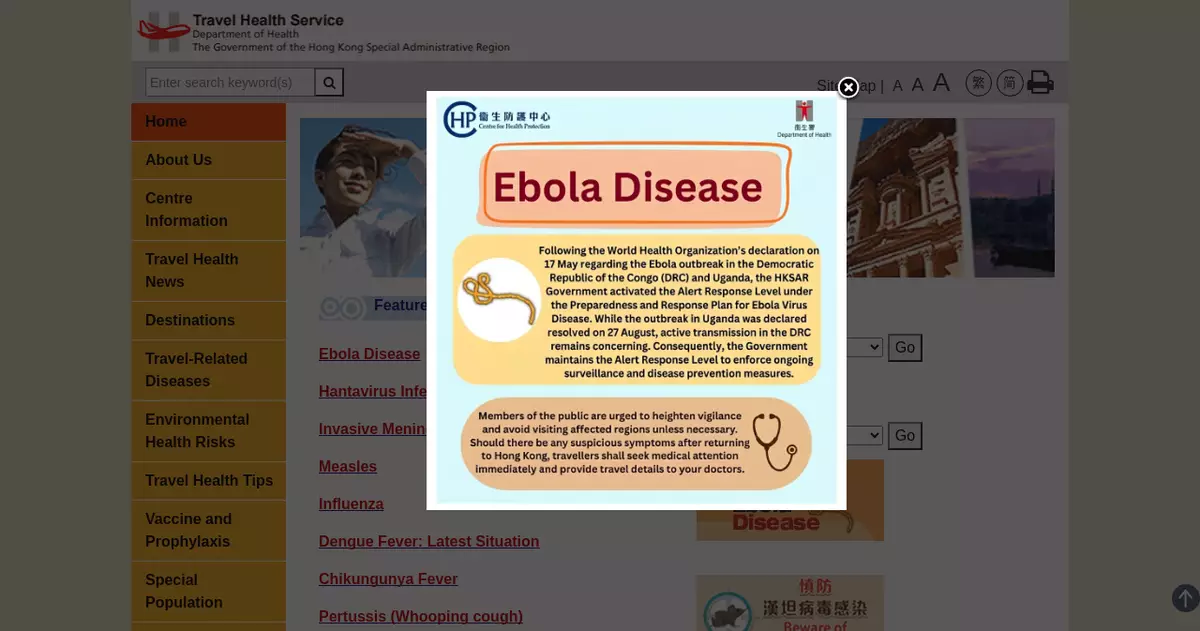
For more information on measles, the public may visit the CHP'smeasles thematic page. Members of the public who are going to travel can visit the website of the DH'sTravel Health Servicefor news of measles outbreaks outside Hong Kong.
Source: AI-found images