SINGAPORE, Nov. 4, 2026 /PRNewswire/ -- As AI adoption accelerates across Singapore, TechTIQ Solutions, a Singapore-based software development company, highlights a growing business challenge: integrating AI into mobile applications, enterprise systems, and everyday operations.
The company believes the next stage of digital transformation will depend not simply on adopting AI, but on connecting it with the software and data businesses rely on.
Singapore's AI Growth Brings Integration into Focus
Singapore's digital economy reached S$144.1 billion in 2025, contributing 19.3% of GDP, according to the Singapore Digital Economy Report released by the Infocomm Media Development Authority (IMDA) in October 2026.
AI adoption among small and medium-sized enterprises (SMEs) rose from 14.5% in 2024 to 23.4% in 2025. Yet only 28.3% of AI-adopting enterprises customized AI solutions to meet specific business requirements.
These figures highlight an opportunity to move beyond general-purpose AI tools toward tailored applications integrated with business operations.
From Mobile Apps to Connected Business Operations
For businesses investing in mobile app development, AI integration offers opportunities beyond customer-facing features.
A retail chain, for example, could connect bookings, loyalty programmes, inventory, and customer support through a unified mobile platform. AI could then automate enquiries, personalize recommendations, and generate operational insights.
Similar approaches can support healthcare, logistics, and financial services. However, successful implementation requires reliable data integration, system interoperability, security, and scalable architecture rather than simply adding AI features.
TechTIQ Solutions Focuses on Practical AI Integration
TechTIQ Solutions approaches AI-powered mobile app development as part of a broader engineering strategy, connecting mobile experiences with business processes and existing infrastructure.
Its services include custom mobile and web development, AI integration, API connectivity, cloud solutions, and enterprise software modernization.
"Adding AI features to a mobile application is only one part of the process. The real engineering challenge is making AI work reliably with a company's existing data, systems, and operations," said Thanh (Bruce) Pham, Co-founder of TechTIQ Solutions.
"Businesses should evaluate AI investments based on the problems they solve, the workflows they improve, and the value they deliver."
Singapore Accountability, Vietnam Engineering Excellence
Vietnam's digital technology industry generated an estimated US$198 billion in revenue in 2025, growing 26% year-on-year, according to its Ministry of Science and Technology.
TechTIQ Solutions combines Singapore-based contracting, project management, and quality assurance with Vietnam's engineering capabilities, supported by a strategic investment from Saigon Technology. Recognized in the Vietnam Top 10 Tech & Map 2025 awards, Saigon Technology brings established software engineering expertise to this partnership.
This model offers Singapore businesses an end-to-end development approach combining local accountability, cost-competitive engineering, and structured delivery timelines.
Singapore's AI Ambitions Demand Faster Execution
Singapore's AI ambitions require more than technology adoption. Businesses need reliable solutions delivered within defined timelines and integrated into existing operations.
Through its Singapore-Vietnam engineering model, TechTIQ Solutions aims to combine international-standard software development, scalable delivery, and cost efficiency without compromising quality.
For Singapore businesses, the next competitive advantage will not come from adopting AI first, but from turning AI ambition into operational results faster.
About TechTIQ Solutions
TechTIQ Solutions is a Singapore-based software development company specializing in mobile app development, custom software, AI integration, and digital transformation. With Singapore-based project oversight, engineering capabilities in Vietnam, and a strategic investment from Saigon Technology, the company provides scalable, cost-efficient technology solutions for businesses across multiple industries.
** This press release is distributed by PR Newswire through automated distribution system, for which the client assumes full responsibility. **

TechTIQ Solutions Highlights Singapore's Shift Toward AI-Integrated Mobile Apps
New research highlights the importance of system integration, application-specific technology choices and lifecycle readiness in advancing embodied AI toward industrial deployment
SINGAPORE, Nov. 4, 2026 /PRNewswire/ -- As embodied artificial intelligence (AI) advances from research toward practical applications, one of the industry's key challenges is integrating intelligence, sensing, movement, computing, energy management and connectivity into systems that can perform reliably in demanding environments.
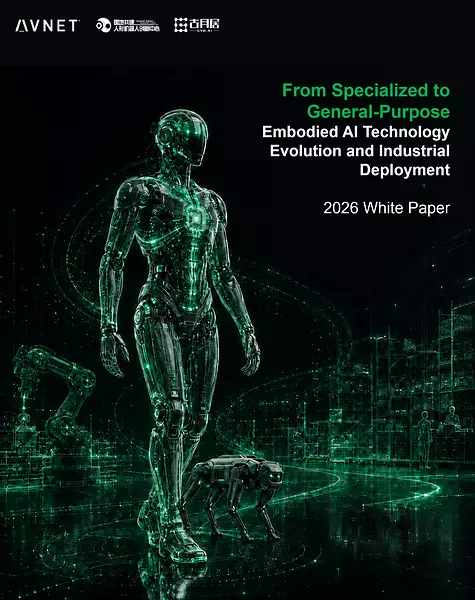
This is a central finding of From Specialized to General-Purpose: 2026 White Paper on Embodied AI Technology Evolution and Industrial Deployment, jointly published by Avnet, the National and Local Co-Built Humanoid Robotics Innovation Center and GYH.AI.
Embodied AI combines artificial intelligence with physical systems such as robots and autonomous machines, enabling them to perceive their surroundings, make decisions and act in the physical world. While advances in AI models, computing and robotics are accelerating innovation, broader adoption will depend on how effectively these technologies function as an integrated system.
"Much of the discussion around embodied AI today focuses on individual technologies, but the next stage of progress will depend on how well these technologies work together," said Edward Tsaur, VP, Avnet Design Services, Marketing & Communications, Asia Pacific. "The challenge is not just about making systems smarter. It is about ensuring they perform reliably, adapt to changing conditions and deliver consistent results over time."
The research identifies four factors that will influence the transition from specialized embodied AI applications toward broader industrial deployment:
- System integration is fundamental to performance. AI models, computing platforms, sensors, motion control, energy management and communications must function as a coordinated system. Weaknesses in any area can affect overall performance and reliability.
- Technology selection must reflect application requirements. Developers need to balance performance, energy efficiency, reliability, scalability and cost according to the intended task and operating environment. The most advanced individual component does not necessarily deliver the most effective overall solution.
- The path to general-purpose embodied AI will be gradual. Progress will build on specialized systems designed for defined tasks, with broader capabilities developing over time through advances in system architecture and integration.
- Industrial deployment requires lifecycle planning. Beyond initial functionality, organisations must consider testing, software compatibility, component availability, safety, maintenance and long-term support to ensure solutions remain practical and dependable in operational environments.
These findings highlight the importance of evaluating embodied AI not only by individual technology performance, but by how effectively complete systems perform useful tasks under actual operating conditions.
"Across Asia Pacific, we are seeing growing interest in intelligent systems for manufacturing, logistics, healthcare and other operational environments. For organisations exploring where embodied AI can deliver business value, the priority is to bring together technologies that meet defined requirements and can be deployed, scaled and maintained reliably," Tsaur added.
"Collaboration across the technology ecosystem will also be critical to translating advances in embodied AI into practical solutions. This means looking beyond individual components to consider how hardware, software and engineering expertise can work together to address specific needs."
As embodied AI moves toward broader industrial deployment, progress will increasingly depend on performance beyond controlled settings. Bringing system integration, application requirements and lifecycle considerations together from the outset will be essential to turning technological advances into deployable industrial solutions.
About Avnet
As a leading global technology distributor and solutions provider, Avnet has served customers' evolving needs for more than a century. Through regional and specialized businesses around the world, we support customers and suppliers at every stage of the product lifecycle.
We help companies adapt to change and accelerate the design and supply stages of product development. With a unique viewpoint from the center of the technology value chain, Avnet is a trusted partner that solves complex design and supply-chain issues so customers can realize revenue faster.
Learn more about Avnet at www.avnet.com.
** This press release is distributed by PR Newswire through automated distribution system, for which the client assumes full responsibility. **
Embodied AI's Next Frontier: Integrating Intelligence with Real-World Systems