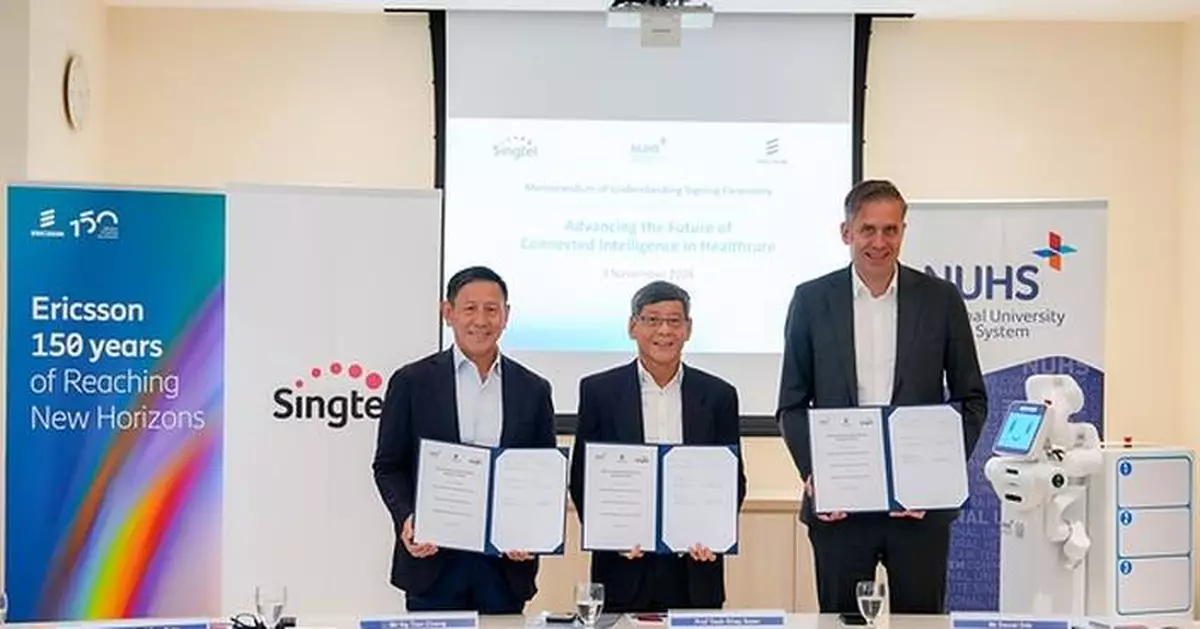
Extended collaboration will accelerate research and development in advanced connectivity and emerging 5G Advanced & future 6G technologies for Healthcare of the Future.
SINGAPORE, Nov. 3, 2026 /PRNewswire/ -- The National University Health System (NUHS), Singtel and Ericsson today signed a Memorandum of Understanding (MOU), reinforcing their commitment to a strategic partnership to advance connected healthcare, 5G-Advanced and 6G technology, as well as connected intelligence.
The collaboration will focus on research and development, harnessing successive generations of telecommunications and artificial intelligence technology to deliver deployable healthcare applications. NUHS will provide clinical, academic and research leadership; Ericsson will contribute expertise in mobile network technologies, network architecture and future 6G research; and Singtel will contribute expertise in advanced network deployment and services.
As part of the collaboration, Singtel and Ericsson will be founding partners of NUHS' newly established National University XG AI Centre (NXAC), which will serve as a platform for developing and translating network-enabled healthcare applications.
NXAC will bring together healthcare, telecommunications and technology expertise. The name "XG" reflects the Centre's longer-term ambition to span successive generations of network technology, from 5G today towards 6G and beyond.
NXAC will be the world's first 6G AI centre dedicated to healthcare, as well as Singapore's first translational research and development centre, which aims to serve the global healthcare community. It will provide a platform for industry experts and healthcare professionals to co-develop and validate applications using next-generation network infrastructure and AI technologies.
Professor Yeoh Khay Guan, Chief Executive, NUHS, said: "Our interest in advanced networks and AI lies in what they can do for our patients across our 14 entities, and the healthcare professionals who care for them. By bringing together clinical and industry expertise, we hope to harness future generations of telecommunications technology into practical healthcare applications. These range from autonomous mobile robots supporting hospital logistics and patient care, to connected mobile devices that extend care into the home, AI-enabled intelligent fabric for the healthcare industry, and human augmentation for advanced surgeries."
Growing R&D capabilities as a testbed for healthcare solutions
NXAC will support the translation of emerging technologies from research into real-world healthcare use. As a testbed, it will enable its team and industry partners to work alongside clinicians, nurses and operations teams to develop and evaluate technologies in a working hospital environment.
The collaboration will grow capabilities at the intersection of healthcare, telecommunications, AI and robotics. This will include joint training programmes, fellowships, internships and clinician-engineer collaborations, bringing healthcare and technology expertise closer. Additionally, the partners intend to jointly pursue public research and innovation funding, including the establishment of a corporate laboratory or equivalent industry-public research programme hosted by NUHS and undertaken through NXAC.
Mr Ng Tian Chong, Chief Executive Officer, Singtel Singapore, said: "As Singapore prepares for a rapidly ageing population and increasingly complex healthcare needs, we have an opportunity to fundamentally rethink how care is delivered with technology. Singtel is proud to bring our advanced network and digital capabilities to help realise NUHS' vision of an intelligent, trusted and borderless healthcare system – one that empowers healthcare professionals and enables more Singaporeans to live longer, healthier and more fulfilling lives."
Mr Daniel Ode, Head of Ericsson Singapore, Brunei and Philippines and Global Customer Unit Singtel, said: "Next-generation healthcare applications such as robotic surgery, holomedicine, and remote monitoring demand deterministic network performance that cannot be compromised. Through NXAC, Ericsson is proud to partner with Singtel and NUHS, contributing our global R&D and advanced network capabilities to translate innovation into clinical practice. By elevating clinical care standards and augmenting frontline clinical teams, we are further reinforcing Singapore's global leadership as the benchmark for the AI-native hospital."
Driving better outcomes for patients and hospitals
Through NXAC, NUHS aims to enable a future for proactive, personalised and continuous care, extending from the hospital into patients' homes and communities. Connected wearables could support continuous monitoring and preventive care beyond the hospital, while ambient AI and contactless sensing could help care teams better understand patients' conditions and identify potential risks.
Within hospitals, autonomous robotics could support logistics, medication delivery and patient support, while spatial intelligence and smarter facilities could improve the way hospitals manage their people, assets and infrastructure. Extended-reality technologies could also support robot-assisted surgery, holographic guidance, clinical training and remote specialist collaboration.
Together, these capabilities point towards a healthcare environment where technology works increasingly in the background to support clinical teams, make hospital operations more responsive, and maintain continuity of care across different settings.
Key innovation initiatives supported by next-gen connectivity
NXAC plans to spearhead initiatives built on the potential of emerging technologies, first supported by 5G and 5G-Advanced capabilities, with the programme designed to evolve towards early 6G.
Areas of development include:
- Ambient AI healthcare: Supporting clinical workflows, contactless monitoring and earlier risk detection.
- Spatial intelligence and sensing: Developing real-time location and sensing capabilities to improve visibility of people, assets and hospital activities.
- Simulation-to-real-world development: Training and testing physical and AI-enabled systems in simulated hospital environments before real-world deployment.
- Autonomous healthcare facilities: Using AI, digital twins and predictive technologies to improve facilities management, reliability and sustainability.
- Connected devices and wearables: Connecting medical devices and wearables to support hospital operations and care beyond the hospital, including hospital-at-home and remote rehabilitation.
- Autonomous medical robotics: Exploring the use of autonomous robots for hospital logistics, medication delivery and patient support.
- Medical extended reality: Advancing applications for clinical education, remote specialist collaboration and surgical support.
Note to editors
The NUHS-Singtel-Ericsson MOU builds on five years of collaboration between them in exploring advanced connectivity for healthcare. Beginning with 5G infrastructure in 2021, the partnership expanded to the deployment of an indoor 5G network at NUH in 2022, covering 10 operating theatres and three inpatient wards when fully commissioned in November 2023.
In February this year, NUHS also formed a strategic partnership with the Global System for Mobile Communications Association (GSMA) GSMA Foundry, under which NUHS serves as the first global healthcare sandbox for the telecommunications industry. NXAC will serve as the global healthcare test-bed sandbox for over-the-horizon technology, that may be co-developed and validated here in NUHS.
Key terms
| National University XG AI Centre (NXAC) | A translational R&D centre and testbed for developing and evaluating network-enabled healthcare applications. |
| XG | A reference to successive generations of network technology, from 5G today towards 6G and beyond. |
| 5G-Advanced | The evolving generation of 5G capabilities that will support the programme before it progresses towards early 6G. |
| Connected healthcare | Healthcare applications enabled by connectivity linking devices, systems, care teams and settings. |
| Ambient AI healthcare | Applications supporting clinical workflows, contactless monitoring and earlier risk detection. |
| Spatial intelligence and sensing | Real-time location and sensing capabilities to improve visibility of people, assets and hospital activities. |
| Medical extended reality | Applications supporting clinical education, remote specialist collaboration and surgical support. |
National University XG AI Centre (NXAC)
A translational R&D centre and testbed for developing and evaluating network-enabled healthcare applications.
XG
A reference to successive generations of network technology, from 5G today towards 6G and beyond.
5G-Advanced
The evolving generation of 5G capabilities that will support the programme before it progresses towards early 6G.
Connected healthcare
Healthcare applications enabled by connectivity linking devices, systems, care teams and settings.
Ambient AI healthcare
Applications supporting clinical workflows, contactless monitoring and earlier risk detection.
Spatial intelligence and sensing
Real-time location and sensing capabilities to improve visibility of people, assets and hospital activities.
Medical extended reality
Applications supporting clinical education, remote specialist collaboration and surgical support.
About the National University Health System (NUHS)
The National University Health System (NUHS) aims to transform how illness is prevented and managed by discovering causes of disease, development of more effective treatments through collaborative multidisciplinary research and clinical trials, and creation of better technologies and care delivery systems in partnership with others who share the same values and vision.
Institutions in the NUHS Group include the National University Hospital, Ng Teng Fong General Hospital, Jurong Community Hospital, Alexandra Hospital and the upcoming Tengah General and Community Hospital; three National Specialty Centres – National University Cancer Institute, Singapore (NCIS), National University Heart Centre, Singapore (NUHCS) and National University Centre for Oral Health, Singapore (NUCOHS); the National University Polyclinics (NUP); Jurong Medical Centre; and three NUS health sciences schools – NUS Yong Loo Lin School of Medicine (including the Alice Lee Centre for Nursing Studies), NUS Faculty of Dentistry and NUS Saw Swee Hock School of Public Health.
With member institutions under a common governance structure, NUHS creates synergies for the advancement of health by integrating patient care, health science education and biomedical research. As a Regional Health System, NUHS works closely with health and social care partners across Singapore to develop and implement programmes that contribute to a healthy and engaged population in the Western part of Singapore.
For more information, please visit www.nuhs.edu.sg.
About Singtel Group
Singtel Group is a leading Asia-based connectivity, digital infrastructure and services company with businesses and strategic investments globally that serve consumers, enterprises and governments.
The Group's telecoms businesses include Singtel Singapore, Optus and regional associates Airtel, AIS, Globe and Telkomsel. Together, they give Singtel a significant footprint across Asia, Australia and Africa, reaching over 839 million mobile customers in 20 countries.
Its digital infrastructure business includes regional data centre arm, Nxera, and a joint investment with KKR in STTGDC. Digital services arm, NCS, complements this infrastructure with enterprise technology and AI solutions, while sovereign AI cloud RE:AI brings together Singtel's AI capabilities.
As it powers the digital and AI economy, Singtel is dedicated to driving innovation and transformation to create new and exciting customer experiences, support enterprises in their digital transformation and shape a more sustainable, digital future.
About Ericsson
Ericsson's high-performing, programmable networks provide connectivity for billions of people every day. For 150 years, we've been pioneers in creating technology for communication. We offer mobile communication and connectivity solutions for service providers and enterprises. Together with our customers and partners, we make the digital world of tomorrow a reality.
** This press release is distributed by PR Newswire through automated distribution system, for which the client assumes full responsibility. **
NUHS, SINGTEL AND ERICSSON EXPAND PARTNERSHIP TO ADVANCE NEXT-GENERATION CONNECTED HEALTHCARE