Skip to Content Facebook Feature Image

Half of Organizations Lack a Formal Critical Event Management Strategy as Global Threats Accelerate, New Everbridge Report Finds

Business

Half of Organizations Lack a Formal Critical Event Management Strategy as Global Threats Accelerate, New Everbridge Report Finds
Business

Business

Half of Organizations Lack a Formal Critical Event Management Strategy as Global Threats Accelerate, New Everbridge Report Finds

2026-11-04 21:32 Last Updated At:21:50

VIENNA, Va.--(BUSINESS WIRE)--Nov 4, 2026--

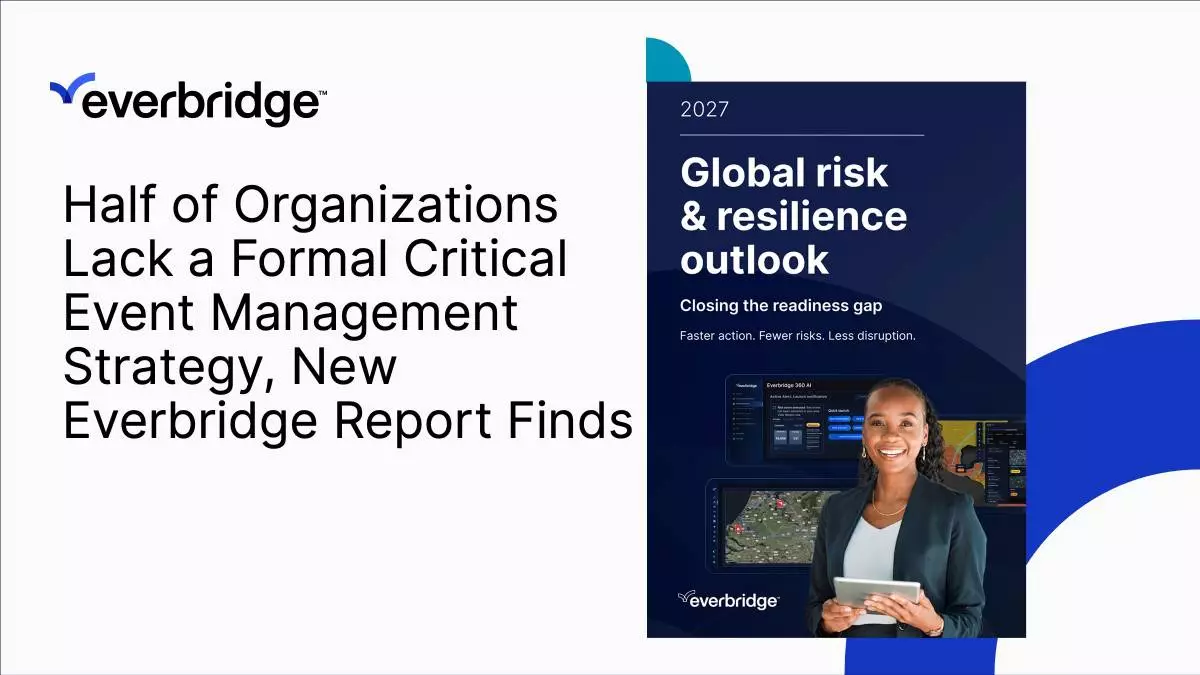
Everbridge, the global leader in High Velocity Critical Event Management (CEM) and national public warning solutions, today released its 2027 Global Risk & Resilience Outlook, revealing significant gaps in organizational preparedness as cyberattacks, geopolitical instability, and other interconnected threats challenge businesses and governments worldwide.

This press release features multimedia. View the full release here: https://www.businesswire.com/news/home/20261104544289/en/

Titled Closing the Readiness Gap, the report identifies the ten most consequential risks facing organizations in 2027 and highlights a growing challenge: while organizations have more information about emerging threats than ever before, many remain unprepared to translate that intelligence into timely, coordinated action.

Drawing on Everbridge risk intelligence, authoritative industry research, and findings from the company's 2026 Best in Resilience Study, the outlook highlights several concerning findings:

Together, these findings underscore the report's central conclusion: the greatest challenge for organizations in 2027 is not simply understanding the risks they face but closing the gap between awareness and action.

"The defining challenge for organizations in 2027 isn't simply identifying the risks ahead. It's being ready to act when those risks become reality," said Dave Wagner, Chief Executive Officer of Everbridge. "We're seeing threats move faster and become more interconnected, yet too many organizations still rely on disconnected processes and plans that haven't been tested under pressure. That's why we recently introduced Everbridge 360 AI Advisor, helping organizations turn intelligence into decisions, empower teams to act, and coordinate their response before disruption escalates. That's what will separate organizations that simply respond to critical events from those that are truly resilient."

Top 2027 Risk Rankings

The outlook ranks cyberattacks and systemic cyber risk as the leading global threat for 2027, followed by geopolitical conflict and geoeconomic confrontation, and natural disasters and climate-driven extremes. The report also examines emerging challenges involving artificial intelligence, supply-chain disruption, misinformation, and other risks that increasingly intersect and amplify one another.

A central theme is that threats rarely occur in isolation. A cyberattack can disrupt critical services while misinformation complicates response efforts. Geopolitical conflict can trigger supply-chain interruptions, regulatory changes, and workforce safety concerns across multiple regions. Severe weather can simultaneously threaten infrastructure, employees, and essential operations.

Closing the Readiness Gap

Beyond identifying the most pressing threats, the report examines the operational barriers that prevent organizations from responding effectively, including unclear decision-making authority, fragmented risk intelligence, and delays in activating response plans.

The outlook outlines practical steps organizations can take to strengthen preparedness, improve coordination, and accelerate decision-making. It also includes real-world examples, compound-risk scenarios, executive-level considerations, and a 90-day roadmap to help leaders turn resilience strategies into measurable action.

Everbridge will host a webinar on November 18 to discuss the report's key findings and share best practices for navigating the evolving global risk landscape. Register for the webinar here.

Download the full Everbridge 2027 Global Risk & Resilience Outlook: Closing the Readiness Gap for the complete ranking of all ten risks, in-depth analysis, and actionable recommendations for 2027.

About Everbridge

Everbridge helps more than 6,500 enterprises and government organizations manage critical events by enabling them to know earlier, respond faster, and improve continuously. Through an all-in-one AI-powered platform, Everbridge High Velocity CEM™ is autonomous when you want it to be and human-guided when you need it to be, so every incident response is optimized. For more information, visit everbridge.com and follow us on LinkedIn.
Half of Organizations Lack a Formal Critical Event Management Strategy as Global Threats Accelerate, New Everbridge Report Finds

Half of Organizations Lack a Formal Critical Event Management Strategy as Global Threats Accelerate, New Everbridge Report Finds

WASHINGTON (AP) — Sen.-elect Abdul El-Sayed told The Associated Press on Wednesday that Michigan voters had rejected “a hateful, spiteful campaign” after months of Republican attacks on his Muslim identity in one of the nation’s most closely watched Senate races.

El-Sayed said he was “running on adrenaline and caffeine” after his race with Republican Mike Rogers was called early Wednesday, giving Democrats another significant victory in a premier swing state as they won a substantial majority in the Senate in Tuesday’s midterms.

Throughout the cycle, Republicans sought to demonize El-Sayed, who was born in the U.S. after his parents immigrated from Egypt. President Donald Trump repeatedly called him a “jihadist” who was “on the side of the terrorists.”

“Michigan proved just how big we are. Rejected a hateful, spiteful campaign that had nothing to say about the issues and only wanted to point to my name and my face,” El-Sayed said. “Michiganders rejected that. Every single county, every single one, pushed against that.”

In a sign of how combative the race had become, Rogers and El-Sayed had not spoken as of Wednesday afternoon, even after Rogers issued a statement conceding the race. In 2024, Rogers called then-Rep. Elissa Slotkin to concede on Wednesday morning, before the AP had even called the race.

El-Sayed, who will become the nation’s first Muslim senator, told the AP by phone that the morning was “a moment of reflection,” including about what his victory would mean to his two young daughters. His 3-year-old, he said, has no idea what happened, while his 8-year-old understands but sees it as normal.

“Now, this is something they read about in the history books,” he said.

With approximately 97% of the vote in, El-Sayed held a 7 percentage point lead over Rogers. Every county in the state shifted toward Democrats compared with 2024, according to AP voting data.

The AP Voter Poll, an expansive survey of more than 4,500 voters in Michigan, showed that Michigan Senate voters were roughly split on whether El-Sayed’s views were “too extreme,” with about half saying they were.

El-Sayed rose from a double-digit defeat eight years ago in the state's Democratic gubernatorial election to an upset victory of an establishment-backed candidate in the primary after being outspent by tens of millions. He said his campaign proved that “old-fashioned politics can work if you’re willing to do the work.”

El-Sayed quickly pivoted, though, toward the future, saying his victory is “not the success” and that “the success is what you're able to do with the seat.”

He would not commit to supporting Senate Democratic Leader Chuck Schumer for another term, saying he did not yet know who else might run. Schumer is expected to retain the leadership position.

“I do believe we need new leadership and I think people are hungry for it,” El-Sayed added.

Associated Press reporter Linley Sanders contributed.

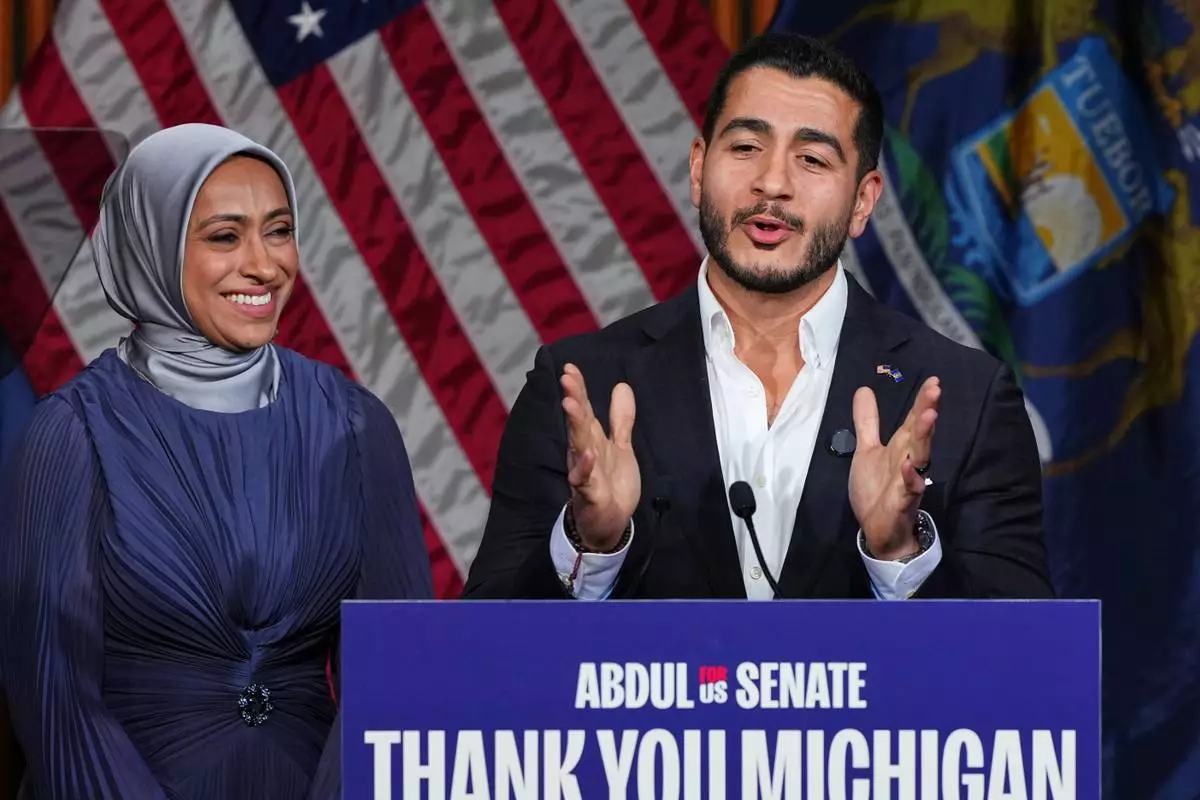
Michigan Democratic Senate candidate Abdul El-Sayed speaks at an election night event, early Wednesday, Nov. 4, 2026, in Detroit, as his wife Sarah Jukaku watches. (AP Photo/Julia Demaree Nikhinson)

Michigan Democratic Senate candidate Abdul El-Sayed speaks at an election night event, early Wednesday, Nov. 4, 2026, in Detroit, as his wife Sarah Jukaku watches. (AP Photo/Julia Demaree Nikhinson)

Michigan Democratic Senate candidate Abdul El-Sayed speaks at an election night event, early Wednesday, Nov. 4, 2026, in Detroit, as his wife Sarah Jukaku watches. (AP Photo/Julia Demaree Nikhinson)

Michigan Democratic Senate candidate Abdul El-Sayed speaks at an election night event, early Wednesday, Nov. 4, 2026, in Detroit, as his wife Sarah Jukaku watches. (AP Photo/Julia Demaree Nikhinson)

Recommended Articles