A photographer from the Republic of Korea (ROK) has dedicated three decades to capturing images of a group survivors of Japan's wartime "comfort women" atrocities, producing a moving photo collection which serves as a vivid visual testimony to their strength and courage while keeping their memory alive.
Through the powerful images captured through his camera lens, photographer Ahn Se-hong has sought to expose the crimes against humanity committed by Japanese militarism during World War II (WWII) and their long-lasting human impact on the survivors.
His work is the focus of a new documentary titled "Five," a joint Chinese-ROK film production, which centers on the stories of five survivors of Japan’s war crimes photographed by Ahn, who shares the profound stories behind the portraits. The span of his body of work is wider than many imagine as Ahn sought to track down women across the broader Asia-Pacific region, following the painful wounds of history across Southeast Asian villages, the Chinese countryside and island towns. Behind every photograph is a woman whose life was rewritten by war. "I started taking these photos in 1996. Thirty years have passed since then. I'd always thought about doing something meaningful. What else could we do together? Then the answer came: document these women through photography and make their stories widely known. And that's how it began," said Ahn.
"In fact, during Japan's war of aggression, 20 to 30 countries were victimized. I've visited survivors in the Philippines, Indonesia, China, and Timor-Leste, documenting and sharing their stories," he said.
In documenting the survivors through his photography, Ahn sought to delve deeper into the lives of the survivors, learning more about their families and memories, while hoping to share the struggles these brave "comfort women" faced.
"This woman is Park Dae-im. She was carrying her 8-month-old son on her back at the time. Someone said they'd take her to northeastern China, and she was dragged away against her will. Even by the 1950s, victims like her had no nationality. They were neither Chinese citizens nor citizens of ROK. It wasn't until the mid-1950s that she received her People's Republic of China citizenship certificate. That was the only proof of her identity, so she cherished it her entire life, until the day she died," said Ahn, as he introduced one of his photographs on display.

Photographer from ROK shares stories of ‘comfort women’ survivors through powerful portraits
China's Fujian aircraft carrier has completed its cross-sea area test training over the past year, transforming from initial to full combat capability, said a Chinese military affairs expert.
On June 17, 2022, the Fujian was launched and named with hull number 18, making China one of the few countries in the world capable of building large aircraft carriers. On November 5, 2025, the Fujian held its commissioning and flag-presentation ceremony at a naval port in Sanya. Just 13 days after commissioning, the Fujian carrier strike group conducted its first live-force training at sea. The year of 2026 is a critical year for the carrier's full transition from initial operational capability to full operational capability.
"'Initially forming combat capability' means the Fujian carrier can sail normally, the carrier-based aircraft can take off and land on the deck, and it can conduct basic formation training with escort vessels. 'Fully forming combat capability' means raising it from 'being able to sail, take off and land, and fight limited wars' to 'being able to fight high-intensity, all-weather, systematic and sustainable wars,'" said Zhang Junshe, a military affairs expert.
"Within one year of its commissioning, the Fujian carrier sailed south through the Taiwan Strait to the South China Sea and then north to the East China Sea and the Yellow Sea, completing cross-sea area test training. This demonstrates that the carrier has acquired the ability to operate in distant seas across different sea areas, with escort ship coordination reaching a certain level and combat capability initially formed," said Zhang.
"Within the same year, the Fujian completed catapult takeoffs and landings of multiple types of carrier-based aircraft, initially gaining full-deck operating capability. It then conducted live-troop formation training and multiple cross-sea area maneuvers. Coordination among formation escort ships has reached a certain level, and the carrier has developed an initial capability to conduct combat operations," he said.
As the world's first aircraft carrier using conventional-power electromagnetic catapult technology, the Fujian's electromagnetic catapult system, unlike the ski-jump takeoff of the Liaoning and Shandong, allows the carrier to flexibly organize the takeoff of different aircraft types, including the J-35 stealth fighter, J-15T heavy fighter and KJ-600 fixed-wing early warning aircraft.
"The Fujian is equipped with electromagnetic catapults and electromagnetic arresting devices. This is the carrier's most core and most watched technical highlight. Compared with traditional takeoff methods, electromagnetic catapult brings many changes to carrier aircraft sortie rates and formation operations. In the future, carrier-based drones can be deployed on board, and the carrier formation can conduct manned-unmanned coordinated operations," said Zhang.
The Fujian's commissioning in November 2025 marked the Chinese People's Liberation Army (PLA) Navy's entry into the three-carrier era. Over the past year, the PLA Navy has accelerated its transformation, with the three-carrier system as a hallmark.
"The real significance of the three-carrier era is not in having them appear together, but in rotation. Rotation means the three carriers cycle in an orderly way among the three states of 'duty-training-maintenance.' The three carriers strongly advance the PLA Navy's strategic transformation from 'near-sea defense' to 'far-sea defense,' with far-sea operations entering a new stage of normalized and systematic deployment. The Navy will continue to undertake far-sea missions such as escort, evacuation of overseas Chinese and humanitarian rescue, effectively safeguarding national interests and fulfilling the responsibilities and obligations of a responsible major country," said Zhang.
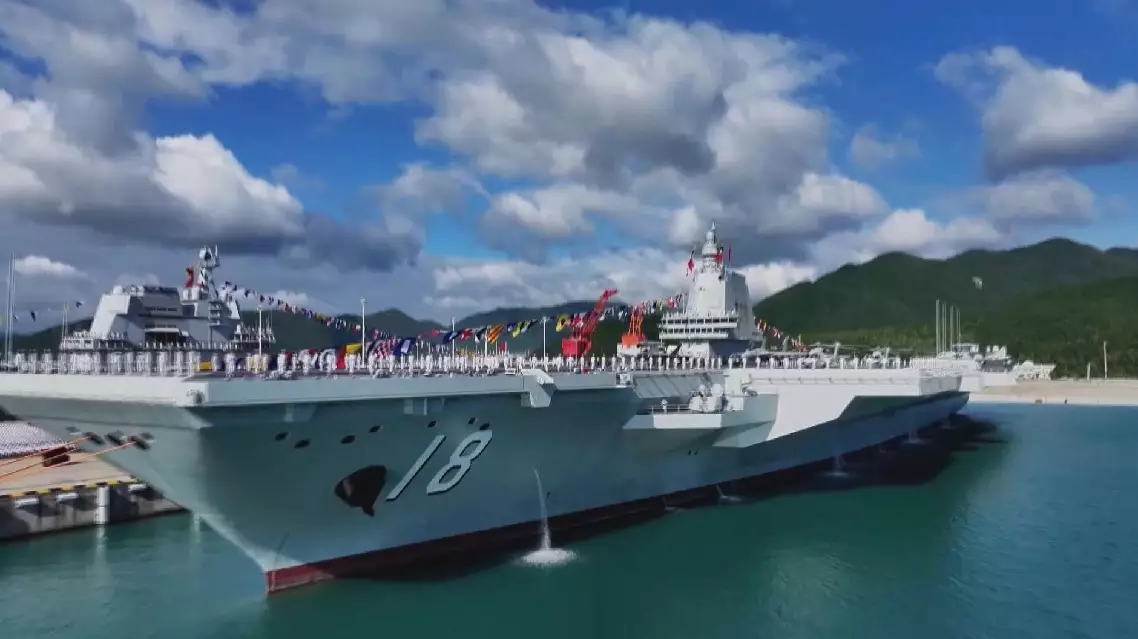
China's aircraft carrier Fujian transforming from initial to full combat capability: expert