Artificial intelligence is moving rapidly from concept to core operations across the oil and gas sector, according to insiders at a major industry conference in the United Arab Emirates, who say more companies are seeking to harness the technology by deploying robotics, automation and advanced analytics to squeeze more efficiency out of mature oil fields and complex supply chains.
The four-day Abu Dhabi International Petroleum Exhibition and Conference (ADIPEC) drew to a close in the UAE capital on Thursday, after gathering a record number of more than 2,250 exhibitors and over 239,000 visitors, making it the biggest ever edition of the long-running event.
This year much of the focus was on tackling energy security and supply chain resilience following months of regional shipping disruptions in the Strait of Hormuz.
Organizers dedicated special exhibition zones to key areas including AI, digitalization, low-carbon and chemicals, and maritime and logistics, showcasing technologies and solutions designed to drive the energy sector's digital transformation, enhance operational efficiency, and strengthen supply chains.
The exhibition's AI zone generated significant interest, with its high-tech displays proving popular. From boosting exploration and production efficiency to optimizing refining processes and supply chain management, many attendees note how AI is being embedded across the sector's value chain.
"Now it goes into the deep fundamental operational level, [such as] how many people yield how much productive work and then the benchmarking. It goes into what are my stock levels, inventory levels, what are my logistical incoming workflow. Recently, AI has become a large part because you see the investment you put in AI yield benefits," said Huzaifa AJ, vice chairman and CTO of the Dolphin Group, a leading supplier of marine, oilfield and drilling equipment based in Sharjah.
"We are embracing the AI and we know it is one of the technological advantages that will bring or create a lot of value for our operations or industry. And we used it also in the drilling and the development of Hadiba field. So we went to drill and expand the productivity. By the way, the productivity increased by 300 times. So while we drill, the AI helps us to guide us what is the best [tracking] laterals," said Khamis Al Mazrouei, CEO of SNOC, a government-owned oil and gas producer also based in Sharjah.
New tech solutions are also being deployed beyond exploration and production to corporate management and supply chains. By integrating data previously scattered across different business segments, companies can identify operational problems faster and cut resource waste and production interruptions.
"This industry has the biggest data in the world. But if we go and re-look at all the seismic data that we've been acquiring over the past 30-40 years, reprocess it with AI, with agents, etc, maybe we get a better recovery factor. If you get a better recovery factor, that means maybe you get fields to extend their life [by] 30-40 years," said Sherif Foda, chairman and CEO of the National Energy Services Reunited Corp (NESR), a large oilfield services company in the Middle East and North Africa region.
Launched in 1984, ADIPEC has evolved from a primarily oil-and-gas-focused trade show into a comprehensive platform covering the entire energy value chain, including production, infrastructure, technology, industrial development, and emerging energy systems.
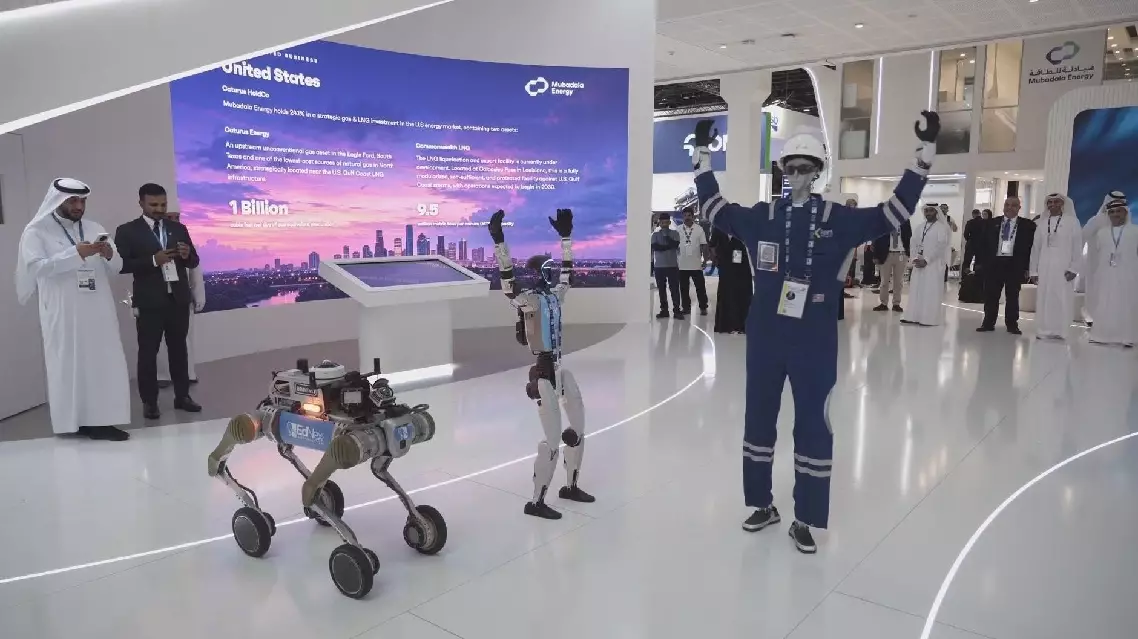
AI takes center stage at Abu Dhabi oil show as under pressure industry pursues efficiency gains
China's Fujian aircraft carrier has completed its cross-sea area test training over the past year, transforming from initial to full combat capability, said a Chinese military affairs expert.
On June 17, 2022, the Fujian was launched and named with hull number 18, making China one of the few countries in the world capable of building large aircraft carriers. On November 5, 2025, the Fujian held its commissioning and flag-presentation ceremony at a naval port in Sanya. Just 13 days after commissioning, the Fujian carrier strike group conducted its first live-force training at sea. The year of 2026 is a critical year for the carrier's full transition from initial operational capability to full operational capability.
"'Initially forming combat capability' means the Fujian carrier can sail normally, the carrier-based aircraft can take off and land on the deck, and it can conduct basic formation training with escort vessels. 'Fully forming combat capability' means raising it from 'being able to sail, take off and land, and fight limited wars' to 'being able to fight high-intensity, all-weather, systematic and sustainable wars,'" said Zhang Junshe, a military affairs expert.
"Within one year of its commissioning, the Fujian carrier sailed south through the Taiwan Strait to the South China Sea and then north to the East China Sea and the Yellow Sea, completing cross-sea area test training. This demonstrates that the carrier has acquired the ability to operate in distant seas across different sea areas, with escort ship coordination reaching a certain level and combat capability initially formed," said Zhang.
"Within the same year, the Fujian completed catapult takeoffs and landings of multiple types of carrier-based aircraft, initially gaining full-deck operating capability. It then conducted live-troop formation training and multiple cross-sea area maneuvers. Coordination among formation escort ships has reached a certain level, and the carrier has developed an initial capability to conduct combat operations," he said.
As the world's first aircraft carrier using conventional-power electromagnetic catapult technology, the Fujian's electromagnetic catapult system, unlike the ski-jump takeoff of the Liaoning and Shandong, allows the carrier to flexibly organize the takeoff of different aircraft types, including the J-35 stealth fighter, J-15T heavy fighter and KJ-600 fixed-wing early warning aircraft.
"The Fujian is equipped with electromagnetic catapults and electromagnetic arresting devices. This is the carrier's most core and most watched technical highlight. Compared with traditional takeoff methods, electromagnetic catapult brings many changes to carrier aircraft sortie rates and formation operations. In the future, carrier-based drones can be deployed on board, and the carrier formation can conduct manned-unmanned coordinated operations," said Zhang.
The Fujian's commissioning in November 2025 marked the Chinese People's Liberation Army (PLA) Navy's entry into the three-carrier era. Over the past year, the PLA Navy has accelerated its transformation, with the three-carrier system as a hallmark.
"The real significance of the three-carrier era is not in having them appear together, but in rotation. Rotation means the three carriers cycle in an orderly way among the three states of 'duty-training-maintenance.' The three carriers strongly advance the PLA Navy's strategic transformation from 'near-sea defense' to 'far-sea defense,' with far-sea operations entering a new stage of normalized and systematic deployment. The Navy will continue to undertake far-sea missions such as escort, evacuation of overseas Chinese and humanitarian rescue, effectively safeguarding national interests and fulfilling the responsibilities and obligations of a responsible major country," said Zhang.
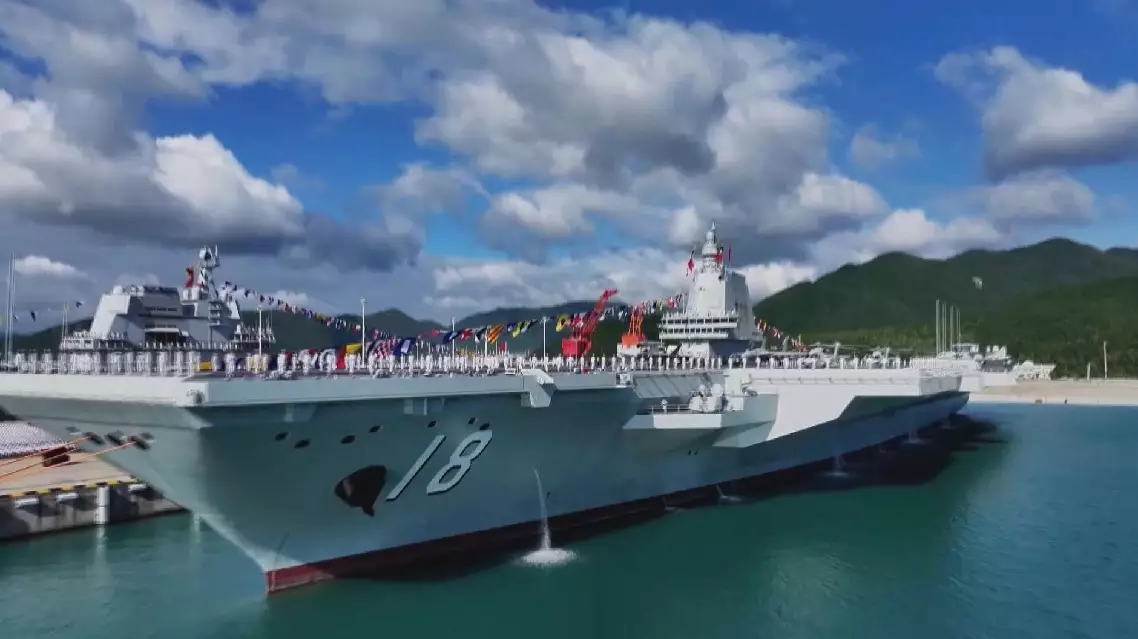
China's aircraft carrier Fujian transforming from initial to full combat capability: expert