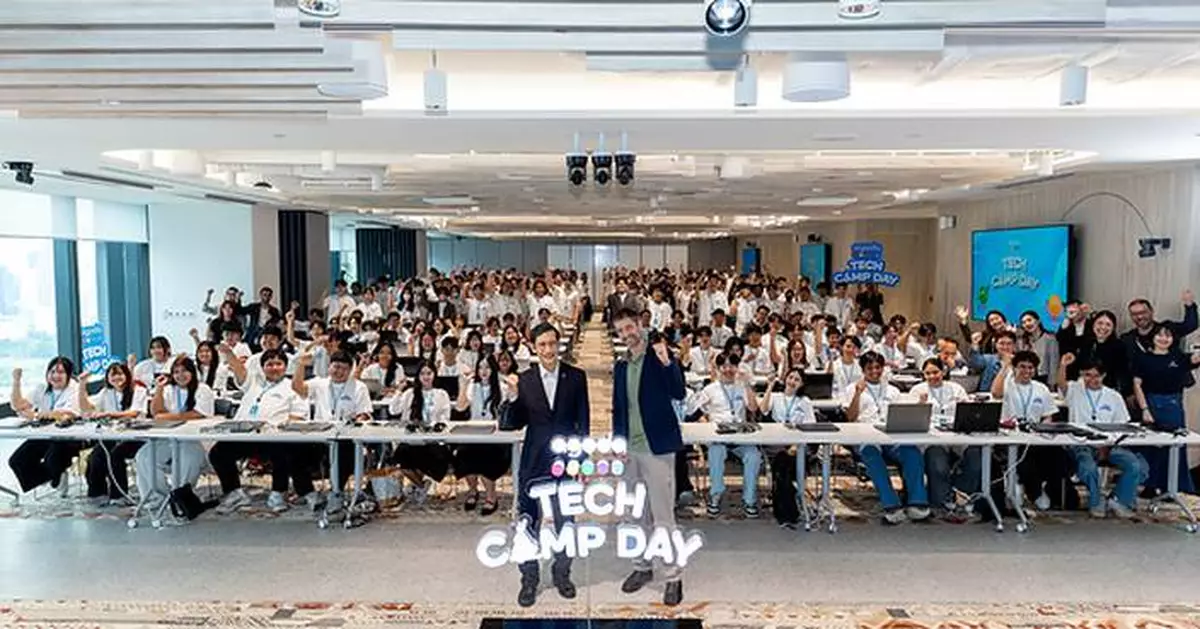
BANGKOK, Nov. 6, 2026 /PRNewswire/ -- Digital travel platform Agoda hosted the 12th edition of Agoda Tech Camp Day on 5–6 November, welcoming over 420 students from four Thai universities. The latest edition, in collaboration with OpenAI, brings the program's cumulative reach to over 4,100 students since 2023.
Delivered in collaboration with OpenAI, the program introduced university students to foundational AI concepts and practical ways to use ChatGPT in their academic and future professional lives, drawing on real-world examples from Agoda.
Agoda's AI Developer Report 2026 found that junior developers were nearly three times as likely as senior developers to cite a lack of skills as a barrier to wider AI agent adoption (17% versus 6%). The finding underscores the value of giving students early, hands-on opportunities to work with AI and build the skills to apply it thoughtfully as software development evolves.
Throughout the Tech Camp Day workshops, students explored ChatGPT's agentic capabilities, comparing conversational interactions in Chat mode with tool-enabled workflows in Work mode. They used personal instructions, tools, and skills to guide an agent through multi-step tasks, transforming spreadsheet data into a presentation and an interactive web app. Students also built and published their own applications and learned to package workflow instructions into reusable skills, enabling an agent to repeat the same set of steps from a single prompt.
As part of the collaboration, participating students will receive two months of ChatGPT Plus access, giving them an extended period after the event to practice with ChatGPT, apply AI to their studies and career preparation, and build on the skills introduced at the workshop.
"AI becomes useful when people understand what it can do, where its limitations are, and how to apply it to a problem they want to solve," said Idan Zalzberg, Chief Technology Officer at Agoda. "Tech Camp Day lets us share Agoda's practical experience with future tech talent in Thailand and across the region. Working with OpenAI connects that experience with expertise in building AI, helping students use it responsibly and giving educators and policymakers practical insights to build on."
"Thailand's students are already curious about what AI can do. Access to AI is just the beginning. We also want to help them build the confidence and skills to use it well, to ask better questions, explore ideas and build things they might not have been able to build before," said Sandy Kunvatanagarn, OpenAI's Head of Policy for ASEAN. "That means learning to use the tools available to them, while questioning the output, checking sources and applying their own judgment. Through our work with Agoda, we hope students can carry these skills into their studies and future careers."
The appetite for AI is already visible in Thailand, which ranks among the top 20 countries for weekly active ChatGPT users. According to OpenAI's internal data, the three most common uses of ChatGPT among 18- to 24-year-olds in Thailand are creative media, writing and communication, and education and learning, reflecting how young people are using AI to create, communicate and learn.
The program brought together first- to fourth-year students from Sripatum University, Rajamangala University of Technology Phra Nakhon, Rajamangala University of Technology Thanyaburi, and Suan Sunandha Rajabhat University.
Dr. Preesan Rakwatin, Acting Senior Executive Vice President, Chief Operational Officer, Digital Transformation Unit, Digital Economy Promotion Agency (DEPA) also attended the event's opening ceremony, broadening government support for the program alongside the Ministry of Higher Education, Science, Research and Innovation (MHESI) and the Bangkok Metropolitan Administration (BMA).
"Building AI skills is essential to preparing Thailand's young people for the changing world of work and strengthening our digital economy," commented Dr. Preesan. "This initiative by Agoda and OpenAI brings together practical applications and AI expertise, giving students opportunities to develop skills relevant to their future careers, supporting our ambition to broaden access to AI learning and help people use the technology responsibly and productively."
As Thailand advances AI adoption and its digital economy, practical AI skills can help drive productivity, growth and new jobs. Through Tech Camp Day, Agoda and OpenAI support these ambitions while developing the next generation of Thai technology talent. The initiative also builds on Agoda's ties to Thailand, a key technology hub where its teams develop solutions used by travelers worldwide, by sharing that expertise with local universities.
Since its launch, Agoda Tech Camp Day, Agoda's technology-focused social impact initiative, has offered high school and university students hands-on learning in emerging technology fields, including AI applications, UX/UI design and web development. Through workshops developed and led by Agoda engineers, the program connects technical learning with real-world applications, helping students build practical skills and explore further study and career opportunities in technology.
** This press release is distributed by PR Newswire through automated distribution system, for which the client assumes full responsibility. **
Agoda and OpenAI Bring AI Learning to Life at Agoda's 12th Tech Camp Day in Thailand