SAN SALVADOR, El Salvador (AP) — Haiti's prime minister will meet with El Salvador's government next week in a visit to the Central American nation to discuss the future of Salvadoran troops in Haiti, a Salvadoran government official confirmed to The Associated Press on Monday.
The source spoke on condition of anonymity because they were not authorized to discuss the matter. It was not clear if Haitian Prime Minister Alix Didier Fils-Aimé would meet directly with Salvadoran President Nayib Bukele.
The visit comes as Bukele has ramped up his offensive against Haiti's gangs with at least 2,500 Salvadoran forces now operating in Haiti.
The offensive began in October after four Salvadoran aviation technicians went missing in an attack by gangs. Since, Bukele has sought to project an image as a crusader on crime coming to vanquish Haitian gangs, which control whole parts of Haiti’s territory and are deeply entwined with some of the country’s political elite.
On Sunday, Haitian police and Salvadoran soldiers destroyed a home of Wilson Joseph, the leader of 400 Mawozo, one of Haiti’s most powerful gangs. The operation was first reported by Haitian media and confirmed by Damian Merlo, a lobbyist working for El Salvador's government. The offensive did not kill the leader, better known as Lanmò San Jou, and Haitian gang leaders regularly cycle between a number of houses.
Last Friday, two days before the operation, Bukele posted on the social media platform X asking for the location of Joseph’s house in Haitian Creole.
“Give us the exact address, and we’ll destroy it,” he wrote. A number of accounts responded with what appear to be direct coordinates.
Joseph previously told the AP that the four Salvadorans are dead and were attacked in the territory of another gang, Chen Mechan. The Salvadoran government has maintained they are alive.
Salvadoran troops are operating in Haiti under an agreement signed between the two governments, Merlo said.
He would not provide details on exactly what rights were granted to Salvadoran forces in Haiti. But he said the troops were operating under either a status of forces agreement, which establishes the legal rights and responsibilities of a foreign military working in another country, or a memorandum of understanding, which establishes military cooperation more broadly.
Haiti’s government did not immediately respond to a request for comment.
So far, details of operations by Salvadoran forces in Haiti have been murky, fueling concerns over the legality of Salvadoran operations in Haiti, how long the offensive will last and if the move by Bukele could escalate violence in the Caribbean nation.
Fils-Aimé responded to mounting scrutiny last week, saying Salvadoran forces were with the government in Haiti to support the fight against the gangs.
Bukele gained international fame for his contentious war on El Salvador’s gangs, which sharply decreased homicide rates, but fueled allegations of mass human rights abuses.
——
Janetsky reported from Mexico City. Associated Press journalist Evens Sanon contributed to this report from Port-au-Prince, Haiti.
——
This story corrects the spelling of Haitian gang. The correct spelling is 400 Mawozo, not 400 Mawoza.

A soldiers from El Salvador looks out from a convoy of armored vehicles carrying military personnel in the Tabarre neighborhood of Port-au-Prince, Haiti, Friday, Oct. 30, 2026. (AP Photo/Odelyn Joseph)

A soldier from El Salvador looks out while riding in a convoy of armored vehicles transporting troops and equipment from the airport to the base in the Tabarre neighborhood of Port-au-Prince, Haiti, Saturday, Oct. 31, 2026. (AP Photo/Odelyn Joseph)

Soldiers from El Salvador stand guard as a convoy of armored vehicles carrying military personnel arrives in the Tabarre neighborhood of Port-au-Prince, Haiti, Friday, Oct. 30, 2026. (AP Photo/Odelyn Joseph)
SACRAMENTO, Calif. (AP) — California voters have rejected a first-in-the-nation tax on the net worth of billionaires following a contentious ballot fight that generated huge spending by some prominent tech leaders eager to stop their taxes from going up.
The measure’s failure is a win for Democratic leaders who opposed it, including Gov. Gavin Newsom, who may run for president in 2028. Critics of the tax, known as Proposition 40, said it would have prompted ultrawealthy taxpayers to leave the state.
Most Californians vote by mail, and any ballot postmarked by Election Day that arrives within a week is counted, meaning it often takes days or even weeks for close races to be settled. The Associated Press determined Monday that ‘no’ had received enough votes to win.
The “no” side raised roughly 10 times as much as the “yes” side. Google co-founder Sergey Brin alone dumped more than $100 million into a political action committee working to defeat the measure.
The measure would have imposed a one-time 5% tax on the wealth of Californians whose net worth exceeds $1 billion. Most of the money would have been used to backfill federal funding cuts to healthcare, and 10% would have gone toward education and food-assistance programs. SEIU United Healthcare Workers West, which backed the tax, said it was necessary to replace an estimated $100 billion the state will lose in federal healthcare funding over five years.
Proposition 40 was the nation’s biggest test yet on an idea progressives have long championed: raising taxes on the ultra-rich by targeting the main way they make their money — through their investments as opposed to the paychecks they receive from work.
The measure attracted support from liberal leaders beyond the state, including Vermont Sen. Bernie Sanders, who rallied in cities across California in the race’s closing weeks to urge voters to pass it.
The “Yes on 40” campaign said the measure sought to protect healthcare for Californians and that they will put a tax back on the ballot in 2028 if patients are not protected.
“Buying an election is not the same as winning the debate,” the measure's proponents said in a statement on Monday. “The billionaires may have bought themselves a temporary victory at the ballot box, but they have not bought themselves an end to this debate, and this is only round one.”
Billionaires donated millions of dollars to a political action committee, Building a Better California, working to defeat the measure. The committee, which backed other measures on the ballot designed to nullify the tax, raised more than $333 million, nearly a third of which came from Brin.
The AP Voter Poll indicates that the majority of young voters in California — those younger than 30 — voted “yes” on Proposition 40. Older voters were far less supportive, with roughly 7 in 10 voters who were 65 and older saying they voted “no” on the ballot measure.
About half of voters with a household income under $100,000 annually said they were in support of the initiative. Closer to 6 in 10 California voters with an income of $100,000 or higher said they were opposed.
Brin, along with his fellow Google co-founder Larry Page, was among the billionaires who started cutting ties with the state in anticipation of the possible tax. Another tech mogul, Mark Zuckerberg, said he would remain in the state for eight years and made a deal with Meta to help him pay the tax without losing his ownership stake in the company.
Some traditional Democratic allies, including Planned Parenthood and the California Medical Association, were part of a coalition opposing it. They were concerned about how the tax revenue would be divvied up and about the potential impact on the state’s budget if there was a mass exodus of wealthy taxpayers. California’s budget relies heavily on the income tax of the state’s richest residents.
“Proposition 40 was a reckless experiment conducted on our state’s economy with little regard for the harms it would cause,” the coalition said in a statement.
Robert Swonger, an auto glass technician living near Sacramento who’s politically independent, said before voting concluded Nov. 3 that he planned to vote against it.
“Obviously, I would like billionaires not to have as much money as they do,” he said. “But I don’t believe taxing them out of existence is going to work.”
Progressive politicians, including Sanders and Massachusetts Sen. Elizabeth Warren, have long supported a federal wealth tax. Newsom says a California wealth tax would disadvantage the state, but he supports a national minimum tax on anyone with a net worth above $100 million.
Days before Sanders held rallies in California cities last month, Newsom told reporters that the senator’s focus on wealth inequality was “spot-on.” But he said that “on this issue, we fundamentally disagree.”
Supporters of the California tax started running ads recently in New Hampshire, New Mexico and Virginia, states that will vote early in the Democratic presidential primary in 2028, that criticize Newsom for his opposition to the measure.
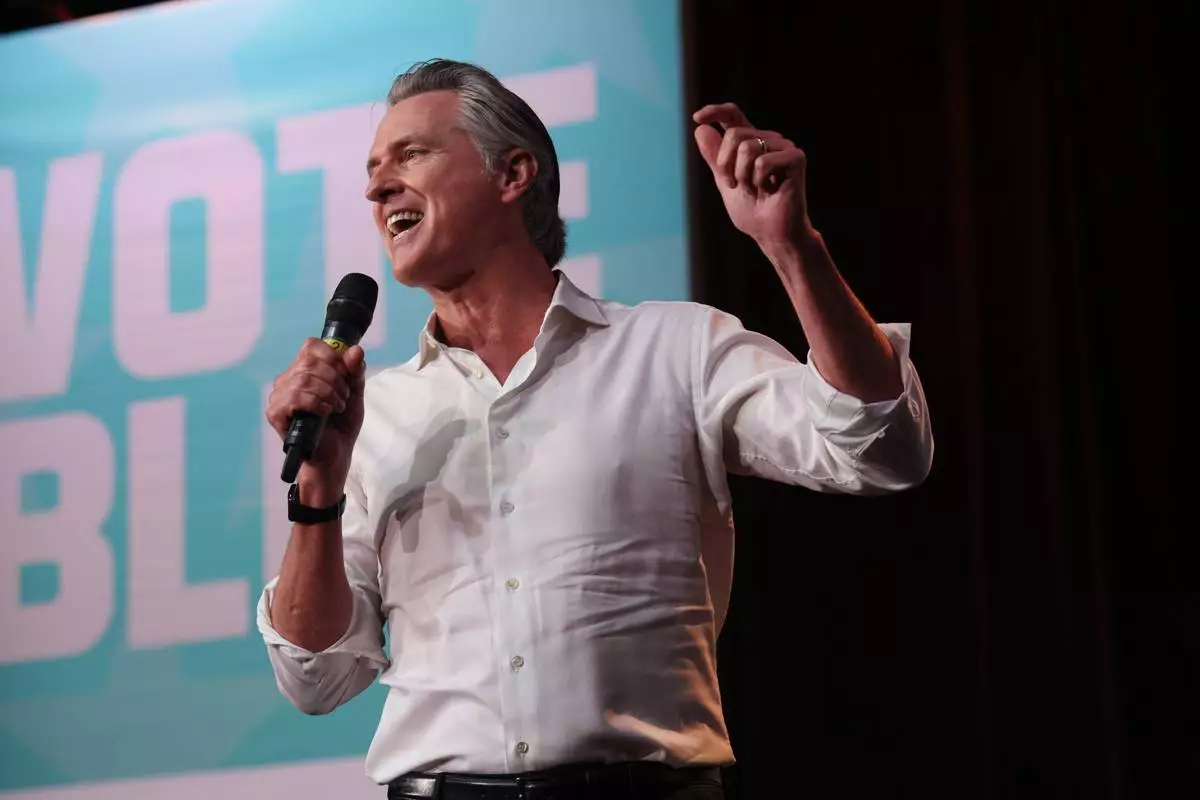
California Gov. Gavin Newsom speaks during a campaign event ahead of the Nov. 3 midterms on Sunday, Nov. 1, 2026, in the Hollywood section of Los Angeles. (AP Photo/Jill Connelly)