LONDON--(BUSINESS WIRE)--Nov 10, 2026--
Everbridge, the global leader in High Velocity Critical Event Management (CEM) and national public warning solutions, today announced continued global momentum for its Public Warning business, with new and expanded deployments across Europe, Asia-Pacific, the Middle East and the Americas as governments and mobile network operators modernise how they communicate with people during emergencies.
This press release features multimedia. View the full release here: https://www.businesswire.com/news/home/20261110564467/en/
Recent projects span Malaysia, Estonia, Australia, Thailand, Sweden, Saudi Arabia, Sint Maarten, the Dominican Republic, the United Arab Emirates and Hungary, reflecting a mix of new customer wins and expanded deployments.
Today, Everbridge Public Warning technology helps protect more than 800 million people across more than 25 countries. Everbridge supports national governments and mobile operators with capabilities including Cell Broadcast, location-based SMS and address-based SMS, as well as traditional communication channels such as television, radio, sirens, email, voice calls and social media.
“When an emergency happens, reaching people quickly with clear, actionable information can make an enormous difference,” said Dave Wagner, President and CEO of Everbridge. “Governments and mobile operators around the world are continuing to strengthen how they warn and protect their populations, and we are proud of the trust they place in Everbridge. The growth we are seeing reflects both the importance of this work and our continued focus on advancing Public Warning technology for the communities we serve.”
That momentum includes continued innovation in the technology behind national Public Warning systems. In Estonia, Everbridge is supporting the next phase of the country's nationwide Public Warning modernisation initiative with end-to-end Cell Broadcast capabilities across government agencies and all three national mobile network operators. The project represents the first planned deployment of a new microservices-based Cell Broadcast platform from Everbridge, designed to support scalable and resilient national Public Warning operations. The technology has now reached the technical testing phase, with Cell Broadcast expected to become part of Estonia's national EE-ALARM public warning system in spring 2027.
Across Europe, Everbridge supports Public Warning ecosystems in 12 countries: Austria, Denmark, Estonia, Germany, Greece, Hungary, Iceland, the Netherlands, Norway, Spain, Sweden and the United Kingdom. Each country's approach reflects its own infrastructure and requirements, bringing together government authorities, mobile network operators and multiple communications technologies to reach residents and visitors during emergencies.
That flexibility is increasingly important as authorities prepare for threats ranging from severe weather, floods and wildfires to industrial accidents and security events. Modern Public Warning systems must also account for populations that are increasingly mobile, including commuters, travellers and tourists who may not be registered for local alerting services. Technologies such as Cell Broadcast can enable authorities to rapidly reach compatible mobile devices within a defined geographic area without requiring prior registration.
Government agencies and mobile network operators have highlighted the value of Everbridge technology in strengthening national Public Warning capabilities.
“The Everbridge public warning system allows us to turn around critical information very quickly,” explained Inspector Hemraj Kumar Mohit of the State of Mauritius. “Within minutes, we can reach large portions of the population leveraging a system with proven scale.”
In Tonga, Laitia Fifita, Acting Director of Tonga Meteorological Service, said: “With the Everbridge Cell Broadcast platform, we are confident in our ability to provide rapid and targeted warnings to our communities.”
In the United Kingdom, Nazirali Rajvani, Director of Architecture, Solutions & Analysis at British Telecommunications, said: “We partnered with Everbridge to provide a trusted and proven world-class solution which was already in use in several other countries.”
In Estonia, Margo Klaos, Director General of the Estonian Rescue Board, said: “Our ability to quickly inform people is improving significantly. [This technology] can deliver threat information to smartphones in seconds, it works even in congested mobile networks, and the notification is designed to appear on the screen as a pop-up window in front of all other applications.”
Everbridge has been advancing Public Warning technology for more than two decades, including the development of Cell Broadcast and location-based SMS solutions. The company continues to contribute to Public Warning standardisation through organisations including 3GPP, ATIS, ETSI and EMTEL.
To learn more, visit the Everbridge Public Warning page.
About Everbridge
Everbridge helps more than 6,500 enterprises and government organizations manage critical events by enabling them to know earlier, respond faster, and improve continuously. Through an all-in-one AI-powered platform, Everbridge High Velocity CEM™ is autonomous when you want it to be and human-guided when you need it to be, so every incident response is optimized. For more information, visit everbridge.com and follow us on LinkedIn.

Everbridge Builds Global Public Warning Momentum with New and Expanded National Deployments
ABU DHABI, United Arab Emirates (AP) — Three-way talks between Russia, Ukraine and the United States are starting Tuesday in the United Arab Emirates, renewing a push to end the war between Moscow and Kyiv after three rounds of negotiations earlier this year.
The two-day session in Abu Dhabi, the first such meeting since February, will focus on security guarantees.
U.S. President Donald Trump’s son-in-law, Jared Kushner, said on X that he and fellow envoy Steve Witkoff were working on a "negotiated solution that can deliver lasting peace and create the conditions for a sovereign, secure, and prosperous Ukraine within a more stable European security environment.”
Rustem Umerov, the head of Ukraine's Foreign Intelligence Service who is leading Kyiv's delegation, said that the day began with a meeting between the Ukrainian team, the U.S. envoys and representatives from the United Kingdom, France, Germany, Italy, NATO and the European Commission.
"Next, we will move to a trilateral format involving Ukraine, the United States and Russia,” Umerov said in a social media post.
Russian state news agency RIA Novosti reported Tuesday that the Russian delegation has arrived at the site of the talks.
The Russian and Ukrainian governments remain far apart on key elements of any prospective deal to end the full-scale war, now nearing its five-year mark.
Russian President Vladimir Putin wants Ukraine to pull its troops back from Donetsk, Luhansk, Zaporizhzhia and Kherson — the four regions that Moscow illegally annexed in September 2022 but never fully captured. He also demands that Ukraine abandon its bid to join NATO, accept strict limits on its military and drop restrictions on the Russian language and the Moscow-affiliated Orthodox Church in Ukraine.
Putin wants a comprehensive peace deal on those conditions and won’t agree to a general halt in hostilities, arguing that it would only allow Ukrainian troops to rest and replenish their weapons stockpiles. He has warned that Russia will achieve its goals by force if Kyiv refuses to meet its conditions for peace.
Ukrainian President Volodymyr Zelenskyy, who was visiting Denmark on Tuesday, rejects Putin’s demands to voluntarily cede territory that Russia hasn't been able to take on the battlefield. Zelenskyy also rejects any limits on Ukraine's military or its arrangements with Western partners, which Kyiv sees as essential security guarantees to stop Moscow from invading again.
Ukraine argues that an immediate ceasefire is the necessary first step toward negotiating a wider settlement and says a direct meeting between Putin and Zelenskyy is the only way territorial issues can be settled.
The Russian and Ukrainian delegations include senior officials who have attended previous rounds of talks.
Russia’s chief negotiator is Putin aide Vladimir Medinsky, who has led Moscow’s team since the first direct peace talks with Ukraine in Istanbul in March 2022. The Russian delegation also includes deputy foreign ministers Sergei Ryabkov and Mikhail Galuzin, military intelligence chief Igor Kostyukov and deputy chief of the General Staff’s operational department, Yuri Zhigarlovsky.
Apart from Umerov, the Ukrainian delegation also reportedly includes Zelenskyy’s chief of staff, Kyrylo Budanov, his deputy, Sergiy Kyslytsya, and Davyd Arakhamia, the parliamentary faction leader of Zelenskyy’s Servant of the People party.
Last week, Trump declared that some kind of grand deal about European security was in the works, describing it as “a big agreement” that is “going to involve more than Ukraine.”
Kushner said Monday on X that a “comprehensive and lasting settlement will also require direct engagement between Russia and our European partners on the broader security arrangements that affect them.” The discussions in Abu Dhabi will set the stage for “that engagement to begin in the near future, as part of a broader multilateral process,” he said.
Moscow has praised the broad approach.
“We can only welcome the (U.S.) negotiators on President Donald Trump’s request proposing to put the issue of collective security on top of the agenda of the talks on a Ukrainian settlement,” Russian Foreign Minister Sergey Lavrov said.
Just before Moscow launched the all-out invasion in 2022, it demanded that NATO roll back its deployments in the alliance’s member countries in Central and Eastern Europe, seeing their presence as a security threat. Similar demands will likely be part of any comprehensive peace deal proposed by Russia.
Kushner said that before the start of the three-way talks, he and Witkoff will meet separately with envoys from Ukraine, the European Union, NATO, Germany, France, the United Kingdom and Italy to “continue the close consultation and coordination we have undertaken on European security and Ukraine’s postwar future over the past several weeks.”
Some in the EU see Washington's proposals as too accommodating to Moscow.
Russia has objected to the Europeans’ involvement in the three-way talks, but said that EU representatives could join at a later stage.
While the ground battles have morphed into a war of attrition along the 1,200-kilometer (about 750-mile) front line, Russia and Ukraine have ramped up their long-range strikes with drones and missiles.
Russia has intensified its air campaign against Ukraine’s power grid, seeking to weaken the country’s resolve as winter sets in. Moscow has relied on ballistic missiles and jet-powered drones, taking advantage of Ukraine’s shortage of U.S.-made Patriot interceptors.
Ukraine, meanwhile, has escalated its drone strikes on Russian oil refineries.
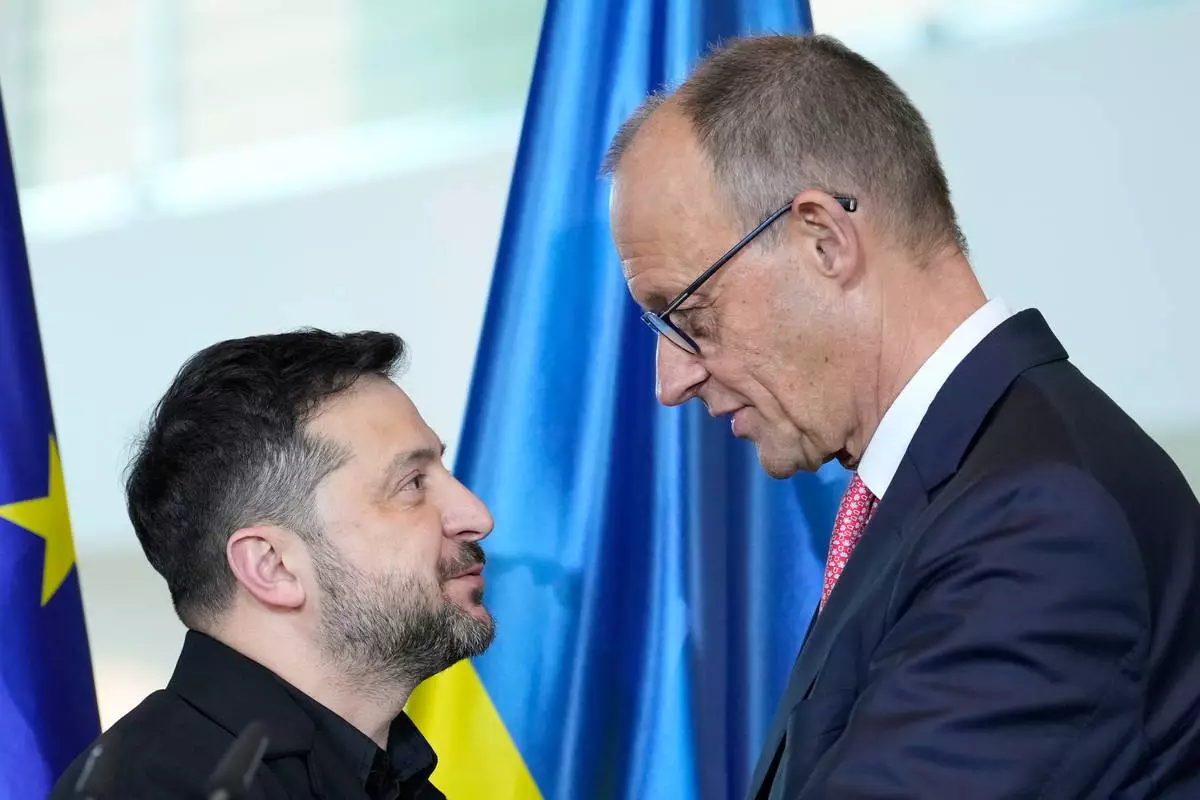
German Chancellor Friedrich Merz, right, and Ukrainian President Volodymyr Zelenskyy attend a press conference in Berlin, Germany, Tuesday, Nov. 3, 2026. (AP Photo/Ebrahim Noroozi)
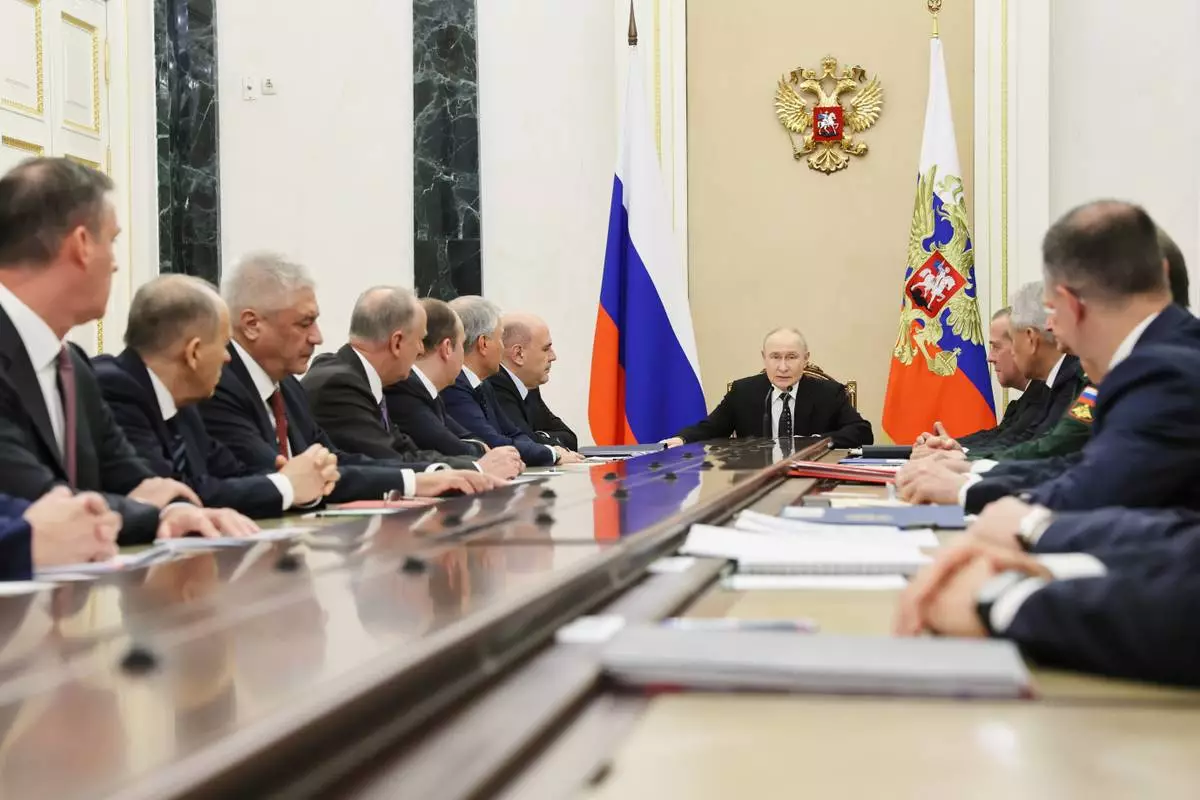
Russian President Vladimir Putin, center, chairs the Security Council meeting in Moscow, Friday, Nov. 6, 2026. (Alexei Babushkin, Sputnik, Kremlin Pool Photo via AP)
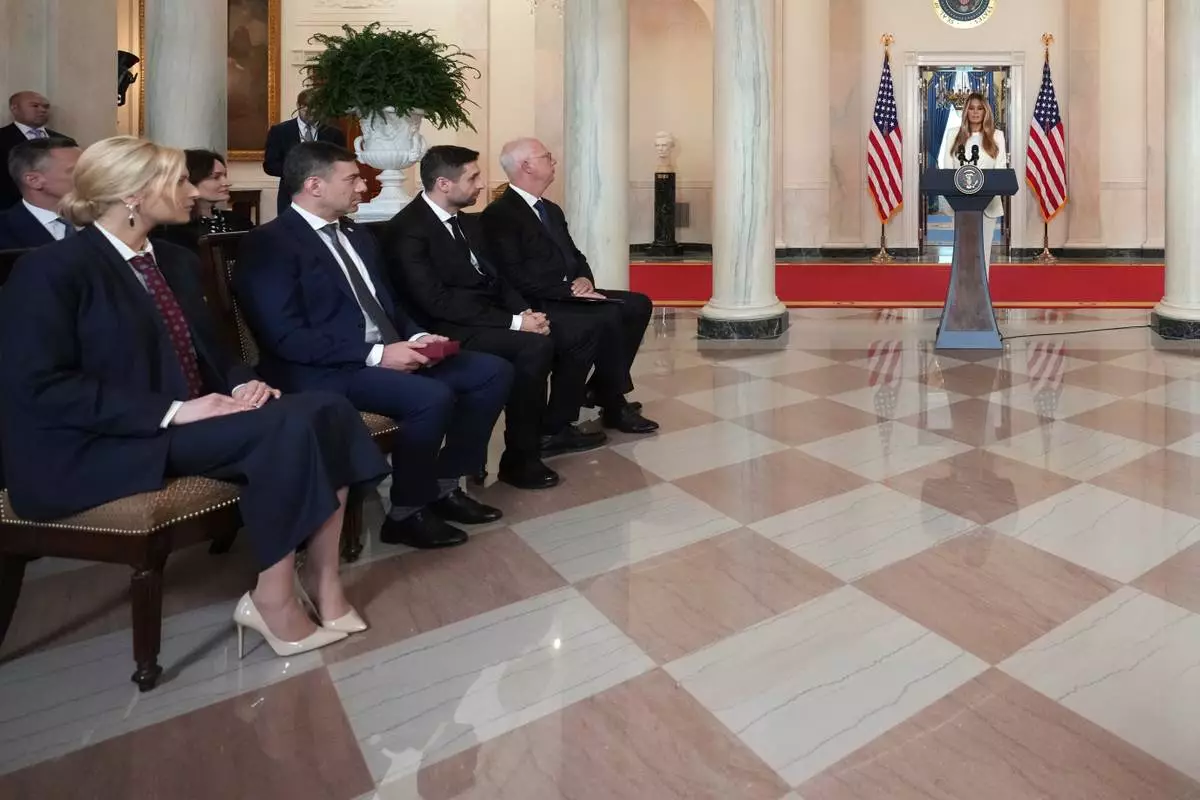
First lady Melania Trump speaks as Russia's Commissioner for Human Rights Yana Lantratova, from left, Ukraine's human rights ombudsman Dmytro Lubinets, Davyd Arakhamia, lawmaker with President Zelenskyy's Servant of the People's party, and Russian Presidential Envoy Kirill Dmitriev listen during a meeting with Russian and Ukrainian representatives in the Grand Foyer of the White House, Thursday, Nov. 5, 2026, in Washington. (AP Photo/Alex Brandon)
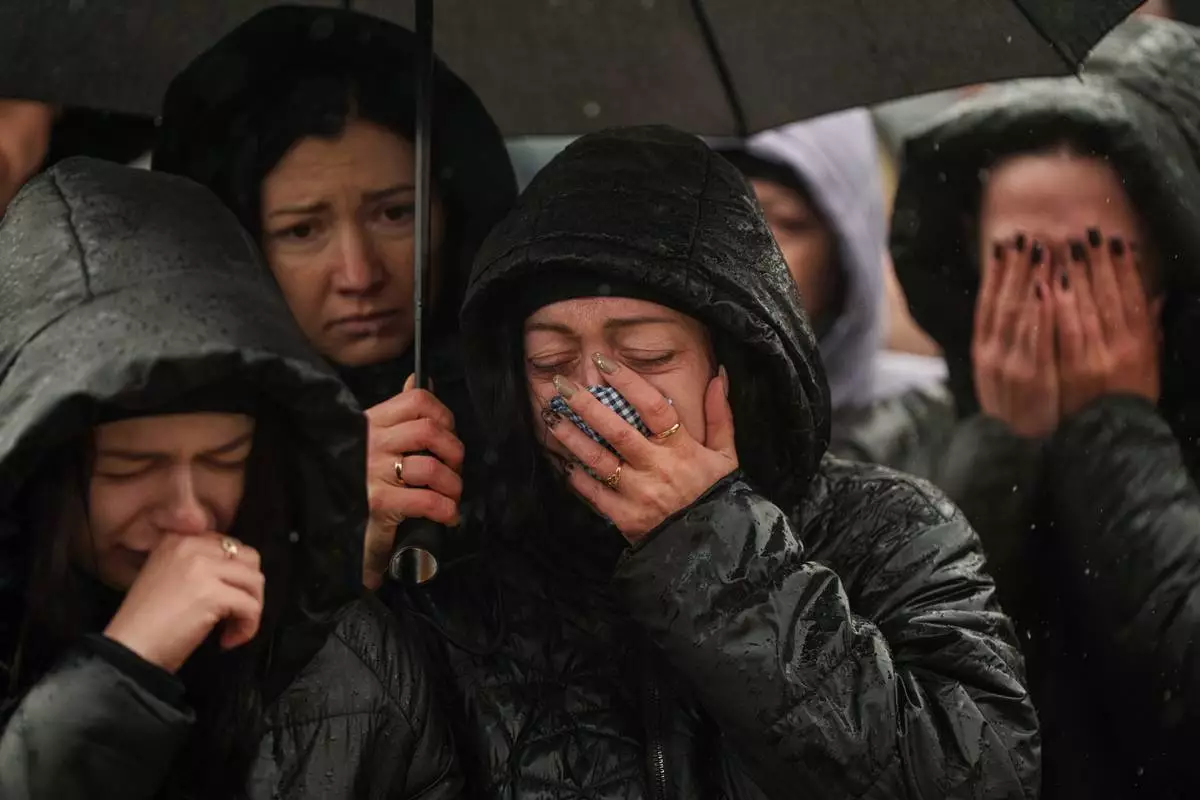
Family members cry beside the coffins of police officers Dmytro Besedin, Mykhailo Buzhenko, Mykola Balanda and Mykhailo Romanov, killed in a Russian airstrike that destroyed an underground school, and Serhii Berezhko and Oleg Dubetskyi, killed in an FPV drone attack in Komyshuvakha, during a farewell ceremony on Khortytsia Island in Zaporizhzhia, Ukraine, Saturday, Nov. 7, 2026. (AP Photo/Evgeniy Maloletka)
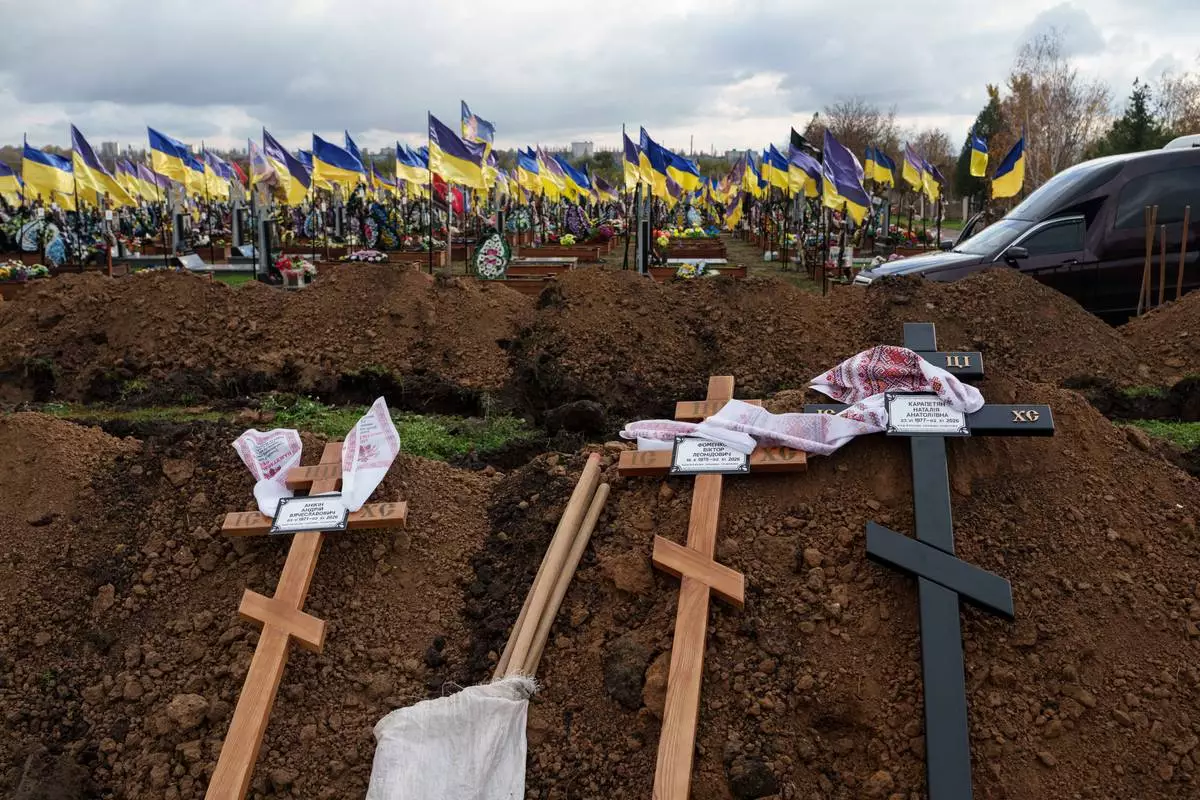
Crosses bearing the names of Viktor Fomenko, Natalia Karapetian and Andrii Anikin, killed in a Russian airstrike that destroyed an underground school in Komyshuvakha, lie in a cemetery in Zaporizhzhia, Ukraine, Saturday, Nov. 7, 2026. (AP Photo/Evgeniy Maloletka)