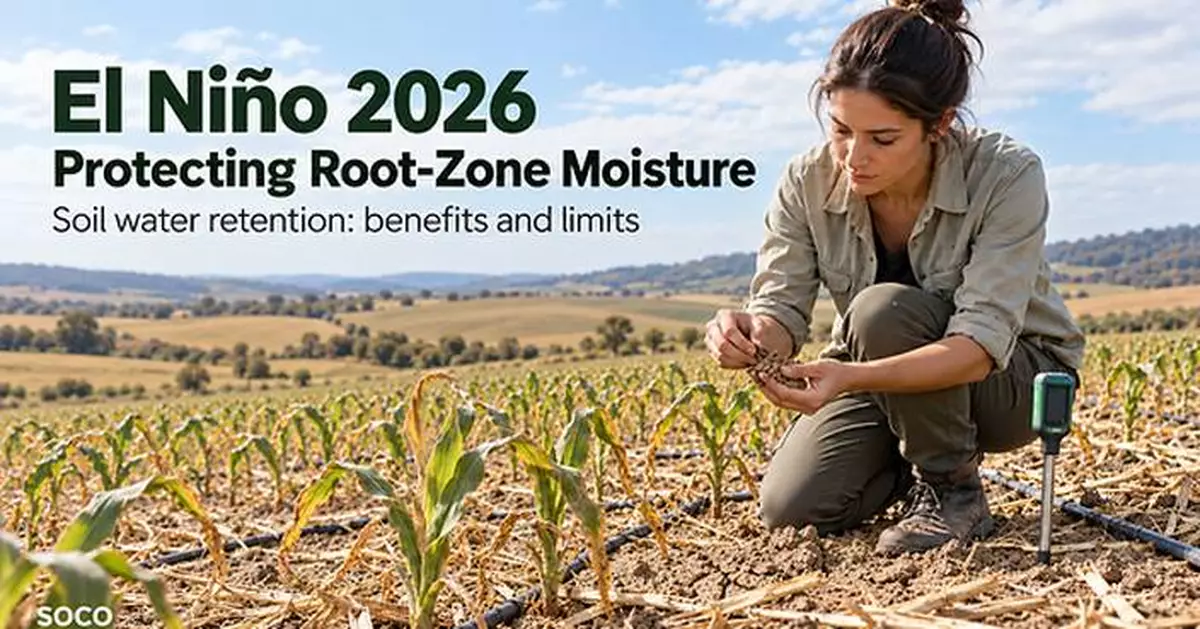
SOCO explains where soil hydrogels can help retain moisture and what growers should consider when irrigation water is limited.
CHINO, Calif., Nov. 10, 2026 /PRNewswire/ -- As the 2026 El Niño event continues to intensify, agricultural regions across Asia-Pacific, Africa and South America face drought conditions and growing pressure on irrigation supplies. Described as one of the strongest events on record, the phenomenon is projected to cause billions in agricultural losses, raising concerns about food security and the need for climate-resilient farming practices.
According to reports from the United Nations World Food Programme and regional meteorological agencies, Indonesia, India, the Philippines and South Africa are among the countries experiencing significant impacts. For growers facing depleted water supplies and uncertain planting conditions, managing moisture in the root zone is an important part of the response.
The Growing Crisis: Water Scarcity and Food Security
The challenge extends beyond a single harvest. Prolonged water shortages can disrupt planting schedules and leave growers with fewer options for maintaining crop production. Smallholder farmers with limited irrigation infrastructure face particular difficulties when rainfall becomes less reliable.
Adapting to these pressures requires practical measures that fit existing farming systems. Alongside irrigation planning and soil management, technologies that help retain moisture around plant roots can give growers another tool for managing dry periods.
"El Niño-related water stress is putting pressure on farming systems," said a regional agricultural analyst. "Growers need practical solutions that fit their existing operations and help crops make better use of available water."
Soil Water Retention: Supporting the Root Zone
Qingdao SOCO New Material Co., Ltd., a provider of soil hydrogel technologies, is working with agricultural partners on water retention solutions for drought-prone growing conditions. The company's biodegradable soil hydrogel are designed to absorb and retain moisture and make stored water available as the surrounding root zone dries.
The aim is to improve the availability of water already supplied through rainfall or irrigation. Depending on the crop, soil, water quality and application method, soil hydrogels may help maintain root-zone moisture between watering events and support plant establishment during dry periods.
Benefits described in SOCO's field applications include:
- Longer intervals between irrigation events where local conditions allow.
- Improved moisture retention within the treated root zone.
- Support for transplant establishment and crop performance during dry periods.
These applications form part of a wider approach to water management. Matching product selection and dosage to the growing environment is essential to evaluating their practical value.
Building Climate-Adaptive Agriculture
SOCO's Soil Hydrogel are designed to help growers manage moisture in the root zone during dry periods. The company's approach addresses immediate drought challenges while supporting growers' longer-term efforts to use water more efficiently. "Our goal is to help growers make better use of the water available to them," said a SOCO technical representative. "As climate pressures increase, practical tools for root-zone moisture management can support more resilient production systems."
SOCO provides customized soil hydrogel solutions and technical guidance to partners across the Americas, Australia, Southeast Asia, the Middle East and Africa. Where available, local agronomists and distribution partners help tailor product recommendations to regional growing conditions and crop needs.
A Call for Proactive Adaptation
As the agricultural sector responds to El Niño-related water stress, the immediate priority is to protect production while preparing for future uncertainty. Water management decisions need to reflect local conditions, available resources and the requirements of each crop.
For SOCO, soil water retention technologies are one component of that response. By helping growers evaluate root-zone moisture management within their existing practices, the company aims to support more efficient use of water and greater resilience during dry periods.
For more information about SOCO soil hydrogel technologies and their agricultural applications, visit [www.socopolymer.com].
About Qingdao SOCO New Material Co., Ltd.
Founded in 2009, SOCO® Group is a technology-driven manufacturer specializing in water-absorbing and retention solutions for agricultural and industrial applications. The company focuses on application-led research and development, developing customized solutions tailored to specific operating needs across industrial and infrastructure settings. Through continued product development and collaboration with global partners, SOCO® supports customers with solutions designed to improve water management, resource efficiency, and project performance.
** This press release is distributed by PR Newswire through automated distribution system, for which the client assumes full responsibility. **
2026 El Niño: Managing Root-Zone Moisture When Water Is Limited