
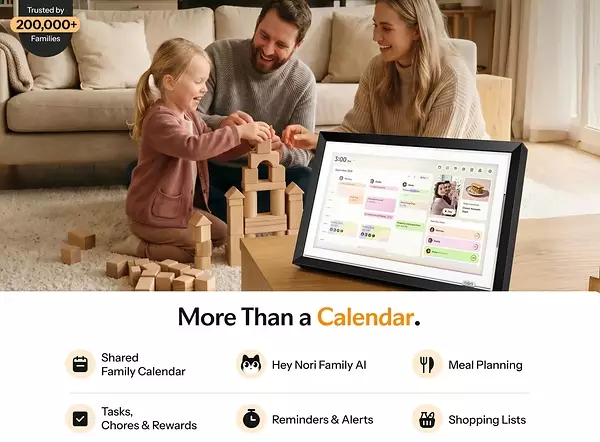
Used by more than 200,000 families, Nori connects hands-free voice on the Nori Family Hub with shared calendars, tasks, and plans accessible across app, web, and home display
SAN FRANCISCO, Nov. 9, 2026 /PRNewswire/ -- Nori, the AI family assistant used by over 200,000 families, is highlighting how its voice features bring family coordination into the moments when families can't stop to look at a screen. On the Nori Family Hub and the Nori app, every household member can add calendar events, update shopping lists, assign tasks, and run multi-step plans using the same "Hey Nori" wake word, no typing or on-screen confirmation required.
Voice for the moments when hands are full
Family plans often need attention while people are already doing something else. Someone preparing Thanksgiving dinner realizes cranberries are missing from the shopping list. A parent getting the kids ready to leave wants to check tomorrow's schedule. Another family member remembers something that needs to happen before the weekend.
With Nori, any family member can use "Hey Nori" to check the calendar, add groceries to a shared list, or create a reminder without putting down what they're doing. Because every request connects to the family's shared plan, the results don't stay with the person who made them. Someone adding cranberries while cooking leaves them for another family member to pick up at the store. A reminder created in the morning is available to everyone who needs to see it.
Nori represents a new approach to the digital wall calendar category. Where existing digital calendars focus on displaying schedules and household information, Nori combines that with Family AI Assistant, natural voice interaction, and shared household coordination. The result is a shift from a passive display to a platform that helps families act on what they see, manage responsibilities together, and make plans in the moment. It is how the digital calendar becomes genuinely useful in everyday household situations.
From voice requests to shared family plans
Nori's meal planning shows how the steps connect. Families can turn a recipe link, a video, or a photo into a saved recipe with step-by-step instructions, add it to a meal plan, and move the ingredients into a shared shopping list. Family members can update the list and take responsibility for related tasks. In North America, the list can also be sent to Instacart for checkout.
These capabilities sit on an established Family AI platform. Nori has been used by more than 200,000 families overall, with households averaging 9.4 AI interactions per day across the platform. The Nori Family Hub itself has shipped to thousands of families within two months of its hardware launch. Nori was also featured in Google Play's editorial Play Story "A career coach's top 5 AI power-ups," where a featured user described its role in organizing household routines, shared calendars, and everyday tasks.
Together, these features point to what Nori is building: a household where one person can start something and others can take it on, without needing to coordinate every step.
Voice convenience, with privacy in mind
Voice interaction makes family planning easier, but a voice-enabled device in a shared living space also needs to give families clear control over when its microphone is active.
Nori Family Hub has no built-in camera and includes a physical switch that disables the microphone at the hardware level. When the switch is off, the device cannot be activated by voice. The Hub supports voice through the "Hey Nori" wake phrase, and the Nori app offers voice input through its own microphone control. Both connect to the same family planning tools, keeping calendars, tasks, and lists accessible across devices.
Less coordination, more time together
Family schedules will still change, groceries will still run out, and plans will still need adjusting. What Nori can change is how much of that work depends on one person remembering, reminding, and following up. With voice making everyday updates easier and shared plans keeping everyone informed, more family members can step in and take part without being asked.
During the US holiday period, when schedules stack up and everyone has their hands full, the same capability does more work. Every family member can contribute to the plan without stopping what they are doing.
"The holidays make it obvious, but this is how families actually work all year," said Isaac Long, co-founder of Nori. "Nobody has a free hand to type things into an app. Voice lets the whole family contribute from wherever they are, so coordination stops being one person's job."
Availability
Nori is available on iOS, Android, and the web, with the Nori Family Hub offering a dedicated shared home display and hands-free voice.
About Nori
Headquartered in San Francisco, California, Domus Next Inc. is building Family AI Assistant infrastructure to help families stay organized, keep track of what is going on, and make decisions together. Built by veterans from ByteDance and Samsung, Nori takes the stress out of managing schedules, tasks, meals, and daily routines so families can focus on what matters.
For more information, visit heynori.com.
Media Contact
Luna Young
lunayoung@domusnext.ai
** This press release is distributed by PR Newswire through automated distribution system, for which the client assumes full responsibility. **
Nori Brings Family AI Beyond the Screen with Voice-First Household Coordination