Speech by CE at Joint Business Community Luncheon
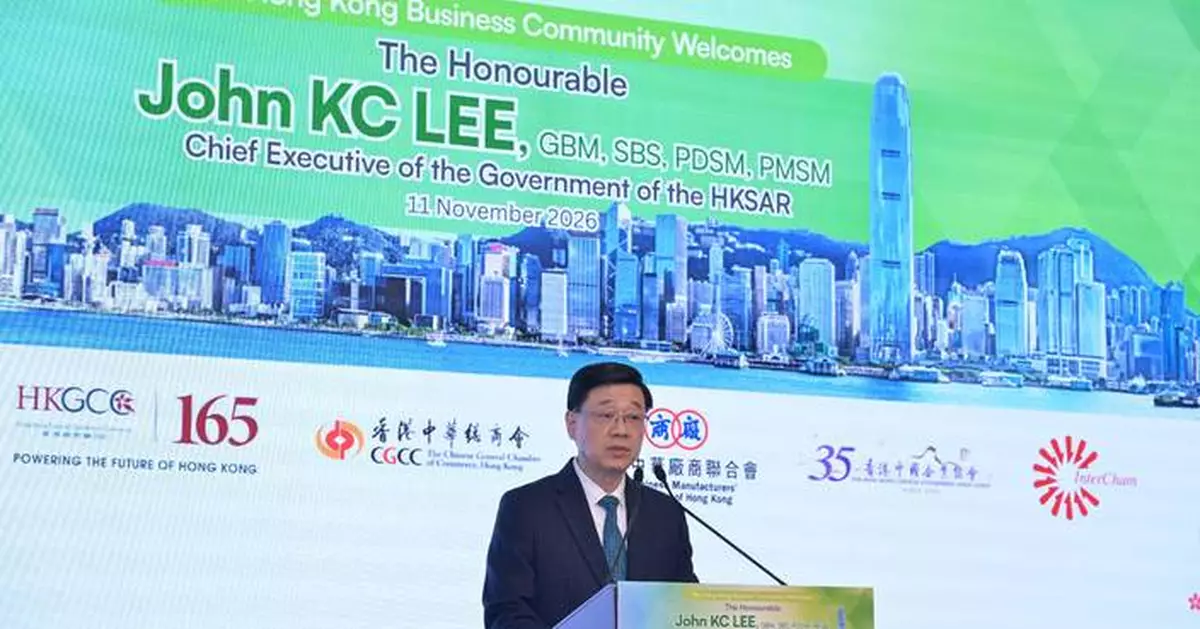
Following is the speech by the Chief Executive, Mr John Lee, at the Joint Business Community Luncheon today (November 11):
Dr Jacob Kam (Chairman of the Hong Kong General Chamber of Commerce), Mr Anthony Lam (Chairman of the Federation of Hong Kong Industries), Mr Ricky Tsang (Chairman of the Chinese General Chamber of Commerce, Hong Kong), Dr Wingco Lo (President of the Chinese Manufacturers' Association of Hong Kong), Mr Yu Xiao (Vice Chairman and President of the Hong Kong Chinese Enterprises Association), Mr Paul McSheaffrey on behalf of InterCham (Chair of the British Chamber of Commerce in Hong Kong), business leaders, Consuls-General, distinguished guests, ladies and gentlemen,
Good afternoon. It is a pleasure to be here today, to join you, once again, for this welcome gathering – the annual Joint Business Community Luncheon. I thank you for this joint business luncheon, held each and every year after the Policy Address has been announced, and for giving me the opportunity to explain as much as possible what the Policy Address can do for the business and industry sector.
There are some 380 of you here this afternoon. You represent five local chambers and 17 international chambers, as well as consulates-general. And I must say the room radiates business energy and, I trust, business optimism.
Like you, I'm very optimistic. And in the next few minutes, I would like to tell you why I'm optimistic about the future of Hong Kong.
The current term of the HKSAR (Hong Kong Special Administrative Region) Government assumed office over four years ago. Over the past four years, the Hong Kong economy has turned around – and then some. Gone from minus 3.7 per cent growth to positive growth, last year, of 3.6 per cent.
Our GDP in the first three quarters of this year is up 5.1 per cent, year on year. And that, ladies and gentlemen, is the fastest growth, for the corresponding period, in five years.
Over the past four years, our goods exports are up more than 26 per cent, year on year. The number of registered local and non-local companies have hit record highs. Median monthly employment earnings climbed a cumulative 20 per cent over the past four years.
Our international achievements are also noteworthy. We continue to be the world No.1 in economic freedom, while ranking fourth, globally, in talent competitiveness.
If money could choose a postcode, it would choose Hong Kong – and increasingly, it does. This year, we became the largest cross-boundary wealth management centre in the world, and climbed to second place in global competitiveness. We also continue to be one of the world's top three global financial centres.
And there's more cheering news in Hong Kong's rankings. But then there's also more, and more, uncertainty in the global economy. More geopolitical complexities. And technology, led by AI, is reshaping companies, economies and competition around the world.
Which is why, in mid-September, we unveiled Hong Kong's First Five-Year Plan. We believe that in creating a long-term blueprint detailing Hong Kong's development priorities, business benefits. You benefit.
The Plan, designed to align with our country's National 15th Five-Year Plan, minimises the volatility that defines today's global economy, and the world at large. It does so by giving you confidence. The confidence to do business and invest your future in Hong Kong.
Hong Kong's First Five-Year Plan is built on the concept of "four centres and one hub":
• international financial centre,
• international shipping centre,
• international trade centre,
• international innovation and technology centre, and
• international hub for high-calibre talent.
I would now like to touch on each of these policy priorities in turn.
Let me start with finance. Finance is Hong Kong's pivotal sector, playing an irreplaceable role in our high-quality development.
In finance, Hong Kong's First Five-Year Plan focuses on five core areas:
- First, strengthening our roles as a global offshore Renminbi business hub and international asset and wealth management centre and risk management centre;
- second, enhancing equity and bond markets, while helping Mainland enterprises go global and bringing in international capital;
- third, developing a commodity trading ecosystem with gold as an entry point;
- fourth, pursuing "Finance+" to serve the broader economy; and
- fifth, strengthening financial risk prevention.
On "Finance+", it can help us better integrate our financial strengths with the rest of the economy. "Finance + Trade", for example, is focused on strengthening trade finance, supply chain finance and risk management services to expand our support for SMEs (Small and Medium-Sized Enterprises).
In "Finance + Technological Innovation", the possibilities are as boundless as I&T itself. To name a few, we will encourage patient capital and venture capital investments in industry and technological innovations. We will support the expansion of financing services for I&T enterprises through the acceleration of fintech development.
We will expedite green and sustainable finance, advancing the international carbon market and contributing to our country's low-carbon transition.
Let me now turn to the next centre, shipping. As an international shipping centre, Hong Kong has ranked fourth, globally, in its comprehensive maritime strengths over the past seven years.
Yes, the Hong Kong port is busy. But our real edge, with our world-class service industry, is what happens when the ship leaves for business – the contracts, the insurance, the arbitration, and more. To boost our status, we will promote a "volume to value" transformation of the Hong Kong port and strengthen our high value-added maritime services.
We are planning a network of Hong Kong-centred green energy corridors, with Mainland cities supplying green maritime fuel for bunkering and trading in Hong Kong.
We will deepen our co-operation with Mainland and international shipping ports, strengthening our standing as an international transhipment hub and integrating into the country's logistics network.
Now I'll come to the third centre, trading. Hong Kong has long been in the international trade arena as a trade centre. In merchandise trade last year, Hong Kong was ranked the world's fifth-largest.
In Hong Kong, the door always stays open – and we don't charge those walking through it. We will continue to uphold free trade, support the rules-based multilateral trading system and maintain zero customs tariffs. In doing so, we give businesses the confidence to trade with us, to look to Hong Kong for their future.
Alongside our strong ties with traditional markets, we will expand Hong Kong's interests in ASEAN and the Middle East, while exploring Central Asia, Africa and other emerging markets.
And we will expand our GoGlobal Task Force, established just over a year ago. To date, we have helped some 360 Mainland enterprises through GoGlobal, assisting them with listing and raising capital, aligning with overseas standards, acquiring industry certifications and fulfilling compliance requirements.
And we are committed to two-way flow, enabling overseas companies to find business opportunities in the Mainland as well.
Now let me talk about the fourth and most promising centre, innovation and technology. Hong Kong is a rising international I&T centre. The Five-Year Plan outlines six main directions in I&T:
First, improving the institutional framework for I&T development. That includes supporting the development of aerospace technology. The Innovation and Technology Commission will launch a new round of Special Call on Aerospace Technology. It will emphasise technology research related to national space missions, covering satellite technology, space exploration instruments aerospace materials and other related areas.
Second, developing three major I&T parks and five key R&D institutions. The three parks are Cyberport, Science Park, and the Hong Kong Park in the Hetao co-operation zone and San Tin Technopole. The five key R&D institutions cover productivity, applied science, microelectronics, artificial intelligence, and life and health technology.
Third, advancing new industrialisation and expediting I&T industry development, including establishing Hong Kong's first national manufacturing innovation centre.
Fourth, developing an international hub for science and technology co-operation. We're off to a fine start. The United Nations Industrial Development Organization has chosen Hong Kong to launch its first centre of excellence on global advanced manufacturing in the Asia-Pacific region. It's expected to begin operation in the first half of next year.
Fifth, deepening development of the Greater Bay Area; and
Sixth, adopting a holistic approach to development and security.
I was in Beijing and Shanghai last week. We worked to build on the close co-operation we enjoy with our country. There, I encouraged strategic Mainland enterprises to consider the Northern Metropolis and its planned research institutions, and told them about the opportunities in the three university towns of the Northern Metropolis. And I'm here today to invite you, the Hong Kong business community, to help us reap the boundless promise of the Northern Metropolis.
Just last week, Hong Kong held the World Class University Presidents Forum. It attracted more than 130 academic leaders from some 50 universities. Several expressed an interest in establishing a presence in Hong Kong, in the university towns, clearly attracted by the concept – the integrated development of education, technology and talent.
We need a world of high-calibre talent to realise our ambitions, to realise also our very ambitious Five-Year Plan. It helps that Hong Kong is home to five universities among the world's top 100, and three universities among Asia's top five.
Our Top Talent Pass Scheme, as of September, had approved over 145 000 applicants, many of whom from the commerce, finance and innovation sectors.
We are committed to developing Hong Kong into an international hub for post-secondary education and talent. To that end, we will promote the Study in Hong Kong and Study Tour in Hong Kong brands internationally.
We'll be talking about the Five-Year Plan for the next five years. More important is how all of us could bring it to rewarding and inclusive life.
Government can make plans of all shapes, sizes and promised payoffs. But without the support of business, and the community at large, they will surely remain plans and promises only.
I look forward to your continuous co-operation with the Government in making Hong Kong a better business hub, and a better home for all of us.
Ladies and gentlemen, we do it all for the economy, the community and the people of Hong Kong. Enjoy your lunch and the afternoon. Thank you.
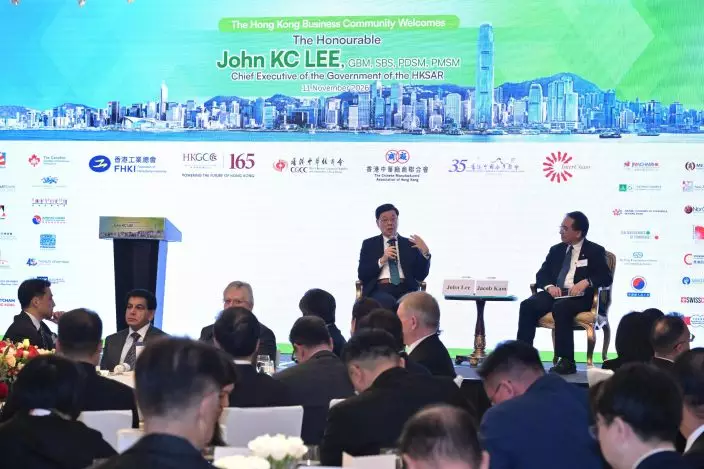
The Chief Executive, Mr John Lee (left), attended the Joint Business Community Luncheon today (November 11). Looking on is the Chairman of the Hong Kong General Chamber of Commerce, Dr Jacob Kam (right). Source: HKSAR Government Press Releases
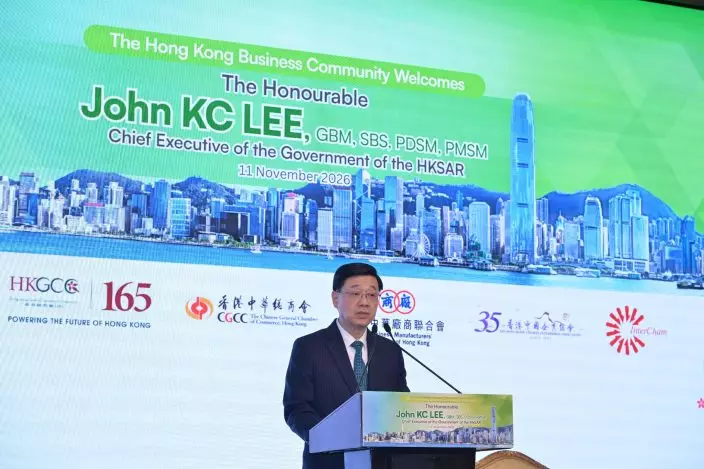
The Chief Executive, Mr John Lee, speaks at the Joint Business Community Luncheon today (November 11). Source: HKSAR Government Press Releases