SAN JOSE, Calif.--(BUSINESS WIRE)--Nov 11, 2026--
KIOXIA America, Inc. today announced a new storage-density milestone in supporting modern AI and data lake workloads. In collaboration with Dell Technologies, the company’s 245.76 TB KIOXIA LC9 Series SSDs are used to create the world’s first 1 157 PB object storage solution in a single industry-standard 42U server rack. The solution is designed to improve data center efficiency through a smaller storage footprint, higher TB/W and lower cooling requirements compared with HDDs or lower capacity SSDs at the same capacity.
This press release features multimedia. View the full release here: https://www.businesswire.com/news/home/20261111365949/en/
The solution is built with software-defined Dell ObjectScale™ running on 16 PowerEdge™ R7725xd servers and configured with 640 KIOXIA LC9 Series 245.76 TB SSDs to deliver 157 PB of raw flash capacity in an industry-standard 42U rack.
Dell ObjectScale is an enterprise-grade, cloud-scale object storage platform designed for unstructured data workloads, including AI training, big data analytics and modern cloud-native applications.
AI is Reshaping Infrastructure Requirements
As AI workloads drive continued growth in unstructured data, organizations need storage that can deliver higher capacity without a corresponding increase in data center floor/rack space, power consumption or cooling requirements. High-capacity NVMe™ SSDs can help address these demands by consolidating more data into a smaller, more efficient infrastructure footprint.
Together, Dell Technologies and Kioxia have a long history of enabling scalable infrastructure for data-driven applications. This latest milestone underscores a shared commitment to advancing high-density architectures that improve performance, reduce energy consumption and maximize data center efficiency. Last summer, Kioxia announced the industry’s first 2 245.76 TB NVMe SSD, highlighting its value for generative AI, large-scale datasets, vector databases and other data-intensive environments. Dell Technologies published a blog on high-density object storage for AI-era data environments using KIOXIA 245.76 TB SSDs.
“AI is driving unprecedented growth in unstructured data, and customers need to scale capacity without scaling their data center footprint and power consumption,” said George Papadopoulos, SVP, Product & Engineering, Dell Technologies. “With Dell ObjectScale and KIOXIA’s 245.76 TB SSDs, customers can consolidate more data into fewer systems and racks while reducing cabling, power and cooling requirements. This collaboration helps deliver a more efficient, scalable foundation for AI and data-intensive workloads.”
Key features of the KIOXIA LC9 Series include:
“KIOXIA’s 245.76 TB LC9 Series SSDs enable Dell Technologies to deliver a new level of storage density for AI and data-intensive workloads – helping customers consolidate massive data footprints into fewer systems while improving data center efficiency and scalability,” said Faraz Velani, Head of Go-to-Market, SSD business unit at KIOXIA America, Inc. “Together, KIOXIA and Dell are redefining what’s possible with high-capacity flash storage.”
For more information, please visit www.kioxia.com and follow the company on X and LinkedIn®.
About KIOXIA America, Inc.
KIOXIA America, Inc. is the U.S.-based subsidiary of Kioxia Corporation, a leading worldwide supplier of flash memory and solid-state drives (SSDs). From the invention of flash memory to today’s breakthrough BiCS FLASH™ 3D technology, Kioxia continues to pioneer innovative memory, SSD and software solutions that enrich people's lives and expand society's horizons. The company's innovative 3D flash memory technology, BiCS FLASH, is shaping the future of storage in high-density applications, including advanced smartphones, PCs, automotive systems, data centers and generative AI systems. For more information, please visit Kioxia.com.
© 2026 KIOXIA America, Inc. All rights reserved. Information in this press release, including product pricing and specifications, content of services, and contact information is current and believed to be accurate on the date of the announcement, but is subject to change without prior notice. Technical and application information contained here is subject to the most recent applicable Kioxia product specifications.
Notes:
1: Source: Kioxia survey as of November 11, 2026.
2: Source: Kioxia survey as of July 25, 2026.
3: Flash Die Failure Protection allows for a NAND die to fail and the SSD will continue to function with full reliability.
4: MTTF (Mean Time to Failure) is not a guarantee or estimate of product life; it is a statistical value related to mean failure rates for a large number of products which may not accurately reflect actual operation. Actual operating life of the product may be different from the MTTF.
5: Sanitize Instant Erase (SIE), Self-Encrypting Drive (SED) and FIPS (Federal Information Processing Standards) SED security optional models are available. SIE optional model supports Cryptographic Erase, which is a standardized feature defined by the technical committees (SCSI) of INCITS (the InterNational Committee for Information Technology Standards). SED optional model supports TCG Opal and Ruby SSCs. It has a few unsupported features of TCG Opal SSC. For more details, please make inquiries through “Contact us”. FIPS SED optional model utilizes a security module designed to comply with FIPS 140-3, which defines security requirements for cryptographic module by NIST (National Institute of Standards and Technology). For the latest validation status, please make inquiries through “Contact us”. Security optional models are not available in all countries due to export and local regulations.
Definition of SSD capacity: KIOXIA Corporation defines a kilobyte (KB) as 1,000 bytes, a megabyte (MB) as 1,000,000 bytes, a gigabyte (GB) as 1,000,000,000 bytes, a terabyte (TB) as 1,000,000,000,000 bytes, a petabyte as 1 billion megabytes and a kibibyte (KiB) as 1,024 bytes. A computer operating system, however, reports storage capacity using powers of 2 for the definition of 1GB = 2^30 bytes = 1,073,741,824 bytes and 1TB = 2^40 bytes = 1,099,511,627,776 bytes and therefore shows less storage capacity. Available storage capacity (including examples of various media files) will vary based on file size, formatting, settings, software and operating system, and/or pre-installed software applications, or media content. Actual formatted capacity may vary.
The flash memory capacity is calculated as 1 terabit (1 Tb) = 1,099,511,627,776 (2^40) bits, and 1 terabyte (1 TB) = 1,099,511,627,776 (2^40) bytes.
Dell Technologies, PowerEdge, Dell, ObjectScale, and other trademarks are trademarks of Dell Inc. or its subsidiaries.
NVMe and NVMe-MI are registered or unregistered trademarks of NVM Express, Inc. in the United States and other countries.
PCIe is a registered trademark of PCI-SIG.
OCP and OPEN COMPUTE PROJECT marks are owned by and used with the permission of the Open Compute Project Foundation.
LinkedIn is a trademark of LinkedIn Corporation and its affiliates in the United States and/or other countries.
Other company names, product names, and service names may be trademarks of third-party companies.
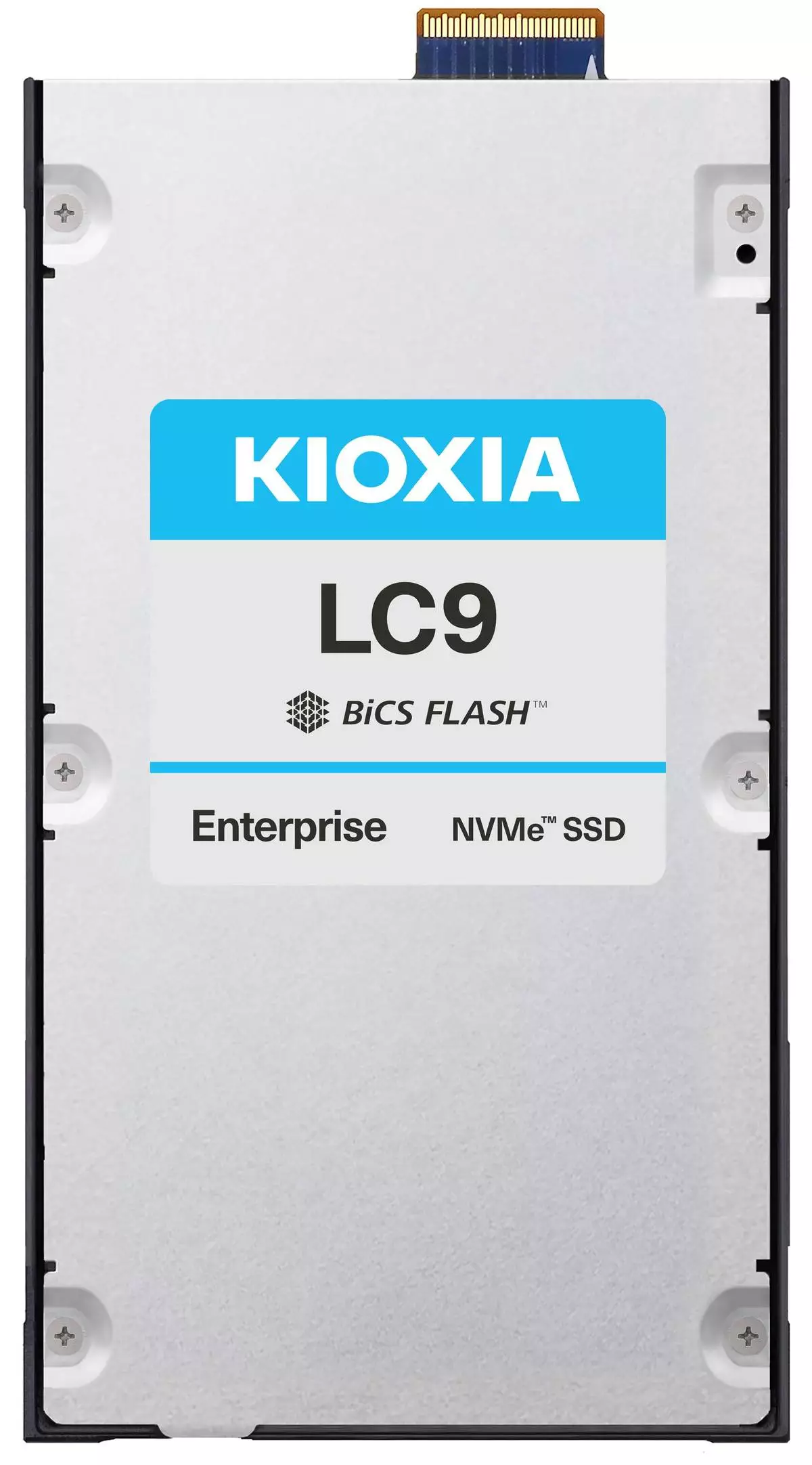
In collaboration with Dell Technologies, 245.76 TB KIOXIA LC9 Series SSDs are used to create the world’s first 157 PB object storage solution in a single industry-standard 42U server rack. The solution is designed to improve data center efficiency through a smaller storage footprint, higher TB/W and lower cooling requirements compared with HDDs or lower capacity SSDs.