Skip to Content Facebook Feature Image

Guangdong pushes for bigger role in connecting APEC economies ahead of summit

China

China

China

Guangdong pushes for bigger role in connecting APEC economies ahead of summit

2026-11-11 17:01 Last Updated At:22:47

South China's Guangdong Province is looking to leverage the upcoming APEC meetings in Shenzhen to cement its role as a gateway into China and a strategic hub linking to Asia-Pacific markets by connecting more closely with regional industrial and supply chains and creating more opportunities for shared growth.

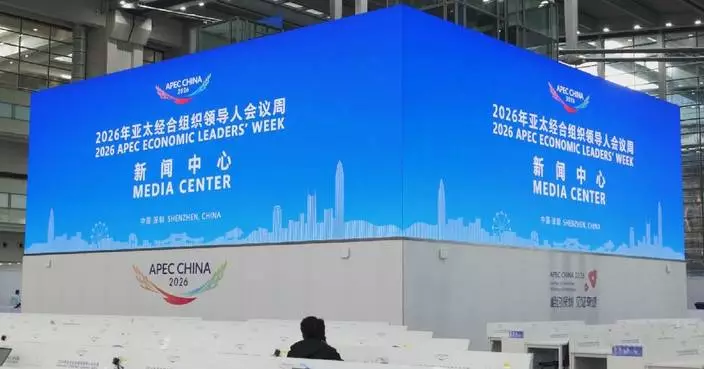
The Asia-Pacific Economic Cooperation (APEC) Economic Leaders' Meeting on Nov 18 and 19 is set to bring political and business representatives from all 21 member economies and beyond to Shenzhen, and Guangdong is keen to use the occasion to expand its regional footprint, drawing on its manufacturing strengths and innovation capacity to deepen trade and cooperation across the Asia-Pacific.

As China's most populous region, Guangdong has been the country's largest provincial trader for 40 years, while customs data shows its total imports and exports reached a record high of nearly 9.5 trillion yuan last year.

Guangdong's trade with other APEC economies alone exceeded 6 trillion yuan, accounting for nearly a quarter of China's overall trade total with other members of the regional organization.

Behind those impressive figures, more companies from across the province are trying to sound out new opportunities, from coffee machines made in the local manufacturing powerhouse of Shunde to robots developed through collaborations with firms in neighboring Hong Kong.

Shunde, a district in Foshan City, has now risen to become the world's largest coffee machine production base. Nearly 80 percent of coffee machines worldwide are made in China, and at least one out of every three exported overseas comes from Shunde, with APEC economies among its major markets.

"We have already shipped [our machines] to more than 60 countries, and for our products, we have been also [able to] sell more than two million units, especially in the APEC markets," Karen Yu, overseas business director at Guangdong Gemilai Intelligent Technology, a prominent Chinese manufacturer and brand specializing in commercial, home-commercial dual-use, and household espresso machines and coffee grinders.

Yu's company is not an outlier. With more than 20 million registered market entities, Guangdong has built a strong foundation for deeper economic integration with APEC economies. The province's exporters are not only selling finished goods -- they are increasingly plugging into regional supply chains, sourcing components and designing products for specific overseas markets.

"Guangdong is really the global hub for coffee machine manufacturing. There is a very stable supply chain and Shunde is also the core production [base] for high-quality coffee machines. Besides the supply chain, Shunde government has been very supportive for [our efforts to reach] overseas markets. We will attend the Canton Fair every year and also we will attend overseas exhibitions to show our product to the global clients," Yu said.

Trade is not the only area where Guangdong is deepening links with the rest of the Asia-Pacific. Leveraging its status as an international innovation hub within the Guangdong-Hong Kong-Macao Greater Bay Area, the province has set up dedicated teams to connect with other APEC economies and promote cooperation on key technologies.

One example is a joint Guangdong-Hong Kong project which is developing robots for the construction industry.

"One Guangdong-Hong Kong joint project has developed a robot capable of fully autonomous spraying in unfinished indoor buildings. It has already been applied in more than 90 construction projects. Many high-quality research outcomes come from joint problem-solving between universities and enterprises," said Ma Jun, assistant professor with expertise in the thrust of robotics and autonomous systems at Hong Kong University of Science and Technology (Guangzhou).

Guangdong pushes for bigger role in connecting APEC economies ahead of summit

Guangdong pushes for bigger role in connecting APEC economies ahead of summit

Trilateral talks between Russia, the United States and Ukraine ended on Wednesday in Abu Dhabi, with Russia and Ukraine reaching an agreement on a "large-scale" prisoner exchange.

Vladimir Medinsky, head of the Russian delegation at the talks, told a press conference that details of the exchange would be announced soon and that negotiations would continue.

He said the delegations had discussed humanitarian issues, with the future of European security being a central focus of the U.S.-mediated talks.

Medinsky added that parties had reached understandings on some issues, without providing further details.

He defended the need to discuss post-war security arrangements at the current stage of negotiations, saying the conflict in Ukraine had exposed shortcomings in Europe's security system.

Medinsky called for the establishment of a fair security framework that takes into account the interests of all countries.

Kremlin spokesman Dmitry Peskov said on Wednesday that Russian President Vladimir Putin had been continuously briefed by the Russian delegation on developments in the trilateral talks.

He said that the Russian delegation did not have any contacts with European representatives in Abu Dhabi, and such contacts had not been planned in the first place.

Meanwhile, Jared Kushner, a member of the U.S. negotiating team, told reporters that a lot of serious issues had been discussed, adding the discussions were thorough and covered all major issues.

He noted that the prisoner exchange deal was one of the positive outcomes of the negotiations, with the exact number of prisoners to be finalized on Thursday.

Kushner said the second day of discussions were "very substantive," describing the negotiations as a good first step forward.

He also said he and U.S. special envoy Steve Witkoff planned to travel to Moscow for further discussions on ending the Ukraine conflict.

Kushner noted that the two would seek progress in Moscow if Russian President Vladimir Putin agreed to U.S. demands to end the war, and would meet Ukrainian President Volodymyr Zelensky afterward.

Kushner added that Russia had its own security concerns and had been asked to put forward proposals to reduce tensions.

On the Ukrainian side, negotiator David Arakhamia, chairman of the Servant of the People parliamentary faction, a Ukrainian political party, said the Abu Dhabi talks had generated "good momentum" toward finding a solution to the conflict before the end of the year.

Rustem Umerov, head of Ukraine's Foreign Intelligence Service and a member of the Ukrainian negotiating delegation, said earlier Wednesday that the Ukrainian team planned to hold separate discussions with European partners following the trilateral session.

"The Russian-Ukrainian war has its implication on the European security structure to begin with. So having the European security structure as part of these trilateral talks is a logical process, because we cannot exclude the effects this war had on Europe's security, on Europe's economy, and it's right on the European border. And that's the whole issue. The main issue that began with is NATO being closer and Europe's security being closer to the Russian border," said Abdulaziz Al-Shehhi, a senior researcher at TRENDS Research and Advisory.

The latest round of Russia-U.S.-Ukraine trilateral talks took place in Abu Dhabi on Tuesday and Wednesday, marking the first meeting among the three countries since February. The first day's discussions lasted nearly four hours, while Wednesday's session concluded in less than two hours.

Although progress was reported on the prisoner exchange, no agreement was announced on a ceasefire, territorial disputes or long-term security guarantees.

Trilateral talks on settlement of Ukraine crisis conclude in Abu Dhabi

Trilateral talks on settlement of Ukraine crisis conclude in Abu Dhabi

Recommended Articles