LG's AI-Powered Platform Recognized for Measuring
the Real-World Impact of Communications
News Summary
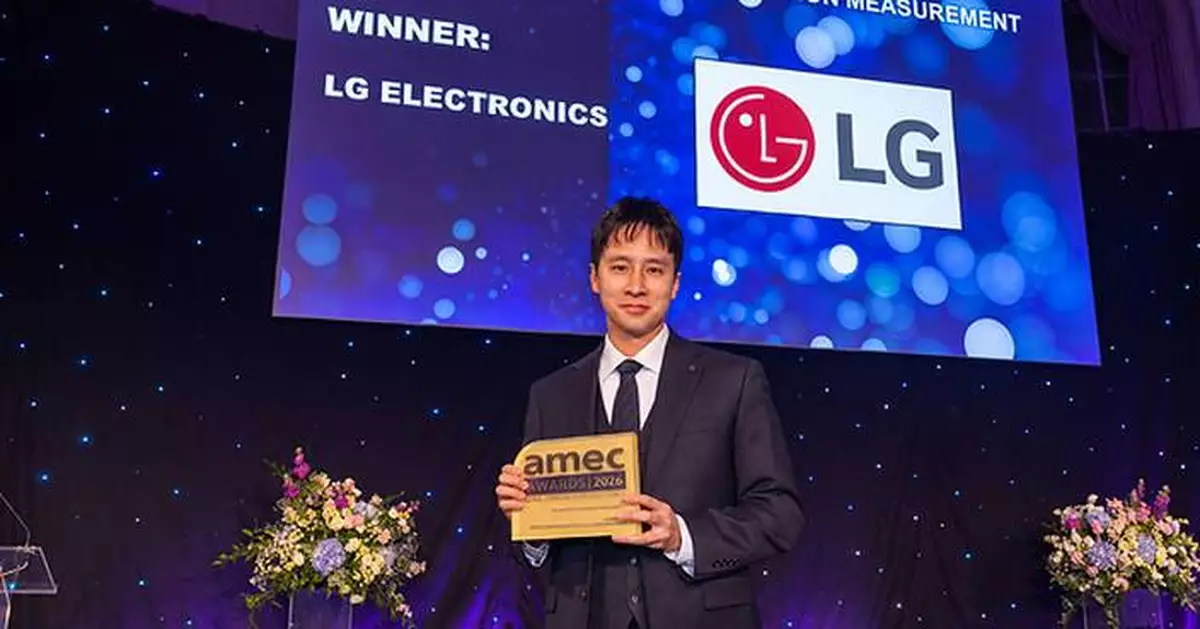
- LG Electronics' PRISM AI has won Gold in the Best Use of AI in Communication Measurement category and Silver in both the Best Use of a Measurement Framework category and the Step Change Award at the 2026 AMEC Global Communication Effectiveness Awards.
- The platform was recognized for its data-handling and impact measurement, which have helped expand LG's media monitoring from 53 to 200 countries and cut reporting time from about one month to one hour.
- A notable example of LG Group's focus on AI transformation (AX), PRISM AI has now been recognized by two major international industry awards this year, including the Best AI Tool or Product category at the 2026 IN2 SABRE Awards Asia-Pacific.
SEOUL, South Korea, Nov. 12, 2026 /PRNewswire/ -- LG Electronics (LG) today announced that PRISM AI, its AI-powered communications measurement platform, has won three honors at the 2026 AMEC Global Communication Effectiveness Awards. The awards are presented by AMEC, the International Association for the Measurement and Evaluation of Communication.
The platform earned Gold in the Best Use of AI in Communication Measurement category and Silver in both the Best Use of a Measurement Framework category and the Step Change Award, which recognizes the best improvement of a measurement journey. The accolades highlight PRISM AI's potential as a reference point for the public relations and communications industry.
How the Awards Were Judged
This year, the AMEC Global Communication Effectiveness Awards adopted a threshold-based judging model, under which each entry is evaluated against fixed criteria for excellence rather than against other entries. To protect the integrity of the process, judges are not permitted to use generative AI tools to support or inform their evaluations.
The judging places the greatest emphasis on real-world effectiveness: how reliable the findings are, whether they were acted on, and how they shape future communications planning and strategy. These priorities are reflected in PRISM AI's approach, with its integrated measurement methodology and multilingual contextual analysis designed to address these criteria, delivering dependable measurement and insights that inform business decisions.
Measuring Impact, Not Just Volume
PRISM AI measures the impact of communications, not just the volume of coverage. The platform is built around three core concepts from AMEC's Barcelona Principles 3.0: outcomes over outputs, quality plus quantity, and transparency. To put these principles into practice, it uses a dual-metric system made up of the PR Score and the Communications Impact Index.
Underpinning this approach is the platform's ability to handle data at scale. To track coverage across a fragmented global media landscape, PRISM AI processes large volumes of articles in real time and uses large language models to interpret coverage across languages and markets, producing more meaningful and comparable insights.
Measurable Gains in Efficiency and Reliability
Since its introduction, PRISM AI has improved the efficiency and reliability of LG's global communications workflows. Its AI-powered filtering removes more than 78 percent of spam and irrelevant content with over 95 percent accuracy. Media monitoring now covers 200 countries, up from 53, and tracked brands have grown from 5 to 30. The time spent on reporting has been reduced from approximately one month to one hour.
Growing International Recognition
As LG Group advances AI transformation (AX) across its businesses, PRISM AI has become an internationally recognized example of AI-driven data collection and analysis in a specialized professional field. The AMEC recognition follows the platform's win in the Best AI Tool or Product category at the 2026 IN2 SABRE Awards Asia-Pacific, held in Singapore this August.
"Winning three AMEC Awards for PRISM AI is especially meaningful, not only because it highlights our efforts in advancing AI-powered communications measurement, but also because the recognition comes directly from the PR industry's most respected global body," said Cho Jung-bum, head of the AX Center at LG Electronics. "We will continue to refine PRISM AI's methodology while expanding its capabilities and scope, further enhancing its value as a solution for driving better business decisions."
About LG Electronics, Inc.
LG Electronics is a global innovator in technology and consumer electronics with a presence in almost every country and an international workforce of more than 75,000. LG's four Companies – Home Appliance Solution, Media Entertainment Solution, Vehicle Solution and Eco Solution – combined for global revenue of over KRW 89 trillion in 2025. LG is a leading manufacturer of consumer and commercial products ranging from TVs, home appliances, air solutions, monitors, automotive components and solutions, and its premium LG SIGNATURE and intelligent LG ThinQ brands are familiar names world over. Visit www.LG.com/global/newsroom/ for the latest news.
** This press release is distributed by PR Newswire through automated distribution system, for which the client assumes full responsibility. **

LG ELECTRONICS' PRISM AI WINS THREE HONORS AT 2026 AMEC AWARDS
HONG KONG, Nov. 12, 2026 /PRNewswire/ -- "AI delivers breadth and efficiency; humans provide depth and decision-making." On November 2, at the Hong Kong FinTech Week 2026 × StartmeupHK panel, Jieyong Lyu, Founding Partner and Chief Executive Officer of Alpha2Fund, described how the firm puts human-machine collaboration to work in quantitative research.
Founded in 2015, Alpha2Fund focuses on quantitative investment strategies and manages approximately RMB 60 billion in assets. It has offices in Beijing, Shanghai and Hong Kong, and in 2025 obtained Type 4 (advising on securities) and Type 9 (asset management) regulated activity licences from the Securities and Futures Commission (SFC) of Hong Kong.
Lyu's central view is that large language models (LLMs) have sharply improved the efficiency of quantitative research without changing how alpha is generated. The more widely available the tools become, the more crowded similar strategies become. What is genuinely scarce is the distinctive capabilities honed through accumulated data, live-trading validation and risk-management discipline.
This Wave of AI Is Different
Lyu divides the development of AI into several phases. The earliest stage was that of rule-based expert systems, epitomized by Deep Blue's 1997 victory over world chess champion Garry Kasparov. Around 2016–2017, AlphaGo set off another wave of enthusiasm, and quantitative investment became one of the fields where AI was put to work. With ChatGPT's launch in late 2022 and the LLM wave of 2023, "AI" in the narrow sense now mostly means LLMs.
"AI is nothing new to quantitative investing; we have been using machine learning for years," Lyu said. "But this wave really is different."
What makes it different? In his view, LLMs have for the first time made technical capabilities available on demand. Whether a piece of research could move forward used to depend heavily on how many engineers and how much computing power a team had. Compute requirements have not changed, but the skill requirements for engineers have shifted. The focus of competition among institutions has shifted from "whether we can build it" to "what we build, and how we judge it."
Democratized Tools Do Not Mean Democratized Alpha
For Lyu, the democratization enabled by LLMs takes two forms.
First, the democratization of tools. Running an experiment used to be hard, especially a coding-heavy one: setting up the environment and writing code both required substantial expertise. With AI coding tools, the barriers to writing code and processing data have fallen sharply.
Second, the democratization of knowledge. No professor or scientist can match an LLM, whose stock of knowledge is a superset of any individual's. Even someone in a remote mountain village, as long as they can connect to AI, can access the world's most advanced knowledge.
In quantitative investing, however, that democratization does not hold.
"Quantitative investing is a deeply research-driven pursuit, much like scientific exploration in universities and research institutes," Lyu said. "AI has brought enormous change, but much of what is essential, above all the insight and understanding that only humans have, cannot be replaced by machines."
He summed up Alpha2Fund's approach in one phrase: human-machine collaboration, each offsetting the other's weaknesses.
In practice, Alpha2Fund uses AI to widen research coverage and iterate faster. The critical decisions, whether a signal is effective and whether it should enter the portfolio, remain in human hands. AI does not make risk-management decisions, and agents do not execute trades on their own.
Lyu argues that however advanced the tools become, the only way to earn excess returns is to build something others have not built; if a firm only builds what others have already built, profits are usually hard to come by. If AI makes every institution smarter, alpha does become scarcer and strategies do become more crowded, but the crowding is concentrated in similar strategies. Genuinely differentiated capability, by contrast, becomes harder to replicate.
2010–2026: A Market-Tested Path for Quantitative Investing in mainland China
Looking back at how quantitative investing developed in mainland China, Lyu traces the starting point to April 2010, when CSI 300 index futures were listed. The arrival of derivatives and hedging tools led the industry to call that year "Year One" of quantitative investing.
Before that, investment in mainland China was dominated by discretionary strategies. With few investment tools to draw on, portfolios largely rose and fell with the market. Quantitative investing brought the first real change: it made tracking a broad-based index while seeking excess returns a repeatable process, and with hedging added on top, it became possible to earn returns less correlated with market moves.
Over sixteen years, a nascent strategy has grown into a large-scale industry. Lyu attributes that growth to four conditions:
First, a clear direction. Quantitative investing was a model imported from overseas, and it was also a model mainland investors genuinely needed. It gave them more choices: those seeking excess returns had a way to track an index; those seeking lower volatility had a hedged approach with lower correlation to the market. A model brought back from mature overseas markets happened to match long-unmet demand in mainland China. The direction was right from the start.
Second, a solid engineering foundation. Quantitative investing places heavy demands on engineering: data, backtesting and trading systems each rest on engineering capability. Mainland China's education system has produced a large supply of STEM talent, and years of growth in the internet industry have developed a pool of experienced engineers. Moving into quantitative finance, they could apply their engineering experience almost seamlessly, and the industry's foundations grew steadily stronger.
Third, a virtuous cycle between the market and talent. When investors earn positive returns, the wealth effect draws talent. More and more top professionals who built their careers at leading global institutions have chosen to return to mainland China, bringing back methods, engineering expertise and perspectives, and the industry's intellectual base has deepened. As industry standards rise, investors get better service. Once this loop starts turning, the industry's growth reinforces itself.
Fourth, accommodating yet prudent regulation. Compared with mature overseas markets, quantitative investing is still new in mainland China, and regulators have developed a clear understanding of it and monitored it closely: they have gradually adapted the rules to the industry's development while leaving room for innovation. An emerging industry that develops within clear rules can achieve more sustained and stable growth.
Looking ahead, the industry still faces multiple uncertainties. "Views on mainland China's economic environment differ, but I personally remain very optimistic," Lyu said. "In a relatively favorable environment, this positive cycle can continue."
Hong Kong: A Launchpad for Global Expansion
On Hong Kong's role, Lyu was direct: with its strong links to mainland China, Hong Kong is a gateway for mainland quantitative firms expanding internationally. In his view, Hong Kong's value comes down to three things:
First, capital channels. Hong Kong has a mature and open environment for cross-border capital flows, providing access to institutional capital from Europe, the US and elsewhere. It is the first stop for entering international markets.
Second, talent. Hong Kong has a clear edge in its concentration of financial and international talent. In international competition, talent comes first, and Hong Kong offers substantial opportunities for collaboration on that front.
Third, policy and compliance. Alpha2Fund obtained its SFC Type 4 (advising on securities) and Type 9 (asset management) licences in 2025, the basis for conducting asset management business in Hong Kong. A clear compliance framework and legal system are essential to a firm's long-term global expansion.
"We hope to use Hong Kong as our international platform for long-term growth," Lyu said. Drawing on Hong Kong's cross-border capital access, talent pool and compliance regime, Alpha2Fund will turn the quantitative research capability it has built up in mainland China over the years into a lasting competitive advantage, through differentiated positioning and adaptation to local markets. Rooted in Hong Kong, the firm will compete in the global asset management market.
** This press release is distributed by PR Newswire through automated distribution system, for which the client assumes full responsibility. **

Alpha2Fund's Jieyong Lyu: AI Democratizes Tools, Yet the Source of Alpha Remains Unchanged