By pursuing high-level opening-up, China is creating fresh opportunities for its Asia-Pacific partners, bolstering regional connectivity and injecting vital momentum into the building of an open regional economy, according to experts and entrepreneurs.
At the 2025 APEC Economic Leaders' Meeting in the Republic of Korea, Chinese President Xi Jinping put forward five key proposals: jointly safeguarding the multilateral trading system, building an open economic environment in the region, keeping industrial and supply chains stable and smooth, advancing the digital and green transformation of trade, and promoting universally beneficial and inclusive development.
These forward-looking proposals have since charted a new course for enhancing openness and cooperation across the Asia-Pacific, reinforcing the region's role as an engine of global growth.
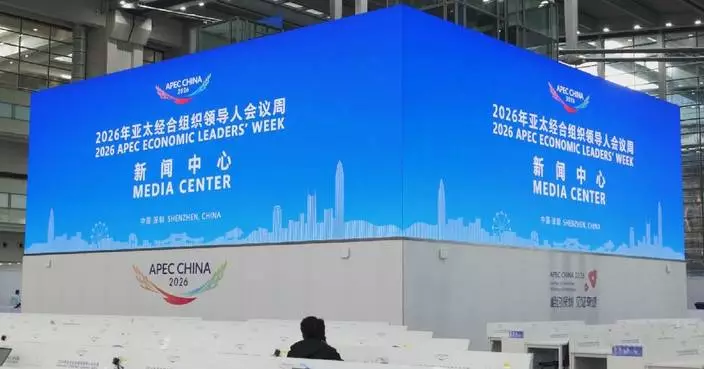
This year, the 33rd APEC Economic Leaders' Meeting is scheduled to take place in the southern Chinese city of Shenzhen from Nov. 18 to 19, with China hosting the APEC leaders' meeting for the third time.
Wang Xuekun, president of the Chinese Ministry of Commerce's Academy of International Trade and Economic Cooperation, highlighted the fruitful outcomes of the APEC "China Year".
"This year, leveraging the important platform of the APEC 'China Year', China is steadily advancing the construction of the Free Trade Area of the Asia-Pacific (FTAAP) and deepening practical cooperation in connectivity, the digital economy, and artificial intelligence among regional economies,” he said.
The impact of this deepening cooperation is already visible on the ground. At the Youyi border port in south China's Guangxi Zhuang Autonomous Region, trucks carrying goods from APEC economies such as Vietnam and Malaysia now clear customs in a matter of seconds. Meanwhile, in Chilean fields, Chinese smart agricultural drones are accelerating the local digital transformation of farming.
Following the launch of island-wide independent customs operations at the Hainan Free Trade Port (FTP) late last year, cross-border business has thrived. APEC partners such as Vietnam and Thailand have seen a surge in exports of commodities like natural rubber, driven by the FTP's preferential tariff policies.
"China's opening-up of the Hainan Free Trade Port has created favorable conditions for Vietnamese enterprises to enhance their market competitiveness. From the beginning of this year to date, our export volume to Hainan has consistently maintained double-digit growth," said Vo Quang Hieu, manager of a rubber enterprise in Vietnam.
China is a firm advocate of free and open trade. It has been actively promoting the construction of the FTAAP. In 2023, the Regional Comprehensive Economic Partnership (RCEP), which includes 12 APEC economies, was fully implemented, creating the world's largest free trade area.
Fifteen APEC economies have signed free trade agreements with China, making the regional free trade network increasingly valuable.
The Asia-Pacific region's average tariff rate has dropped from 16.9 percent to 5.1 percent, while the share of zero-tariff product lines among APEC member economies has jumped from 27.3 percent to 48.9 percent.
Beyond the region, China is expanding Asia-Pacific cooperation to other parts of the world. Currently, more than half of all APEC economies participate in cooperation under the Belt and Road framework.
Recently, the Johor Bahru-Singapore Rapid Transit System (RTS) Link, a cross-border rail project between Singapore and Malaysia featuring Chinese technology and construction know-how, has entered the joint commissioning and testing phase.
Once operational, it will significantly facilitate cross-border commuting for residents in both countries.
"APEC is about promoting economic, human and information connectivity. The opening of the RTS aligns perfectly with the objectives of APEC," said Tan Khee Giap, chairman of the Singapore National Committee for Pacific Economic Cooperation.
Beyond infrastructure, connectivity in trade rules, information, and data among APEC economies is also advancing steadily.
The Asia-Pacific Model E-port Network (APMEN), proposed by China, now covers 13 APEC economies, delivering significant improvements in data interoperability, customs efficiency, and cost reduction.
"The network helps relevant member enterprises achieve single-entry and multi-party reuse of import and export data, reducing customs declaration costs by 66 percent and compressing declaration time by nearly 50 percent," said Wei Xiaoming, executive deputy general manager of Shanghai E-P International Inc., a subsidiary of the data technology firm China Unidata.
By continuously shortening the negative list for foreign investment, expanding the opening-up of the service sector, and leveraging the advantages of its vast consumer market, China is poised to bring even greater cooperation opportunities to its APEC partners in the years ahead.

China's high-level opening-up drives connectivity, cooperation across Asia-Pacific: experts, entrepreneurs