A senior U.S. delegation visited the Museum of the Communist Party of China (CPC) in Beijing on Wednesday, exploring the Party's centenary history and reflecting on key milestones in bilateral relations.
The delegation was in the Chinese capital to attend the U.S.-China Political Dialogue 2026, held the day after the museum visit under the theme of "U.S.-China Relations in the New Era: Exploring the Right Approach in a Changing Asia-Pacific and the World."
Located at the northern end of Beijing's Central Axis, the museum presents a panoramic view of the Party's century-long history.
The U.S. delegates listened attentively during the tour and expressed curiosity about the exhibits, from inquiring about the routes and personnel of the Long March to recalling pivotal moments in China-U.S. relations in front of exhibits on then U.S. President Richard Nixon's 1972 visit to China. Many said the visit was deeply rewarding.
"I obviously knew a lot about the Long March and read about it and heard about it, but this was the first time maybe I was able to truly understand the status it has and the Chinese national story, and I really appreciated that aspect of it and the sort of immersive storytelling. I thought that really was quite striking," said Conor McCutcheon, a member of the U.S. delegation.
The Long March was an epic 12,500-kilometer strategic shift undertaken by the CPC-led Red Army between 1934 and 1936 to break through a siege by Kuomintang forces. The historical journey helped pave the way for the founding of the People's Republic of China.
The U.S. delegates were also impressed by the museum’s exhibits that capture China's more recent history, including scientific accomplishments.
"I like the space shuttle, it's really amazing. It's the real one. So I've never seen anything like that so closely. But I would say all of it, there's just a lot to cover from understanding the history of China, the leadership of course, but also some of the cultural elements as well. It's really nice," said Carla Canales, another member of the delegation.
"It's very impressive. I'm very proud, frankly, that the government of China and the Communist Party have erected a very, very educational, significant museum. It's important for not only Chinese to see it, but also for Americans to see it. Because the more our peoples from both countries visit the other and see the museums of each other country, the more likely it is that we're going to really have a good relationship between the U.S. and China," said Max Baucus, head of the delegation and former U.S. ambassador to China.
It was the first time a senior U.S. delegation had visited the museum. The visit gave the delegates a deeper understanding of China's history, culture and social system, especially the history of China and the U.S. fighting side by side against Japanese fascism during World War II, which carries even more meaning in today's context.
Melodee Hanes, another member of the delegation, said exhibits on the Flying Tigers and other examples of China and the U.S. fighting together reminded her of her father, who flew several bombing missions to Shanghai against Japanese fascism during WWII.
The Flying Tigers, officially known as the American Volunteer Group of the Chinese Air Force, was formed in 1941 by U.S. General Claire Lee Chennault. More than 2,000 Flying Tigers airmen lost their lives in the war.
"The most important lesson to learn is that Americans, and especially Americans like my father, were willing to die for Chinese people and risked their lives in the effort to end World War II. And I think as Americans now, we need to reflect back to that time when we were partners and we were allies and we should never forget that. We may have our differences, but we have to remember that really important time in history when we acted as one," said Hanes.
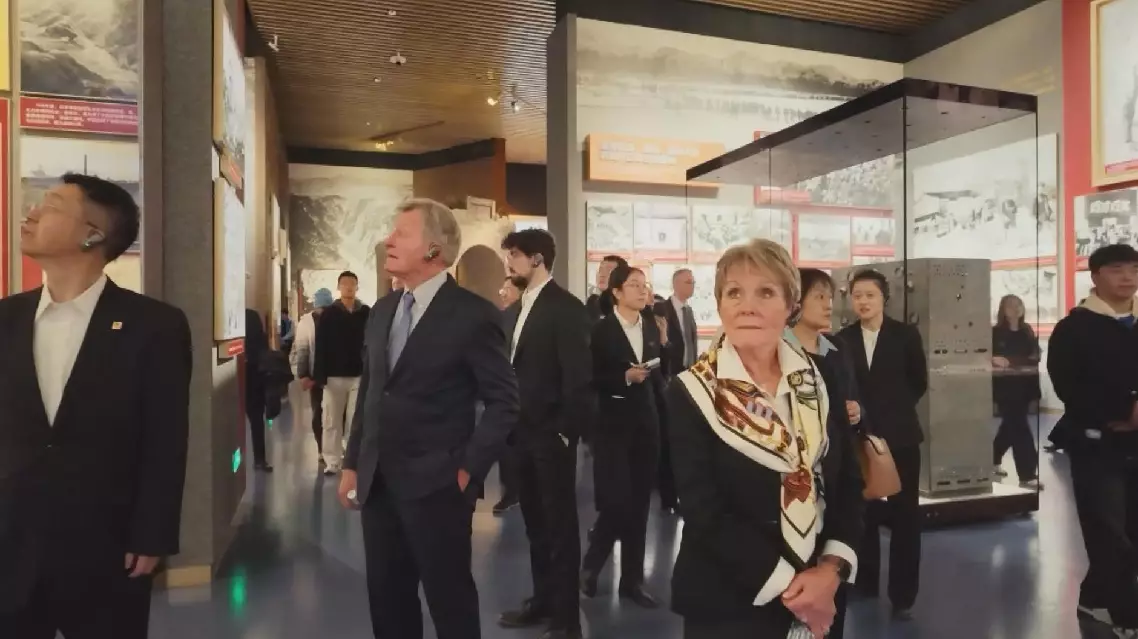
U.S. delegation to political dialogue tours CPC museum in Beijing