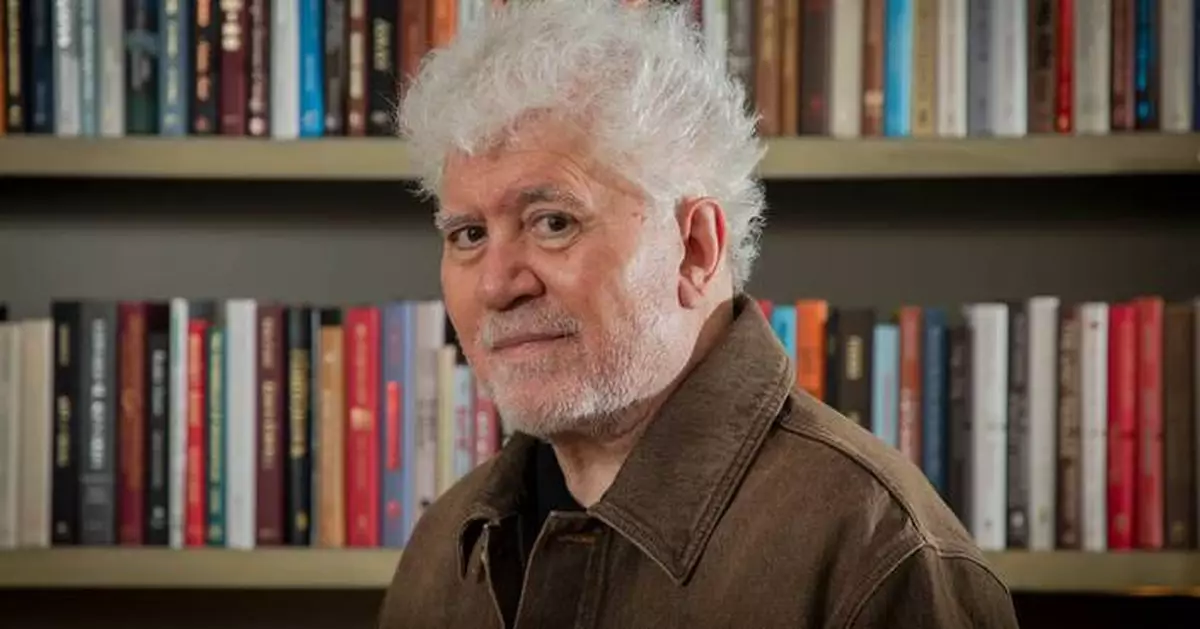
NEW YORK (AP) — Art does far more than imitate life in the films of Pedro Almodóvar.
His movies, from “All About My Mother” to “Pain and Glory,” are grand, melodramatic reflections of Almodóvar's own life that tremble on the brink between fiction and reality.
In the 77-year-old’s latest film, “Bitter Christmas,” Almodóvar's meta inclinations reach a thrilling new realm. Two narratives unspool, both concerning filmmakers. One, a veteran director suffering a creative block, Raúl (Leonardo Sbaraglia), is notably similar to Almodóvar himself.
There are, as always, twists and turns in Almodóvar's new film, which Sony Pictures Classics releases Friday in theaters. But “Bitter Christmas” builds toward an inquiry into the director's — and Almodóvar's — plundering of real life for the purpose of art. It's a portrait of the artist as a not-so-young thief.
As one of the top global filmmakers, Almodóvar has increasingly come to be a conscience of cinema. He has passionately defended theaters while arguing against Netflix films (which he dings in “Bitter Christmas”). Almodóvar has also been a loud critic of President Donald Trump, decried the rise of the far right in Europe and turned down lucrative offers from a Saudi festival.
Almodóvar has resolutely stuck to his values. That makes his decision to turn himself into the villain of “Bitter Christmas” all the more interesting. In a recent interview while in Manhattan for the New York Film Festival, Almodóvar discussed the autofiction turn of “Bitter Christmas” and his abiding creative hunger.
ALMODÓVAR: I agree. When I wrote the script, I wanted to shoot these 20 final minutes. That was new to me. When I was writing, I was surprised. I didn’t think, when I was writing, that was the end. I was driving the story to another ending. But it suddenly appeared: the possibility of being questioned by one of the characters. I thought of (Italian author and playwright Luigi) Pirandello. It felt new. I had never done it like that. I was always interested in the deep relation between creativity and reality. They are like two sides of one coin. I realized that I didn’t think about the other people. I only thought about the idea, the inspiration.
ALMODÓVAR: The question is: When an author is working on things that have to do with real life, are there limits to what he should do? And if there are limits, what should they be? It’s a moral question that I think depends on the ethical sensibility of the author. When I’ve done it, I try not to hurt anyone. But I realize, and I have to admit, that the creator becomes someone selfish because you only think about the story. It’s the dark side of us.
ALMODÓVAR: Yes. I feel a little guilty. I never considered changing. But I felt a little uncomfortable. This is the nature of the creator. We are dangerous people for the friends and the family. There’s a wonderful autofiction writer who said that any family with a writer will have conflict.
ALMODÓVAR: Twenty-four.
ALMODÓVAR: Yes, yes, yes. Even after 24 films, I’m thinking with a lot of anxiety: What’s coming next? For me, making films is a passion not a job. And I think it’s a passion that grows with time, even more than my first film.
ALMODÓVAR: My life now, or the last five years or something like that, is only writing and making movies and promoting them. I didn’t discover anything more exciting. It’s the base of my life. That means, of course, solitude that I only do this. Little by little, I become more isolated. Writing has been filling up all the holes in my life.
ALMODÓVAR: The moment I stop feeling that passion for a particular script, that might be the moment I stop making films. The change in my scripts from the ’80s until now is that in the ’80s, it was really a communal situation in the sense I was surrounded by a lot of people. I was living by day and night. This was the beginning of democracy in Spain. I was young. My movies at the time reflected that — my joy of living, the lack of limits, all the kinds of people that were out at night. Transsexuals, gays, everybody mixed together. I was not alone in the ’80s. But as time passed, I began to live a more solitary life. I wasn’t going out as much. In the ’80s, it was this perpetual party with drugs. But at some point, the drugs stop working and also become dangerous. In the ’90s, I decided to leave excitement behind for work. I embraced discipline. I supplanted the life I was leaving behind with writing. And that became the excitement in my life.
ALMODÓVAR: I would mark that transition around ’95, when I shot “The Flower of My Secret.” It’s a film in which I talk about my family and about creation. It’s the first time in my cinema that I went back to my hometown. That first time I set up the tripod to take a shot and look at the earth around me — it’s a reddish kind of earth there — was a very moving moment for me. I had left there when I was 9 years old. But I realized at that point that I actually belonged to that place. After that comes “Live Flesh” and “All About My Mother” and a more mature period in my career.
ALMODÓVAR: Someone like Trump is a constant part of your everyday life. You can’t get away from him. You see him every day. Every time he opens his mouth, he’s going to say something unbearable or inhumane. For me, it’s more my reaction as a person, as a citizen. This inhumane hunting by ICE, we’re witnesses to that. I don’t consider myself an activist, but I do want to speak against the dangers around us. There’s tragedy happening around the world. For me, the topics are not necessarily just political. They’re about human value.
ALMODÓVAR: Two or three years ago, we saw the beginning of this crisis in Spain. Five hundred theaters closed in a short period of time. We’re seeing the rhythm of these closures slow down. People are returning to the cinema. I would like to believe that it’s a reversible situation.
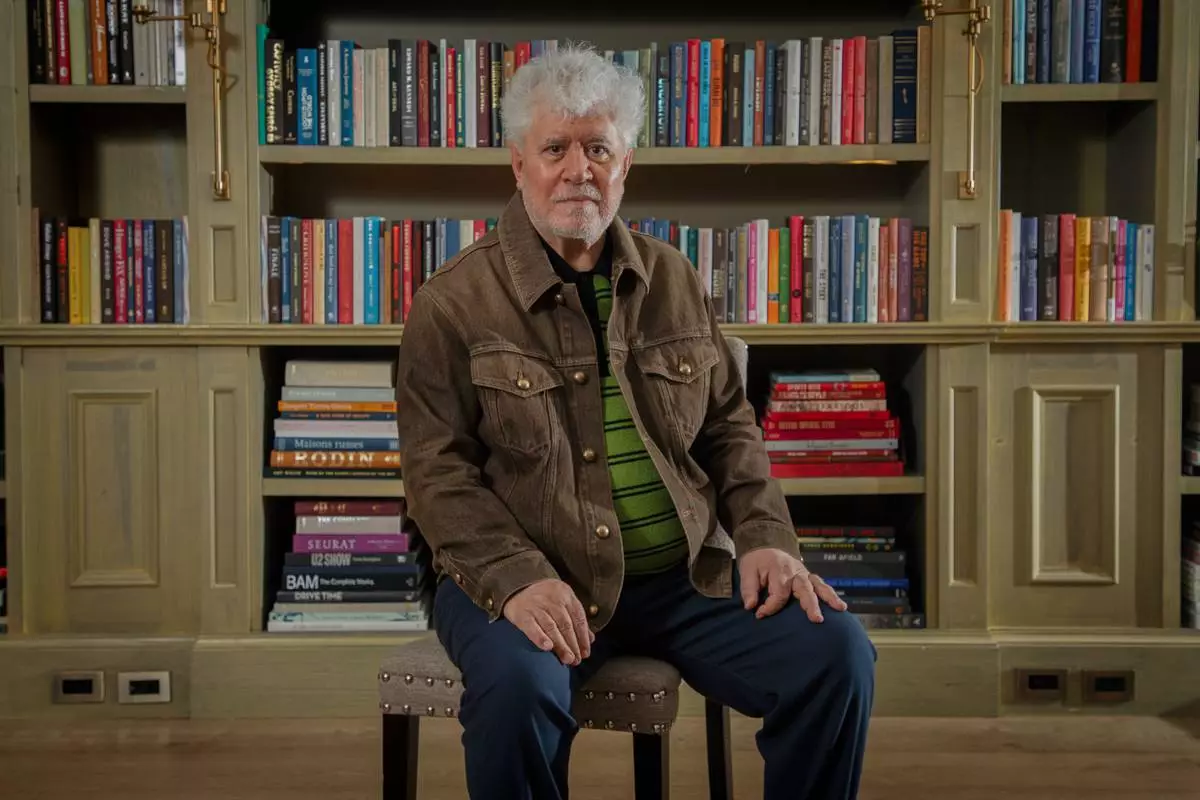
Pedro Almodóvar poses for a portrait in New York on Monday, Oct. 5, 2026. (Photo by Andy Kropa/Invision/AP)
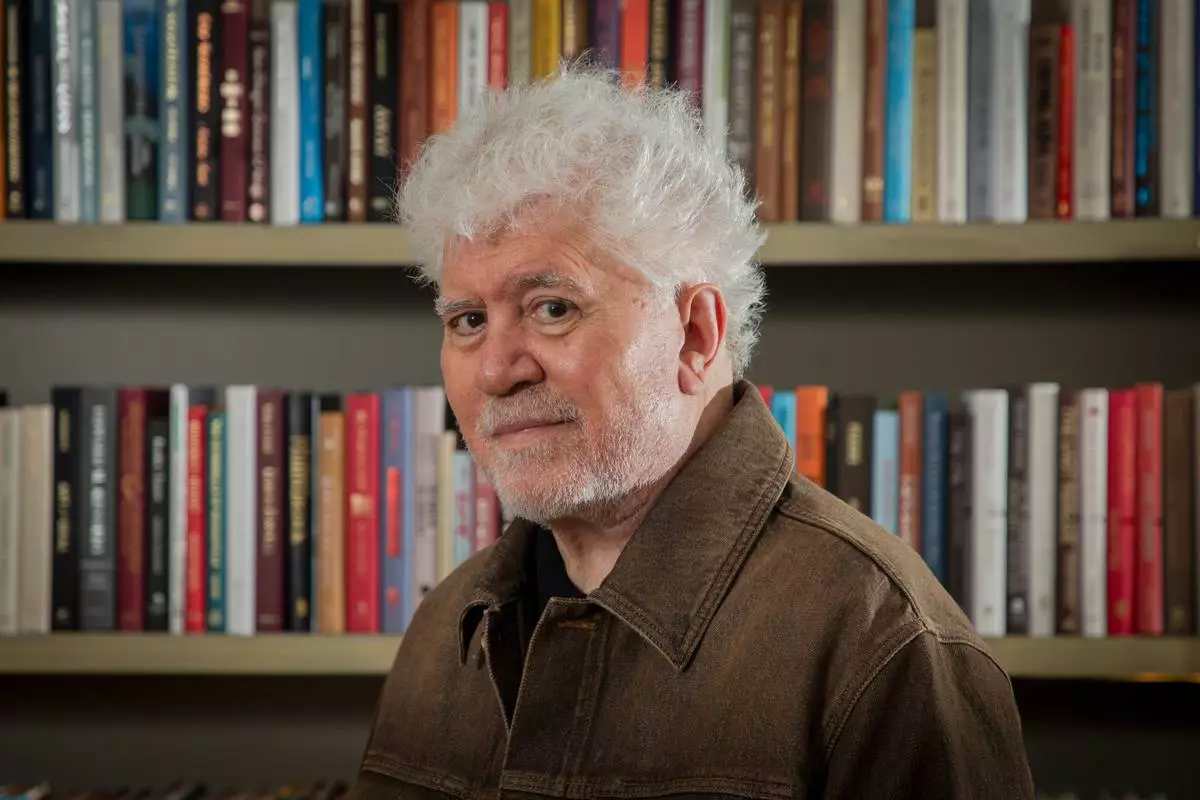
Pedro Almodóvar poses for a portrait in New York on Monday, Oct. 5, 2026. (Photo by Andy Kropa/Invision/AP)