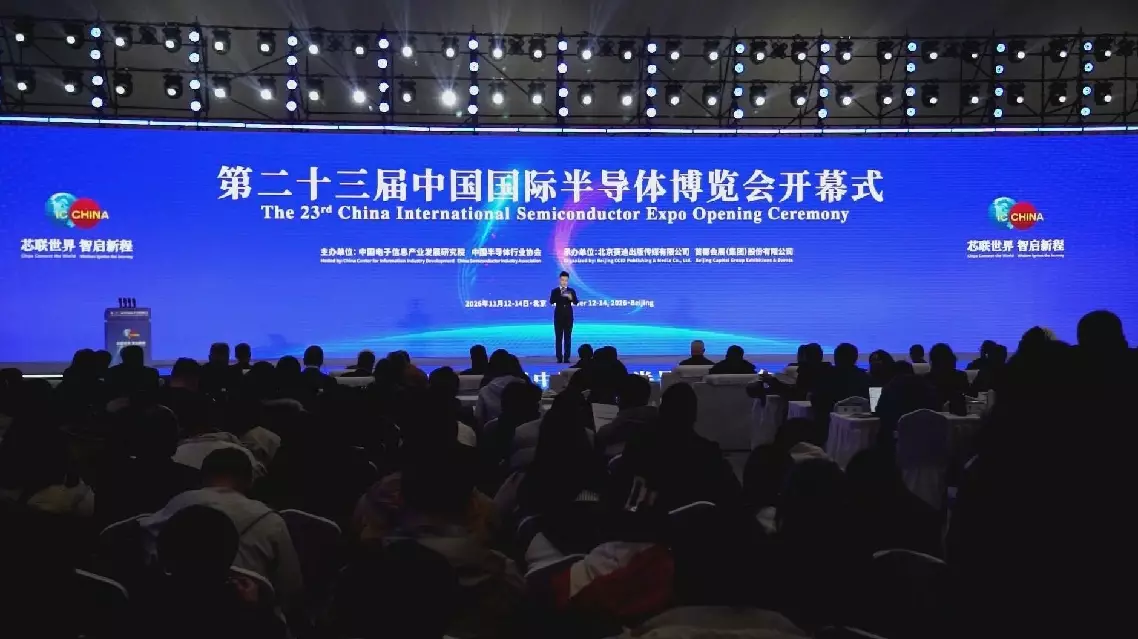
Chinese semiconductor and tech firms showcased next-generation AI memory chips, rapid-deployment computing containers and automated factory logistics at the 23rd China International Semiconductor Expo (IC China 2026) in Beijing, with domestic suppliers moving beyond import substitution toward product innovation.
Running from Nov. 12 to 14 at the China National Convention Center, the expo featured new products and technologies driven by surging artificial intelligence demand.
ChangXin Memory Technologies (CXMT) exhibited what it described as the world‘s first mass-produced LPDDR6 chip, which the company said offers 60 percent higher bandwidth and 20 percent lower power consumption than LPDDR5X. The company reported a 73 percent rise in research and development spending to 11.07 billion yuan (about 1.66 billion U.S. dollars) in the first three quarters of 2026 and noted that servers now account for over half of global DRAM demand.
"The growth trend of computing power is continuing. According to industry forecasts, from 2024 to 2031, the seven-year compound annual growth rate of global AI computing power will reach 96.1 percent, meaning it roughly doubles every year. And right now is just the beginning," said Luo Xiaodong, vice president and head of the marketing center at CXMT.
In computing hardware, domestic AI chipmaker Tecorigin unveiled a "distributed computing container" designed to avoid the year-long construction cycles of traditional intelligent computing centers. A 256-card unit, equipped with 32 to 256 domestic AI accelerator cards and high-density liquid cooling, which the company says functions like a small data center capable of supporting over 20,000 concurrent users.
"We are combining the concept of prefabrication with computing power. We can achieve 90 percent prefabrication in the factory. Our computing servers and energy equipment are prefabricated in standardized form, shipped within 24 hours to research institutions or manufacturing sites of the small-and-medium-sized enterprises (SMEs), and put into operation in as little as two hours to meet demand for domestic computing power," said Chen Xinjie, head of brand communications at Tecorigin.
Beyond chip design, domestic suppliers are expanding into semiconductor manufacturing support. JD Logistics, which became independent from JD Group in 2017, now provides warehouse automation solutions to semiconductor manufacturers. The company said semiconductor production is highly automated, but warehousing and logistics remain largely manual.
"In our own 'Wolf' series robot products, a large portion of our products already use domestic chips. The overall performance of domestic chips has improved significantly, and is now no worse than foreign chips. Moreover, our entire domestic supply chain is more stable and reliable," said Chen Jia, industry general manager at JD Logistics, noting plans to deploy self-developed robots in overseas warehouses with localized services.
Chinese chip firms showcase AI memory, containerized computing at Beijing semiconductor expo