MEXICO CITY (AP) — The Trump administration has designated 22 Latin American and Caribbean criminal groups as “foreign terrorist organizations,” adding a Guatemalan group to the list on Friday.
The label was once reserved for groups like the Islamic State group or al-Qaida that use violence for political ends — not for money-focused crime rings. But Trump’s aim was to increase pressure on the groups and anyone who the U.S. sees as aiding them.
The strategy rolled out in February 2025 and served as a pretext for the capture of Venezuelan Nicolás Maduro, and for dozens of attacks on alleged “narcoterrorist” boats, resulting in more than 200 deaths. It also led Latin American countries such as Guatemala and Argentina to take similar actions against certain groups and states like Ecuador to launch joint operations on Ecuadorian soil.
Mexico, with eight groups on the list, has the most of any country. Its government is under extreme pressure from the U.S. to avoid Trump's unilateral actions, especially since the indictments of high-ranking officials in Sinaloa state.
But Trump’s approach has also revealed contradictions. Former Honduras President Juan Orlando Hernández, sentenced to 45 years for drug trafficking and accused during the trial of protecting the Sinaloa Cartel, was pardoned by Trump last year and has returned to his country.
Here’s a look at the 22 Latin American and Caribbean criminal groups labeled as foreign terrorist organizations:
The Sinaloa Cartel and the Jalisco New Generation Cartel, named for the states that are their strongholds in northwestern Mexico, are multinational criminal groups and the largest fentanyl traffickers into the U.S.
The Sinaloa Cartel is Mexico’s oldest criminal organization dating back to the 1970s. It is a criminal conglomerate that moves all sorts of drugs across continents using boats, planes, migrants and cross-border tunnels.
A former security chief was convicted of helping it. It controls the western portion of the U.S.-Mexico border although the arrest of Ismael “El Mayo” Zambada set off internal jockeying for power and weakened the group.
The Jalisco New Generation Cartel, established in the early 2010s, is a hyperviolent group that has attacked Mexican authorities, using explosive-dropping drones and improvised explosive devices. It attempted a spectacular assassination of the then-Mexico City police chief — now Mexico’s security secretary — in the heart of the capital.
The DEA says the group now distributes tons of cocaine, methamphetamine and fentanyl in all 50 U.S. states. The Jalisco Cartel has remained powerful following the killing of its leader Nemesio Oseguera, “El Mencho” in February and ongoing captures.
The Gulf Cartel and the Northeast Cartel operate along the eastern end moving drugs, immigrants, guns and money in what is the most direct route to the U.S. from Central and South America.
The Gulf Cartel’s former leader, Osiel Cárdenas Guillén (now imprisoned in Mexico after serving a sentence in the U.S.), recruited members of Mexico’s military in the late 1990s to form a fearsome element known as the Zetas that eventually split and became their own drug trafficking organization. The Northeast Cartel is a remnant of the Zetas and their base is Nuevo Laredo, the busiest commercial port on the U.S.-Mexico border.
The Juarez Cartel has controlled for decades a key crossing point in the central part of the Mexico-U.S. border: Ciudad Juárez, across from El Paso, Texas. Both its founder, Amado Carrillo Fuentes and the brothers and sons who succeeded him, turned the trafficking of tons of drugs into a multimillion-dollar business. Despite the arrests of many of its leaders, the cartel and its allied gangs maintained control of a vast infrastructure for smuggling illegal shipments into the U.S.
These local organized crime groups operating in the west-central Mexican state of Michoacan produce synthetic drugs and have consolidated their regional control of the territory through extortion and shifting names, loyalties and alliances.
La Familia Michoacana , now renamed “Nueva Familia Michoacana” is the oldest. The other two, former allies, emerged following the 2013–2014 armed uprising led by farmers who succeeded in driving out many of the old cartels, only to see them replaced by new ones.
Their extortion affects all economic sectors, including a key Mexican export to the U.S.: avocados.
Barrio 18 and Mara Salvatrucha, also known as MS-13, are both largely based in El Salvador, Guatemala and Honduras. They originated in Los Angeles as a street gangs created by Salvadoran immigrants. When many of their members were deported from the U.S. to El Salvador, the gangs expanded and gained power across Central America, where they continue to terrorize communities.
In recent years, both groups has been dealt a powerful blow by El Salvador President Nayib Bukele, who has waged war on the country’s gangs, imprisoning more than 80,000 people for alleged gang ties. Last October, Guatemala also designed both gangs as terrorists and toughened laws against them.
Los Lorenzana is a Guatemala-based criminal group and family clan accused of drug trafficking. It wields power in eastern and northern Guatemala along the border with Honduras and is the most recent Latin American group to be designated as a foreign terrorist organization in mid-November.
It’s accused of drug trafficking and Guatemalan authorities say it is allied with the Sinaloa Cartel. The U.S. State Department described the group as “one of Guatemala’s most powerful drug trafficking clans.”
The same day it received the designation, the State Department also labeled Los Lorenzana along with two other Guatemalan groups accused of providing material support to Mexican cartels — Los Huistas and Los Mendoza — as Specially Designated Global Terrorists. The separate terrorist designation primarily imposes financial sanctions, while the “foreign terrorist organization" designation comes with specific criminal and immigration consequences.
With an estimated 9,000 fighters, Clan del Golfo is one of Colombia’s most powerful armed groups. Also known by its Spanish acronym AGC, the group evolved from right-wing paramilitary squads that fought Marxist guerrillas in Colombia in the 1990s and 2000s.
According to a report of the Human Rights Defender’s Office, AGC is present in about a third of Colombia’s 1,103 municipalities, where it extorts local businesses.
Clan del Golfo was involved in peace talks with Colombia’s government last year, but those talks dissolved with the election of Abelardo de la Espriella as president.
This organized crime group emerged from a prison in central Venezuela more than a decade ago. In recent years, it has spread from Chile to the U.S., capitalizing on the exodus of some 8 million Venezuelans escaping their country’s political and economic crises.
While its origins are in drug trafficking, its main businesses are migrant smuggling, human trafficking, sexual exploitation and forced labor. It’s known for extreme violence — decapitations and burying victims alive..
The entity that the U.S. government alleges was led by Maduro, is not a cartel per se but was designated as such less that six weeks before Maduro was captured in January.
Venezuelans began using the term Cartel de los Soles in the 1990s to refer to high-ranking military officers who had grown rich from drug-running. As corruption expanded under the late President Hugo Chávez and then under Maduro, its use loosely expanded to police and government officials as well as activities like illegal mining and fuel trafficking. The “suns” in the name refer to the epaulettes affixed to the uniforms of high-ranking military officers. The umbrella term was elevated to a Maduro-led drug-trafficking organization in 2020 when the U.S. announced the indictment of Venezuela’s leader.
Los Lobos, Los Choneros, The Chone Killers and Los Tiguerones are gangs blamed for much of the violence that began during the COVID-19 pandemic. All are involved in contract killings, extortion operations and the movement and sale of drugs.
Los Tiguerones is an armed group that was formed in Guayaquil in 2019 as the armed wing of Los Choneros, the criminal organization that serves as the parent group for most of Ecuador’s criminal gangs.
Authorities have blamed them for the increased violence in the country as they fight over drug-trafficking routes to the Pacific and control of territory, including within prisons, where hundreds of inmates have been killed since 2021.
All of them are among 22 criminal gangs designated as “terrorists” by Ecuador in 2024.
Commando Vermelho and Primeiro Comando da Capital are two of the most violent criminal organizations in Brazil. They work with some 50 smaller gangs all over the country.
Together, they command thousands of members and have orchestrated brutal attacks against Brazilian police officers, public officials, and civilians. Their influence and illicit networks extend far beyond Brazil’s borders.
The two Haitian groups are mainly linked to arms trafficking, kidnapping, murdering, extortion and, to a lesser extent, to drug trafficking.
The Viv Ansanm coalition is best known for launching a series of attacks starting in February 2024 that shuttered Haiti’s main international airport, freed hundreds of inmates from the country’s two biggest prisons and eventually forced former Prime Minister Ariel Henry to resign. It controls at least 85% of the capital, which forces nonprofits and other groups to negotiate with gangs so they can gain access to communities to provide food, water and other critical supplies.
In October, the gang was blamed for killing more than 70 people in Pont-Sondé.
—
Associated Press reporters Gonzalo Solano in Quito, Sonia Pérez D in Guatemala City, Astrid Suárez in Bogota, Mauricio Savarese in Rio de Janeiro and Dánica Coto in San Juan, Puerto Rico contributed to this story
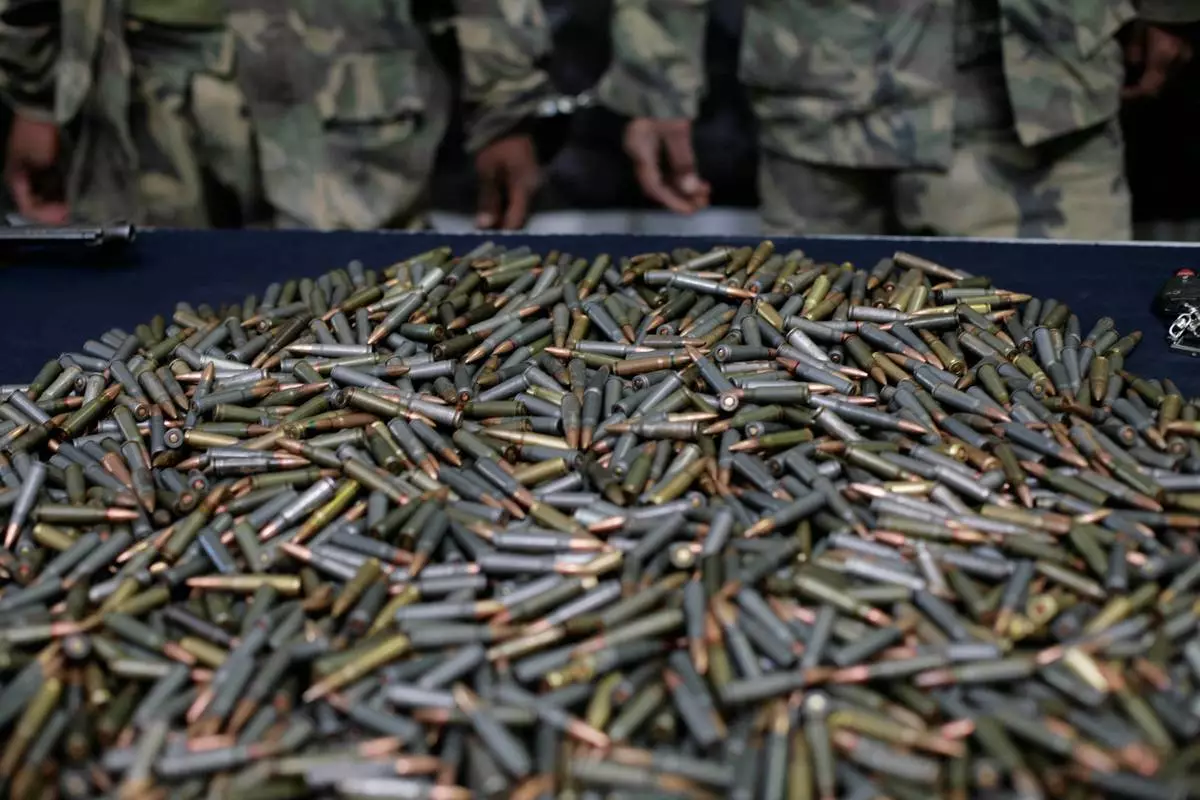
FILE - AK-47 ammunition sits on a table in front of 18 alleged members of the drug cartel El Milenio during a presentation to the press in Guadalajara, Mexico, May 23, 2010. (AP Photo/Carlos Jasso, File)