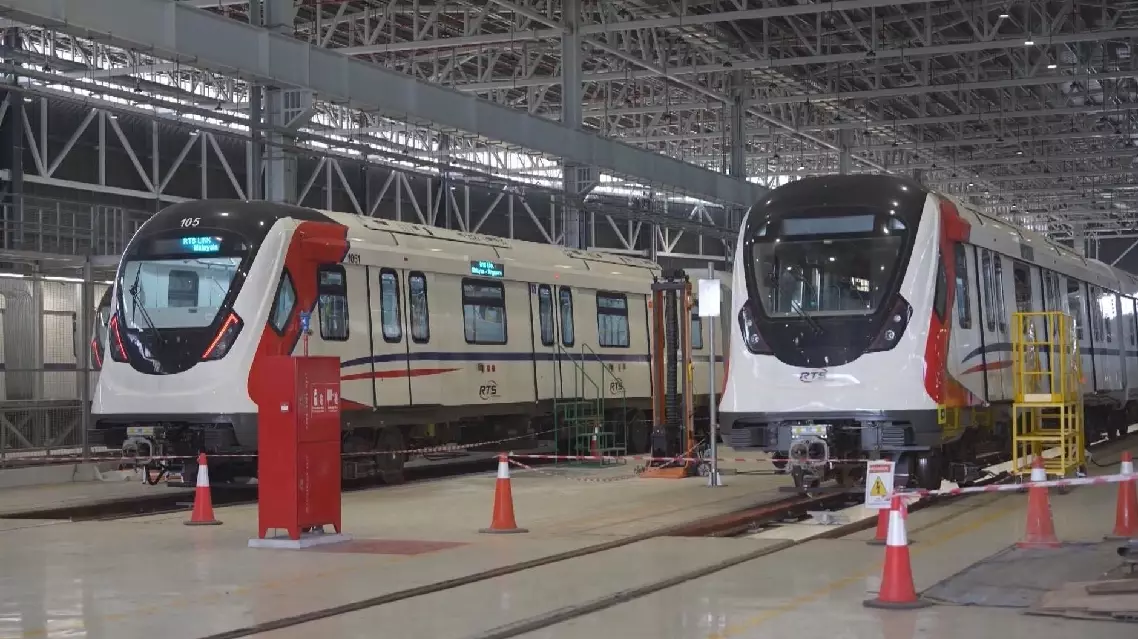
The Rapid Transit System (RTS) Link connecting Singapore and Malaysia's Johor Bahru is entering the final testing and commissioning phase in the run-up to its opening in February next year, offering an alternative to the congested Johor–Singapore Causeway that about 300,000 people cross daily at peak times.
Singapore and Johor Bahru already have close economic and social links, with traffic congestion frequently building up at the land crossings connecting the two sides during peak periods and holidays. Currently, about 19.4 million annual round trips are made from Singapore to Johor Bahru, and 5.9 million in the opposite direction, using existing transport modes.
Spanning 4 km across the Johor Strait, the Johor Bahru-Singapore RTS Link is set to connect the Bukit Chagar station in Johor Bahru to the Woodlands North station in Singapore, crossing the Johor Strait via elevated bridges and an underground tunnel.
Once operational, the light rail transit system will be able to carry up to 10,000 passengers per hour in each direction, easing congestion at one of the world's busiest border crossings.
The journey between the two countries will take five to six minutes.
"Currently, we are almost near to the crucial, the critical progress, which is the integration between all the systems," said Shafiq, on-site coordinator in Malaysia.
As a cross-sea, cross-border rail line, the project has required the contractors to tackle complex marine construction conditions and coordinate works between the two countries. Chinese firms handling the elevated bridges and tunnel works drew on domestic bridge-building experience to refine construction methods.
"There is a lot of rock underneath here, and the geological conditions are quite complex. During the construction, we adopted some special structures and platforms and successfully completed the pile foundation work. In addition, the pile caps are quite large. A single pile cap contains about 5,000 cubic meters of concrete, (including auxiliary parts,) and weighs more than 20,000 tonnes, with half of it in the water. Therefore, in the process of construction, we used an automated caisson-lowering technique. This approach protected the environment and reduced overall construction costs, while significantly improving construction efficiency," said Chen Chao, project manager of a Chinese company's Singapore branch.
Residents in both countries are looking forward to the line's opening.
"If this RTS can help us to go to the destination earlier, it would be more much better," said a Malaysian resident.
"I'm very much looking forward to [the RTS opening], because this way I can reach my destination in one stop, without the hassle of getting on and off, and the journey will be very fast. [In future] the two countries will be more integrated and cooperate on many projects together," said a Singapore resident.
"After the subway rail lines of the two countries are connected with each other, people-to-people exchanges will flow smoothly. APEC [promotes] economic connectivity, people-to-people connectivity and information connectivity. The opening of the RTS is consistent with the aims of APEC," said Tan Khee Giap, chairman of the Singapore National Committee for Pacific Economic Cooperation.
Upcoming Singapore-Malaysia rail link to ease congestion at border crossing