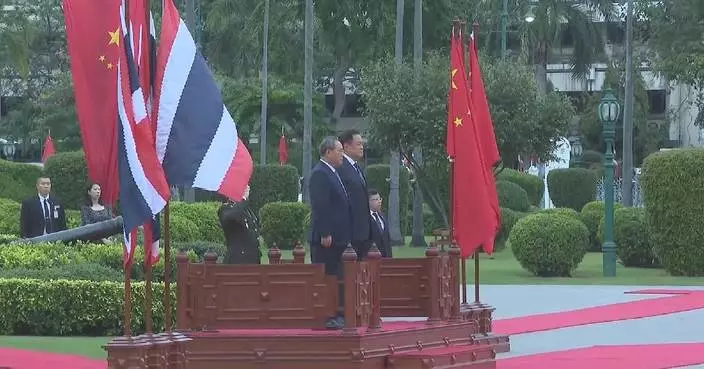
ASEAN Secretary-General Kao Kim Hourn has hailed the opening of southern China's Pinglu Canal as a game-changer for regional trade, pointing to its potential to lower shipping costs and link maritime transport.
The Pinglu Canal officially opened on Sept 16. It is China's first major river-to-sea canal project planned and coordinated at the national level since 1949.
In an exclusive interview with China Media Group (CMG), Kao explained why the canal's impact reaches far beyond logistics, noting that lower shipping costs and stronger port connectivity will ultimately translate into tangible benefits for people across both China and ASEAN.
"Water transport will always lower the cost. So, this Pinglu Canal that was inaugurated, connecting some of the landlocked provinces of China to the seas, open more doors or gates of opportunities linking up. Because between us and China, it's not just air-to-air connectivity, or rail link, but port-to-port connectivity is very poor. Because we do a lot more trade together and with the Pinglu Canal, meaning that more ships can move across both ways and therefore, the cost of doing business will be going down. And at the end of the day, people will benefit from a closer economy through the bilateral trade that we have between us and China," he said.
Looking beyond immediate transport savings, Kao believes pairing the new waterway with the digital economy will link regional ports more tightly and transform how goods move between China and ASEAN.
"We're talking about the digital economy. This is going to be significant because that's would be, I believe this digital economy would be also a game changer. And that will link up with the transport sector, particularly water transport, I think this is very important. That's why we need to make sure that all our ports are linked to each other. For commerce, for trade, for shipment and all the likes, I think it's so significant. I mean, we have not seen something like this before. Let's see, one year or five years from now, how all these will factor in. Because it's still at the beginning, there's a lot of excitement already," he said.
The 134.2-kilometer canal runs from Nanning City, capital of the Guangxi Zhuang Autonomous Region, to the Beibu Gulf in the South China Sea, linking the Xijiang River shipping route in the north with the Beibu Gulf in the south, building up the closest maritime outlet for much of southwest China.

Pinglu Canal to cut down costs, open up new regional trade opportunities: ASEAN chief
The 2026 World Chinese Language Conference is underway in Beijing from Friday to Sunday, with representatives from more than 160 countries and regions discussing the future of international Chinese language education.
Young people learning Chinese from around the world have also gathered to share their experiences.
Interest in learning Chinese continues to grow worldwide, with 210 million people outside China learning or using the language. For many, curiosity about China is the beginning, and learning Chinese brings them closer to the country.
At this year's World Chinese Language Conference, young people from around the world performed an original musical in Chinese, sharing how the language has shaped their lives.
"I'm very interested in Chinese philosophy. When I first heard about Confucius's ideas, I began to fall in love with this culture," said Mattia Marconi, an Italian student from Beijing Foreign Studies University.
For other learners, the language is a way to deepen their understanding of the country, making the whole process of learning about China easier.
"The reason that I enjoy learning Chinese is because I enjoy learning about China. Learning about China through Chinese makes the whole process easier," said Hernan Perez Mckay, an Irish student from Peking University.
Beyond culture and understanding, Chinese has also become a tool for building a new life and discovering new possibilities.
"Chinese has been not only a language for me, but a tool to start a new life here. Because here I discovered myself totally, you know, a new adult with new hobbies, new interests and new ambitions," said Eliz Stepanyan, an Armenian student from Beijing International Studies University.
That interest can also lead to new opportunities. Today, 92 countries have included Chinese in their national education systems. The language connects people, while also opening access to education, professional skills and new opportunities.
"I saw the opportunities and I saw how China was cooperating with different countries across the world. That's when I thought, 'If I learned Chinese, I could have more opportunities'," said Echoni Moses Sterling, a Ugandan student from Beijing Institute of Technology.
Some learners are already looking ahead, hoping to use their language skills to build bridges between China and their home regions.
"I'm hoping sort of to be a bridge between China and Europe. And I hope to do that through sinology and through all the projects, to be able to connect these two peoples. That would be my goal, my mission," said Benjamin Herman, a Belgian student from Peking University.
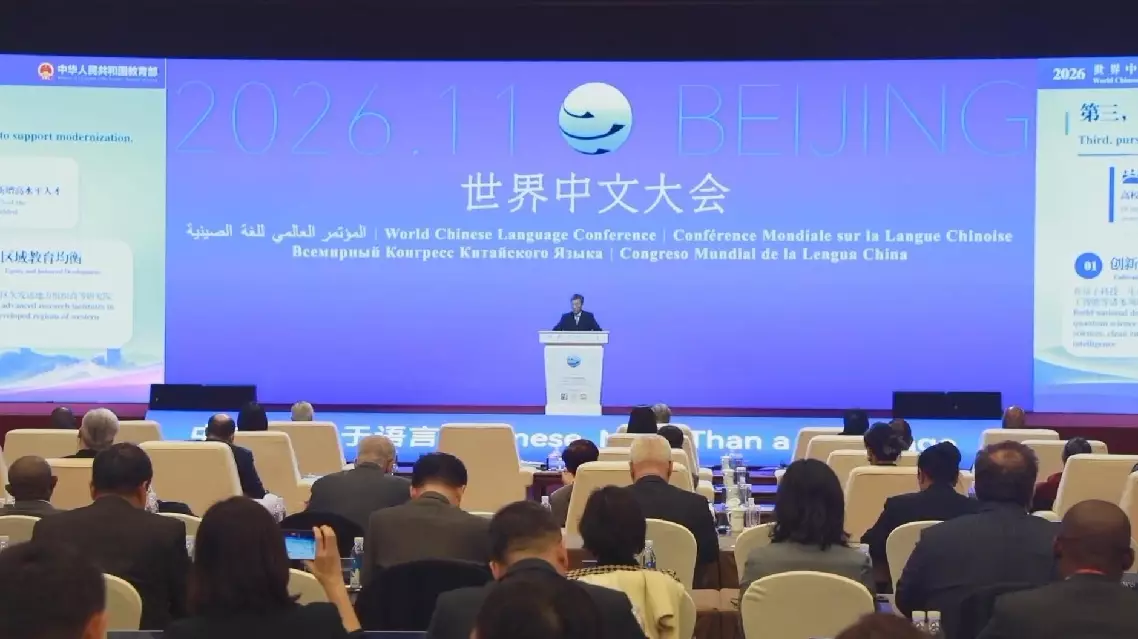
Young foreign learners see Chinese as more than language