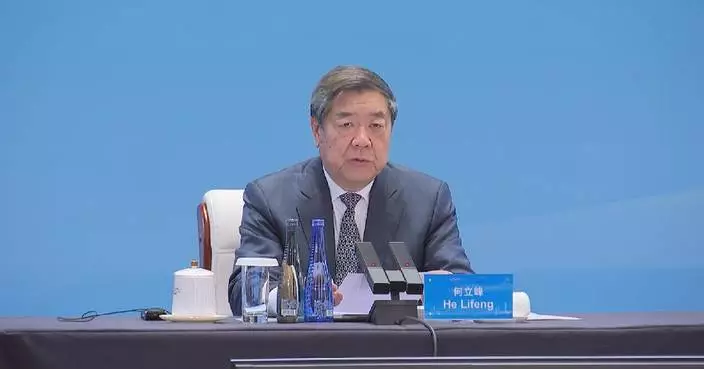
A Chinese scholar has recently hailed the role of the Asia-Pacific Economic Cooperation (APEC) in fostering cooperation and translating principles into action.
On a China Global Television Network (CGTN) program, Li Haitao, dean of Cheung Kong Graduate School of Business, explained APEC's strength.
"Innovation is definitely a key engine of growth, and thus it's important to explore different ways to facilitate innovation, something the Greater Bay Area has done particularly well. It's more efficient, after all, when different countries or regions specialize in different areas and then trade with other partner countries. What one should specialize in depends on the natural resources and capabilities that the country or city or region has," he said on the program aired in the run-up to the 33rd APEC Economic Leaders' Meeting scheduled for November 18-19 in Shenzhen City of south China's Guangdong Province.
Li cited a powerful example of innovation-driven cooperation across the Asia-Pacific, saying that by empowering people on the ground, technology turns the broader vision of regional cooperation into tangible benefits for local communities. "In Vietnam's Mekong Delta, a 30-year-old man who once worked far from home returned to operate smart agricultural drones made by the Chinese company XAG. Farmers using his service cut crop-protection chemicals by 30 percent, while precision spraying helps fruit exports like durian and jackfruit [which] meet strict overseas residue standards. The Chinese technology, Vietnamese farmland and growers, and regional consumer markets - one drone connects all three," Li said.
The 2026 APEC Digital and AI Ministerial Meeting, held in July in Chengdu City, southwest China's Sichuan Province, adopted the Chengdu Statement, in which the participating economies agreed to jointly leverage digital technologies and AI to empower the Asia-Pacific community.
"This directly reflects this year's APEC Chengdu Statement on digital agriculture. When technologies bring a young person back home, the Asia-Pacific community is no longer an abstract phrase. It's the orchard unfolding beneath his drone every morning," Li said.

APEC fosters cooperation, translates principles into action: Chinese scholar
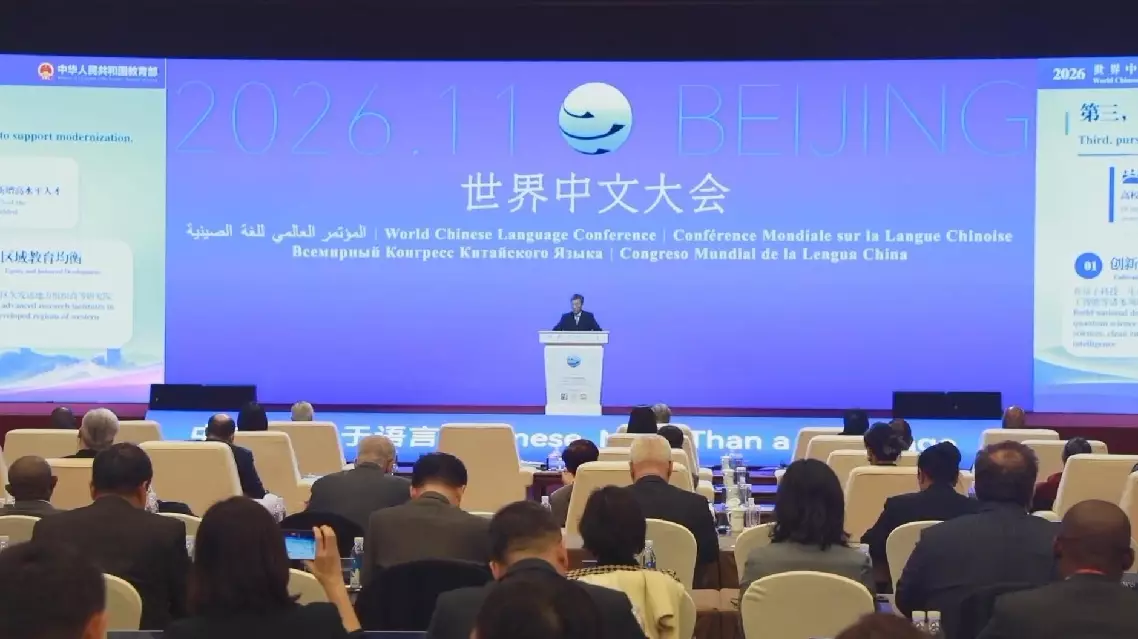
The 2026 World Chinese Language Conference is underway in Beijing from Friday to Sunday, with representatives from more than 160 countries and regions discussing the future of international Chinese language education.
Young people learning Chinese from around the world have also gathered to share their experiences.
Interest in learning Chinese continues to grow worldwide, with 210 million people outside China learning or using the language. For many, curiosity about China is the beginning, and learning Chinese brings them closer to the country.
At this year's World Chinese Language Conference, young people from around the world performed an original musical in Chinese, sharing how the language has shaped their lives.
"I'm very interested in Chinese philosophy. When I first heard about Confucius's ideas, I began to fall in love with this culture," said Mattia Marconi, an Italian student from Beijing Foreign Studies University.
For other learners, the language is a way to deepen their understanding of the country, making the whole process of learning about China easier.
"The reason that I enjoy learning Chinese is because I enjoy learning about China. Learning about China through Chinese makes the whole process easier," said Hernan Perez Mckay, an Irish student from Peking University.
Beyond culture and understanding, Chinese has also become a tool for building a new life and discovering new possibilities.
"Chinese has been not only a language for me, but a tool to start a new life here. Because here I discovered myself totally, you know, a new adult with new hobbies, new interests and new ambitions," said Eliz Stepanyan, an Armenian student from Beijing International Studies University.
That interest can also lead to new opportunities. Today, 92 countries have included Chinese in their national education systems. The language connects people, while also opening access to education, professional skills and new opportunities.
"I saw the opportunities and I saw how China was cooperating with different countries across the world. That's when I thought, 'If I learned Chinese, I could have more opportunities'," said Echoni Moses Sterling, a Ugandan student from Beijing Institute of Technology.
Some learners are already looking ahead, hoping to use their language skills to build bridges between China and their home regions.
"I'm hoping sort of to be a bridge between China and Europe. And I hope to do that through sinology and through all the projects, to be able to connect these two peoples. That would be my goal, my mission," said Benjamin Herman, a Belgian student from Peking University.
Young foreign learners see Chinese as more than language